

On Tuesday, Mikhail Gorbachev, the last Soviet leader, died at the age of 91. The news sparked reflection around the world, such was his importance. Old debates are resurgent, too.
In the Middle East, he will be remembered specifically for his moderating influence in the regional crises of the day. An important one was the joint Soviet-US statement in strong condemnation of Saddam Hussein's 1990 invasion of Kuwait.
For the West, and much of Eastern Europe, he is a geopolitical hero. He will be remembered as a figure who helped move global politics on from the traumatic, polarised aftermath of the Second World War.
He also became an important voice in explaining to the world the new Russia and its people. Towards the end of his life, this focused much on the danger of mounting tensions between his country and the West.
In the western narrative of the fall of the Soviet Union, Gorbachev's work is beyond laudable. His burden, after all, was the biggest. Ronald Reagan's call to Gorbachev in 1987 to "tear down this wall", in reference to the Berlin Wall that for 28 years separated the western half of the city from the Soviet-aligned East Germany, is a triumphant soundbite that still adds gravitas to the American president's legacy. The proclamation by then UK prime minister Margaret Thatcher that "I like Mr Gorbachev. We can do business together" is among her most famous lines.
-

General Secretary of the Communist Party of the Soviet Union Mikhail Gorbachev (right) shaking hands with Syrian President Hafez Al Assad in Moscow on June 19, 1985. AFP -
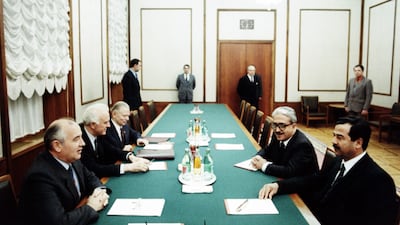
Iraqi President Saddam Hussein (right) and his Vice President Tarek Aziz in Moscow with Mr Gorbachev (left) and his Foreign Minister Edward Shevardnadze during their visit to Soviet Union in 1985. AFP -
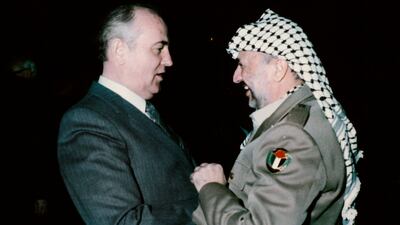
Mr Gorbachev with Yasser Arafat, President of Palestine Liberation Organisation, in East Berlin on April 17, 1986 during the 11th Congress of the Socialist Unity Party of East Germany. AFP -
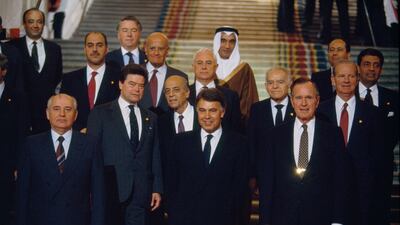
Delegates attend the 1991 Madrid Peace Conference. The 1991 conference for the Middle East was the first time Israel, Syria, Lebanon, Jordan, and the Palestinians all came together for negotiations. Pictured from left are Soviet President Mr Gorbachev, Soviet Foreign Minister Boris Pankin, Spanish Prime Minister Felipe Gonzalez, Israeli Prime Minister Yitzhak Shamir, US President George Bush, US Secretary of State James Baker, Egyptian Foreign Minister Amr Moussa, Palestinian delegate Abdel Haidar Shafi, and Jordanian Foreign Minister Kamel Abu Jaber. Getty Images -
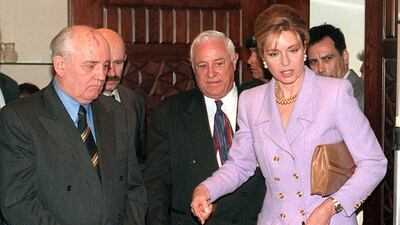
Jordan's Queen Noor greets Mr Gorbachev in Amman in 1998. Mr Gorbachev is in Jordan to give a lecture on the UN Leadership Programme. AFP -

World leaders and Nobel laureates participate in a conference, organised by the Peres Centre for Peace to add impetus to the stalled Israeli-Palestinian peace process, join hands in January 1999 at the end of the two-day meeting in Ramallah. Pictured from left are Archbishop Desmond Tutu, former Costa Rican president Oscar Sanchez, Polish President Alexander Kwasniewski, Palestinian President Yasser Arafat, former Israeli Prime Minister Shimon Peres, ex-Soviet leader Mr Gorbachev and former South African president FW de Klerk. AFP -
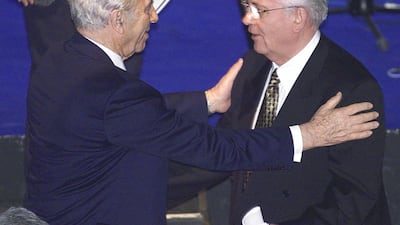
Former Soviet president Mr Gorbachev (right) is greeted by former Israeli prime minister Shimon Peres after the latter's speech to the second annual meeting of the board of the Peres Centre for Peace in Tel Aviv in January 1999. AFP -
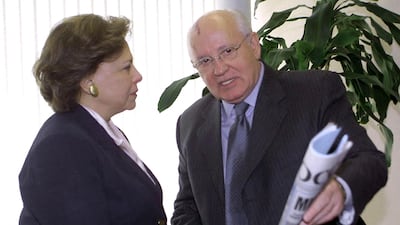
Former Soviet president Mr Gorbachev shakes hands with UN official and former Egyptian minister Mervat Tallawy at the UN head office in Beirut in April 2003. Mr Gorbachev called on the US and Britain to end the "bloodbath" in Iraq and allow the UN to resolve the crisis. AFP -

Former Russian Mr Gorbachev (left) meets Lebanese Prime Minister Rafiq Hariri in Beirut in 2003. AFP -

Mr Gorbachev (centre) speaks with Iraqi boys Ali Ismael Abbas (right) and his friend Ahmed (left) during an awards ceremony where Dr Ahmed Al Shatti, representing Iraqi and Kuwaiti doctors, was honoured with the "Men of the year award" for work during the Iraq war at the World Awards gala in Hamburg on October 22, 2003. Reuters -

Lebanese President Michel Sleiman (left) with Mr Gorbachev at the presidential palace in Baabda, east of Beirut, on February 1, 2010. Gorbachev is on a private visit to Lebanon. AFP -
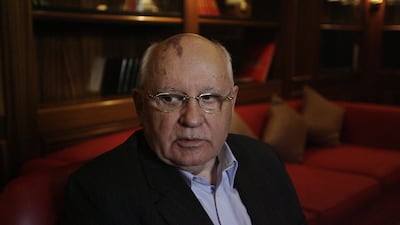
Mr Gorbachev speaks to journalists at the Middle East and North Africa Cristal Festival at a hotel in Faraya, north-east of Beirut, on February 2, 2010. AFP -
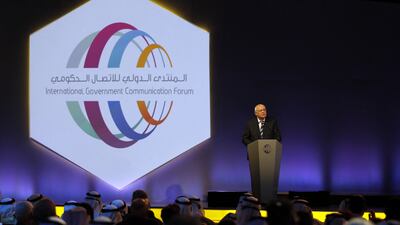
Mr Gorbachev speaks during the International Government Communication Forum (IGCF 2014) in Sharjah on February 23, 2014. The event, gathering international professionals from government, private and media sectors, has the theme "Different Roles...Mutual Interest. AFP


He might receive abounding praise in the West, but, unlike his American and British counterparts, his legacy at home is far more complicated. There are Russians who were happy to see the end of the Soviet Union. There are others who were not. And wherever people fit into that political debate, there is also the strategic one about whether dissolution was carried out in a way that benefited the strategic goals of the West more than Russia's. In 2005, Russian President Vladimir Putin called the end of the Soviet Union the "greatest geopolitical catastrophe of the century".
Gorbachev also faced criticism for the domestic state of Russia after 1991. For some, the period saw promising moves towards a more open state. For many others, however, the significant economic turmoil and the expansion of Nato in those years are considered disasters.
The Kremlin's response to his passing reflects this. Spokesman Dmitry Peskov said Gorbachev's co-operation with the West was wrong: "The honeymoon did not work out ... It's good that we realised this in time and understood it."
His commitment to dialogue and diplomacy cannot be faulted, however. In an interview with American broadcaster PBS on the Iraqi invasion of Kuwait, he was asked why he released his joint statement with the US so quickly. The response reflects his maturity: "The world had become different and the two superpowers were in the situation where we had to show whether we were able to co-operate in this new situation, especially on such a critical issue like aggression." The Intermediate-Range Nuclear Forces Treaty he signed with Reagan in 1987 was perhaps his greatest achievement of all.
Towards the end of his life, Gorbachev's muted existence in Russia became a much-cited trope in the western media to describe the ambivalence of his reputation in the country. Whatever people think of his policies, it cannot be denied that he was one of the 20th century’s most consequential statesmen.

