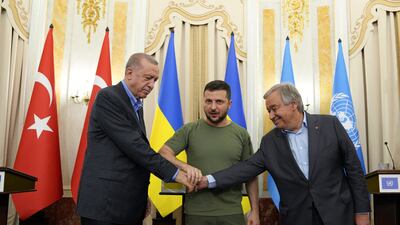
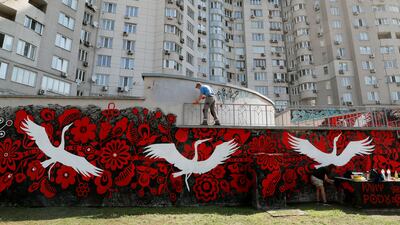
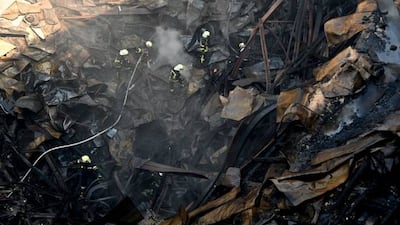
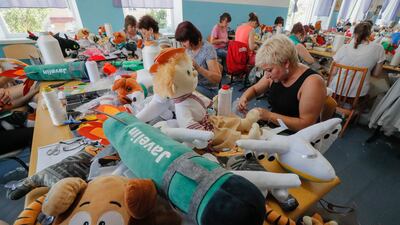
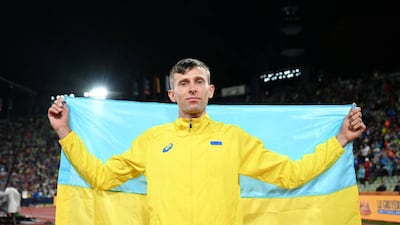
Since the start of Russia’s war in Ukraine, Ukrainians have feared that their country’s Independence Day, on August 24, would be marked with the entirety of their territory under Russian occupation.
And yet, it is not. Simultaneously, however resilient Ukraine's forces have proven to be, driving Russian tanks back across the countries’ internationally recognised border remains an immense challenge.
At the moment, the prospects for a ceasefire are bleak. Gennady Gatilov, Russia's envoy to the UN in Geneva, has said his country sees little chance of a negotiated peace with Kyiv.
Ukraine’s President Volodymyr Zelenskyy has said he will not engage in negotiations if Ukrainian troops captured by Russia during its campaign on the city of Mariupol are put on trial, something that could well happen.
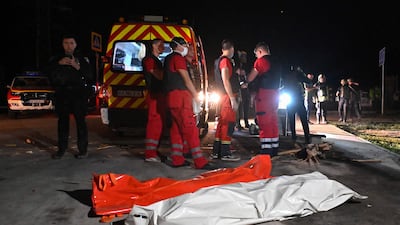
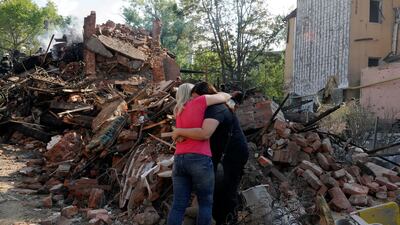
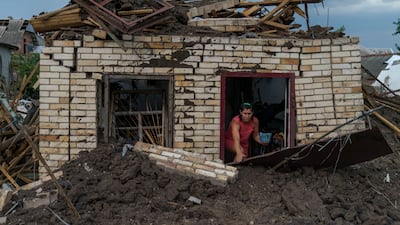
Ending fighting as quickly as possible must be the priority of both sides and the international community. At the moment, it is killing hundreds of troops and civilians on a daily basis, both on and behind the front lines. A potential disaster at the Zaporizhzhia nuclear plant, which is now under Russian control, could threaten even more people, although French President Emmanuel Macron’s office has now said that an independent team of inspectors will be allowed to visit the facility.
As deaths mount, tensions are only rising. Mr Zelenskyy has warned of the possibility of a “particularly nasty and cruel” attack on Independence Day. On the weekend, a car bomb in Moscow killed the daughter of an important ally of President Putin. Ukraine has denied allegations it was behind the attack, while some say it is the work of a Russian dissident group.
It is one of the more dramatic attacks with possible links to the conflict to have taken place in Russian territory, but others have sown uncertainty, too. Russian military facilities near the border with Ukraine have been hit on a number of occasions. Crimea, which Moscow claims is its territory, has been struck, too. Again, it has proven hard to attribute responsibility. At points, Russia has said human error is to blame. Ukrainian officials have given mixed messages, likely in a bid to throw strategic ambiguity into the mix.
These twists and turns are generating a great deal of conversation about tactics, hardware, morale and upcoming battles. In an academic sense, the first interstate conflict to take place in Europe since the Second World War is understandably interesting to many. It feels, however, that discussions about securing peace are getting less attention.
In June, former German chancellor Angela Merkel gave her first interview since the war began. She, along with her predecessors, has received a great deal of criticism for what many in the West view as an approach to Russia after the collapse of the Soviet Union that was permissive and naive. She, however, was unapologetic: "It’s a great shame that it didn’t succeed, but I don’t blame myself for having tried ... I don't see that I should now say it was wrong, and I won't apologise."
Many will disagree, but a voice for peace, particularly from such a distinguished politician, must be reflected on tomorrow. Six months from the beginning of the conflict, if the situation is to be any better this time next year, difficult conversations about compromise and co-operation will have to come to the fore.

Mercer, the investment consulting arm of US services company Marsh & McLennan, expects its wealth division to at least double its assets under management (AUM) in the Middle East as wealth in the region continues to grow despite economic headwinds, a company official said.
Mercer Wealth, which globally has $160 billion in AUM, plans to boost its AUM in the region to $2-$3bn in the next 2-3 years from the present $1bn, said Yasir AbuShaban, a Dubai-based principal with Mercer Wealth.
“Within the next two to three years, we are looking at reaching $2 to $3 billion as a conservative estimate and we do see an opportunity to do so,” said Mr AbuShaban.
Mercer does not directly make investments, but allocates clients’ money they have discretion to, to professional asset managers. They also provide advice to clients.
“We have buying power. We can negotiate on their (client’s) behalf with asset managers to provide them lower fees than they otherwise would have to get on their own,” he added.
Mercer Wealth’s clients include sovereign wealth funds, family offices, and insurance companies among others.
From its office in Dubai, Mercer also looks after Africa, India and Turkey, where they also see opportunity for growth.
Wealth creation in Middle East and Africa (MEA) grew 8.5 per cent to $8.1 trillion last year from $7.5tn in 2015, higher than last year’s global average of 6 per cent and the second-highest growth in a region after Asia-Pacific which grew 9.9 per cent, according to consultancy Boston Consulting Group (BCG). In the region, where wealth grew just 1.9 per cent in 2015 compared with 2014, a pickup in oil prices has helped in wealth generation.
BCG is forecasting MEA wealth will rise to $12tn by 2021, growing at an annual average of 8 per cent.
Drivers of wealth generation in the region will be split evenly between new wealth creation and growth of performance of existing assets, according to BCG.
Another general trend in the region is clients’ looking for a comprehensive approach to investing, according to Mr AbuShaban.
“Institutional investors or some of the families are seeing a slowdown in the available capital they have to invest and in that sense they are looking at optimizing the way they manage their portfolios and making sure they are not investing haphazardly and different parts of their investment are working together,” said Mr AbuShaban.
Some clients also have a higher appetite for risk, given the low interest-rate environment that does not provide enough yield for some institutional investors. These clients are keen to invest in illiquid assets, such as private equity and infrastructure.
“What we have seen is a desire for higher returns in what has been a low-return environment specifically in various fixed income or bonds,” he said.
“In this environment, we have seen a de facto increase in the risk that clients are taking in things like illiquid investments, private equity investments, infrastructure and private debt, those kind of investments were higher illiquidity results in incrementally higher returns.”
The Abu Dhabi Investment Authority, one of the largest sovereign wealth funds, said in its 2016 report that has gradually increased its exposure in direct private equity and private credit transactions, mainly in Asian markets and especially in China and India. The authority’s private equity department focused on structured equities owing to “their defensive characteristics.”
Who's who in Yemen conflict
Houthis: Iran-backed rebels who occupy Sanaa and run unrecognised government
Yemeni government: Exiled government in Aden led by eight-member Presidential Leadership Council
Southern Transitional Council: Faction in Yemeni government that seeks autonomy for the south
Habrish 'rebels': Tribal-backed forces feuding with STC over control of oil in government territory
UAE currency: the story behind the money in your pockets
Profile of RentSher
Started: October 2015 in India, November 2016 in UAE
Founders: Harsh Dhand; Vaibhav and Purvashi Doshi
Based: Bangalore, India and Dubai, UAE
Sector: Online rental marketplace
Size: 40 employees
Investment: $2 million
New process leads to panic among jobseekers
As a UAE-based travel agent who processes tourist visas from the Philippines, Jennifer Pacia Gado is fielding a lot of calls from concerned travellers just now. And they are all asking the same question.
“My clients are mostly Filipinos, and they [all want to know] about good conduct certificates,” says the 34-year-old Filipina, who has lived in the UAE for five years.
Ms Gado contacted the Philippines Embassy to get more information on the certificate so she can share it with her clients. She says many are worried about the process and associated costs – which could be as high as Dh500 to obtain and attest a good conduct certificate from the Philippines for jobseekers already living in the UAE.
“They are worried about this because when they arrive here without the NBI [National Bureau of Investigation] clearance, it is a hassle because it takes time,” she says.
“They need to go first to the embassy to apply for the application of the NBI clearance. After that they have go to the police station [in the UAE] for the fingerprints. And then they will apply for the special power of attorney so that someone can finish the process in the Philippines. So it is a long process and more expensive if you are doing it from here.”
Dengue%20fever%20symptoms
%3Cp%3EHigh%20fever%20(40%C2%B0C%2F104%C2%B0F)%3Cbr%3ESevere%20headache%3Cbr%3EPain%20behind%20the%20eyes%3Cbr%3EMuscle%20and%20joint%20pains%3Cbr%3ENausea%3Cbr%3EVomiting%3Cbr%3ESwollen%20glands%3Cbr%3ERash%26nbsp%3B%3C%2Fp%3E%0A
%3Cp%3EMATA%0D%3Cbr%3EArtist%3A%20M.I.A%0D%3Cbr%3ELabel%3A%20Island%0D%3Cbr%3ERating%3A%203.5%2F5%3C%2Fp%3E%0A
500 People from Gaza enter France
115 Special programme for artists
25 Evacuation of injured and sick
U19 World Cup in South Africa
Group A: India, Japan, New Zealand, Sri Lanka
Group B: Australia, England, Nigeria, West Indies
Group C: Bangladesh, Pakistan, Scotland, Zimbabwe
Group D: Afghanistan, Canada, South Africa, UAE
UAE fixtures
Saturday, January 18, v Canada
Wednesday, January 22, v Afghanistan
Saturday, January 25, v South Africa
UAE squad
Aryan Lakra (captain), Vriitya Aravind, Deshan Chethyia, Mohammed Farazuddin, Jonathan Figy, Osama Hassan, Karthik Meiyappan, Rishabh Mukherjee, Ali Naseer, Wasi Shah, Alishan Sharafu, Sanchit Sharma, Kai Smith, Akasha Tahir, Ansh Tandon
Terror attacks in Paris, November 13, 2015
- At 9.16pm, three suicide attackers killed one person outside the Atade de France during a foootball match between France and Germany
- At 9.25pm, three attackers opened fire on restaurants and cafes over 20 minutes, killing 39 people
- Shortly after 9.40pm, three other attackers launched a three-hour raid on the Bataclan, in which 1,500 people had gathered to watch a rock concert. In total, 90 people were killed
- Salah Abdeslam, the only survivor of the terrorists, did not directly participate in the attacks, thought to be due to a technical glitch in his suicide vest
- He fled to Belgium and was involved in attacks on Brussels in March 2016. He is serving a life sentence in France
SANCTIONED
- Kirill Shamalov, Russia's youngest billionaire and previously married to Putin's daughter Katarina
- Petr Fradkov, head of recently sanctioned Promsvyazbank and son of former head of Russian Foreign Intelligence, the FSB.
- Denis Bortnikov, Deputy President of Russia's largest bank VTB. He is the son of Alexander Bortnikov, head of the FSB which was responsible for the poisoning of political activist Alexey Navalny in August 2020 with banned chemical agent novichok.
- Yury Slyusar, director of United Aircraft Corporation, a major aircraft manufacturer for the Russian military.
- Elena Aleksandrovna Georgieva, chair of the board of Novikombank, a state-owned defence conglomerate.
COMPANY%20PROFILE%20
%3Cp%3E%3Cstrong%3EName%3A%3C%2Fstrong%3E%20Haltia.ai%0D%3Cbr%3E%3Cstrong%3EStarted%3A%3C%2Fstrong%3E%202023%0D%3Cbr%3E%3Cstrong%3ECo-founders%3A%3C%2Fstrong%3E%20Arto%20Bendiken%20and%20Talal%20Thabet%0D%3Cbr%3E%3Cstrong%3EBased%3A%3C%2Fstrong%3E%20Dubai%2C%20UAE%0D%3Cbr%3E%3Cstrong%3EIndustry%3A%3C%2Fstrong%3E%20AI%0D%3Cbr%3E%3Cstrong%3ENumber%20of%20employees%3A%3C%2Fstrong%3E%2041%0D%3Cbr%3E%3Cstrong%3EFunding%3A%3C%2Fstrong%3E%20About%20%241.7%20million%0D%3Cbr%3E%3Cstrong%3EInvestors%3A%3C%2Fstrong%3E%20Self%2C%20family%20and%20friends%26nbsp%3B%3C%2Fp%3E%0A