


If former US president Franklin D Roosevelt were alive today, he might have valuable ideas about how to solve the war in Ukraine. He might also be distraught. In one of the most famous anti-war speeches of all time, delivered by him in 1936, he told an American audience: "I have seen war ... I have seen 200 limping, exhausted men come out of line – the survivors of a regiment of one thousand that went forward 48 hours before. I have seen children starving. I have seen the agony of mothers and wives. I hate war."
Knowing first-hand the horrors of First World War, he spent much of his presidency between 1933 and 1945 using diplomacy to try to prevent another. But the very particular conditions in Europe in the run-up to the Second World War meant that even the engagement of the most powerful country on Earth was not enough. And when conflict did erupt, Roosevelt eventually did not shy away from the fight, deploying millions of US troops.
He also sent billions of dollars in military aid to US allies, including Britain, China and the Soviet Union, as part of the "lend-lease" system. It was pivotal to the Allies' victory and to restoring peace in Europe. Eighty years later, in a sign of how damaging the war in Ukraine is becoming, that same term, which many assumed to be consigned to history, has made a comeback. On Monday, US President Joe Biden signed an updated version, known as the Ukraine Democracy Defense Lend-Lease Act. It comes as the US is on the verge of sending $33 billion to Ukraine – possibly more – to help it fight Russia's invasion that began in February.
-
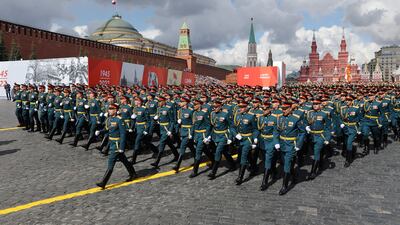
Thousands of Russian soldiers march during the Victory Day parade in Red Square in central Moscow, which marks the 77th anniversary of the Soviet Union's victory over Nazi Germany in the Second World War. Reuters -
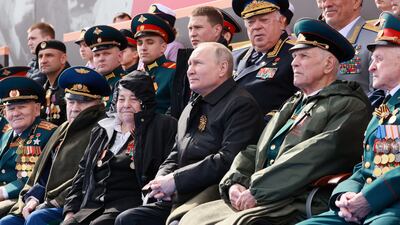
Russian President Vladimir Putin watches the Victory Day military parade in Red Square in central Moscow. Reuters -
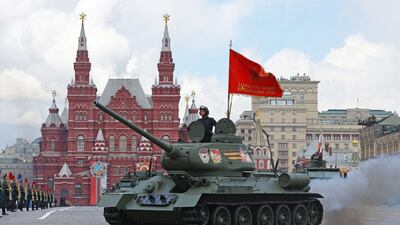
A T-34 Soviet-era tank powers along in Red Square. Reuters -
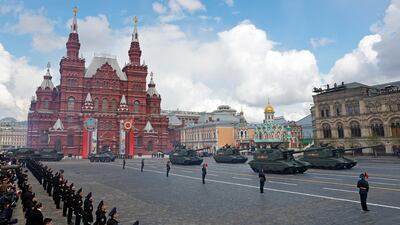
Russian armoured vehicles, including MSTA-S self-propelled howitzers, drive through Red Square. Reuters -
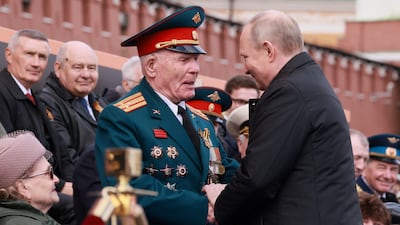
Vladimir Putin shakes hands with spectators before the parade in Moscow. Reuters -
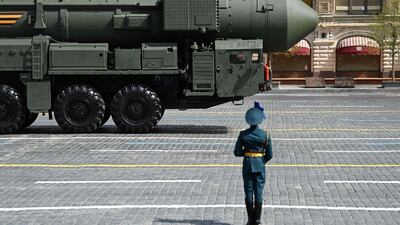
A Russian Yars intercontinental ballistic missile launcher parades through Red Square. AFP -
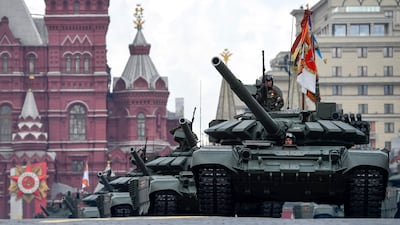
Russian T-72B3M tanks parade through Red Square. AFP -
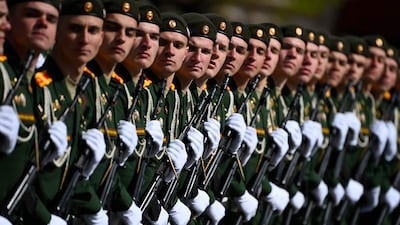
Russian servicemen march in Red Square. AFP -
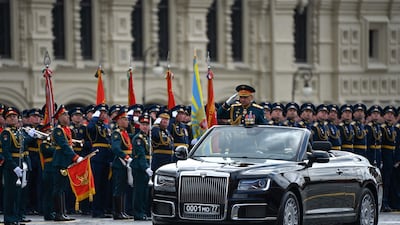
Russian Defence Minister Sergey Shoigu salutes soldiers as he is driven along Red Square in central Moscow. AFP -
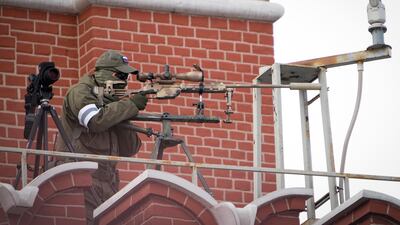
A security service officer aims his sniper rifle while securing the area in Moscow. AP Photo -
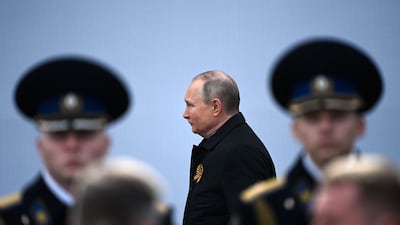
Vladimir Putin arrives to watch the Victory Day military parade at Red Square in central Moscow. AFP -
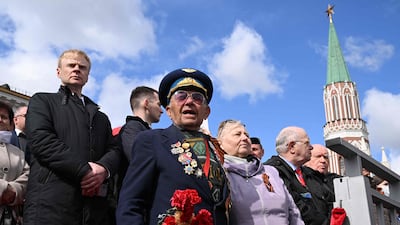
Veterans and guests watch the Victory Day military parade at Red Square in central Moscow. AFP -
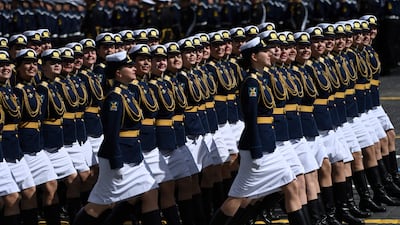
Russian servicewomen march on Red Square during the parade in central Moscow. AFP -
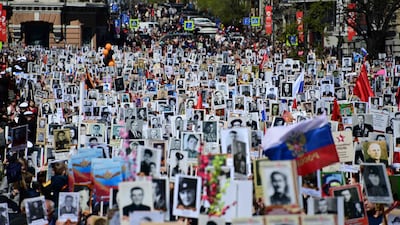
People carry portraits of their relatives who were Second World War soldiers as they take part in the Immortal Regiment march in the far eastern Russian city of Vladivostok. AFP -
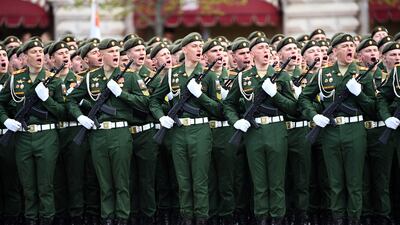
Russian servicemen shout during the Victory Day military parade in Red Square. AFP -
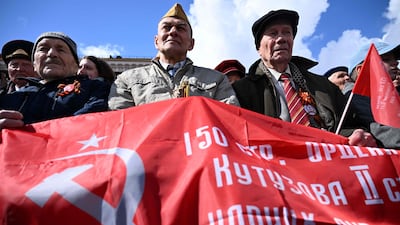
Military veterans watch the Victory Day parade in Red Square in Moscow. AFP -
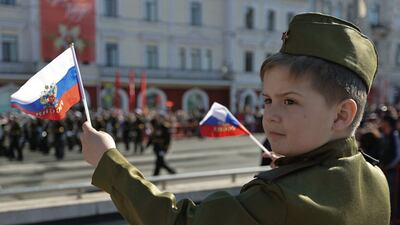
A boy wearing a Red Army-styled uniform watches a military parade in Vladivostok. Reuters


On its own, Monday's legislation is largely symbolic. But symbolism matters in war, particularly this one, and it is coming thick and fast. Also on Monday, Russia held Victory Day, one of the most important dates in the country's calendar, which celebrates the Soviet Union's crucial role in defeating the Nazis. President Vladimir Putin used the event's keynote address to thank Russian forces currently fighting against what he claimed are "neo-Nazis" in Ukraine's government and armed forces. In a video released the same day, Ukrainian President Volodymyr Zelenskyy in turn accused Russia of adopting "Nazi philosophy".
There have been yet more references to the Second World War in recent weeks. British Prime Minister Boris Johnson said that Ukraine's efforts are its "finest hour", a reference to a speech made by Winston Churchill, the UK's emblematic wartime prime minister.
The fact that 15 presidents later, lend-lease is being revived is ultimately a sign of long-term diplomatic failure and complacency about the importance of peace in Europe. Lend-lease might have been a good policy in a very bad time, but its recipients were still devastated after their wars ended. Britain never recovered from the debt it had to pay the US. The last repayment was made in 2006. Russia lost 27 million of its citizens. And for all of Europe, an age of peace did not follow the defeat of the Nazis. For decades, the continent, indeed much of the world, was divided by the Cold War and filled to the brim with nuclear weapons.
The past few weeks might have seen plenty of historical references from capitals across the world, but there have been far fewer indications of a diplomatic plan to end fighting, or even an idea of what victory or compromise for both sides would look like. For now, Europe and the world can only be increasingly reminded of Roosevelt's belief that peace is never guaranteed and needs constantly to be preserved.

