


Roughly 420 kilometres above the Earth, a remarkable story of scientific achievement is entering a tumultuous final chapter. Nasa announced earlier this year that the International Space Station (ISS), in operation since 1998, will be decommissioned in 2031. Its final mission will see it plunge explosively into the Pacific Ocean.
It will be an uncharacteristically fiery exit for an institution that has long symbolised peaceful international co-operation. Throughout its decades of service, the station has floated above Earthly matters even when they have been at their most heated. There are fears that the gravity of the Ukraine conflict might be enough to suck it into terrestrial disputes, as acrimony between its two main sponsors, the US and Russia, grows. But many are confident that the next generation of collaborative space projects can get the mission back on track for its remaining years.
As its space programme goes from strength to strength, the UAE is joining the ranks of countries pursuing these aims. The latest milestone was announced last week: a six-month mission in 2023 to the ISS by an Emirati astronaut, who, for now, remains unnamed. It will be the first long-term space mission by an Arab country on board the ISS, a historic moment for the Arab world that will go down alongside Saudi Prince Sultan bin Salman Al Saud's first ever voyage by an Arab to space and UAE astronaut Hazza Al Mansouri's trip in 2019, which saw him become the first Arab to board the ISS.
-
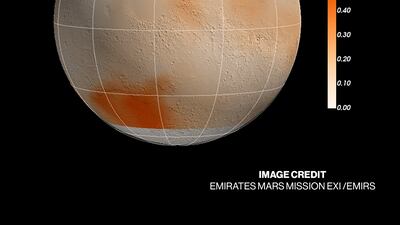
Observations late December confirmed thick dust clouds only in Hellas, an impact crater on the southern hemisphere, but showed low amounts of suspended dust elsewhere – indicating that a dust storm was forming. Photo: Hope Mars Mission -

By January 5, the storm had grown massively, stretching 2,500 km across, as it approached from the east. It partially covered Syrtis Major, with greyish water-ice clouds also visible in the storm. Meanwhile, Hellas was completely covered by dust clouds. Photo: Hope Mars Mission -

By January 7, dust haze and greyish water-ice clouds spread to the east of Syrtis Major and north of Hellas. Photo: Hope Mars Mission -

By January 9, the storm shrunk in size and moved over to northwestern Syrtis, measuring 1,200 km across. The dust haze, however, is still covering the plains east of Syrtis, with Hope probe data showing how it spread so far, spanning about one-third of the circumference of Mars. Photo: Hope Mars Mission -
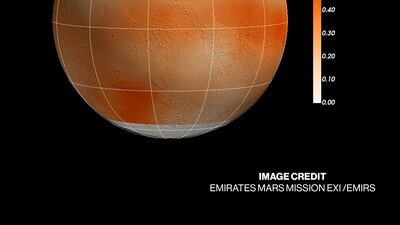
The haze started to thin by January 14 and no dust storms were visible by then. Photo: Hope Mars Mission


So far, this has been the grandest announcement from the country's space programme this year. But behind every legendary journey beyond the atmosphere are legions of contributors without whom such spectacular moments would be impossible. Testifying on the future of the US space programme in 2011, astronaut Eugene Cernan said: "The Space Program has never been an entitlement, it’s an investment in the future – an investment in technology, jobs, international respect and geopolitical leadership, and perhaps most importantly in the inspiration and education of our youth."
Other developments in the UAE's programme in 2022 demonstrate as much. In April, researchers at New York University Abu Dhabi discovered new features of high-frequency waves that stretch around the Sun, particularly that they could penetrate deeper into and travel much faster around it than previous estimates. That same month, the UAE and the US announced a new data-sharing partnership that will see the Emirates Mars Mission working with Nasa's Maven Mars Mission to co-operate on a subject that is fast becoming one of the key priorities of astronomy in the 21st century.
The UAE's contribution is already bearing fruit. A recent collection of data on the Red Planet added 57 gigabytes of images and information, bringing the country's total cache to 827.7 gigabytes.
Cernan's words on the importance of space programmes are made all the more poignant by the fact that before he left, he wrote "we shall return" on the moon's dusty ground, along with his daughter's initials. No one has yet returned, but in the 21st century old pioneers continue to break new ground in a field of infinite possibilities, with a growing number of new partners. The UAE is fast becoming a key one.

