


Few moments in the latter stages of the 20th century were as closely watched around the world as the end of apartheid in South Africa. In 1994, South Africans switched suddenly from decades-long racial segregation to a political system with the capacity to be truly representative. It meant South Africa could go into the 21st century as a "Rainbow Nation", no longer a place where more than three quarters of its population were discriminated against at all levels by a small, white elite.
It was a lesson in forgiveness. After decades of tension, and not before some violence, the final stage of the transition was peaceful, largely down to visionary leaders who never wavered from the importance of keeping the country together and building an inclusive future.
Yesterday, Archbishop Desmond Tutu, one of these leading pioneers, died.
Born in 1931, Tutu was ordained in 1961 and made history when he became Johannesburg’s first black Anglican dean in 1975. He became archbishop, one of the highest offices in the Christian church, in 1986. He was a Nobel Prize laureate, along with other figureheads of the movement such as former presidents Nelson Mandela and FW De Klerk, all part of a generation of "outstanding South Africans who bequeathed a liberated South Africa", President Cyril Ramaphosa said after the news of Tutu's passing.
-
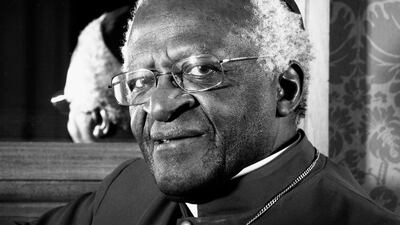
Desmond Tutu, then the head of South Africa's Truth and Reconciliation Committee, pictured in 2004 at Dean's Yard in London. Getty -

Desmond Tutu, third left, pictured with The Elders in Johannesburg. The international NGO is made up of statesmen, peace advocates and human rights activists, and was set up by Nelson Mandela, seated, in 2007. Getty -
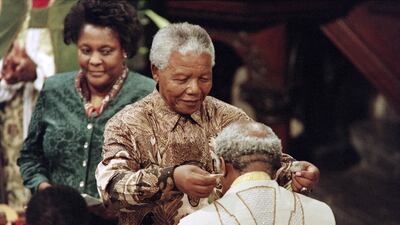
On June 23, 1996, South African leader Nelson Mandela bestowed the Order of Meritorious Service on Desmond Tutu at a farewell service at St George's Cathedral in Cape Town. Described as the country's moral compass, Tutu died on December 26, 2021, aged 90. AFP -
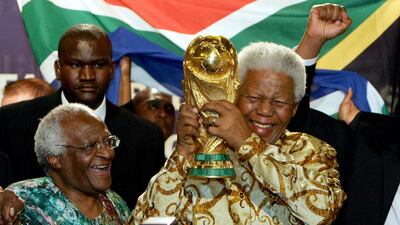
Nelson Mandela holds the Jules Rimet World Cup beside Desmond Tutu. AFP -
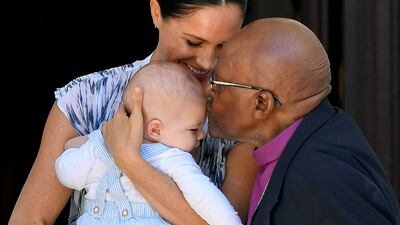
Desmond Tutu kisses Archie Mountbatten-Windsor on the head as he is held by his mother, Meghan, Duchess of Sussex, during a royal tour of South Africa on September 25, 2019. Getty -
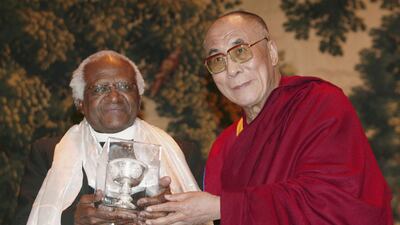
The Dalai Lama and Archbishop Desmond Tutu in 2006 in Brussels, Belgium. Getty -

US president Barack Obama chats with Archbishop Desmond Tutu following a tour of the Desmond Tutu HIV Foundation Youth Centre in Cape Town, South Africa. AFP -

Archbishop Desmond Tutu with Graca Machel, the wife of former South African president Nelson Mandela. AFP -

Desmond Tutu with his wife Nomalizo Leah Tutu and other members of his family pictured in the UK, December, 1984. Getty -
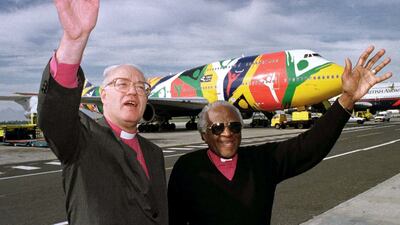
Desmond Tutu greets George Carey, then the Archbishop of Canterbury. Reuters -
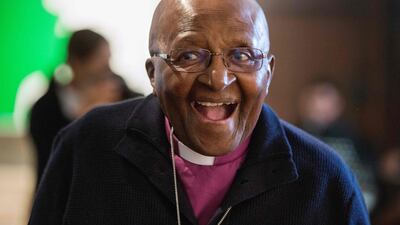
Desmond Tutu in 2019. AFP -
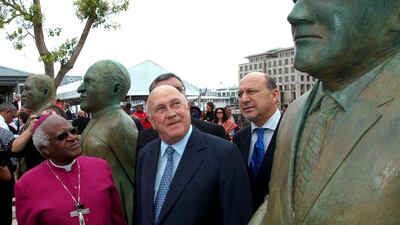
Desmond Tutu and former South African president FW de Klerk during the unveiling of statues of South Africa's four Nobel Peace Prize winners: de Klerk, Tutu, Chief Albert Luthuli, former president of the African National Congress, and former president Nelson Mandela. AFP -
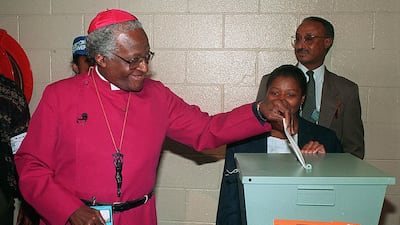
Desmond Tutu casts his vote in Cape Town during South Africa's first democratic elections, which were held in 1994. AFP -
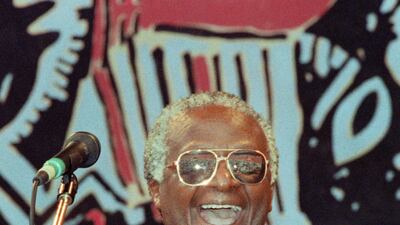
Desmond Tutu blesses the "human rainbow" concert to celebrate Nelson Mandela's release from prison in 1990. AFP -
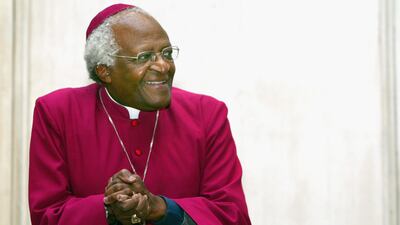
Desmond Tutu takes up his position as visiting professor in post-conflict studies at Kings College London in 2004. Getty -
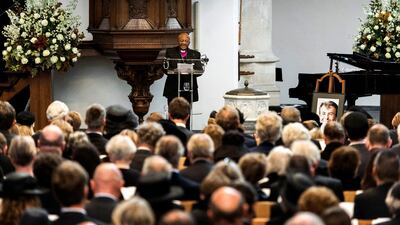
Desmond Tutu speaks during the memorial for Prince Friso in the Old Church in Delft, the Netherlands on November 2, 2013. Getty -
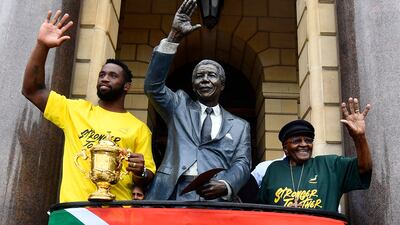
Desmond Tutu, right, during the Rugby World Cup 2019 Champions Tour on November 11, 2019 in Cape Town.


After Mandela's election in 1994, the first vote in which black South Africans could participate, Tutu was appointed head of the Truth and Reconciliation Commission, which investigated human rights abuses that took place during the apartheid era. While its main purpose was to gather evidence from victims and perpetrators on historic crimes, it did not set out to prosecute retrospectively. Rather, it sought to only establish the truth. It published its final findings in 2003.
Tutu summed up the approach in these lines: "When we see others as the enemy, we risk becoming what we hate. When we oppress others, we end up oppressing ourselves. All of our humanity is dependent upon recognising the humanity in others."
There was nothing easy or inevitable about this outlook. North of the border, in Zimbabwe, a government led by Robert Mugabe was descending into corruption and division that eventually saw the violent seizure of white-owned farms, a move that left Zimbabweans traumatised and with severe food shortages.
Having now lost two of their country’s chief architects – Mandela died in 2013 – younger South Africans bear a special responsibility to keep its peaceful development on track. This mission became particularly crucial in 2021. Widespread riots broke out in July, fuelled by poverty in a country where it is increasingly hard to find jobs. And while South Africa has come a great distance since the end of apartheid, the system’s legacy is often blamed for this lingering inequality.
Much work is still to be done, then. But for tough moments, South Africans will always have the example of leaders such as Tutu to remind themselves that a better, more peaceful way exists.

