


Over the past few years, the world appears to have sleepwalked into a number of crises, be it the sudden shock of Covid-19, or a longer, ongoing inability to do enough to deal with climate change.
In a speech at this year's Abu Dhabi International Petroleum Exhibition and Conference (Adipec), a global energy conference, Dr Sultan Al Jaber, UAE Minister of Industry and Advanced Technology, spoke of another crisis into which the world has "sleepwalked": the one in our energy markets.
A faster-than-expected economic recovery from the pandemic has caught an under-invested energy sector off guard. Now, some countries are paying the price of sky-high rates, as demand outstrips supply. The situation contains important lessons about global energy strategy going forward.
This year's Adipec has broken a mould. Traditional conversations about the sector’s profitability are happening, but with a new subtext: energy transition. A move away from carbon-intensive means of generating power, however far off it may be, is inevitable. Should this worry economies built on petroleum? The emerging consensus at Adipec says it should not.
-
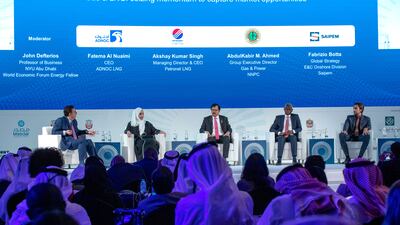
Strategic panel: Gas and LNG: Seizing Momentum to Capture Market Opportunities. From left, John Defterios, professor of business, NYU Abu Dhabi; Fatema Al Nuaimi, chief executive, Adnoc LNG; Akshay Kumar Singh, managing director chief executive, Petronet LNG; AbdulKabir M Ahmed, group executive director gas and power, NNPC; and Fabrizio Botta, global strategy E&C onshore division, Saipem. All photos Victor Besa / The National. -
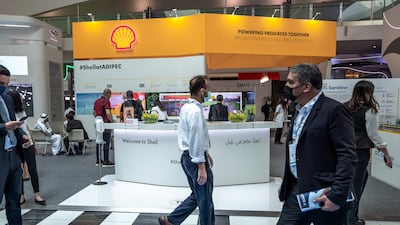
The Shell stand at Adipec. -

'The National' stand at Adipec. -
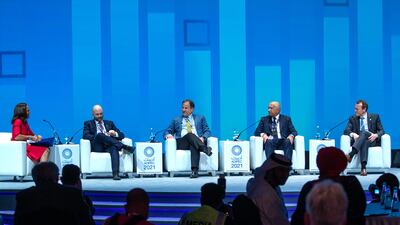
IFAD: The Story So Far. From left, Helima Croft, managing director and global head of strategy, RBC Capital Markets; Stuart Williams, president, Ice Futures Europe; Mike Muller, head of Vitol Asia; Philippe Khoury, executive vice president sales and trading DM&T, Adnoc; Thomas Weymel, president of trading and shipping, Totsa Totalenergies Trading SA. -
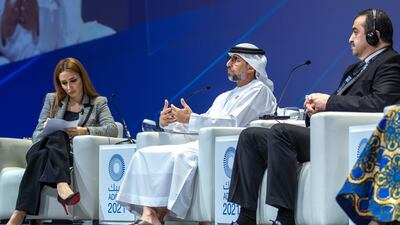
Suhail Al Mazrouei, Minister of Energy and Infrastructure, during the Ministerial Hydrogen Panel: What Policies are Needed to Support the Development of a Sustainable Hydrogen Industry? -
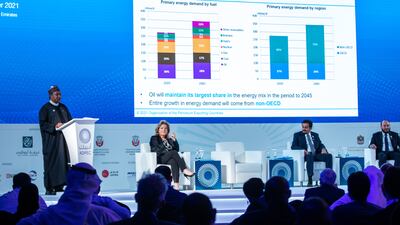
Opec's World Oil Outlook 2021. Mohammad Barkindo, secretary general, Opec. -
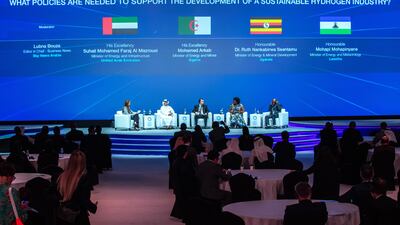
Suhail Al Mazrouei, Minister of Energy and Infrastructure, during the Ministerial Hydrogen Panel: What Policies are Needed to Support the Development of a Sustainable Hydrogen Industry? -
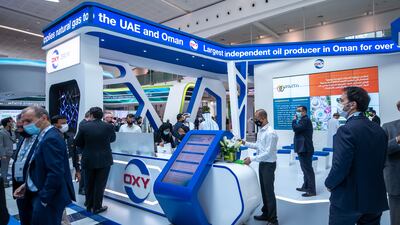
The Occidental stand at Adipec. -
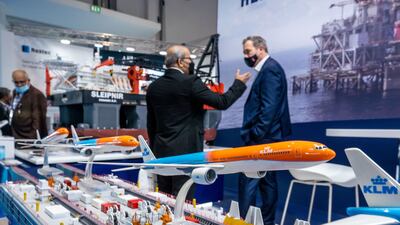
Visitors in discussion at Adipec. -
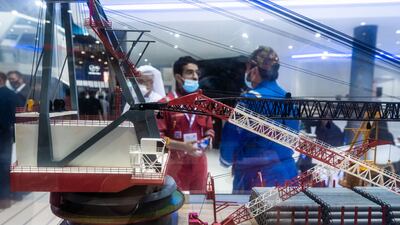
Adipec brings together oil, gas and energy professionals from around the world. -
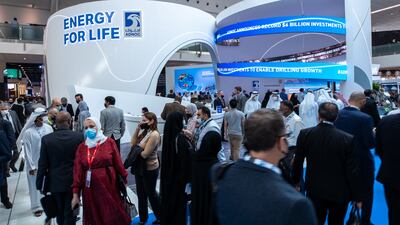
Crowds of visitors throng to Adipec. -
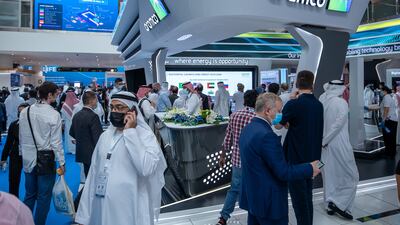
A bustling scene at Adipec. -
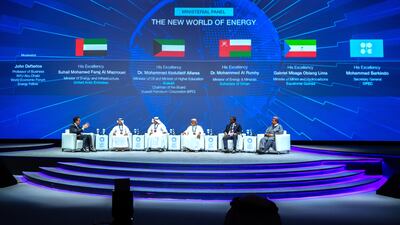
Ministerial Panel: The New World of Energy. -
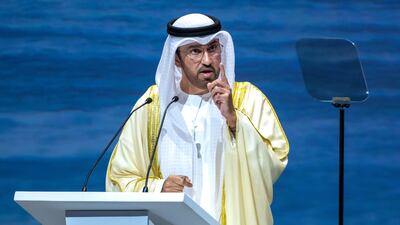
Dr Sultan Al Jaber, Minister of Industry and Advanced Technology, and managing director and group chief executive, Adnoc. -

Energy of the Future: How are Oil and Gas Companies Evolving? -
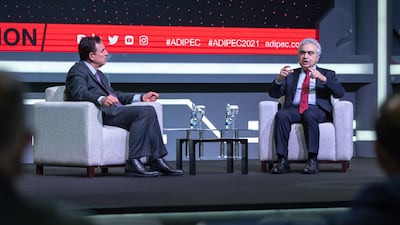
Fatih Birol, right, executive director, International Energy Agency, in discussion with John Defterios, professor of business, NYU Abu Dhabi. Mr Birol received a Lifetime Achievement award at the Adipec Awards. -

Visitors to Adipec on the first day of the event. -
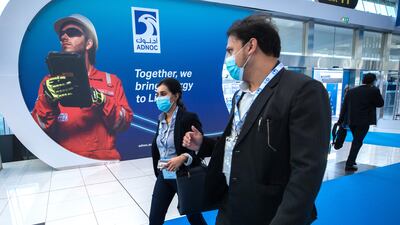
Visitors arrive for the first day of Adipec.


The industry, particularly off the back of Cop26, is urgently aware of the need for it to prepare for a transition to more renewable, efficient and clean energy sources in order to help save the planet. Where stakeholders differ is whether they see this as a moment of vulnerability or opportunity.
In the UAE, the latter approach is building momentum. Adnoc, Abu Dhabi’s oil producer, has said it plans to increase its production capacity. But this is being matched with heavy investment in carbon-capturing technology, a strategy the company hopes will actually decrease its emissions as production ramps up, and put it at the centre of a new, profitable branch of environmental technology. So far, it is on track to expand its carbon capture programme five-fold by 2030.
The strategy of other firms, such as BP, to meet net-zero goals has been to do the opposite and cut production. This might reduce emissions, but it does not help the world's broader energy crisis, which pushes many people, particularly in developing countries, into hardship of a kind that could well end up creating more environmental damage. We know that poverty does not just hurt people, but the planet, too.
A sense of pragmatism about the ongoing importance of hydrocarbons in the short and medium term is the right way forward. By investing in both the traditional and more innovative branches of the sector, firms and governments can create the most sustainable response to the need for sustainability.
And longer-term technological ambitions are still getting their moment at Adipec. For example, Adnoc and Taqa, a state-backed UAE energy firm, have announced they will launch a global renewable energy and green hydrogen venture that will have a generating capacity of 30 gigawatts by 2030. Hydrogen presents a totally non-polluting energy revolution waiting to happen, though it will take time to be fully realised. On the somewhat uncertain road to energy transition, short-term certainty must fill the gap.
It is demonstrably too simplistic and detrimental to say that breaking suddenly with hydrocarbons will save the planet. Striking a balance between energy security, economic growth and climate action is vital. Understanding this gives the sector an opportunity to move on from the older, fear-based approach to hydrocarbon energy's relationship with the environment. It might have sleepwalked into today's problems, but after discussions at Adipec, it can wake up to new solutions.

