
Covid-19 has shone a light on the acute vulnerabilities of our interconnected world. No country can tackle the pandemic alone, regardless of its size, wealth or technological sophistication.
The only way to overcome the threat is through international co-operation, transparency and common adherence to rules, laws and regulations.
It is a poignant irony that the pandemic has struck on the 75th anniversary of the creation of the United Nations. The UN was born out of the wreckage of a wholly human calamity – the Second World War – amid a determination that future generations should be spared comparable suffering.
In the Middle East and other regions that are suffering from protracted conflicts, the UN and its principles of multilateral co-operation remain indispensable for finding long-term, sustainable solutions that will guarantee peace, stability and prosperity.
I hope the countries of the region can further strengthen their existing multilateral organisations, such as the Arab League and the Gulf Co-operation Council. During my time as UN Secretary General, it was invaluable for me to consult regularly with the Secretaries General of both these important organisations.
The principles of international law are the bedrock of our global order. They provide a framework for defending rights and exercising power that is crucial to all global challenges.
We can see this clearly in the Israeli-Palestinian conflict, which has lasted for almost as long as the UN itself.
The best, most enduring and just solution will be to provide two states – Israel and Palestine – for the two peoples, based on the internationally-recognised pre-1967 borders and in accordance with UN Security Council Resolutions 242 and 2334, among others.
The recent agreements between the United Arab Emirates, Bahrain and Israel are significant political developments that I hope can help overcome decades of estrangement and mistrust.
-
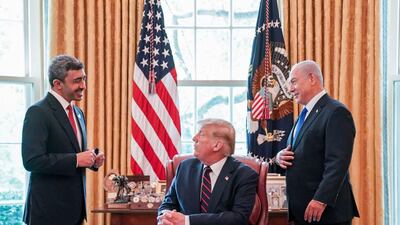
Sheikh Abdullah bin Zayed, UAE Minister of Foreign Affairs and International Co-operation, speaks to Donald Trump, US president at the time, and Israeli Prime Minister Benjamin Netanyahu in the Oval Office in September 2020. Ministry of Foreign Affairs and International Co-operation -
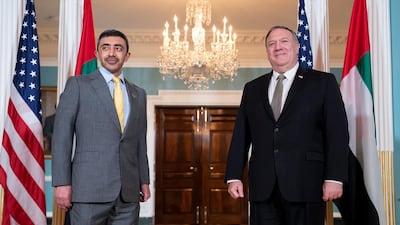
Sheikh Abdullah bin Zayed, UAE Minister of Foreign Affairs and International Co-operation, meets Mike Pompeo, US secretary of state at the time. Wam -
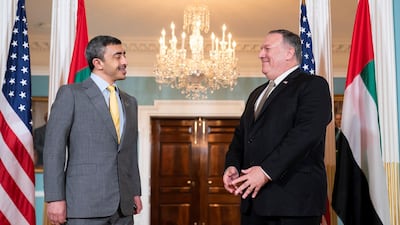
Sheikh Abdullah and Mr Pompeo in Washington. Wam -
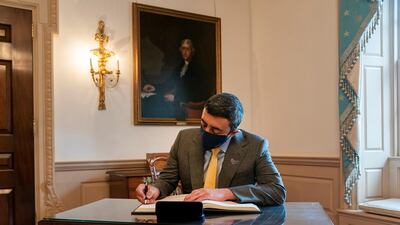
Sheikh Abdullah visits Washington in September last year. Wam -
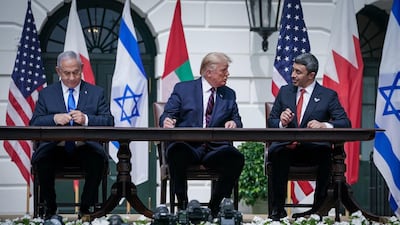
Sheikh Abdullah, UAE Minister of Foreign Affairs and International Co-operation, US President Donald Trump, centre, and Israeli Prime Minister Benjamin Netanyahu sign the Abraham Accord at the White House South Lawn. MOFAIC -
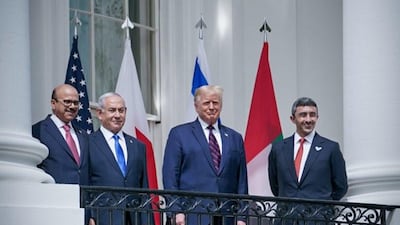
Sheikh Abdullah and, from left, Bahrain's Foreign Minister Abdullatif Al Zayani, Israeli Prime Minister Benjamin Netanyahu and US President Donald Trump at the White House. MOFAIC -
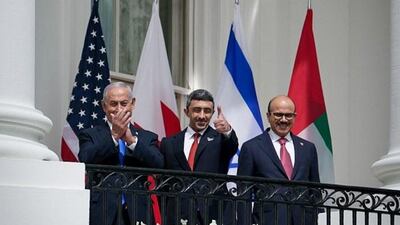
Sheikh Abdullah, Mr Al Zayani and Mr Netanyahu at the White House during the Abraham Accord signing ceremony. MOFAIC -
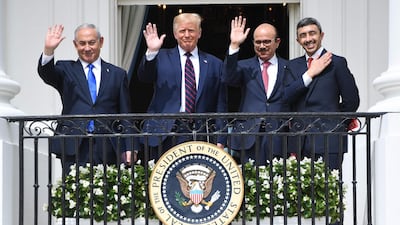
Sheikh Abdullah and, from left, Mr Netanyahu, Mr Trump and Mr Al Zayani wave from the Truman Balcony at the White House. AFP -
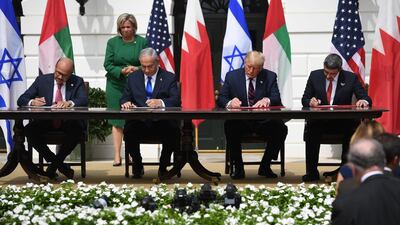
Sheikh Abdullah and, from left, Mr Al Zayani, Mr Netanyahu and Mr Trump sign the Abraham Accord. AFP -
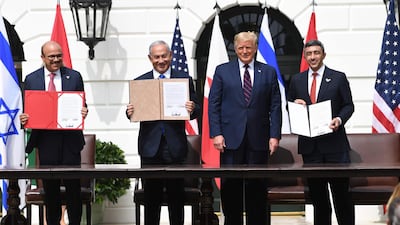
Sheikh Abdullah and, from left, Mr Al Zayani, Mr Netanyahu and Mr Trump after the signing ceremony. AFP -
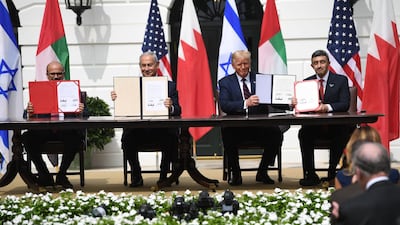
Sheikh Abdullah and, from left, Mr Al Zayani, Mr Netanyahu and Mr Trump after the signing ceremony. AFP -
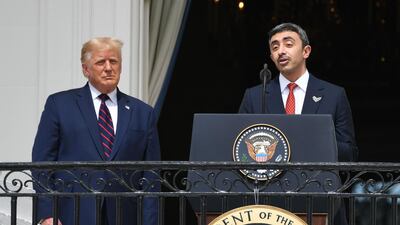
Sheikh Abdullah speaks from the Truman Balcony at the White House during the signing ceremony of the Abraham Accord. AFP -
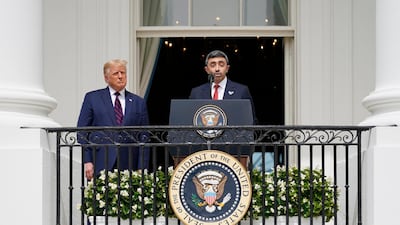
Sheikh Abdullah speaks as Mr Trump looks on before the signing of Abraham Accord on the South Lawn of the White House. AP -
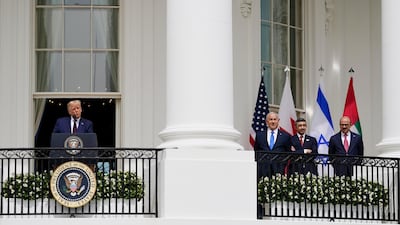
Sheikh Abdullah looks on from the White House as Mr Trump speaks at the Abraham Accord signing ceremony, also attended by Mr Al Zayani and Mr Netanyahu. AP -

Sheikh Abdullah bin Zayed, UAE Minister of Foreign Affairs and International Co-operation, Israeli Prime Minister Benjamin Netanyahu, left, and Bahraini Foreign Minister Abdullatif Al Zayani stand on the Blue Room Balcony during the signing ceremony. AP -
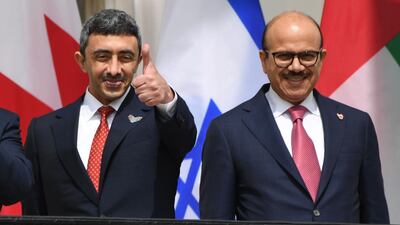
Sheikh Abdullah and Mr Al Zayani shortly before participating in the signing of the Abraham Accord. AFP -
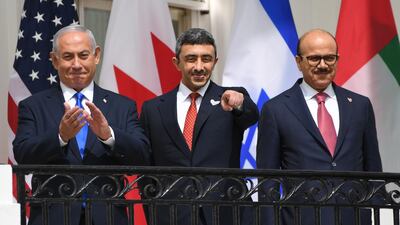
Sheikh Abdullah, with Mr Netanyahu, left, and Mr Al Zayani at the signing of the Abraham Accord on the South Lawn of the White House. AFP -
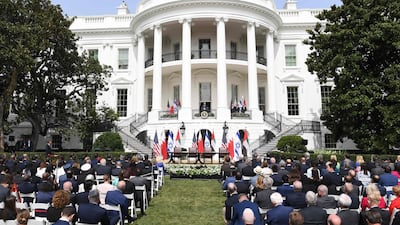
US President Donald Trump speaks from the Truman Balcony at the White House during the signing ceremony of the Abraham Accord. AFP -
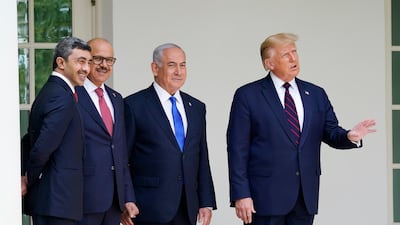
President Donald Trump walks to the Abraham Accord signing ceremony at the White House with Sheikh Abdullah bin Zayed, UAE Minister of Foreign Affairs and International Co-operation, Israeli Prime Minister Benjamin Netanyahu, and Bahrain's Foreign Minister Abdullatif Al Zayani. AP -
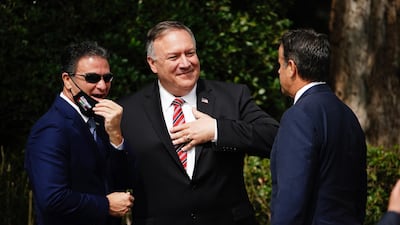
US Secretary of State Mike Pompeo arrives at the White House to attend the Abraham Accord signing ceremony hosted by President Donald Trump. EPA -
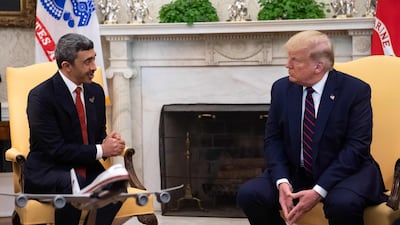
Sheikh Abdullah bin Zayed, UAE Minister of Foreign Affairs and International Co-operation, meets US President Donald Trump in the Oval Office of the White House before the signing of Abraham Accord. AFP -
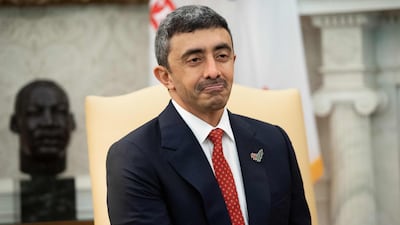
Sheikh Abdullah bin Zayed, UAE Minister of Foreign Affairs and International Co-operation, in the Oval Office. AFP -
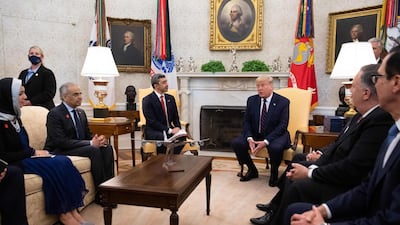
Sheikh Abdullah bin Zayed, UAE Minister of Foreign Affairs and International Co-operation, meets US President Donald Trump in the Oval Office of the White House. AFP -
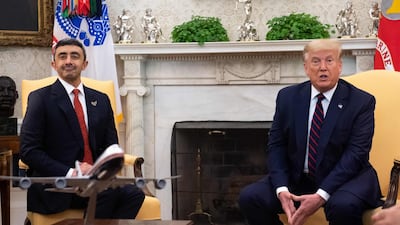
Sheikh Abdullah with Mr Trump in the Oval Office. AFP -
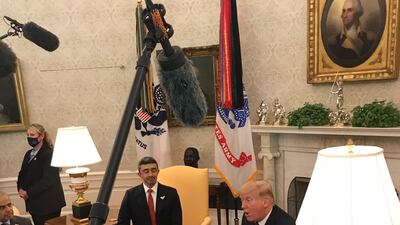
Sheikh Abdullah bin Zayed, UAE Minister of Foreign Affairs and International Co-operation, with by President Donald Trump at the White House. Mustafa Alrawi / The National -
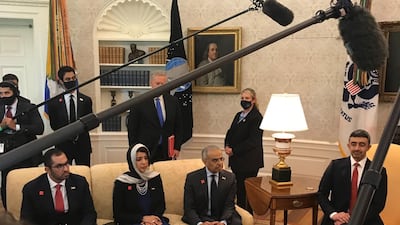
The UAE delegation led by Sheikh Abdullah bin Zayed, Minister of Foreign Affairs and International Co-operation, with US President Donald Trump at the White House. Mustafa Alrawi / The National -
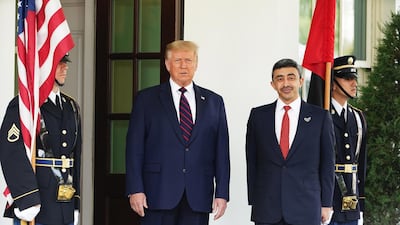
Sheikh Abdullah bin Zayed, UAE Minister of Foreign Affairs and International Co-operation, is welcomed to the White House by US President Donald Trump. EPA -
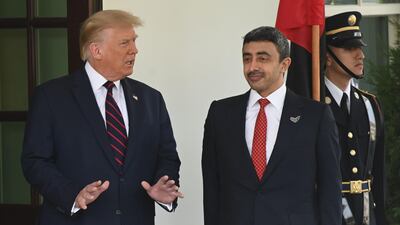
Sheikh Abdullah and Mr Trump outside the White House. AFP -
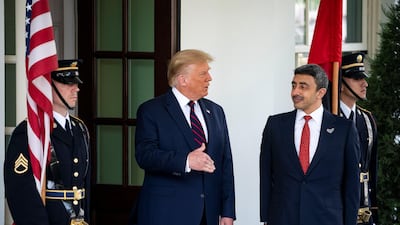
Sheikh Abdullah bin Zayed speaks to Mr Trump after arriving at the White House. Reuters -
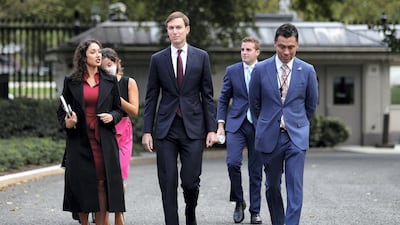
White House Senior Adviser Jared Kushner walks away following a television interview on the North Lawn at the White House in Washington. Reuters -
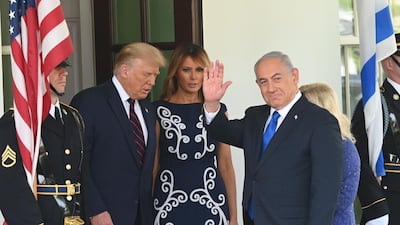
US President Donald Trump and First Lady Melania Trump welcome the arrival of Prime Minister of Israel Benjamin Netanyahu and his wife Sara on the North Lawn of the White House in Washington DC. AFP -
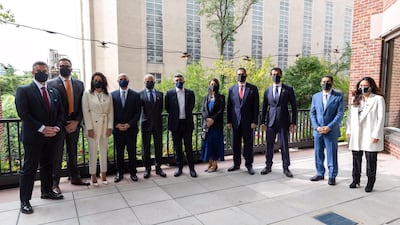
A delegation of senior UAE officials led by Sheikh Abdullah bin Zayed, UAE Minister of Foreign Affairs and International Co-operation, prepares to depart for the White House to sign the Abraham Accord. MOFAIC -
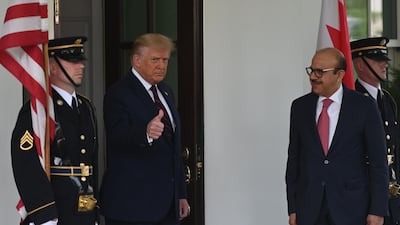
US President Donald Trump welcomes Bahraini Foreign Minister Abdullatif Al Zayani. AFP -

Bahraini Foreign Minister Abdullatif Al Zayani arrives at the White House in Washington DC. AFP -
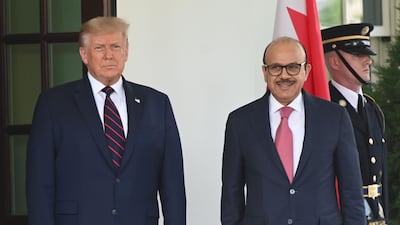
US President Donald Trump welcomes Bahraini Foreign Minister Abdullatif Al Zayani on the North Lawn of the White House in Washington, DC. AFP -
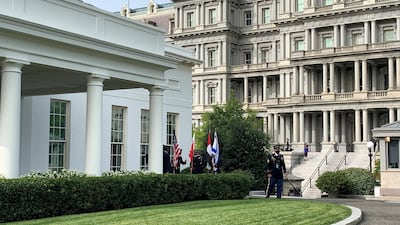
Preparations at the White House for the signing of the Abraham Accord. -
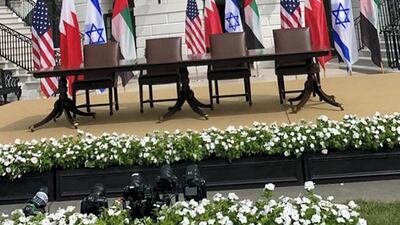
Preparations under way at the White House for the signing of the Abraham Accord. -
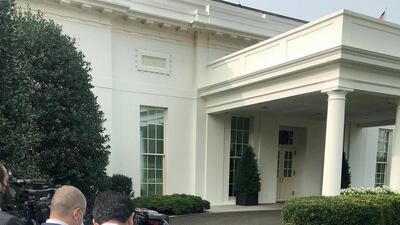
Preparations under way at the White House for the signing of the Abraham Accord. -

Preparation at the White House for the signing of the Abraham Accord. The National


I hope Israel and the entire Arab world can build on the agreements to work towards a durable two-state solution that delivers peace, justice and security to Palestinians and Israelis alike.
As a precondition, though, it is important that unilateral and illegal moves such as the “annexation” of swathes of occupied Palestinian land, as recently proposed by Israel’s Prime Minister Benjamin Netanyahu, are rejected as a matter of principle and practice.
In 1945, it seemed as if the world had finally learned the lessons of two disastrous world wars. The United Nations was created, in the words of its Charter, to “save the world from the scourge of war” and pursue peaceful and inclusive paths to global prosperity and democracy.
Cynics argue that the fact that war, inequality, discrimination and poverty have not been vanquished over the past 75 years means that the UN is a costly failure. I vehemently disagree.
The network of international covenants and institutions agreed and constructed since 1945, with the United Nations at its core, is far from perfect. But it has nevertheless decisively supported the pursuit of peace, security and the protection of human rights, as well as economic and social improvements, around the globe, for over seven decades.

This is why The Elders – the group of independent global leaders founded by Nelson Mandela to work for peace, justice and human rights, of which I have the honour to be Deputy Chair – released a new report on defending multilateralism in June 2020 on the 75th anniversary of the signing of the UN Charter, with five calls to action for today's leaders: recommit to the values of the UN Charter; empower the UN to fulfil its mandate for collective action on peace and security; strengthen health systems to tackle Covid-19 and prepare for future pandemics; show greater ambition on climate change to meet the Paris Agreement targets; and mobilise support for the entirety of the Sustainable Development Goals.
All nations need to recognise that effective multilateralism is in all their interests to meet these goals, regardless of size or strength.

Where the UN has failed, this has been because member states – particularly but not exclusively the five permanent members of the Security Council – have not lived up to their responsibilities, and have placed their narrow national interests above common priorities.
I welcomed the unanimous adoption of UN Security Council resolution 2532 in July 2020, which called for a global humanitarian ceasefire to avert further humanitarian catastrophes in the context of the pandemic. I strongly supported this initiative by Secretary General Guterres when he first raised it in May. However, valuable months were wasted in arguments over the details of the text.
Squabbles over semantics in the face of bloody conflicts and an unprecedented pandemic sent a terrible signal to the world’s public, and I fear that without a radical and urgent change of political mindset, certain member states risk weakening the overall credibility of the UN precisely when it is most needed.
Unfortunately, we are still in the early stages of this pandemic. Beyond the direct health effects, the economic impacts will be both long-lasting and severe, with ripple effects for many fragile and conflict-affected states.
The World Food Programme has warned of the world’s worst humanitarian crisis since the Second World War, with 600,000 children likely to die from famine and malnutrition in the coming months in the worst-affected countries like Yemen, Somalia, Nigeria and South Sudan.
Prosperous, stable and highly-developed countries like the UAE are uniquely positioned to help the world “build back better” from Covid-19 and increase ambition in the face of other existential threats such as climate change. They can also use their influence to ensure that the roots of conflict in the region are addressed, not just the symptoms.
The virus is a sombre reminder of our common human bonds and vulnerabilities. We will dishonour its victims unless we respond to the pandemic and other shared threats with a renewed sense of solidarity and collective action.
Ban Ki-moon is Deputy Chair of The Elders and served as the eighth Secretary General of the United Nations

