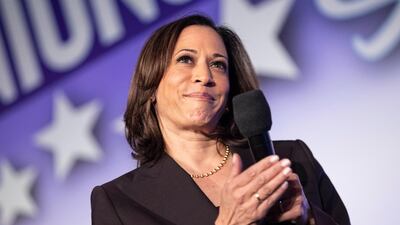
Democratic vice presidential candidate Senator Kamala Harris during the third day of the Democratic National Convention, August 19, in Delaware, US. Carolyn Kaster / AP

Kamala Harris and the complexity of racial identity


  • English
  • Arabic

It has taken a Kamala Harris – half Jamaican, half Indian and by her own definition, all American – to show the United States and the world that race isn’t a black or white issue and there are grey areas in our understanding of identity.

That we are coming to this realisation only now, in 2020, is somewhat surprising. It has been two decades since the US Census Bureau allowed people to self-identify with more than one race when completing their census form. Back in 2015, a Pew Research Centre survey estimated that 6.9 per cent of America’s population was multi-racial. In 2008, the US got its first multi-racial president in Barack Obama, son of a white woman from Kansas and a black man from Kenya. And yet, it is Ms Harris who is seen to embody an explicitly multi-racial reality.

One might well wonder why and what it says about America. A couple of things at the outset. First, Americans, like much of the world, want to be able to easily label people by race.

Mr Obama’s black-white parentage meant he was automatically classified as “black” in the eyes of Americans, even though he is half-white. This was in line with the so-called “one-drop rule,” a social mechanism that once had legal status in some American states and which regards anyone with a trace of African ancestry as black.

But Ms Harris represents a conundrum because her heritage is Indian and Caribbean. Like Mr Obama, she could be labelled black under the one-drop rule and she has, in fact, long been seen as, and self-identified as a black woman.

However, the historic nature of her nomination for vice-president has thrown the Indian-American half of her identity into the foreground, not least her name (Kamala, meaning lotus in Hindi and Devi, meaning goddess), the strength of her ties to family in India, her memories of the Indian meals at home and her rudimentary knowledge of Tamil.

To complicate the matter, there is Ms Harris’s Oakland, California birth certificate from 1964. It records her mother, Shyamala Gopalan’s “colour or race” as Caucasian, the only option available to Indian-Americans at the time.

Assignment of identity continues to remain as bitterly contested as the assertion of it

In itself, Ms Harris’s birth certificate illustrates the rigid black-white binary that has long structured much of the discussion around identity in the US, as well as the country's political and social policy.

As a close friend of her mother recently said of Ms Harris: “Her mother was Indian but in the ’60s, you were either black or white.” With her new political prominence though, Ms Harris is laying claim to two important American communities – black and South Asian – and this raises fraught questions about who she really is and what a multi-racial identity really means.

This brings us to the second point about racial and ethnic identity. It is mostly, sociologists argue, formed by the interaction between assignment and assertion. Assignment refers to what others say a person is. Assertion is who or what that person claims to be.

  • Democratic candidate for Presidency and Senator, Kamala Harris delivers a speech during SEIU's Unions for All summit in Los Angeles, California, USA, in October 2019. EPA
    Democratic candidate for Presidency and Senator, Kamala Harris delivers a speech during SEIU's Unions for All summit in Los Angeles, California, USA, in October 2019. EPA
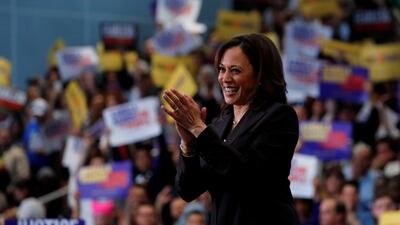
  • Senator Kamala Harris holds her first organizing event in Los Angeles as she campaigns in the 2020 Democratic presidential nomination race in Los Angeles, California, US, May 19, 2019. REUTERS
    Senator Kamala Harris holds her first organizing event in Los Angeles as she campaigns in the 2020 Democratic presidential nomination race in Los Angeles, California, US, May 19, 2019. REUTERS
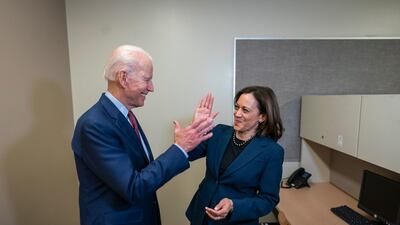
  • Former US Vice President and presumptive Democratic candidate for President Joe Biden with California Senator Kamala Harris, released after the campaign announced that Biden has chosen Kamala Harris as his vice presidential running mate. EPA/BIDEN CAMPAIGN /
    Former US Vice President and presumptive Democratic candidate for President Joe Biden with California Senator Kamala Harris, released after the campaign announced that Biden has chosen Kamala Harris as his vice presidential running mate. EPA/BIDEN CAMPAIGN /
  • The two are scheduled to appear together at an event in Wilmington, Delaware, USA, on 12 August 2020. AP
    The two are scheduled to appear together at an event in Wilmington, Delaware, USA, on 12 August 2020. AP
  • Biden on August 11, 2020, named Harris, a black US senator from California, as his choice for vice president, capping a months-long search for a Democratic partner to challenge President Donald Trump in November. AFP
    Biden on August 11, 2020, named Harris, a black US senator from California, as his choice for vice president, capping a months-long search for a Democratic partner to challenge President Donald Trump in November. AFP
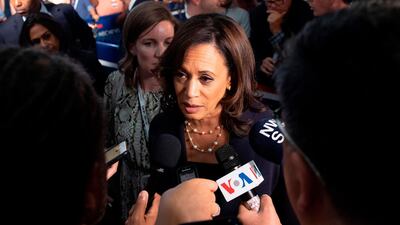
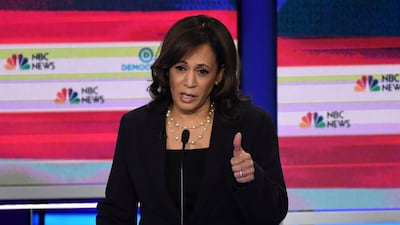
  • US Senator for California Kamala Harris speaks during the second Democratic primary debate of the 2020 presidential campaign season at the Adrienne Arsht Center for the Performing Arts in Miami, Florida. AFP
    US Senator for California Kamala Harris speaks during the second Democratic primary debate of the 2020 presidential campaign season at the Adrienne Arsht Center for the Performing Arts in Miami, Florida. AFP
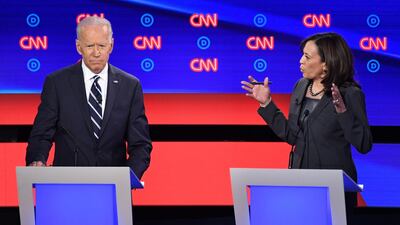
  • Democrats Joe Biden and Kamala Harris speak during the second round of the second Democratic primary debate of the 2020 presidential campaign season at the Fox Theatre in Detroit, Michigan. AFP
    Democrats Joe Biden and Kamala Harris speak during the second round of the second Democratic primary debate of the 2020 presidential campaign season at the Fox Theatre in Detroit, Michigan. AFP
  • Kamala Harris addresses Presidential Forum the NAACP's 110th National Convention at Cobo Center in Detroit, Michigan. AFP
    Kamala Harris addresses Presidential Forum the NAACP's 110th National Convention at Cobo Center in Detroit, Michigan. AFP

Unlike Mr Obama, whose first memoir documented his agonising quest for identity, Ms Harris has always denied any soul-searching over issues of race, ethnicity and how to categorise herself. The dissonance between the two is odd because both belong to the same generation – at 55, Ms Harris is just four years younger than Mr Obama.

Even so, last year, she recalled her first run for public office in the early 2000s as a constant struggle with having “to define yourself in a way that you fit neatly into the compartment that other people have created.” She added a blunt and assertive response to the issue. “My point was: I am who I am. I’m good with it. You might need to figure it out, but I’m fine with it.”

Many are clearly struggling to figure it out. Some prominent members of the Indian-American political community have been acerbic about Ms Harris’s public embrace of the black part of her ethnicity all these years, rather than the Indian. Equally, some black voters are debating whether Ms Harris is “black enough” or in fact, really black at all because she has not descended from slaves in America.

Last February, when Ms Harris was running for the Democratic Party’s presidential nomination, black American TV journalist Don Lemon challenged her self-categorisation with a withering reference to the racial segregation laws that relegated African-Americans to second-class citizens. “Jamaica is not America,” he said, in a dismissive nod to Ms Harris’s father’s pedigree, “Jamaica did not come out of Jim Crow. I’m just saying.”

Evidently, assignment of identity continues to remain as bitterly contested as the assertion of it. This was last apparent when Meghan Markle became the first multi-racial woman to join the British royal family. The British press saw Ms Markle as black; she described herself as bi-racial, stressing both the black and white halves of her heritage.

But it is Ms Harris’s predicament that may be the most telling. She has offered a sharp riposte to all the questioning: “I kinda feel like that’s their problem, not mine”. But Diana Sanchez, a scholar of multi-racial identity at Rutgers University, says Ms Harris is faced with a situation fairly typical for mixed-race people. They are routinely subject to subtle aggression because “people have trouble putting multiracial people in a box”.

Should they be put in a box? Why deny the organic breakdown of binary racial categories? Multi-racialism is increasingly colouring Britain and the US.

In Singapore, inter-ethnic marriages are rising, from just 7.6 per cent of all marriages in 1990 to 21.5 per cent in 2015. In Brazil, where European, African and indigenous populations have long been mixing, the 2010 census found some 43 per cent of the population identifying as ‘pardo’, or mixed-race.

Soon after Donald Trump’s inauguration as President, a multi-racial American writer noted the revivifying aspects of “being mixed”. Your background, he said, “pushes you to construct a worldview that transcends the tribal”.

That can only be good.

Rashmee Roshan Lall is a columnist for The National

Our legal consultant

Name: Hassan Mohsen Elhais

Position: legal consultant with Al Rowaad Advocates and Legal Consultants.

POSSIBLE ENGLAND EURO 2020 SQUAD

Goalkeepers: Jordan Pickford, Nick Pope, Dean Henderson.
Defenders: Trent Alexander-Arnold, Kieran Trippier, Joe Gomez, John Stones, Harry Maguire, Tyrone Mings, Ben Chilwell, Fabian Delph.
Midfielders: Declan Rice, Harry Winks, Jordan Henderson, Ross Barkley, Mason Mount, Alex Oxlade-Chamberlain.
Forwards: Harry Kane, Raheem Sterling, Marcus Rashford, Jadon Sancho, Tammy Abraham, Callum Hudson-Odoi.

What are NFTs?

Are non-fungible tokens a currency, asset, or a licensing instrument? Arnab Das, global market strategist EMEA at Invesco, says they are mix of all of three.

You can buy, hold and use NFTs just like US dollars and Bitcoins. “They can appreciate in value and even produce cash flows.”

However, while money is fungible, NFTs are not. “One Bitcoin, dollar, euro or dirham is largely indistinguishable from the next. Nothing ties a dollar bill to a particular owner, for example. Nor does it tie you to to any goods, services or assets you bought with that currency. In contrast, NFTs confer specific ownership,” Mr Das says.

This makes NFTs closer to a piece of intellectual property such as a work of art or licence, as you can claim royalties or profit by exchanging it at a higher value later, Mr Das says. “They could provide a sustainable income stream.”

This income will depend on future demand and use, which makes NFTs difficult to value. “However, there is a credible use case for many forms of intellectual property, notably art, songs, videos,” Mr Das says.

MATCH INFO

Liverpool 4 (Salah (pen 4, 33', & pen 88', Van Dijk (20')

Leeds United 3 (Harrison 12', Bamford 30', Klich 66')

Man of the match Mohamed Salah (Liverpool)

Mercer, the investment consulting arm of US services company Marsh & McLennan, expects its wealth division to at least double its assets under management (AUM) in the Middle East as wealth in the region continues to grow despite economic headwinds, a company official said.

Mercer Wealth, which globally has $160 billion in AUM, plans to boost its AUM in the region to $2-$3bn in the next 2-3 years from the present $1bn, said Yasir AbuShaban, a Dubai-based principal with Mercer Wealth.

Within the next two to three years, we are looking at reaching $2 to $3 billion as a conservative estimate and we do see an opportunity to do so,” said Mr AbuShaban.

Mercer does not directly make investments, but allocates clients’ money they have discretion to, to professional asset managers. They also provide advice to clients.

“We have buying power. We can negotiate on their (client’s) behalf with asset managers to provide them lower fees than they otherwise would have to get on their own,” he added.

Mercer Wealth’s clients include sovereign wealth funds, family offices, and insurance companies among others.

From its office in Dubai, Mercer also looks after Africa, India and Turkey, where they also see opportunity for growth.

Wealth creation in Middle East and Africa (MEA) grew 8.5 per cent to $8.1 trillion last year from $7.5tn in 2015, higher than last year’s global average of 6 per cent and the second-highest growth in a region after Asia-Pacific which grew 9.9 per cent, according to consultancy Boston Consulting Group (BCG). In the region, where wealth grew just 1.9 per cent in 2015 compared with 2014, a pickup in oil prices has helped in wealth generation.

BCG is forecasting MEA wealth will rise to $12tn by 2021, growing at an annual average of 8 per cent.

Drivers of wealth generation in the region will be split evenly between new wealth creation and growth of performance of existing assets, according to BCG.

Another general trend in the region is clients’ looking for a comprehensive approach to investing, according to Mr AbuShaban.

“Institutional investors or some of the families are seeing a slowdown in the available capital they have to invest and in that sense they are looking at optimizing the way they manage their portfolios and making sure they are not investing haphazardly and different parts of their investment are working together,” said Mr AbuShaban.

Some clients also have a higher appetite for risk, given the low interest-rate environment that does not provide enough yield for some institutional investors. These clients are keen to invest in illiquid assets, such as private equity and infrastructure.

“What we have seen is a desire for higher returns in what has been a low-return environment specifically in various fixed income or bonds,” he said.

“In this environment, we have seen a de facto increase in the risk that clients are taking in things like illiquid investments, private equity investments, infrastructure and private debt, those kind of investments were higher illiquidity results in incrementally higher returns.”

The Abu Dhabi Investment Authority, one of the largest sovereign wealth funds, said in its 2016 report that has gradually increased its exposure in direct private equity and private credit transactions, mainly in Asian markets and especially in China and India. The authority’s private equity department focused on structured equities owing to “their defensive characteristics.”

LILO & STITCH

Starring: Sydney Elizebeth Agudong, Maia Kealoha, Chris Sanders

Director: Dean Fleischer Camp

Rating: 4.5/5

Captain Marvel

Director: Anna Boden, Ryan Fleck

Starring: Brie Larson, Samuel L Jackson, Jude Law,  Ben Mendelsohn

4/5 stars

What are the influencer academy modules?
  1. Mastery of audio-visual content creation. 
  2. Cinematography, shots and movement.
  3. All aspects of post-production.
  4. Emerging technologies and VFX with AI and CGI.
  5. Understanding of marketing objectives and audience engagement.
  6. Tourism industry knowledge.
  7. Professional ethics.