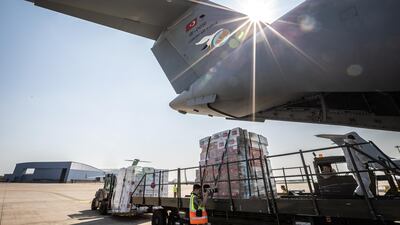
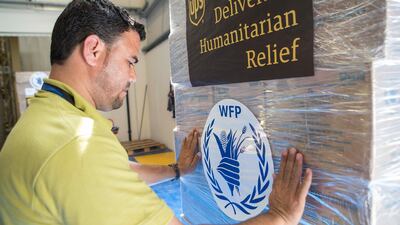
• A staff member of the World Food Programme checks boxes that arrived, mostly personal protective equipment (PPE), at Ethiopian Airlines' cargo facility at the Bole International Airport in Addis Ababa, Ethiopia, on April 14. Samuel Habtab / AFP
    A staff member of the World Food Programme checks boxes that arrived, mostly personal protective equipment (PPE), at Ethiopian Airlines' cargo facility at the Bole International Airport in Addis Ababa, Ethiopia, on April 14. Samuel Habtab / AFP
  • A girl waits outside her home in Cairo to see if she and her family will get a carton filled with food from the non-governmental organisation Resala Nour Ala Nour. Nariman El-Mofty / AFP
    A girl waits outside her home in Cairo to see if she and her family will get a carton filled with food from the non-governmental organisation Resala Nour Ala Nour. Nariman El-Mofty / AFP
  • An Egyptian worker distributes food boxes by the Egyptian Food Bank to people who have lost their jobs due to the pandemic, in New Cairo, Egypt. Khaled Elfiqi / EPA
    An Egyptian worker distributes food boxes by the Egyptian Food Bank to people who have lost their jobs due to the pandemic, in New Cairo, Egypt. Khaled Elfiqi / EPA
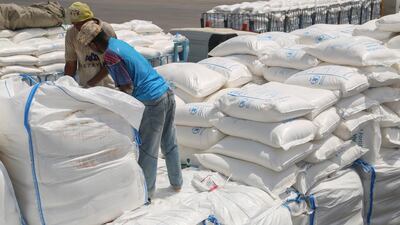
  • A security force member stands guard as women line up to receive rations distributed by the World Food Programme in Herat, Afghanistan, 31 March. Jalil Rezayee / EPA
    A security force member stands guard as women line up to receive rations distributed by the World Food Programme in Herat, Afghanistan, 31 March. Jalil Rezayee / EPA
  • Rohingya refugees at the Kutupalong refugee camp in Cox’s Bazar, Bangladesh. Aid workers are bracing for a possible outbreak of coronavirus in one of the world's largest refugee camps in Bangladesh. Officials warn that containing the disease among more than one million tightly packed Rohingya Muslims will be a daunting task. Suzauddin Rubel / AP
    Rohingya refugees at the Kutupalong refugee camp in Cox’s Bazar, Bangladesh. Aid workers are bracing for a possible outbreak of coronavirus in one of the world's largest refugee camps in Bangladesh. Officials warn that containing the disease among more than one million tightly packed Rohingya Muslims will be a daunting task. Suzauddin Rubel / AP
  • Palestinian workers at the United Nation Relief and Works Agency prepare rations for refugee families at Al Shatea refugee camp, Gaza City. Mohammed Saber / EPA
    Palestinian workers at the United Nation Relief and Works Agency prepare rations for refugee families at Al Shatea refugee camp, Gaza City. Mohammed Saber / EPA
  • A volunteer prepares boxes with food and other basic goods at the Montessori School grounds in Nairobi, Kenya. The boxes will be delivered in the slums to people affected by the measures adopted by the Kenyan Government to stop the spread of Covid-19. Luis Tato / AFP
    A volunteer prepares boxes with food and other basic goods at the Montessori School grounds in Nairobi, Kenya. The boxes will be delivered in the slums to people affected by the measures adopted by the Kenyan Government to stop the spread of Covid-19. Luis Tato / AFP
  • Boxes with food and other basic goods that are delivered to people in Nairobi's slums affected by the measures adopted by the Kenyan Government to stop the spread of Covid-19, March 28. Luis Tato / AFP
    Boxes with food and other basic goods that are delivered to people in Nairobi's slums affected by the measures adopted by the Kenyan Government to stop the spread of Covid-19, March 28. Luis Tato / AFP
  • Aid boxes prepared by a volunteer to be delivered in the slums in Nairobi, Kenya on March 28. Luis Tato / AFP
    Aid boxes prepared by a volunteer to be delivered in the slums in Nairobi, Kenya on March 28. Luis Tato / AFP

Coronavirus knows no borders, and neither should the response


  • English
  • Arabic

The notion of our vast world as a "global village" has perhaps never before had such resonance. What began as a localised outbreak of a novel virus, has in mere weeks become a pandemic of unprecedented proportions.

Covid-19 is the very definition of a crisis in a globalised world; its spread rapid and wide-reaching, its impacts profound and interconnected.

Countries are containing the virus by testing, treating and tracing, by limiting travel and imposing quarantine measures. But it continues onwards like a wave – one that may crash on those least able to withstand it.

As I write, 210 countries have reported cases, over 128,000 people have lost their lives, infections have tipped 2 million, societies are in turmoil and economies at a standstill.

Such an extraordinary challenge requires an extraordinary response; decisive, bold, and – above all – collective and grounded in solidarity with the whole of humanity as we weather this storm together.

Covid-19 is the defining public health crisis of our time, but it is fast becoming much more. By challenging every country and community it impacts, it has the potential to create devastating social, economic and political consequences that may leave deep scars.

In a previous column, I explained why when food security is threatened, so too are stability and prosperity. As the full effect of Covid-19 across the world unfolds, we are truly in uncharted territory.

We have already witnessed how it is blind to national borders, race, ethnicity or economic strength.

We have seen how the world’s most developed nations, with unrivalled capacities to endure the challenge and safeguard domestic populations, have struggled to confront it.

Although the impact of the pandemic has only just begun to reveal itself in the world’s so-called “developing” nations, there is good reason to believe that they will be disproportionately affected.

Already dealing with economic shocks, conflict and the effects of climate change, these countries will have to face devastating consequences. Consequences that will impact all aspects of life – starting with food insecurity, as the most basic of needs.

Entering 2020, the number of hungry people around the world was already on the rise.

Today, over 800 million people face chronic undernourishment and 100 million are in need of life-saving food assistance.

The world has long produced more than enough food to feed its over 7 billion inhabitants

Covid-19 risks undermining efforts to reverse this trend.

Why?

To begin, communities in the “developing” world tend to live in closer proximity to one another, complicating social distancing and massively increasing the risk of spread.

A higher proportion of people suffer from pre-existing health problems that render them more vulnerable to the disease.

As everywhere, stay-at-home measures and other necessary restrictions will mean lost production, lost employment and lost income.

But for people already living hand-to-mouth and with limited access to savings, credit or the already-overstretched social safety net programmes, this can be the difference between securing a meal and going hungry.

Governments in these countries cannot replicate the stimulus responses of their "developed" counterparts. They face fewer and harder choices when confronted with the pandemic and its multitude of impacts. Health systems are weaker and ill prepared for a crisis of this kind.

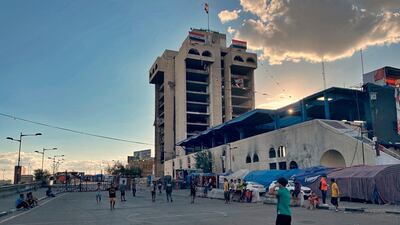
  • Despite a curfew imposed by the government to help fight the spread of the coronavirus, anti-government protesters play football in Tahrir Square, Baghdad, Iraq. AP Photo
    Despite a curfew imposed by the government to help fight the spread of the coronavirus, anti-government protesters play football in Tahrir Square, Baghdad, Iraq. AP Photo
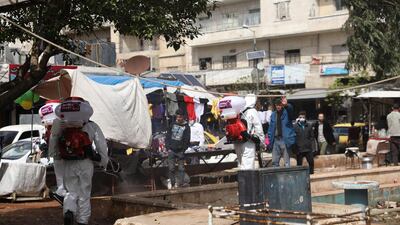
  • Volunteers from 'Violet Organisation', a local non government organisation, wear personal protective equipment during a disinfection operation in Idlib, Syria. EPA
    Volunteers from 'Violet Organisation', a local non government organisation, wear personal protective equipment during a disinfection operation in Idlib, Syria. EPA
  • Iranians, some wearing personal protective equipment, walk past shops in the southeastern city of Kerman, Iran. AFP
    Iranians, some wearing personal protective equipment, walk past shops in the southeastern city of Kerman, Iran. AFP
  • Anti-government protesters stand in Tahrir Square, Baghdad during anti-government protests. AP Photo
    Anti-government protesters stand in Tahrir Square, Baghdad during anti-government protests. AP Photo
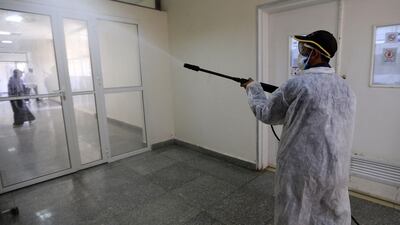
  • A man sprays disinfectant at the Central Health Laboratory in the Yemeni capital Sanaa. AFP
    A man sprays disinfectant at the Central Health Laboratory in the Yemeni capital Sanaa. AFP
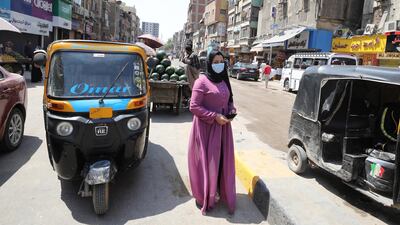
  • An Egyptian woman wearing a face mask walks at Bolaq district in Giza, Egypt. EPA
    An Egyptian woman wearing a face mask walks at Bolaq district in Giza, Egypt. EPA
  • Egyptians at a local market in the Bolaq district in Giza, Egypt. EPA
    Egyptians at a local market in the Bolaq district in Giza, Egypt. EPA
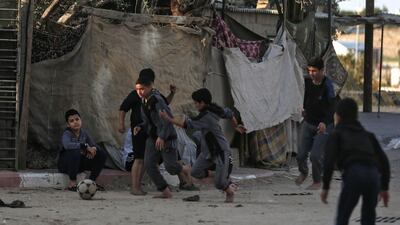
  • Palestinian children play football at a refugee camp in Khan Yunis in the southern Gaza Strip. AFP
    Palestinian children play football at a refugee camp in Khan Yunis in the southern Gaza Strip. AFP
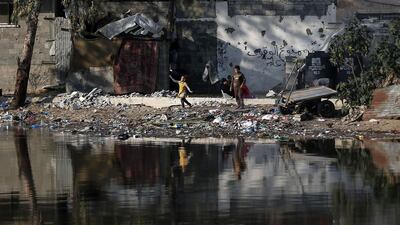
  • Palestinian childen play in an impoverished neighbourhood in Gaza city. AFP
    Palestinian childen play in an impoverished neighbourhood in Gaza city. AFP
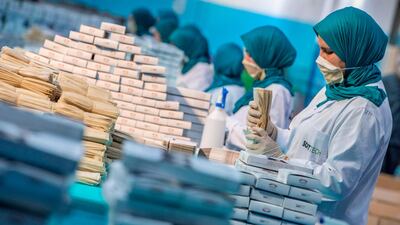
  • Factory workers package disposable protective masks along a production line in Morocco's Casablanca, as the North African country increases mask production due to the coronavirus pandemic. AFP
    Factory workers package disposable protective masks along a production line in Morocco's Casablanca, as the North African country increases mask production due to the coronavirus pandemic. AFP
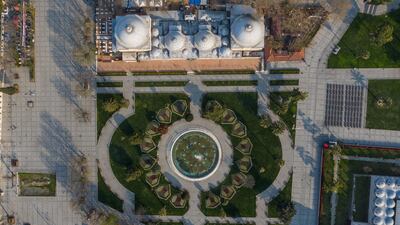
  • Sultanahmet Square and the surrounding gardens are empty during a two-day lockdown imposed to prevent the spread of coronavirus in Istanbul, Turkey. Getty
    Sultanahmet Square and the surrounding gardens are empty during a two-day lockdown imposed to prevent the spread of coronavirus in Istanbul, Turkey. Getty
  • Crucial supplies of personal protective equipment (PPE) for medical staff are delivered from Turkey into a Royal Air Force base for distribution around the country, in Carterton, Britain. Reuters
    Crucial supplies of personal protective equipment (PPE) for medical staff are delivered from Turkey into a Royal Air Force base for distribution around the country, in Carterton, Britain. Reuters

Economies depend largely on imports of staple foods to ensure the food security of their populations. Already, Covid-19 related containment measures have started to make it more challenging to move food from the world’s breadbaskets to where it is consumed.

If additional restrictions are imposed on exports and major supply routes close or slow down, food may not reach where it is needed and prices may rise.

We saw during the 2007-2008 global financial crisis how inflation can hit developing countries and their populations hardest; particularly as poor families spend a higher proportion of their income on food.

Global food markets are still well supplied and prices remain stable as I write this. We know that the world has long produced more than enough food to feed its almost eight billion inhabitants. What happens next depends in large measure on how the world responds.

Volunteers deliver aid at a camp for displaced Syrians near the town of Deir al-Ballut, by the border with Turkey, in northwest Syria, April 14. Rami al Sayed/ AFP

Many before me have observed that Covid-19 may be the greatest test to humanity since World War Two, but it is a test of a very different nature.

While nations of the world have long focused on protecting themselves against known enemies, we may have neglected to prepare for an invisible adversary to all of humankind.

If nothing else, this pandemic should remind us that we are all equal as citizens of the world and this is why any effort to confront its human and economic costs must be truly global in design and application.

It may be hard to think of the world at this time when so many of us are feeling the immediate, painful impact of the pandemic. But think of the world we must. For, as long as Covid-19 rages somewhere it is a threat everywhere.

As long as people suffer its direct and indirect consequences in the world's most vulnerable corners, those consequences will affect all of us. The crisis knows no borders, neither should the response.

Here, at the United Nations World Food Programme (WFP) we are working tirelessly to do our part. We are closely monitoring trends in food security, health access and markets around the world and are sharing that information widely to support global decision-making.

  • The World Food Programme loads trucks with food and supplies in response to the drought in Somalia at the International Humanitarian City Warehouses in Dubai. Antonie Robertson / The National
    The World Food Programme loads trucks with food and supplies in response to the drought in Somalia at the International Humanitarian City Warehouses in Dubai. Antonie Robertson / The National
  • Displaced Yemenis receive humanitarian aid, donated by the World Food Programme (WFP) in cooperation with the Danish Refugee Council ( DRC), in the northern province of Hajjah on December 30, 2019. AFP
    Displaced Yemenis receive humanitarian aid, donated by the World Food Programme (WFP) in cooperation with the Danish Refugee Council ( DRC), in the northern province of Hajjah on December 30, 2019. AFP
  • Yemenis receive sacks of food aid packages from the World Food Programme in the Yemeni port city of Hodeida on June 25, 2019. AFP
    Yemenis receive sacks of food aid packages from the World Food Programme in the Yemeni port city of Hodeida on June 25, 2019. AFP
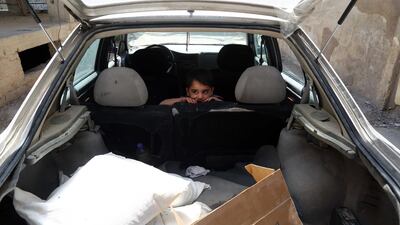
  • A Syrian boy sits in a car after his family received from the local council aid parcels provided by the UN World Food Programme and the Syrian Arab Red Crescent on May 11, 2016, in the rebel-held village of Saqba, on the eastern outskirts of the capital Damascus. AFP
    A Syrian boy sits in a car after his family received from the local council aid parcels provided by the UN World Food Programme and the Syrian Arab Red Crescent on May 11, 2016, in the rebel-held village of Saqba, on the eastern outskirts of the capital Damascus. AFP
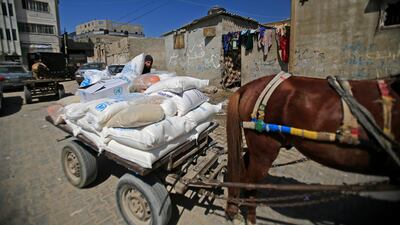
  • A Palestinian loads a cart with aid food provided by the UN's World Food Programme and its agency for Palestinian refugees, UNRWA, in the Gaza Strip's al-Shati refugee camp on May 15, 2019. AFP
    A Palestinian loads a cart with aid food provided by the UN's World Food Programme and its agency for Palestinian refugees, UNRWA, in the Gaza Strip's al-Shati refugee camp on May 15, 2019. AFP
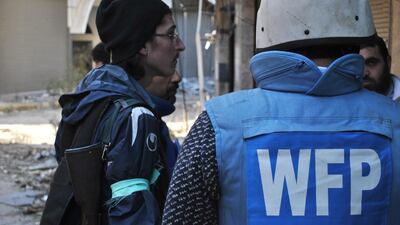
  • A United Nations World Food Programme worker talks to rebel fighters on February 8, 2014 on the second day of a humanitarian mission in a besieged district of the central city of Homs, Syria. AFP
    A United Nations World Food Programme worker talks to rebel fighters on February 8, 2014 on the second day of a humanitarian mission in a besieged district of the central city of Homs, Syria. AFP
  • The World Food Programme loads trucks with food and supplies in response to the drought in Somalia at the International Humanitarian City Warehouses in Dubai. Antonie Robertson / The National
    The World Food Programme loads trucks with food and supplies in response to the drought in Somalia at the International Humanitarian City Warehouses in Dubai. Antonie Robertson / The National
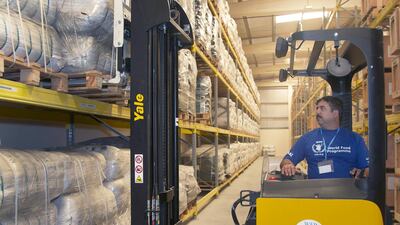
  • Ali Goahr, a forklift operator for the United Nations World Food Programme, moves blankets in the World Food Programme Warehouse in International Humanitarian City, Dubai. Kevin J. Larkin / The National
    Ali Goahr, a forklift operator for the United Nations World Food Programme, moves blankets in the World Food Programme Warehouse in International Humanitarian City, Dubai. Kevin J. Larkin / The National

As the logistics backbone of the humanitarian community, we are rolling out essential support services so that humanitarian and health workers on the frontlines of the Covid-19 pandemic are able to stay and deliver.

We are establishing humanitarian hubs to facilitate the dispatch of essential cargo, setting up air transport links, contracting charter vessels and providing passenger air and Medevac services for humanitarian and health staff.

Right here in the UAE – where WFP is generously hosted at Dubai's International Humanitarian City and runs the biggest of its six United Nations humanitarian response depots where it procures, stores and rapidly transports emergency supplies on behalf of the humanitarian community – we are readying our support. But we urgently need $350 million to do this.

We are working to sustain – and scale-up if necessary – our vital food assistance programmes which already offer a lifeline to close to 100 million vulnerable people every year.

To do so, we are adapting our delivery mechanisms in the face of border closures, travel restrictions and supply chain complexities never seen before. It is a sobering reality that if the critical work of WFP cannot be carried out – if our supply chain breaks down or we do not receive the $1.9 billion we require to sustain operations for three months – some 150,000 people could lose their lives every day.

Ten short years away from 2030, the world has suffered a major setback in its quest to achieve the Sustainable Development Goals. Goals that were designed to embody a universally shared vision of a safe, just and sustainable world in which the whole of humanity thrives. At this critical moment in history, let us stand together again in this same spirit.

Many have remarked that life may never be the same after Covid-19 but I believe that by working together in solidarity we can build our "global village" back better.

Mageed Yahia is the Director of the United Nations World Food Programme Office in UAE and regional representative of the WFP in GCC

Essentials

The flights
Whether you trek after mountain gorillas in Rwanda, Uganda or the Congo, the most convenient international airport is in Rwanda’s capital city, Kigali. There are direct flights from Dubai a couple of days a week with RwandAir. Otherwise, an indirect route is available via Nairobi with Kenya Airways. Flydubai flies to Kinshasa in the Democratic Republic of Congo, via Entebbe in Uganda. Expect to pay from US$350 (Dh1,286) return, including taxes.
The tours
Superb ape-watching tours that take in all three gorilla countries mentioned above are run by Natural World Safaris. In September, the company will be operating a unique Ugandan ape safari guided by well-known primatologist Ben Garrod.
In the Democratic Republic of Congo, local operator Kivu Travel can organise pretty much any kind of safari throughout the Virunga National Park and elsewhere in eastern Congo.

%3Cp%3E%3Cstrong%3EDirector%3A%3C%2Fstrong%3E%20Nag%20Ashwin%3C%2Fp%3E%0A%3Cp%3E%3Cstrong%3EStarring%3A%20%3C%2Fstrong%3EPrabhas%2C%20Saswata%20Chatterjee%2C%20Deepika%20Padukone%2C%20Amitabh%20Bachchan%2C%20Shobhana%3C%2Fp%3E%0A%3Cp%3E%3Cstrong%3ERating%3A%20%3C%2Fstrong%3E%E2%98%85%E2%98%85%E2%98%85%E2%98%85%3C%2Fp%3E%0A
Washmen Profile

Date Started: May 2015

Founders: Rami Shaar and Jad Halaoui

Based: Dubai, UAE

Sector: Laundry

Employees: 170

Funding: about $8m

Funders: Addventure, B&Y Partners, Clara Ventures, Cedar Mundi Partners, Henkel Ventures

Sonchiriya

Director: Abhishek Chaubey

Producer: RSVP Movies, Azure Entertainment

Cast: Sushant Singh Rajput, Manoj Bajpayee, Ashutosh Rana, Bhumi Pednekar, Ranvir Shorey

Rating: 3/5

Sarfira

Director: Sudha Kongara Prasad

Starring: Akshay Kumar, Radhika Madan, Paresh Rawal 

Rating: 2/5

TOURNAMENT INFO

Women’s World Twenty20 Qualifier

Jul 3- 14, in the Netherlands
The top two teams will qualify to play at the World T20 in the West Indies in November

UAE squad
Humaira Tasneem (captain), Chamani Seneviratne, Subha Srinivasan, Neha Sharma, Kavisha Kumari, Judit Cleetus, Chaya Mughal, Roopa Nagraj, Heena Hotchandani, Namita D’Souza, Ishani Senevirathne, Esha Oza, Nisha Ali, Udeni Kuruppuarachchi

UAE central contracts

Full time contracts

Rohan Mustafa, Ahmed Raza, Mohammed Usman, Chirag Suri, Mohammed Boota, Sultan Ahmed, Zahoor Khan, Junaid Siddique, Waheed Ahmed, Zawar Farid

Part time contracts

Aryan Lakra, Ansh Tandon, Karthik Meiyappan, Rahul Bhatia, Alishan Sharafu, CP Rizwaan, Basil Hameed, Matiullah, Fahad Nawaz, Sanchit Sharma

Our legal columnist

Name: Yousef Al Bahar

Advocate at Al Bahar & Associate Advocates and Legal Consultants, established in 1994

Education: Mr Al Bahar was born in 1979 and graduated in 2008 from the Judicial Institute. He took after his father, who was one of the first Emirati lawyers

COMPANY%20PROFILE
%3Cp%3E%3Cstrong%3ECompany%3A%20%3C%2Fstrong%3EMascotte%20Health%3C%2Fp%3E%0A%3Cp%3E%3Cstrong%3EStarted%3A%20%3C%2Fstrong%3E2023%3C%2Fp%3E%0A%3Cp%3E%3Cstrong%3EBased%3A%20%3C%2Fstrong%3EMiami%2C%20US%3C%2Fp%3E%0A%3Cp%3E%3Cstrong%3EFounder%3A%3C%2Fstrong%3E%20Bora%20Hamamcioglu%3C%2Fp%3E%0A%3Cp%3E%3Cstrong%3ESector%3A%20%3C%2Fstrong%3EOnline%20veterinary%20service%20provider%3C%2Fp%3E%0A%3Cp%3E%3Cstrong%3EInvestment%20stage%3A%3C%2Fstrong%3E%20%241.2%20million%20raised%20in%20seed%20funding%3C%2Fp%3E%0A
DUNE%3A%20PART%20TWO
%3Cp%3E%3Cstrong%3EDirector%3A%3C%2Fstrong%3E%20Denis%20Villeneuve%3C%2Fp%3E%0A%3Cp%3E%3Cstrong%3EStarring%3A%3C%2Fstrong%3E%20Timothee%20Chamalet%2C%20Zendaya%2C%20Austin%20Butler%3C%2Fp%3E%0A%3Cp%3E%3Cstrong%3ERating%3A%3C%2Fstrong%3E%205%2F5%3C%2Fp%3E%0A
Tank warfare

Lt Gen Erik Petersen, deputy chief of programs, US Army, has argued it took a “three decade holiday” on modernising tanks. 

“There clearly remains a significant armoured heavy ground manoeuvre threat in this world and maintaining a world class armoured force is absolutely vital,” the general said in London last week.

“We are developing next generation capabilities to compete with and deter adversaries to prevent opportunism or miscalculation, and, if necessary, defeat any foe decisively.”

David Haye record

Total fights: 32
Wins: 28
Wins by KO: 26
Losses: 4

Other acts on the Jazz Garden bill

Sharrie Williams
The American singer is hugely respected in blues circles due to her passionate vocals and songwriting. Born and raised in Michigan, Williams began recording and touring as a teenage gospel singer. Her career took off with the blues band The Wiseguys. Such was the acclaim of their live shows that they toured throughout Europe and in Africa. As a solo artist, Williams has also collaborated with the likes of the late Dizzy Gillespie, Van Morrison and Mavis Staples.
Lin Rountree
An accomplished smooth jazz artist who blends his chilled approach with R‘n’B. Trained at the Duke Ellington School of the Arts in Washington, DC, Rountree formed his own band in 2004. He has also recorded with the likes of Kem, Dwele and Conya Doss. He comes to Dubai on the back of his new single Pass The Groove, from his forthcoming 2018 album Stronger Still, which may follow his five previous solo albums in cracking the top 10 of the US jazz charts.
Anita Williams
Dubai-based singer Anita Williams will open the night with a set of covers and swing, jazz and blues standards that made her an in-demand singer across the emirate. The Irish singer has been performing in Dubai since 2008 at venues such as MusicHall and Voda Bar. Her Jazz Garden appearance is career highlight as she will use the event to perform the original song Big Blue Eyes, the single from her debut solo album, due for release soon.

UPI facts

More than 2.2 million Indian tourists arrived in UAE in 2023
More than 3.5 million Indians reside in UAE
Indian tourists can make purchases in UAE using rupee accounts in India through QR-code-based UPI real-time payment systems
Indian residents in UAE can use their non-resident NRO and NRE accounts held in Indian banks linked to a UAE mobile number for UPI transactions

How%20to%20avoid%20getting%20scammed
%3Cul%3E%0A%3Cli%3ENever%20click%20on%20links%20provided%20via%20app%20or%20SMS%2C%20even%20if%20they%20seem%20to%20come%20from%20authorised%20senders%20at%20first%20glance%3C%2Fli%3E%0A%3Cli%3EAlways%20double-check%20the%20authenticity%20of%20websites%3C%2Fli%3E%0A%3Cli%3EEnable%20Two-Factor%20Authentication%20(2FA)%20for%20all%20your%20working%20and%20personal%20services%3C%2Fli%3E%0A%3Cli%3EOnly%20use%20official%20links%20published%20by%20the%20respective%20entity%3C%2Fli%3E%0A%3Cli%3EDouble-check%20the%20web%20addresses%20to%20reduce%20exposure%20to%20fake%20sites%20created%20with%20domain%20names%20containing%20spelling%20errors%3C%2Fli%3E%0A%3C%2Ful%3E%0A
WRESTLING HIGHLIGHTS
The years Ramadan fell in May

1987

1954

1921

1888

War

Director: Siddharth Anand

Cast: Hrithik Roshan, Tiger Shroff, Ashutosh Rana, Vaani Kapoor

Rating: Two out of five stars 

The five pillars of Islam
MATCH INFO

Champions League quarter-final, first leg

Tottenham Hotspur v Manchester City, Tuesday, 11pm (UAE)

Matches can be watched on BeIN Sports

Key facilities
  • Olympic-size swimming pool with a split bulkhead for multi-use configurations, including water polo and 50m/25m training lanes
  • Premier League-standard football pitch
  • 400m Olympic running track
  • NBA-spec basketball court with auditorium
  • 600-seat auditorium
  • Spaces for historical and cultural exploration
  • An elevated football field that doubles as a helipad
  • Specialist robotics and science laboratories
  • AR and VR-enabled learning centres
  • Disruption Lab and Research Centre for developing entrepreneurial skills