
The World Health Organisation’s decision-making assembly begins today at an inflection point in the pandemic. In this, the second year of the coronavirus crisis, there is little consensus about how to vaccinate richer and poorer countries in tandem.s
Though almost everyone agrees that no one is safe anywhere until everyone is safe everywhere, a bitter row is brewing over who gets what, when and how. Every week, there are calls for affluent countries to share their stash of pre-ordered vaccine doses with low- and middle-income countries and to prioritise the least vaccinated parts of the world over potential booster shots in the autumn for their own people or jabs for younger sections of their populations.
Unicef, the WHO, the IMF and the World Bank have each made a plea for a global vaccination effort that would spread the limited supplies of doses more widely.
Former Swedish prime minister Carl Bildt, special envoy for the WHO’s Access to Covid-19 Tools (ACT) Accelerator for equitable vaccine access, suggests that sharing demonstrates good global citizenship. “If the choice is vaccinating young people in Austria or Germany or Sweden, and vaccinating health workers in Africa (the latter should have) higher priority,” he says.
Another former prime minister, Britain's Gordon Brown, is urging the forthcoming G7 summit of leading industrial nations to underwrite the costs of producing and supplying vaccines to immunise poorer parts of the world, especially Africa.
It will not be charity, he argues, but an act of self-protection, because arresting the spread of the disease will prevent the virus from mutating and threatening the economic and psychological recovery of rich countries and their carefully vaccinated people.
-

People gather in Central Park in New York, US on May 22. After 16 months, New Yorkers can now enjoy a city where most restrictions have been lifted. AFP -

Stickers seen in Las Vegas, Nevada, US. AFP -
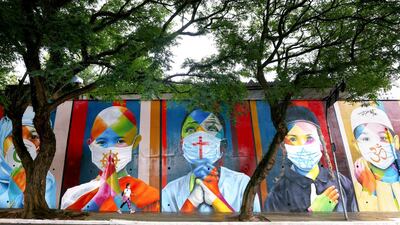
A mural by Brazilian artist Eduardo Kobra is dedicated to victims of the Covid-19, in Sao Paulo, Brazil, May 22. Covid-19 has now killed more than 1 million people in Latin America and the Caribbean. Getty -
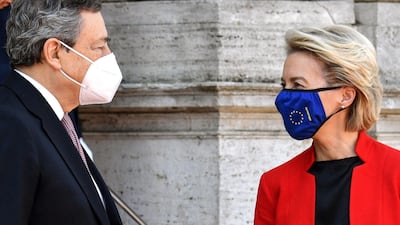
Italian Prime Minister Mario Draghi (L) and European Commission President Ursula von der Leyen talk upon arrival for the Global Health Summit at the Villa Doria Pamphili in Rome on May 21. AFP. -

Britain's Prince William receives his coronavirus vaccine in London, May 18. Kensington Palace via AP -

Two men from the Haredi Orthodox Jewish community at an event to encourage vaccine uptake in Britain's Haredi community at the John Scott Vaccination Centre in London, February 13. AP -
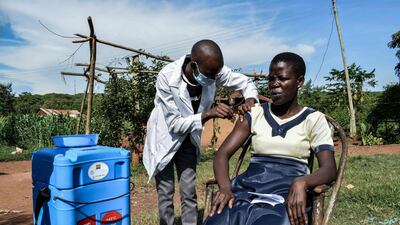
A medical health worker injects the Oxford/AstraZeneca Covid-19 vaccine to a woman as they visit door-to-door to deliver the vaccines to people who live far from health facilities in Siaya, Kenya, on May 18. AFP -

Malawi's Minister of Health Khumbize Chiponda, places Covid-19 vaccines in an incinerator, in Lilongwe, Malawi, May 19. Malawi has burned nearly 20,000 doses of AstraZeneca vaccines because they had expired. AP -
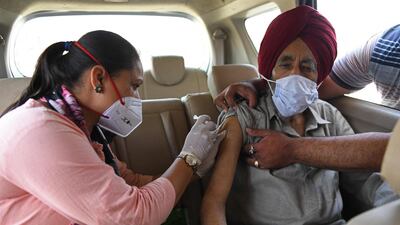
A health worker inoculates a man with a dose of the Covishield vaccine on the outskirts of Amritsar on May 24. AFP -
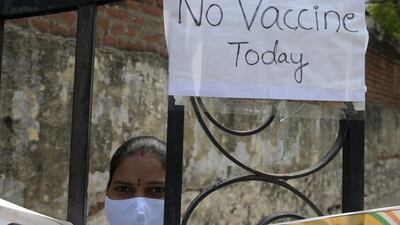
A notice at a primary health centre in Hyderabad on May 24, as India passed more than 300,000 deaths from coronavirus. AFP


All of this is true. The blistering pace of vaccination in the US and UK may be a singular triumph for those countries. Nearly half their populations have already received at least one dose, but what of sub-Saharan Africa, where little more than 1 per cent is protected from Covid-19?
As of May 23, Our World in Data, the international tracker that’s updated with official figures every day, showed 1.65 billion vaccinations worldwide, with the bulk of them in Asia (854.24 million), North America (340.83 million) and Europe (319.77 million).
Africa, a continent of 1.2 billion people, had vaccinated just 27.16 million, which leaves it stranded between Turkey (27.8 million) and Russia (26.42 million). Clearly, Africa is a long way off from the African Union's (AU) target of vaccinating 300 million people this year, not to speak of the mishandling that led to tens of thousands of vaccine shots being binned in Malawi and South Sudan.
This is a grim situation. As Yale professor and former World Bank Group chief economist Pinelopi Koujianou Goldberg recently noted, only universal vaccination can end the cycle of coronavirus misery.
But how to get there? Covax, the Covid-19 Vaccine Global Access scheme, planned to make two billion doses available to poorer countries by the end of 2021.
But the initiative, launched last year by the WHO, Gavi, the Vaccine Alliance, and the Coalition for Epidemic Preparedness Innovations, and paid for by advanced economies, has managed just 68 million doses, or 3.4 per cent of its target.
The shortage will only get worse because Covax was depending on the Serum Institute of India, the world’s largest vaccine manufacturer, to supply a third of this year’s planned doses. But India’s own spiralling coronavirus crisis has halted shipments for the remainder of 2021.
In the circumstances, it seemed to make sense for countries like India and South Africa to demand a waiver for Covid-19 vaccine patents. And for the US administration to declare its support for such a step, in the hope that the global manufacturing and distribution of vaccines can be accelerated. But the proposal has run into problems.
Germany, France and some other European governments are not keen, arguing that patent suspension would stifle future innovation. Pharmaceutical companies are aggrieved. Some experts argue fiercely against abrogating intellectual property protections, saying the basic challenges would remain, notably the need for know-how, technical and human expertise in the manufacture of complex biologic drugs like vaccines for Covid-19. In any case, the head of the World Trade Organisation says a vote on any waiver will not be held until December.
Even the vice-chancellor of Oxford University, which produces one of the first western vaccines with a commercial partner at cost, has said a patent waiver won’t be “a quick fix”. Louise Richardson explained that creating the necessary infrastructure for vaccine production involves profound political, commercial and logistical challenges, which makes it hard to see how a patent-waiver “could increase vaccine supply this year”.
The alternative, Ms Richardson suggests, is for manufacturers to do the same as AstraZeneca – that is, transfer technology and support to sites around the world “and contribute to the development of infrastructure in low- and middle-income countries”.
There are signs of a push along those lines. Last week’s global health summit in Rome, hosted by European Commission president Ursula von der Leyen and Italy’s prime minister Mario Drasghi, promised to boost Africa’s capacity to manufacture vaccines. This would complement an AU goal to supply 60 per cent of Africa’s routine vaccine needs from within the continent by 2040. It currently stands at just 1 per cent.
This is good news. South Africa has already produced its first batch of Johnson & Johnson doses for the coronavirus. In Senegal, the Institut Pasteur is working with France and the European Investment Bank to produce 300 million vaccines a year for Covid-19 from 2022. Algeria will make the Russian Sputnik vaccine from September. Egypt, Tunisia and Morocco already have experience making vaccines for yellow fever, tetanus and cholera. Ghana, Kenya, Nigeria and Ethiopia also have potential. Rwanda is trying to get two mRNA vaccine manufacturers to set up in the country.
The business case for such infrastructural investment is simple and goes beyond the pandemic. Childhood vaccines will always be needed, as will those for yellow fever, chikungunya, dengue and Zika.
Africa has much going for it, not least the new continent wide free-trade area, which came into force this year, creating a huge single market for vaccines.
That said, Africa too will need to do its bit. It has been many years since an African Medicines Agency was proposed as a regulatory and certifying authority for the continent but a treaty to establish this has not yet been ratified.
The pandemic’s human and economic costs on poorer parts of the world are immense but with effort on all sides, it may also force through long overdue change.
Rashmee Roshan Lall is a columnist for The National

