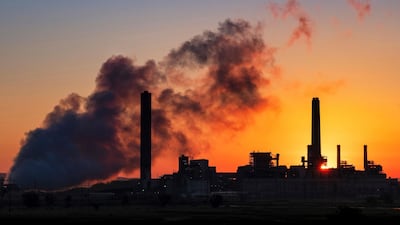
A coal-fired power plant in Wyoming, US. More than 300 businesses and investors are calling on the Biden administration to set a climate change goal to cut US greenhouse gas by at least 50% below 2005 levels by 2030. AP
A coal-fired power plant in Wyoming, US. More than 300 businesses and investors are calling on the Biden administration to set a climate change goal to cut US greenhouse gas by at least 50% below 2005

Do countries need a system to distinguish 'green' from 'greenwash'?


  • English
  • Arabic

Taxonomy, the author Bill Bryson once said, is sometimes described as a science and sometimes as an art, but really it is a battleground. European policymakers would probably agree as they struggle to label economic activity by means of an ambitious green “taxonomy”.

Just days ago, the European Commission published a second draft of its landmark classification system, but tellingly, it was incomplete. Europe remains divided over how to classify energy sources such as natural gas and nuclear power.

Those big, problematic issues have been shunted off to a later date, to be dealt with after the summer. But there is no guarantee of a quick resolution on what is green and what is not. Even the draft document’s inclusion of forestry and bioenergy as forms of green economic activity is controversial.

Thirteen months from the first version of its green taxonomy, the only classification Europe seems able to agree on is difficult. Does it even matter? Yes, in the sense that Europe’s labelling effort is the first by a leading regulatory body to create a green gold standard for investment.

Unlike the green bond catalogue issued by the People’s Bank of China in 2015, which is often referred to as China’s taxonomy, Europe’s version highlights climate change and specifies detailed measurements on carbon emissions. Europe’s taxonomy would also be more accessible than China’s.

Not too long ago, the Organisation for Economic Co-operation and Development noted that: “there is no official translation of the catalogue into English as yet”. Accordingly, a European benchmark for sustainable financial products would fill an obvious gap.

By setting out clear guidelines for green financial products, Europe would stamp out the tendency of funds and banks to “greenwash”. The taxonomy could greenlight the flow of billions of euros into financial products that help nurture the planet rather than poison it.

A 'fifty shades of green' approach has been suggested by the UN special envoy on climate action

At the very least, a green classification system would slow investment in economic activity that actively harms the environment and boosts sustainable finance in Europe. At full tilt, the green gold standard could serve as a global template for how to harness financial rules for environmental ends. After all, Britain, Canada and Mexico are each thinking of developing their own green taxonomy.

During his Brussels visit last month, US climate envoy John Kerry also expressed interest in developing sustainable finance standards for investors. However, as with data privacy, food safety and chemicals, Brussels could become the world’s de facto rule-setter on what counts as green simply by becoming the first to regulate.

But as things stand, the taxonomy remains a work in progress and there is no certainty of success. Germany and several eastern European countries are adamant that natural gas be included. France and the Czech Republic want nuclear technology. Finland and Sweden see the bioenergy fuels from forestry as important.

Environmental NGOs and groups such as the European Consumer Organisation are complaining that the taxonomy itself is becoming an exercise in greenwashing. And Mairead McGuinness, the EU commissioner for financial services, has been forced to admit that the bloc is trying to balance climate change science with “the real world” and that the taxonomy will continue to evolve.

Mairead McGuinness, financial services commissioner for the EU in Brussels, Belgium, on April 21. Bloomberg

None of this is particularly surprising. A lot is at stake, with the taxonomy set to cover 40 per cent of the EU economy. It is not just EU member states that are pushing their own interests, financial firms and trade groups are lobbying for weaker disclosure rules and carve-outs.

In the circumstances, it may be difficult to get the sort of clarity that asset managers might need to develop investment products in line with Environmental, Social and Corporate Governance criteria.

In that case, how credible would a green taxonomy be? Some experts say the intellectual tidiness of a taxonomy does not really suit issues around decarbonisation that are contentious, economically significant and often emotionally fraught. They have a point. Second-hand goods potentially illustrate the inherent problems in a system of rigid classification.

Eurefas, a newly formed European lobbying group, which seeks to represent companies that deal with refurbished products, is arguing that refurbished furniture, bicycles, computer or network hardware, pianos, toys and other consumer products promote the circular economy and should be part of the European Green Deal for climate neutrality in 2050. But what if a new product has a lower carbon footprint than the process of refurbishing something? In that case, would the refurb really be that green?

Instead of a green taxonomy, economist Mark Carney, currently UN special envoy on climate action, has suggested a “fifty shades of green” approach. This, he says, would encourage “the transition, to take things from brown towards green”. What this would mean is measuring a company’s green ambition against its transformative endeavours towards sustainability.

It would not be enough for a company to use carbon offsets – planting trees and suchlike – to compensate for emissions activities. It would also have to formulate and follow a plan for cutting those activities, embracing renewable energy sources and sustainable practices and eventually getting to carbon zero.

Water lilies in Limpio, Paraguay. Last year the Lagoon turned pink due to pollution generated by waste dropped by a tannery. After locals protested, the Paraguay government ordered the company to stop. Now the lagoon is regenerating naturally and the water has returned to its original colour. Getty

Such gradualism will not suit the impassioned, nor the purists, who demand immediate bold action. But there is much to be said for a broader, more creative view of how to move to decarbonisation.A good example may be the movement on Pakistan's coal plants, which are being financed or built by Chinese companies in the China-Pakistan economic corridor.

Pakistan has said it wants to move away from coal. China, which has withdrawn from a coal project in Bangladesh, is also indicating it wants to rethink coal financing. Might it be possible for a multilateral consortium to invest in Pakistan’s renewable energy sector? The project would not be totally green rightaway but a shade of green. In the end perhaps, it doesn’t matter how you classify it.

Rashmee Roshan Lall is a columnist for The National

Why your domicile status is important

Your UK residence status is assessed using the statutory residence test. While your residence status – ie where you live - is assessed every year, your domicile status is assessed over your lifetime.

Your domicile of origin generally comes from your parents and if your parents were not married, then it is decided by your father. Your domicile is generally the country your father considered his permanent home when you were born. 

UK residents who have their permanent home ("domicile") outside the UK may not have to pay UK tax on foreign income. For example, they do not pay tax on foreign income or gains if they are less than £2,000 in the tax year and do not transfer that gain to a UK bank account.

A UK-domiciled person, however, is liable for UK tax on their worldwide income and gains when they are resident in the UK.

What are NFTs?

Are non-fungible tokens a currency, asset, or a licensing instrument? Arnab Das, global market strategist EMEA at Invesco, says they are mix of all of three.

You can buy, hold and use NFTs just like US dollars and Bitcoins. “They can appreciate in value and even produce cash flows.”

However, while money is fungible, NFTs are not. “One Bitcoin, dollar, euro or dirham is largely indistinguishable from the next. Nothing ties a dollar bill to a particular owner, for example. Nor does it tie you to to any goods, services or assets you bought with that currency. In contrast, NFTs confer specific ownership,” Mr Das says.

This makes NFTs closer to a piece of intellectual property such as a work of art or licence, as you can claim royalties or profit by exchanging it at a higher value later, Mr Das says. “They could provide a sustainable income stream.”

This income will depend on future demand and use, which makes NFTs difficult to value. “However, there is a credible use case for many forms of intellectual property, notably art, songs, videos,” Mr Das says.

Mountain%20Boy
%3Cp%3E%3Cstrong%3EDirector%3A%3C%2Fstrong%3E%20Zainab%20Shaheen%3C%2Fp%3E%0A%3Cp%3E%3Cstrong%3EStarring%3A%3C%2Fstrong%3E%20Naser%20Al%20Messabi%3C%2Fp%3E%0A%3Cp%3E%3Cstrong%3ERating%3C%2Fstrong%3E%3A%203%2F5%3C%2Fp%3E%0A
Who's who in Yemen conflict

Houthis: Iran-backed rebels who occupy Sanaa and run unrecognised government

Yemeni government: Exiled government in Aden led by eight-member Presidential Leadership Council

Southern Transitional Council: Faction in Yemeni government that seeks autonomy for the south

Habrish 'rebels': Tribal-backed forces feuding with STC over control of oil in government territory

Benefits of first-time home buyers' scheme
  • Priority access to new homes from participating developers
  • Discounts on sales price of off-plan units
  • Flexible payment plans from developers
  • Mortgages with better interest rates, faster approval times and reduced fees
  • DLD registration fee can be paid through banks or credit cards at zero interest rates
EA Sports FC 24
MATCH INFO

Barcelona v Real Madrid, 11pm UAE

Match is on BeIN Sports

How to watch Ireland v Pakistan in UAE

When: The one-off Test starts on Friday, May 11
What time: Each day’s play is scheduled to start at 2pm UAE time.
TV: The match will be broadcast on OSN Sports Cricket HD. Subscribers to the channel can also stream the action live on OSN Play.

Four-day collections of TOH

Day             Indian Rs (Dh)        

Thursday    500.75 million (25.23m)

Friday         280.25m (14.12m)

Saturday     220.75m (11.21m)

Sunday       170.25m (8.58m)

Total            1.19bn (59.15m)

(Figures in millions, approximate)

COMPANY%20PROFILE
%3Cp%3E%3Cstrong%3ECompany%20name%3A%3C%2Fstrong%3E%20Sav%3Cbr%3E%3Cstrong%3EStarted%3A%3C%2Fstrong%3E%202021%3Cbr%3E%3Cstrong%3EFounder%3A%3C%2Fstrong%3E%20Purvi%20Munot%3Cbr%3E%3Cstrong%3EBased%3A%3C%2Fstrong%3E%20Dubai%3Cbr%3E%3Cstrong%3EIndustry%3A%3C%2Fstrong%3E%20FinTech%3Cbr%3E%3Cstrong%3EFunding%3A%3C%2Fstrong%3E%20%24750%2C000%20as%20of%20March%202023%3Cbr%3E%3Cstrong%3EInvestors%3A%3C%2Fstrong%3E%20Angel%20investors%3C%2Fp%3E%0A
COMPANY%20PROFILE
%3Cp%3E%3Cstrong%3EName%3A%20%3C%2Fstrong%3EQureos%0D%3Cbr%3E%3Cstrong%3EBased%3A%20%3C%2Fstrong%3EUAE%0D%3Cbr%3E%3Cstrong%3ELaunch%20year%3A%20%3C%2Fstrong%3E2021%0D%3Cbr%3E%3Cstrong%3ENumber%20of%20employees%3A%20%3C%2Fstrong%3E33%0D%3Cbr%3E%3Cstrong%3ESector%3A%20%3C%2Fstrong%3ESoftware%20and%20technology%0D%3Cbr%3E%3Cstrong%3EFunding%3A%20%3C%2Fstrong%3E%243%20million%0D%3Cbr%3E%3C%2Fp%3E%0A

THE SPECS

2020 Toyota Corolla Hybrid LE

Engine: 1.8 litre combined with 16-volt electric motors

Transmission: Automatic with manual shifting mode

Power: 121hp

Torque: 142Nm

Price: Dh95,900

Mercer, the investment consulting arm of US services company Marsh & McLennan, expects its wealth division to at least double its assets under management (AUM) in the Middle East as wealth in the region continues to grow despite economic headwinds, a company official said.

Mercer Wealth, which globally has $160 billion in AUM, plans to boost its AUM in the region to $2-$3bn in the next 2-3 years from the present $1bn, said Yasir AbuShaban, a Dubai-based principal with Mercer Wealth.

Within the next two to three years, we are looking at reaching $2 to $3 billion as a conservative estimate and we do see an opportunity to do so,” said Mr AbuShaban.

Mercer does not directly make investments, but allocates clients’ money they have discretion to, to professional asset managers. They also provide advice to clients.

“We have buying power. We can negotiate on their (client’s) behalf with asset managers to provide them lower fees than they otherwise would have to get on their own,” he added.

Mercer Wealth’s clients include sovereign wealth funds, family offices, and insurance companies among others.

From its office in Dubai, Mercer also looks after Africa, India and Turkey, where they also see opportunity for growth.

Wealth creation in Middle East and Africa (MEA) grew 8.5 per cent to $8.1 trillion last year from $7.5tn in 2015, higher than last year’s global average of 6 per cent and the second-highest growth in a region after Asia-Pacific which grew 9.9 per cent, according to consultancy Boston Consulting Group (BCG). In the region, where wealth grew just 1.9 per cent in 2015 compared with 2014, a pickup in oil prices has helped in wealth generation.

BCG is forecasting MEA wealth will rise to $12tn by 2021, growing at an annual average of 8 per cent.

Drivers of wealth generation in the region will be split evenly between new wealth creation and growth of performance of existing assets, according to BCG.

Another general trend in the region is clients’ looking for a comprehensive approach to investing, according to Mr AbuShaban.

“Institutional investors or some of the families are seeing a slowdown in the available capital they have to invest and in that sense they are looking at optimizing the way they manage their portfolios and making sure they are not investing haphazardly and different parts of their investment are working together,” said Mr AbuShaban.

Some clients also have a higher appetite for risk, given the low interest-rate environment that does not provide enough yield for some institutional investors. These clients are keen to invest in illiquid assets, such as private equity and infrastructure.

“What we have seen is a desire for higher returns in what has been a low-return environment specifically in various fixed income or bonds,” he said.

“In this environment, we have seen a de facto increase in the risk that clients are taking in things like illiquid investments, private equity investments, infrastructure and private debt, those kind of investments were higher illiquidity results in incrementally higher returns.”

The Abu Dhabi Investment Authority, one of the largest sovereign wealth funds, said in its 2016 report that has gradually increased its exposure in direct private equity and private credit transactions, mainly in Asian markets and especially in China and India. The authority’s private equity department focused on structured equities owing to “their defensive characteristics.”

THE SPECS

Jaguar F-Pace SVR

Engine: 5-litre supercharged V8​​​​​​​

Transmission: 8-speed automatic

Power: 542bhp​​​​​​​

Torque: 680Nm​​​​​​​

Price: Dh465,071

The%20Boy%20and%20the%20Heron
%3Cp%3E%3Cstrong%3EDirector%3A%C2%A0%3C%2Fstrong%3EHayao%20Miyazaki%3C%2Fp%3E%0A%3Cp%3E%3Cstrong%3EStarring%3A%3C%2Fstrong%3E%C2%A0Soma%20Santoki%2C%20Masaki%20Suda%2C%20Ko%20Shibasaki%3C%2Fp%3E%0A%3Cp%3E%3Cstrong%3ERating%3A%20%3C%2Fstrong%3E5%2F5%3C%2Fp%3E%0A
The biog

Name: Shamsa Hassan Safar

Nationality: Emirati

Education: Degree in emergency medical services at Higher Colleges of Technology

Favourite book: Between two hearts- Arabic novels

Favourite music: Mohammed Abdu and modern Arabic songs

Favourite way to spend time off: Family visits and spending time with friends

The%20specs
%3Cp%3E%3Cstrong%3EEngine%3A%20%3C%2Fstrong%3E4.0-litre%20twin-turbo%20V8%0D%3Cbr%3E%3Cstrong%3EPower%3A%20%3C%2Fstrong%3E640hp%20at%206%2C000rpm%0D%3Cbr%3E%3Cstrong%3ETorque%3A%20%3C%2Fstrong%3E850Nm%20from%202%2C300-4%2C500rpm%0D%3Cbr%3E%3Cstrong%3ETransmission%3A%20%3C%2Fstrong%3E8-speed%20auto%0D%3Cbr%3E%3Cstrong%3EFuel%20consumption%3A%20%3C%2Fstrong%3E11.9L%2F100km%0D%3Cbr%3E%3Cstrong%3EPrice%3A%20%3C%2Fstrong%3EDh749%2C800%0D%3Cbr%3E%3Cstrong%3EOn%20sale%3A%20%3C%2Fstrong%3Enow%3C%2Fp%3E%0A
Our legal consultant

Name: Hassan Mohsen Elhais

Position: legal consultant with Al Rowaad Advocates and Legal Consultants.

Who was Alfred Nobel?

The Nobel Prize was created by wealthy Swedish chemist and entrepreneur Alfred Nobel.

  • In his will he dictated that the bulk of his estate should be used to fund "prizes to those who, during the preceding year, have conferred the greatest benefit to humankind".
  • Nobel is best known as the inventor of dynamite, but also wrote poetry and drama and could speak Russian, French, English and German by the age of 17. The five original prize categories reflect the interests closest to his heart.
  • Nobel died in 1896 but it took until 1901, following a legal battle over his will, before the first prizes were awarded.
MISSION: IMPOSSIBLE – FINAL RECKONING

Director: Christopher McQuarrie

Starring: Tom Cruise, Hayley Atwell, Simon Pegg

Rating: 4/5
