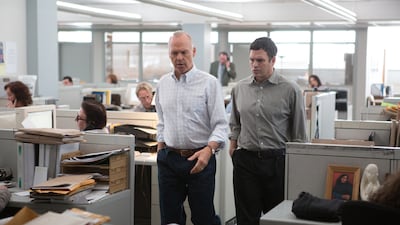

It’s been a decade since Spotlight won Oscars for best picture and best screenplay at the 2016 Academy Awards, with the film recognised for its heroic portrayal of journalism.
This newspaper described it as the “best film about journalism since All the President’s Men”, which was quite the compliment, for its dramatisation of the Boston Globe’s journalists working to expose historic child abuse cases within the Catholic church. Ten years later, Spotlight remains one of the great industry movies and presents a powerful case for investing time, patience, teamwork and shoe-leather into the stories that matter.
The Social Reckoning, released earlier this month, attempts to cover some of the same ground, unravelling a time-hopping dialogue between an investigative journalist at The Wall Street Journal and a marginalised Facebook team member-turned reluctant whistle-blower, as the two work together to explain the algorithmic harm that social media is known to be capable of.
Like Spotlight, The Social Reckoning is an advert for slow-burn reporting work, although journalism is very much the side order to the main-course dissection of the mores of digital platforms where billions of people spend good chunks of their daily lives.

The contrast between those two worlds and the articulation of processes at work in their respective silos are everything you’d expect from a film by Aaron Sorkin, although it appears global audiences have not been especially convinced. The movie has to date underperformed its predecessor, The Social Network, as well as its reported pre-release revenue estimates. The Abu Dhabi cinema I saw the film in had few patrons in attendance on a recent weekend afternoon screening.
One wonders if audiences genuinely want to sit and be instructed on the ills of social media in a darkened cinema when most will already instinctively recognise on some level that these digital platforms have a level of user-induced toxicity about them.
Even armed with that knowledge, we remain broadly happy to scroll passively through our feeds morning, noon and night. And those who paid to watch the movie might have been absentmindedly flipping through their feeds right up until the point the opening credits rolled, an unintentionally amusing state of affairs given the film’s central argument.
Media industry practitioners may still nod sagely at the love-letterish portrayal of investigative reporting, however. Time magazine called it a “brisk, old-school journalism thriller”, which in itself is an energetic hat-tip to a film that celebrates what is described in one scene as “the last two minutes of print journalism”.

The Wall Street Journal’s review, the title at the core of some of the film, describes it as a sequel that “no one saw coming and no one asked for”, in part, it says, because our societal concerns have shifted towards artificial intelligence in recent years.
By comparison, social media might occupy the same place as the legal vices of society, such as excessive use of tobacco or alcohol or overconsumption of processed foods. Most would recognise the ability of these substances to do harm to the individual, but seem to have made an uneasy peace with their own habits.
Given the above, The Social Reckoning seems unlikely to claim a spot on those “best films about journalism” lists that regularly circulate, which usually push the aforementioned Spotlight and All the President’s Men to the upper reaches of their rankings. Who knows if the film will be remembered affectionately a decade from now or even if it will be talked about at all?
Anyone seeking a less glorious portrayal of the industry could do worse than seek out Devil Wears Prada 2, a box-office high-performer earlier in the year that can now be found on streaming platforms. It offers a surprisingly accurate portrayal of journalism in its post-imperial years, although most people will have been attracted to it for its all-star cast and affection for the 2006 original.

The 2026 comedy drama begins with layoffs at Anne Hathaway’s fictional newspaper and quickly progresses to the story at the centre of the film’s light plot being broken all over Instagram and the mea culpa that follows it through push notifications and alerts.
The death of print is very much to the fore, too. The fictional fashion title at the centre of the film “stopped being a magazine years ago … we are digital, downloadable, we are in the ether … [we are] content that people scroll past while they eat”, which is quite the stinging epithet. In this world, digital stories are judged on optics and cut-through to a niche audience by one part of the organisation and on clicks and hard numbers by others.
“Did anyone read the piece?” asks Meryl Streep’s Miranda early in the film at an editorial meeting. It is a question that sits at the heart of audience behaviour discussions in every newsroom, because on many occasions, what is perceived as good work does not line up with genuine high-performance. It is always a wonderful day in a newsroom when they do.
As such, DWP2 probably captures the moment better than Sorkin’s admirable film. Process, production and dissemination of information at speed, as well as the definitive shift of print to being one form of story presentation rather than the only form, are to the fore.
Outsiders may still wonder which is the more accurate portrayal? Insiders, meanwhile, may be locked in to interrogating what their audience wants, in what format and where.

