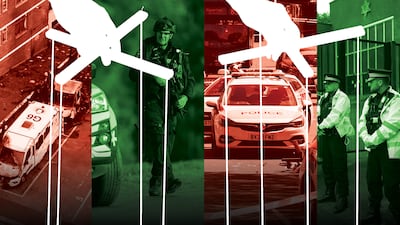

On Tuesday, Ken McCallum, director general of MI5, the UK’s domestic counterintelligence and security agency, gave his annual speech about the threats faced by his country. Iran loomed large, second only to Russia. According to Mr McCallum, Iran was “keen on subcontracting its UK violence” and has spent this year expanding its hybrid campaign across the country. He said that Iran-linked operations had led to more than 50 arrests over the previous 12 months, with much of the aggression targeting Britain’s Jewish communities.
Iran has long had a history of operating beyond its borders. Its neighbours know only too well how it uses proxies and hires criminals to do its nefarious bidding. But until recently, its activities in Britain were mainly targeted at its own dissidents and Persian-language media. In March 2024, for example, Pouria Zeraati, a presenter on the Iran International television station, was stabbed by Romanian criminals; the court found that the attack had been carried out on behalf of Iran.
This escalated after the war began in February. There have been a series of incidents and attacks, mostly on the Jewish community in the UK, which the authorities have attributed to the Islamic Revolutionary Guard Corps. Many of them have been claimed by Harakat Ashab Al Yamin Al Islamia, or Hayi, which Britain regards as a proxy for the IRGC.
In March, two men were charged with spying on London’s Jewish community and assisting a foreign intelligence service. Later that month, four ambulances belonging to the Jewish paramedic charity Hatzola were destroyed and a synagogue damaged in an arson attack claimed by Hayi.
In April, there was a wave of attacks against synagogues and Jewish community centres in London. Last month, five men were arrested near RAF Fairford, a US bomber base used in operations against Iran. Prime Minister Andy Burnham told Parliament the incident was “almost certainly directed” by the IRGC. This month, two men were charged with preparing acts of terrorism; prosecutors say they scouted a synagogue and the Jewish Museum in Manchester.
Iran has furiously – if implausibly – denied responsibility. Foreign Minister Abbas Araghchi told Britain about the RAF Fairford arrests “you’re barking up the wrong tree”, despite the fact that the IRGC had publicly declared the base a legitimate target.
Britain has not been shy of attributing responsibility for the attacks to Iran, and expressing its outrage. In May this year, then-prime minister Keir Starmer said “our message to Iran … is that it will not be tolerated”. Home Secretary Shabana Mahmood said in July that “Iran and Russia are using proxies and thugs to do their dirty work on our shores”. Kemi Badenoch, the leader of the opposition Conservative party, has called the attacks on the Jewish community a national emergency.
But do Britain’s actions match up to the rhetoric? The answer is a qualified “yes”, but with room to do much more. £250 million (about $330 million) over three years has been allocated to protect the Jewish community. The government has taken a series of steps to clamp down on hostile state activity in general, and on the IRGC in particular.

The IRGC and Hayi have been designated under the National Security (State Threats) Act, a new law to make it easier to tackle state threats. As a result, someone found guilty of supporting them now faces up to 14 years in prison; Iran’s Foreign Ministry called this a “despicable and provocative act”.
The difficulty lies in the way that Iran mounts these operations. A minority of those accused are Iranian nationals, some of whom have come over by small boats from France to claim refugee status. But it would be a mistake to make this about Britain’s immigration policy, because most of the attacks are committed by young criminals hired, directed and paid online. The amounts of money are small. The controllers sit in Iran or Iraq and use Telegram and Snapchat to give instructions to their proxies. The attacks on the Hatzola ambulances, for example, were committed by four young British men then aged 17 to 20. These are not ideological lions, but petty criminals paid by the job.
Breaking this model will not be easy, and nor will it be straightforward to go after the controllers rather than the foot soldiers. Doing so will require painstaking effort to target the gangs that sometimes broker the work, to trace the payments and to work with the online platforms to identify the networks.
The problem is less an over-tolerant climate, and more the market in criminals for hire and unpoliced messaging apps. That said, the climate still matters. Growing anti-Semitism provides a target set and cover. Extremist preachers still inspire self-directed extremists in the UK, such as the ISIS-inspired man who attacked a synagogue in Manchester in October last year.
If Britain wanted to get tougher still, there are steps it could take. It could screen more rigorously asylum-seekers from Iran, though many of them are indeed fleeing the regime, themselves targeted by the IRGC rather than its agents. It could tighten rules on hate preachers and keep the pro-Iran Al Quds Day march banned.
It could chill still further the relationship with Iran. It could expel diplomats or downgrade the Iranian embassy, though the Foreign Office remains keen to keep open the British embassy in Tehran. It could close the Islamic Centre of England, described by a Minister to Parliament as “the official religious representative” of Iran’s Supreme Leader in the UK; stop giving visas to clerics trained by the Iranian regime; give the Charity Commission, a regulatory body, powers to deregister “charities” that are a front for hostile state activity. It could even fight fire with fire and use the British state’s own capabilities to cause the regime pain inside Iran.
But in the end, for as long as an IRGC controller can sit in Tehran and use Telegram to direct a teenager to firebomb a synagogue, and the British state neither disrupts the operation nor imposes a sufficient cost on Iran for mounting it, we must expect the attacks to continue.

