

When US President Donald Trump refused to sign the communique at the G7 summit in Canada in 2018, it ended up formalising the split in the western-led bloc. The American leader, who is scheduled to arrive in France on Monday for another gathering of the grouping, is not the sort to reflect on how much he has since changed global politics. Instead, the meeting is on another knife-edge as a real-time experiment in whether or not old institutions can adapt to a bulldozing of Washington’s interests.
There is one theme that unites the most difficult choices that the US President is presenting to his allies at the summit in the French Alps this week: how the G7 member states and the friendly nations they have invited to the summit, including leaders from the Gulf states, can share accessible resources to advance prosperity.
It sounds easy and obvious, but it hasn’t been like that for a while – and it certainly wasn’t the case in 2018.
Having pulled up the communique that Mr Trump refused to sign eight years ago, I can confirm that there isn’t a mention of any of those things. Instead, the US leader was animated by the other countries’ reliance on the US market as a “piggy bank” to anchor their own prosperity. It mostly highlights “mutually beneficial trade and investment” and talks about fighting protectionism.
This year, the G7 will be asked to endorse Mr Trump’s ceasefire with Iran. That overnight framework agreement won’t be signed until Friday in Geneva, but to the American President it already means “let the oil flow”.
Economists will tell you that there are months of disruption already loaded into the global economic system as a result of the war starting on February 28. These filtering effects cannot be wished away. G7 leaders outside the US have described the war as not of their choice or one they have participated in. Yet for them, the hard part is only just beginning as inflation surges and global capital for the debt that the big countries offer is diverted elsewhere.
UK Prime Minster Keir Starmer welcomed Washington’s ceasefire announcement with a statement on Monday that called on all the relevant parties to “ensure the strait reopens and remains fully and permanently open”. Over the coming days, expect to hear much about the coalition of the willing that the British and French, backed by 40-odd other countries, saying they are ready to resume trading operations in full swing should the ceasefire be demonstrably in place over the coming weeks.
Even so, according to former US Navy admiral Mark Montgomery, just the clearance of mines to a certifiable standard – remember that the confidence of the insurance market is vital – would take at least two months.
To get an idea of how much the resources of growth will dominate the G7 proceedings this week, these Hormuz deliberations offer a clue. But they are just the starting point. Mr Starmer met Japanese Prime Minister Sanae Takaichi over the weekend, and the joint economic security declaration the pair signed is a template for just how far the G7 members have travelled since the 2018 summit in Canada.
Their pact talks about developing “resilient and reliable supply chains” not just between the two countries but with strategic allies as well. It seeks to “enhance economic security through efforts such as joint initiatives to promote secure and resilient growth in and through critical technologies”. Critical minerals are the core of the document. In this area, the countries have agreed to “reduce critical dependencies by enhancing co-operation among G7 members and likeminded countries in areas such as mining, refining, processing, recycling, and stockpiling”.
The two countries also signed a Frontier Technology Partnership that is designed to ally the UK’s research strength and depth with Japan’s advanced manufacturing.
Steel, critical minerals and defence build-up partnerships are now the basis of the G7 relationship. Having secure supply lines and a newly deepened production schedule for rare earths and other minerals of advanced production is an overriding priority.
The challenge for the leaders assembling in the Alps is communicating to Mr Trump in a way that secures his confidence that America’s allies are with him. A bigger challenge is determining whether or not the US President is with them.
With the Ukraine war now lasting longer than the First World War, Europe is certainly preoccupied with the resolution of that conflict. Ukrainian President Volodymyr Zelenskyy talked to Mr Trump as part of the roster of calls the latter hosted on his 80th birthday, and Mr Zelenskyy said that the G7 discussions “could help bring peace closer now”. It is worth noting that Russian President Vladimir Putin also talked to Mr Trump on Sunday.
-

Emergency personnel in Tel Aviv after missiles are launched from Iran to Israel. Reuters -
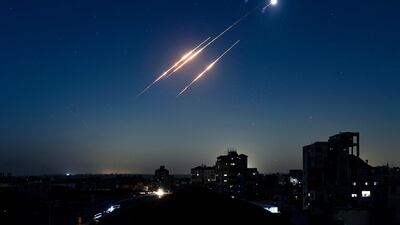
Iranian missiles launched at Israel seen from the Nuseirat refugee camp in the besieged Gaza Strip. AFP -

A convoy carrying activists to the Gaza Strip to challenge Israel's blockade on humanitarian aid is blocked in Sirte, eastern Libya, from continuing towards Egypt. AP -
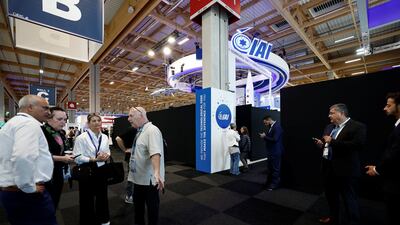
Israeli weapons company stands, including IAI, are shut down by organisers during the 55th Paris Air Show at Le Bourget Airport. Reuters -

Granddaughter of former Gujarat chief minister Vijay Rupani, who died during the Air India crash in Ahmedabad, attends his wreath-laying ceremony. Reuters -

Parents and guardians outside an elementary school at the start of a new school year in Quezon City, Philippines. AP -

A vendor awaits customers at his stall selling plastic cans in a market in Mazar-i-Sharif, Afghanistan. AFP -
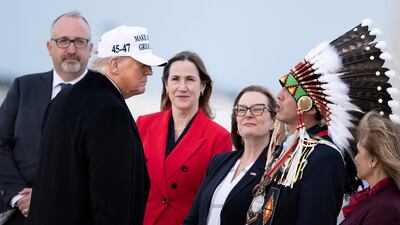
US President Donald Trump is greeted by Steven Crowchild of the Tsuut'ina First Nation at Calgary International Airport before the start of the G7 summit. AFP


Meanwhile, Washington’s decision to close international access to the Fable 5 and Mythos 5 models of Anthropic is the real pinch-point of the summit. UK media reports say that Mr Starmer’s officials are already intensively lobbying for a carve-out from this export ban.
Last month, the historian Niall Ferguson told a London School of Economics audience that he regarded Anthropic’s latest products as the equivalent of achieving success in the race to an atomic weapon. If the stakes are as high as Mr Ferguson believes they are, then the logic behind Washington’s actions last week goes far deeper than most of the reporting on the ban would suggest.
That is why the G7 meeting is fundamentally critical to navigating the many divisions in the world, at a time when the US is reshaping its own interests across the board.

