

Six-year-old city planners in Portugal. The world’s first climate visas in Tuvalu and Australia. Nuclear technology that spots smuggled rhino horns in South Africa. A school in a cinema to bring children back into education in Japan. An “economic nutrition” label in Canada. AI that replaces red tape with “green tape” in the US. And, in Zimbabwe, a humble “friendship bench” where trained grandmothers have reduced depression and suicidal ideation by 78 per cent.
These are just some of the remarkable ideas featured on the Edge 50 list, launched at the World Governments Summit in Dubai last week. A collaboration between the Mohammed Bin Rashid Centre for Government Innovation and Apolitical, Edge 50 recognises that governments everywhere are facing problems that will not yield to incremental thinking. The Edge 50 elevates early, promising ideas that are cutting-edge, sometimes counter-intuitive and which can make a meaningful difference to society if adopted at a country-wide scale.
One of my favourite Edge 50 winners is in the UAE itself, a junior school called Najmara. As a product of homeschooling, I’m always interested in innovative approaches to education and I’m familiar with the frontiers. Yet I was astonished by my recent tour of Najmara. Centred around quest-based learning and situated in an ethereal, flowing building designed by a Japanese architect, the school has no screens, mixed age group classes, no classrooms, an in-school farm and a brimming sense of intellectual freedom. Students there were restoring coral reefs and examining soil. A tiny girl was running a butterfly rehabilitation project. At the end of the school day, children have to be coaxed out of the school. Tellingly, the person who had toured the day before me was a well-known US billionaire, in search of the future.
-
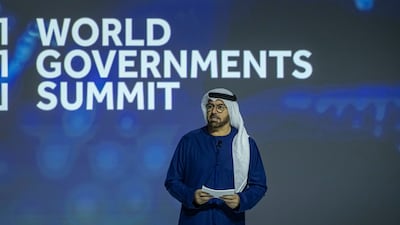
Mohammed Al Gergawi, UAE Minister of Cabinet Affairs and Chairman of the World Governments Summit, speaking at the opening of the summit in Dubai. He said AI was one of the four forces reshaping the world. Antonie Robertson / The National -
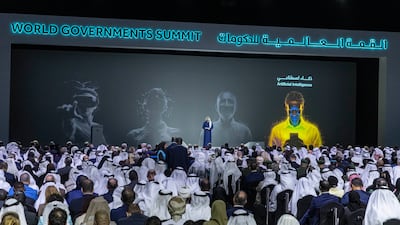
Mr Al Gergawi told the forum the next major discovery would not be in space, but in 'the realm of new capabilities within the human brain itself'. Antonie Robertson / The National -
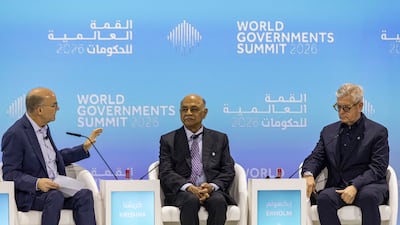
From left, Mike Allen, co-founder of American news company Axios, Arvind Krishna, chairman, president and chief executive of IBM, and Borje Ekholm, president and chief executive of Ericsson, on the first day of the World Governments Summit. Antonie Robertson / The National -
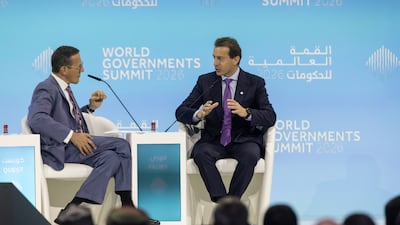
CNN journalist Richard Quest, left, talks to Airbus chief executive Guillaume Faury during a session titled How Do We Keep the World Connected? Antonie Robertson / The National -
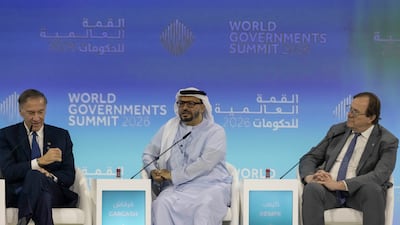
Dr Anwar Gargash, diplomatic adviser to the UAE President, with Mike Pompeo, former US secretary of state, left, and Frederick Kempe, president and chief executive of the Atlantic Council. Antonie Robertson / The National -
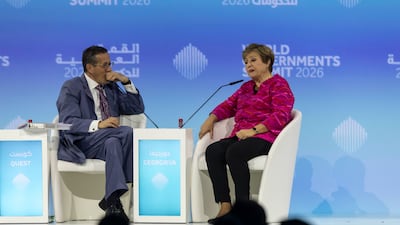
IMF managing director Kristalina Georgieva in conversation with Richard Quest. Antonie Robertson / The National -
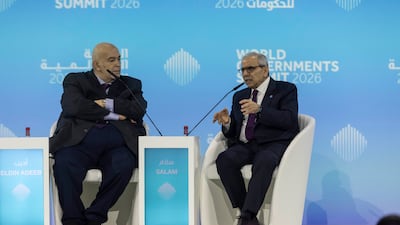
Lebanon's Prime Minister Nawaf Salam discusses the country's future with Emad Eldin Adeeb of Sky News Arabia. Antonie Robertson / The National -
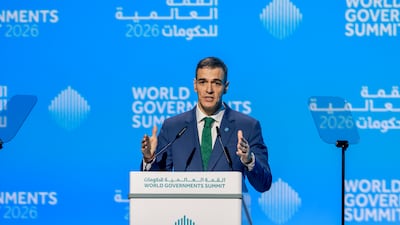
Spanish Prime Minister Pedro Sanchez speaks at the summit. Victor Besa / The National


Najmara epitomises a quality of the UAE government that I have only come to understand having watched the country over time. I first attended the World Governments Summit nearly a decade ago. While there is nothing quite like the summit – which features government leaders like Indian Prime Minister Narendra Modi and technology pioneers like Elon Musk – the event initially struck me as being stronger on projecting a flashy vision of what government could be than on the difficult, unglamorous work involved in making it so.
But I have since watched action steadily follow vision. The appointment of the world’s first AI minister in 2017, labelled a gimmick by many, has come to seem like foresight. The UAE, now a major investor in the frontier AI models, according to Microsoft’s diffusion study last year, is the world leader on AI adoption. The list goes on of examples where the government so often manages to pull off victories and world firsts around what seems initially to be performative or unrealistic.
Nowhere is the country’s will to manifest vision more evident than when it comes to the immense opportunity and challenge of deploying AI in government itself.
The Boston Consulting Group estimates there are $1.75 trillion in productivity gains to be unlocked from harnessing AI in government globally. So far, however, most governments have talked a great deal but progressed little towards capturing the huge rewards of AI done right in the public sector.
AI in government is hard. It is not an add-on, or a technology rollout. It requires a total rethinking, redesign and rewiring of the state around new technological capabilities and a human workforce augmented by artificial intelligence that’s becoming smarter by the month. This must be done in a way that constantly upskills the people in government and maintains human agency, even as machine agency grows.
There is too much talk of agentic AI and too little talk of agentic humans. Governments must not let this dynamic become zero sum. Leaders also need to focus on moving the government workforce “above the algorithm” (using AI as tools to be more effective) and away from jobs “below the algorithm” (jobs where humans are managed by AI; often the lowest agency and most vulnerable jobs).
Other major challenges include designing for sovereignty, deciding who is accountable when AI systems fail, protecting people from algorithmic bias and being clear about where AI should and should not be used. The data here illustrates the scale of the challenge. As one example, according to our global research only 26 per cent of public officials implementing AI understand their governments’ own ethical frameworks for the technology.
And of course, navigating all of the above must be done while also building increasing global co-ordination and regulation commensurate with a changing technology risk profile.
The UAE is leaning into the challenge with alacrity. The enthusiasm to make AI work in government – and to build the world’s first “AI native” government – is palpable. Leaders talk about the standards and “competition” for government services being the last private sector transaction a person experienced. One UAE minister I know asks their team for a weekly report on the latest ways they have used AI in their work. All public officials must do AI training. At this year’s World Governments Summit, I heard aspirations for AI advisers for public sector organisations. And there is the capital to drive a rewiring of the state: Abu Dhabi’s Department of Government Enablement has a Dh13 billion ($3.5 billion) budget for AI transformation, through 2025-2027.
It is because of the country’s longstanding leadership on AI in government that we chose the World Governments Summit to announce two new AI tools designed to help governments wisely navigate and succeed in the age of AI.
The first tool, the Government AI Navigator brings together real-world examples of AI use and policy from around the world, enabling officials to see what has worked elsewhere, understand what has not and connect directly with peers who have implemented similar approaches. When it comes to the frontiers of AI use, shifting like sand dunes, public officials are only as smart as their network.
The second tool, PolicyNova, addresses the challenge of policy design itself. It supports the early, often messy stages of policymaking, helping teams explore how similar problems have been addressed in other contexts and visualise how different interventions may interact before decisions are locked in. Both tools will be made available for free to public servants around the world thanks to philanthropic funding from Google.org.
Even approached with the best intentions, in the course of rolling out AI in governments there will doubtless be some grave mistakes, and many unintended and problematic consequences. I draw comfort from the fact that there will also undoubtedly be new innovators at the edge of government: thinking three steps ahead, fixing the mistakes of our own making and probably harnessing AI ever more to do faster and more powerfully.

