
When Anwar Ibrahim finally succeeded in becoming Malaysia’s Prime Minister in December 2022, expectations were stratospherically high.
As a standard-bearer of the “reformasi” movement for more than 20 years – after being dismissed as deputy to then-premier Mahathir Mohamad in 1998 – some of his supporters appeared to think that a miraculous transformation of the country would take place the moment he took office. Corruption would vanish, growth would surge, racial and religious divides would disappear, and even nasi lemak from the roadside stalls would taste more delicious.
When Mr Anwar turned out to be human after all, and the leader of a potentially fractious “unity” government, not one made up solely of his own supporters, the grumbling started. In particular, some were soon asking, where were the reforms he had long promised? As the Malaysian commentator A Kathirasen recently wrote, critics began to suggest it was less “reformasi” and more “reformati”.
In November 2024, a former Malaysian Anti-Corruption Commission chief, Latheefa Koya, declared that she gave the government “minus 10” for its record on legal reforms – an accusation made all the more blistering as Ms Latheefa had been a prominent activist in Mr Anwar’s own party, PKR.
Mr Anwar would disagree. He would point to his administration addressing numerous issues including cost of living, leakages, subsidies, corruption and transparency. Nevertheless, as he said on January 3: “Sometimes we speak as though we control all 222 seats [in Parliament]. Reforms must be pursued, but they must be implemented wisely, sensibly and through proper negotiations. Obtaining consensus from the leadership of all parties in government is not easy as each party has its own priorities.”
Bedding down the unity government and ensuring its survival after the carousel of five different prime ministers and governments in four years, between 2018 and 2022, was always going to take time. The administration contains two parties – the United Malays National Organisation (Umno) and the mainly Chinese Democratic Action Party (DAP) – that spent decades demonising each other. Stability was not at all a given. Maintaining it for more than three years so far has been an achievement in itself, even if many Malaysians seem to have taken it slightly for granted.
-

Drummers perform during the opening of the Association of South-East Asian Nations (Asean) summit in Kuala Lumpur. EPA -

Water levels reach their annual peak in Ho Chi Minh City, Vietnam, one of the world’s fastest-sinking coastal cities. Getty Images -

Belinda Bencic of Switzerland cerebrates beating Linda Noskova in the final of the Toray Pan Pacific Open in Tokyo. EPA -
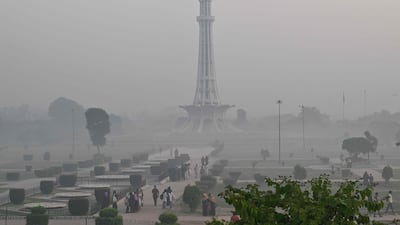
Heavy smog in Lahore, Pakistan. AFP -

The body of Queen Mother Sirikit is driven from Chulalongkorn Hospital to the Grand Palace in Bangkok, Thailand. AP -

A Cornish Rex cat at the FIFe World Show in Bucharest, the world's largest cat event. AP -

The West Side Hallo Fest in Bucharest, Romania's largest Halloween festival. AP -

A mural painted by the Mexican artist Paola Delfin is unveiled on a building in Jounieh, Lebanon. EPA


But now Mr Anwar has announced a series of bills to be tabled this year – and they amount to just the kind of significant reforms his supporters were hoping for. Two in particular will mark major steps.
The first is that prime ministers will be limited to two terms in office, with a maximum of 10 years. This may constitute a subtle rebuke to Mr Anwar’s mentor-turned-nemesis, Dr Mahathir, who was prime minister from 1981 to 2003 and then again from 2018 to 2020. It may also be a check on any ambitions Najib Razak, prime minister for two terms from 2009 to 2018, may have to try to regain office once he is free from jail.
The second will make the positions of attorney general and the public prosecutor separate jobs. Hitherto they have been held by the same person, which, given the attorney general is a political appointment, has raised questions about the independence of public prosecutions.
We will have to await the wording, but the proposal to limit prime ministers to two terms is pretty clear. If the bill passes (it will need a two thirds majority in Parliament as it would amend the Constitution), Mr Anwar will have voluntarily limited his own possible tenure as the country’s leader.
I believe the last time any Malaysian prime minister decided to curb his own powers was in 1971, when Tun Abdul Razak Hussein ended the state of emergency that was declared after serious race riots in 1969 and returned the country to parliamentary democracy. So, it’s rare. Unambiguous credit will be due to Mr Anwar if this bill becomes law.
As for separating the attorney general and public prosecutor, yes, ringfencing the latter from political influence will be key, as will which person or institution appoints and has the ability to dismiss such a person. These questions are not mere quibbles. But I would urge those raising them now to take the principle of separation as a win.
It is rarely easy to push reforms through in Malaysia. Most forget that the initial move to force Najib Razak from office began in 2014 not over any financial matter, but because he wanted to repeal the tough colonial-era Sedition Act. It was the threat, made by hardliners in Umno allied to Dr Mahathir, to oust him at the party’s annual assembly that year that forced him to back down.
By contrast, Mr Anwar clearly feels confident enough to put these and other reforms on the parliamentary agenda this year. Why now? Well, the economy has been doing well, the ringgit has strengthened against the US dollar, making imports cheaper and, perhaps most importantly, the domestic opposition has never looked weaker. Mr Anwar’s party and its allies fared poorly in the recent Sabah state elections, but the local parties that did well are part of his unity government at the federal level.
What matters more is the government’s adversaries in the Peninsula – the PN alliance of the Islamist PAS and the Umno-splinter Bersatu. Hitherto led by Bersatu’s Muhyiddin Yasin – one of the “carousel” PMs between 2018 and 2022 – the alliance has been plagued by internal strife and now looks certain to be headed in the future by a PAS leader. Not only do they look disunited and directionless, but their appeal in multiracial Malaysia beyond a particular Malay-Muslim pool of voters will be virtually zero with a PAS chairman.
Internal squabbles will continue in the unity government, especially between Umno and the DAP, and the proposed bills won’t be enough to silence Mr Anwar’s critics. But Malaysia’s Prime Minister deserves kudos for taking advantage of his position of relative strength to announce serious reforms. They will be a legacy, whatever the future holds for his government.

