


The late UK prime minister Winston Churchill had a reputation for operating with resolve and maintaining a clinical focus against the one big threat when it came to defending the country. So, it was fitting that a parliamentary caucus was launched in the Churchill Room of the House of Commons last week to highlight the dangers of the unaddressed extremism threat the country is facing.
The UK has been found wanting by its own representatives in how it goes about tackling not only security threats but also the social impact of extremism.
Labour MP Damien Egan, the chairman of the new group, says that voters he talks to are worried about their neighbourhoods and families becoming more vulnerable to extreme ideas and social tensions. Indeed, More in Common's polling this year found that 70 per cent of the public were worried about the state of UK democracy and 80 per cent feared “people resorting to violence instead of coming together to solve issues peacefully”.

“It’s more in the last few years that people have started to raise worries about it,” Mr Egan told me. Yet governments of both Labour and Conservative stripes have done little to address the issue. The ideologies that are growing in strength range from right wing and left wing, as well as Islamist extremism. Into the mix is the volume of online radicalisation and the rising polarisation of western politics.
Yet the government has sat still. It has prioritised, instead, a now-stalled plan to promote a definition of Islamophobia that would underpin all government responses to the issue. But by choosing a wording that has been backed by bodies close to the Muslim Brotherhood movement, the initiative has provoked division. Those worried say a far more clear path lies in a wording that tackles the very real growth of anti-Muslim hatred. For now, the issue is stuck in these disputes.
-

People hold placards at London Bridge to mark one year since the London Bridge terror attack that killed eight people and injured dozens more. EPA/FACUNDO ARRIZABALAGA -
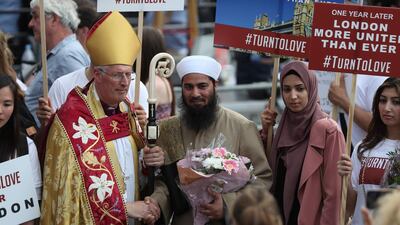
The Bishop of Southwark, Christopher Chessun, meets members of the public during a commemoration service. AFP/Daniel LEAL-OLIVAS -
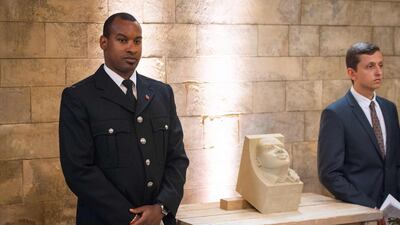
British Transport Police officer Wayne Marques, who was seriously injured fighting off the attackers, stands next to a corbel of his face which will be placed on the north quire aisle of Southwark Cathedral. AFP/POOL/Dominic Lipinski -

A member of the public reacts after the commemoration service. EPA/FACUNDO ARRIZABALAGA -
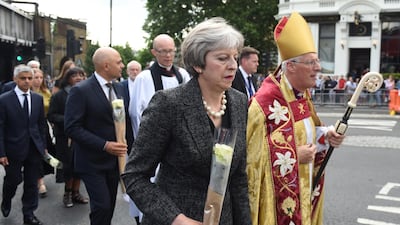
Britain's prime minister Theresa May walks to London Bridge to lay flowers at the scene of the attack. EPA/FACUNDO ARRIZABALAGA -

Mayor of London Sadiq Khan addresses the commemoration service at Southwark Cathedral. Britain held a national minute of silence after the ceremony. AFP/POOL/Dominic Lipinski -

Members of the public lay flowers on London Bridge. EPA/FACUNDO ARRIZABALAGA -

Members of all faiths attended the ceremony. AFP/Daniel LEAL-OLIVAS -
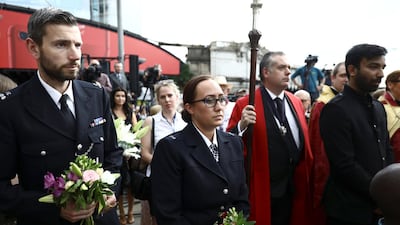
Police officers attend commemorations of the first anniversary of the attack on London Bridge. REUTERS/Simon Dawson


Most people in the UK will have heard of the Prevent programme, which is the centrepiece of the country’s counter-terrorism architecture. Lawrence Taylor, the head of counter-terrorism policing in the UK, told the meeting that the extremism threat the country faces is increasing.
The pace of change is such that the police do not categorise threats but look at a spectrum of beliefs that could produce a terrorist threat. This means that extremism must not just be a matter of policing, which is heavily focused to thwarting terrorism.
The Prevent programme gathers information about people likely to have taken up violent extremist beliefs and works to assess and address the nature of the threat they pose.
Despite hostility from grass roots groups like the Muslim Brotherhood, which fear encroachment on their activities, the programme has only grown in recent years. Mr Taylor told the meeting that it would handle 10,000 referrals this year. This is a double-digit percentage increase on the 8,517 cases last year, itself a 27 per cent increase on the year before.
Extremist influence is a pathway into terrorism, but it is so much more. It creates a permissive environment for criminality. It also promotes and creates violence and division below the legal threshold. Coded language and extremist symbolism are behaviour patterns that are effectively not addressed in the UK as the police rightly concentrate on stopping radicalisation that tips into support for terrorism.
As was said by the MPs, the current UK structures are focused on counter-terrorism, not so much on extremism. Those laws and strategies were forged in the aftermath of the 9/11 attacks on the US that created a new era of security priorities around the world.
Seizing the agenda is the art of politics in this regard, and the British government is far behind the curve in addressing extremism. That is why the MPs moving to form a parliamentary group that specialises in this area is such a welcome step.
While the government is still considering the implications of addressing anti-Muslim hate, it would do well to shift the focus of its efforts to define the ill of extremism. This would allow it to address the scope and scale of the problem beyond the established counter-terrorism infrastructure. It has not, for example, implemented an official report “Operating with impunity”, which recommended tackling “persistent groups” that not only radicalise but propagate extremism.
Inevitably, this would mean a shake-up in Whitehall, where too many ministries have this issue but there is no guiding responsibility. Setting up a directorate to fill in the gaps where the police responsibilities stop, and other authorities are not tasked to intervene, would be a step-change that the UK sorely needs. To ensure accountability, why not create an index of social cohesion to track how people are affected by activities that seek to control or coerce local activity?
Mr Egan says the disquiet has percolated through to ordinary conversations on the doorstep. It is time to respond to fears of powerful ideological currents that seek to divide off sections of society and create discrimination along the lines of “them and us”.
There are many social and technological changes that have made Britain a more divided country. By tackling the ideological factors behind these schisms, London could start to show that it can reverse some of its ugliest trends.

