


During this week’s gathering of the conservation community at the IUCN World Conservation Congress in Abu Dhabi, we have an opportunity to show how economic progress and environmental conservation can go hand-in-hand.
As the global population surges and energy demand rises, protecting nature is not just an environmental imperative, but a social and economic one too. That’s because more than half of global GDP – approximately $58 trillion – is directly or indirectly dependent on nature.
With the world’s population projected to reach 9.7 billion people by 2050, the path forward is not less energy or slower development but a smarter, pragmatic approach. This is because expanding access to affordable, reliable energy remains essential to human progress. This, however, must be squared with the world’s collective responsible for safeguarding nature and biodiversity.
At Adnoc, we assess and manage nature-related risks and opportunities alongside financial and climate considerations in keeping with the goals of the Kunming-Montreal Global Biodiversity Framework. We embed nature into strategic planning and investment decisions and this thinking is at the heart of Adnoc’s Hail and Ghasha, the world’s largest gas development of its kind that aims to operate with net-zero emissions.
Located within Abu Dhabi’s Unesco-designated Marawah Marine Biosphere Reserve, this energy project is expected to produce more than 1.5 billion standard cubic feet per day of gas before the end of the decade, enough gas to cover the daily needs of Ireland, Greece and Portugal combined. It will also capture 1.5 million tonnes of carbon dioxide annually for safe underground storage, produce low-carbon hydrogen to replace fuel gas and draw power from the UAE’s clean energy grid, fed by nuclear and solar.
Hail and Ghasha will not only operate responsibly, producing more energy with fewer emissions, it will also do so while ensuring sustainable use of the natural area.
That’s because the Marawah Reserve hosts extraordinarily diverse marine and coastal ecosystems. It’s rich in seagrass meadows that sustain the world’s second-largest population of dugongs, and is home to coral reefs, mangroves, ospreys, turtles and countless fish species.
To protect this biodiversity, Adnoc, together with the Environment Agency – Abu Dhabi, conducted one of the largest marine environmental baseline surveys in the UAE’s history. By mapping habitats in unprecedented detail, we were able to carefully optimise well locations and trajectories, ensuring construction and drilling activities avoid sensitive areas.
The findings were integrated into a biodiversity monitoring programme which now guides every stage of Hail and Ghasha’s development. It informed initiatives such as building hundreds of nesting platforms for ospreys, deploying artificial coral reef structures and fish domes for marine biodiversity, and creating a rescue and rehabilitation programme for sea turtles, supported by education and research partnerships.
Efforts also extend to large-scale habitat restoration as we are committed to planting one million mangroves during the project’s lifecycle, under our broader pledge to plant 10 million mangroves by 2030.
When I think about Hail and Ghasha in the context of today’s competing priorities to simultaneously meet rising energy demand without neglecting our collective desire to create a world our children would be proud of, three lessons stand out.
The first is that large-scale industrial projects can be responsible by design. With foresight and investment, they can channel new resources, investment and expertise into critical developments that help to build environmental resilience.
Second is that we should see development capital as conservation capital. By embedding biodiversity and emissions-reduction measures into flagship energy projects, we can scale investment in conservation.
And finally, energy security and environmental stewardship can be mutually reinforcing – they do not need to be mutually exclusive. As the UAE’s population rises (one only needs to read The National to note that Abu Dhabi’s population soared to 4.1 million people last year) energy demand will rise too.
-

The opening ceremony of the IUCN's World Conservation Congress takes place at Abu Dhabi National Exhibition Centre (Adnec). All photos: Victor Besa / The National -

Sheikh Khaled bin Mohamed, Crown Prince of Abu Dhabi, at the congress -
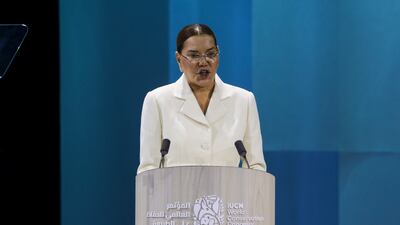
Princess Lalla Hasnaa of Morocco speaking at the event, which aims to raise awareness of pressing environmental challenges and threats to biodiversity -

IUCN President Razan Khalifa Al Mubarak -
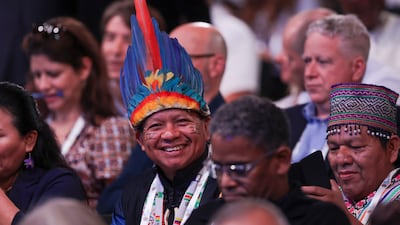
Attendees include leaders from government, science, business and indigenous communities -
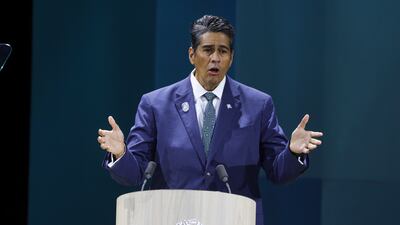
Surangel S Whipps, President of Palau -
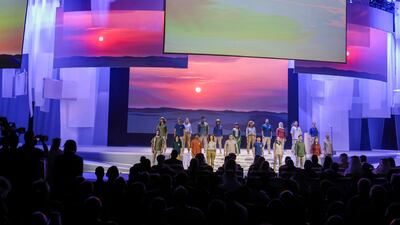
Participants in the opening ceremony. Organisers expect the congress, from October 9-15, to draw 10,000 visitors -
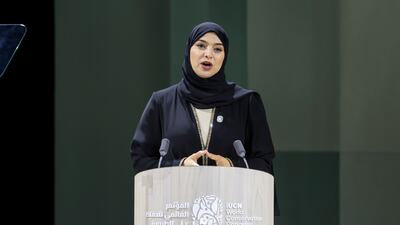
Minister of Climate Change and Environment Dr Amna Al Dahak -

Visitors to the congress have travelled from as far afield as Colombia and Peru -

The UAE has set up a pavilion at the World Conservation Congress -

The Russian pavilion at the event in Abu Dhabi -
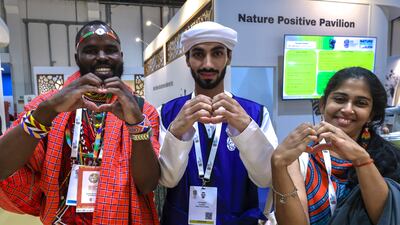
Visitors from Kenya and India at the conservation event


By aligning that goal with decarbonisation and the continued transformation of energy systems, industries can demonstrate how sustainable development does indeed create a clear and pragmatic pathway to multiply conservation impact.
Ever since the UAE’s first oil discovery in 1958, energy has been not only a commodity, but a driver for social and economic progress.
This is what I call “sustainability with a big S”. Sustainability defined not only in carbon and kilowatt-hours, molecules or electrons, but in people, communities, economies and ecosystems positively impacted.

