


Israeli Prime Minister Benjamin Netanyahu and his military establishment are unlikely to accept a truce that would deprive them of the momentum gained from their destruction of Hezbollah’s infrastructure and the assassination of the Lebanese group’s senior leadership, including most recently of secretary general Hassan Nasrallah.
Both American and French diplomats are well aware of this, which could be why they are granting Israel time before pushing for a ceasefire, while exploring ways for de-escalation that could open the door to a broader settlement later. This complex, multi-party settlement – probably requiring several co-sponsors – must inevitably involve Iran, which is navigating between a policy of restraint and seeking a deal that won’t force Tehran to reconsider its reliance on proxies.
The US administration of President Joe Biden, however, has become one of wishful thinking, more focused on waiting passively for opportunities than taking decisive action on major issues. It has thus earned a reputation for impotence, having adopted a policy of appeasement, which has left it in the backseat of a vehicle driven by reckless actors. Today, it finds itself clinging to anyone who might pull it out of the growing regional conflict, which the US does not want to be dragged into – and in this, it has found a common cause with Tehran.
To his credit, Mr Biden has so far succeeded in restraining Iran from engaging in a war with Israel, which would force the US into the conflict alongside Israel. This hasn’t been difficult, as Iran, from the outset, has had no desire for a direct war with Israel, instead preferring to rely on its proxies through what it calls the “unity of resistance” fronts, in response to Israeli aggression in Gaza.
Iran has distanced itself from Hamas after the group’s miscalculated attacks on October 7, and some of its leaders are pointing to the growing public weariness on the Palestine-Israel issue. They are claiming that Iranians want their government to, instead, focus on their economy and livelihoods. If true, this marks a significant shift in the country. While preserving its nuclear capabilities remains a priority, Iran’s regional policy now requires adaptation to new realities and developments, which could entail making some sacrifices.
One key aspect of this adaptation involves reconsidering Tehran’s relations with its proxies, should it wish to reach a major agreement with the US – one that could lead to a gradual lifting of sanctions and normalisation of relations with Washington.
There are indications that Iran could be seeking a shift in strategy.
Last year, Tehran’s rapprochement with Riyadh led to a curb on Houthi attacks on Saudi Arabia – an achievement that stands in stark contrast to Washington’s efforts to get the Houthis to cease their attacks on shipping in the Red Sea. The most significant surprise, however, has come in recent days, with Iran’s leadership distancing itself from Hezbollah in its hour of need, just as its military leadership crumbled under unprecedented Israeli strikes.
Iran’s leaders, across the spectrum, adopted the stance that Hezbollah is capable of defending itself. While Israel bombarded southern Lebanon and attacked Hezbollah leaders in Beirut’s southern suburbs, the new administration in Tehran was said to be indirectly negotiating with the US on the sidelines of the UN General Assembly in New York. The message was clear: Iran does not want to engage in direct war with any nation.
For the first time, driven by developments in Lebanon, the Biden administration has forcefully proposed that Iran change its regional behaviour and use its influence with Hezbollah, and other proxies, to prevent further escalation of the conflict. Furthermore, the US requested that Iran persuade Hezbollah to withdraw north of the Litani River, as stipulated in the 2006 UN Security Council Resolution 1701 and cease its rocket attacks on Israel.
These indirect negotiations have aimed to reach major understandings that could eventually lead to direct meetings, should Iran agree to soften its doctrine and transform itself from an adversarial state to a neutral one. Iran would also need to help enable a ceasefire in Gaza through its influence over Hamas and an end to the war in Lebanon by using its influence over Hezbollah. In return, the US would offer incentives, such as lifting sanctions, reaching nuclear agreements and ending Tehran’s international isolation.
In Washington’s view, if Tehran can convince Hezbollah to de-escalate, the Biden administration might be able to persuade Israel to halt its military operations in Lebanon and cease its open-ended attacks of Hezbollah’s leadership. Whether this can be achieved in the aftermath of Nasrallah’s death – and the subsequent bullish remarks from Iran’s supreme leader, Ayatollah Ali Khamenei – remains to be seen.
-

An explosion in the southern suburbs of Beirut, Lebanon, during an Israeli air strike on Saturday, September 28. AP Photo -

Rockets from Israel's Iron Dome air defence system over the city of Haifa on Friday September 27. Reuters -
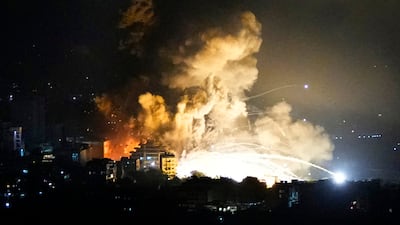
An early morning Israeli attack in south Beirut on September 28. AP Photo -

Beirut residents flee the southern suburbs and gather in Martyrs' Square. EPA -

Smoke is seen following strikes over Beirut's southern suburbs. Reuters -

Smoke over south Beirut as seen from Sin El Fil, Lebanon, on September 28. Reuters -
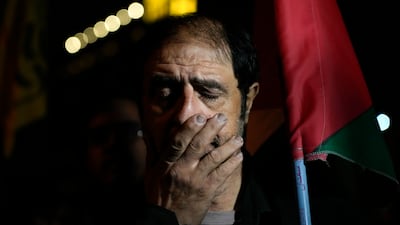
An Iranian demonstrator listens to news from Beirut during a gathering in support of Hezbollah at Felestin (Palestine) Square in Tehran on September 28. AP Photo -
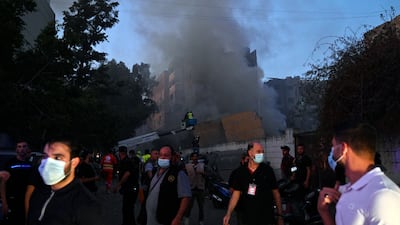
Ruins of a building in Dahieh, Beirut, on September 27 after what Israel called 'a precise strike on the central headquarters of the Hezbollah'. EPA -
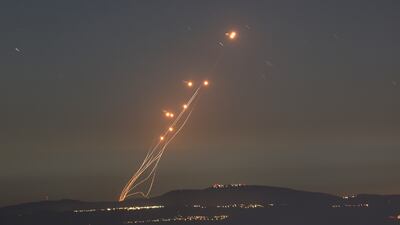
Israeli air defences in Upper Galilee, northern Israel, respond to rocket fire from southern Lebanon on September 27. EPA -
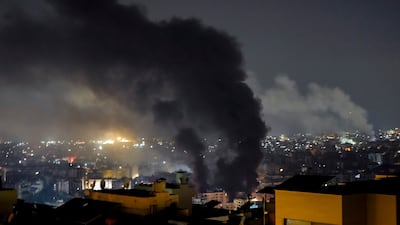
Smoke rises from Israeli airstrikes in Beirut's southern suburbs, Lebanon, Saturday, Sept. 28, 2024. (AP Photo/Hassan Ammar) -
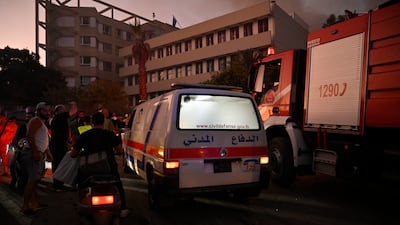
Ambulances attend to the injured following an Israel strike in Dahieh, south Beirut, on September 27. EPA -
Lebanese forced from their homes on September 28 gather at Beirut's Martyrs' Square as Israel attacks the southern suburbs. Reuters -
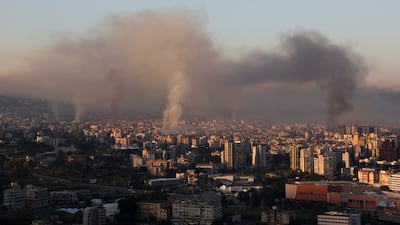
South Beirut as seen from Sin El Fil, Lebanon, on September 28. Reuters -

An ambulance carries injured following an Israel strike in Dahieh, Beirut. EPA -
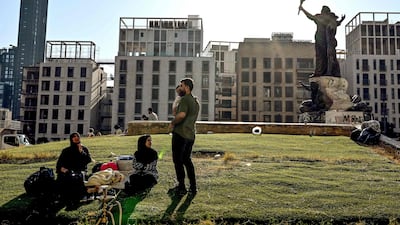
Members of a family who fled Israeli bombardment on Beirut's southern suburbs with some of their belongings in Martyrs Square in the centre of the Lebanese capital on September 28. AFP -
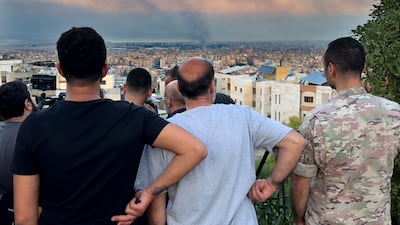
Lebanese citizens watch smoke rise from Israeli air strikes in the southern suburbs of Beirut. AP Photo -
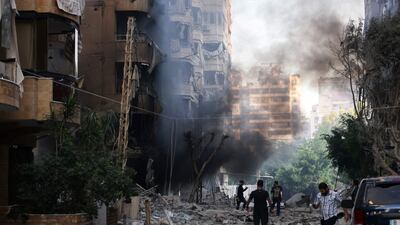
Residents check the damaged in the aftermath of overnight Israeli bombardment in Beirut's southern suburbs, on September 28. Israel claimed its warplanes targeted Hezbollah chief Hassan Nasrallah. AFP -
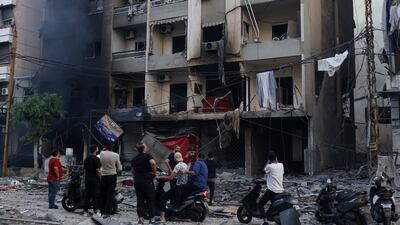
Beirut's southern suburbs after a night of Israeli attacks. AFP -

Smoke rises from an Israeli airstrike in the southern suburbs of Beirut, Lebanon. AP Photo -
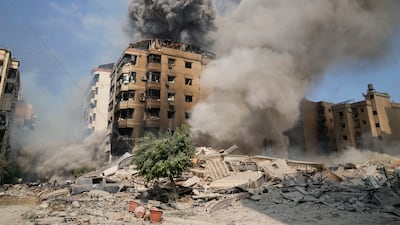
Smoke rises from Israeli air strikes in Beirut's southern suburbs. AP Photo -
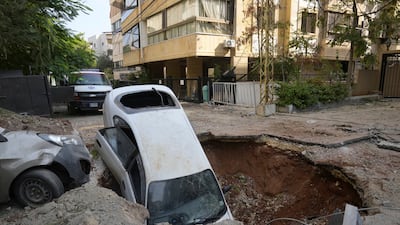
A car sits in a crater in Beirut's southern suburbs. AP Photo


The American and French proposals are driven by an awareness of Iran’s tough position as it watches Israel degrade Hezbollah. Tehran is unlikely to abandon its prized asset as a political entity; rather, it aims for Hezbollah to survive and regenerate itself under its aegis.
It is my understanding that Iran will not intervene in Israel’s war on Hezbollah unless it launches ground operations into Beirut. This is noteworthy because, for Tehran, Beirut seems to hold more importance than southern Lebanon. This is a puzzle that may reflect its need to draw a red line – and it has chosen the Lebanese capital.
Mr Netanyahu, meanwhile, is at the peak of his confidence. The Israeli Prime Minister’s stated goal has been the safe return of residents to his country’s north, along with international guarantees, and will therefore continue his campaign of aggression. He has shown little regard for the civilians that his campaign has displaced or the devastation it has caused in southern Lebanon, effectively turning it into another Gaza.
Regardless of the diplomatic efforts of Washington and Paris, the initiative remains firmly in Israel’s hands as long as American military aid continues and the Biden administration pledges to fight alongside Israel should the conflict escalate into a regional war. The initiative is also in Iran’s hands as long as it insists on using Lebanon as a supporting front for Hamas in Gaza.
Sooner or later, however, both Israel and Hezbollah will need to de-escalate. Hezbollah is losing while Israel risks getting bogged down in two wars.
It is cynical to wonder why Iran as well as key member of the international community have chosen to watch as Israel severely degrades Hezbollah. Could there be a broader preparation for Iran’s return to the international stage as a neutral state?
In any case, one crucial point remains: no matter how triumphant Mr Netanyahu feels, Israel will remain under siege and isolated as long as it continues to impose new realities through air strikes and forced displacement. If its leadership is truly wise, it would call for a truce, with the conditions appearing to be ripe for a settlement with Lebanon.

