US President Joe Biden announced that Israel has offered a "roadmap" to a full ceasefire in the Middle East ally's military campaign against Hamas in Gaza, including a troop withdrawal and release of hostages. AFP
US President Joe Biden announced that Israel has offered a "roadmap" to a full ceasefire in the Middle East ally's military campaign against Hamas in Gaza, including a troop withdrawal and release of
Raghida Dergham is the founder and executive chairwoman of the Beirut Institute, and a columnist for The National
June 09, 2024
Over the past several months, it has become increasingly clear that US President Joe Biden lacks a decisive Middle East policy.
While his administration should undoubtedly be credited for trying to prevent the Gaza war from expanding fully into Lebanon and other arenas, its proposals have tended to be like a hastily cooked dish lacking flavour, and hence inviting scepticism and opposition.
For example, the US hurriedly presented a draft resolution to the UN Security Council supporting Mr Biden’s proposal for a ceasefire in Gaza without properly co-ordinating its positions with any of the other members, including Algeria, the only Arab state currently in the Security Council.
The Biden team appeared to be in a rush to win international support for its three-phase ceasefire initiative, not waiting for Hamas or Israel to agree to the proposals – which they didn’t anyway. And yet the US delegation presented a draft resolution welcoming the ceasefire proposal, describing it as “acceptable” to Israel, and calling on Hamas to accept it as well, urging both parties to fully implement its provisions without delay or condition.
The provisions themselves remain vague, with some still secret. The draft language is oddly worded, calling for a “complete and comprehensive ceasefire” in Gaza in the first phase, and a “permanent cessation of hostilities” in the second phase. The likes of Algeria, Russia and China expressed their reservations over the draft.
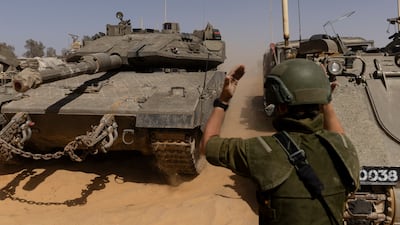
An Israeli soldier directs a tank near Israel's border with southern Gaza. Getty Images
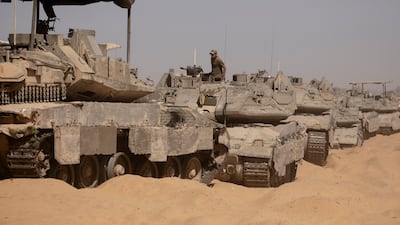
An Israeli soldier stands on a tank in southern Israel. Getty Images
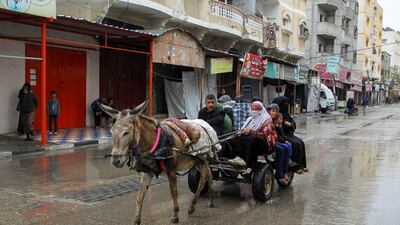
People flee the eastern parts of Rafah ahead of a threatened Israeli incursion. Reuters
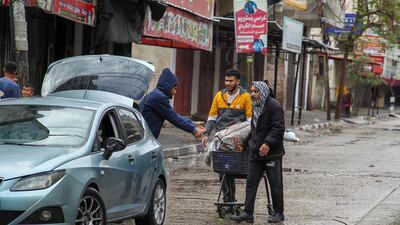
Palestinians leave ahead of a threatened assault on Rafah. Reuters
Palestinians search for casualties in the rubble of a house destroyed in an Israeli strike in Rafah. AFP
Palestinians carry an injured man who was pulled from the rubble of a house destroyed in an Israeli strike in Rafah. AFP
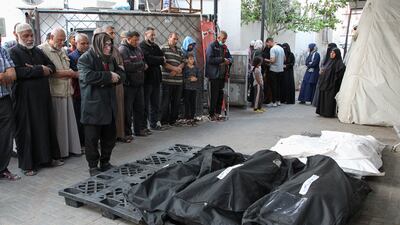
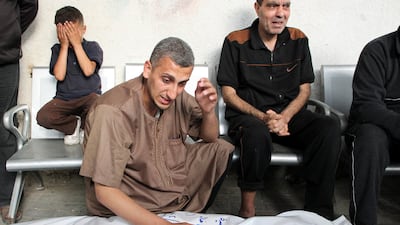
Mourners next to the bodies of Palestinians killed in an Israeli strike in southern Gaza. Reuters
Mourners at Abu Yousef El-Najjar Hospital in Rafah. Reuters
It is puzzling that the US proposal does not involve the PA, even though the latter has an observer status in the UN
It is odd that Washington has been trying to persuade Hamas, which it considers to be a “terrorist” organisation, to agree to its initiative. It is just as puzzling that its proposal does not involve the Palestinian Authority, even though it has an observer status in the UN and is considered the sole legitimate representative of the Palestinian people. Indeed, while Washington has leant on Egypt and Qatar to act as intermediaries, the PA has been excluded from negotiations over Gaza’s future.
Hamas leaders, who seek survival by any means – even if that involves dealing with the US and Israel – must be feeling a mix of terror and euphoria. Terror, due to Israel’s operation in Rafah, which could result in the destruction of the group’s infrastructure. Euphoria, because implicit in Mr Biden’s recent moves is some sort of recognition of Hamas.
One can go on endlessly about the Biden administration’s strategic and tactical mistakes – as well as its duplicity – over dealing with Israel. It has simultaneously put pressure on Prime Minister Benjamin Netanyahu and his war cabinet over their prosecution of the Gaza war and showered them with advanced weaponry and aircraft.
Just as contentious has been the US’s engagement with Iran, with whom it has adversarial relations. In this case, it is at least fair to say that Washington’s secret talks with Tehran have led to the containment of the Gaza war.
Of course, it is also true that Iranian officials are busy preparing for an election to replace Ebrahim Raisi, who was killed in a helicopter crash last month. With preparations under way to pick a new president – with an eye on identifying an eventual successor to the ageing supreme leader, Ayatollah Ali Khamenei – the manoeuvring space for Tehran has become wider and narrower simultaneously.
A banner depicting Israeli Prime Minister Benjamin Netanyahu is held up as activists rally during an anti-government demonstration in Tel Aviv on Saturday. AFP
It is fair to say, then, that for both Iran and the US (also in an election year), strategic and tactical policies have become subject to electoral outcomes. And an arena where these outcomes could have an impact is Lebanon.
Before October 7, it appeared that Lebanon and Israel were making progress on some of the outstanding issues plaguing relations between the neighbours. With the help of the US, they demarcated their maritime border, with an expectation that the land boundaries would be resolved next.
After the Hamas attacks, however, Hezbollah entered into a “supportive” war for the group without a mandate from the Lebanese state or its people. A low-intensity conflict between Hezbollah and Israel ensues today, with the pendulum constantly shifting between a commitment to the rules of engagement to a possible escalation from either side.
Panic over the Gaza war expanding into Lebanon has set in the hearts of the majority of its people, as well as in the Biden administration and the EU. The government in Beirut, meanwhile, has chosen to abscond, having effectively left it to Tehran to decide the country’s fate through Hezbollah.
It is unclear whether all this confusion and panic is strategic, tactical or genuinely the result of poor policymaking. The discussion is not solely about Lebanon or the US or Europe, but also about Iran, Israel, Hamas and Hezbollah. Nothing about the series of conflicts in the Middle East is reassuring, but one still clings to hopes in the diplomatic process, even if it appears powerless and scattershot right now.
A part of the powerlessness stems from the incoherence in Mr Biden’s approach to the region. The message to the US President, therefore, is loud and clear: be firm and avoid appeasement.

Who's who in Yemen conflict
Houthis: Iran-backed rebels who occupy Sanaa and run unrecognised government
Yemeni government: Exiled government in Aden led by eight-member Presidential Leadership Council
Southern Transitional Council: Faction in Yemeni government that seeks autonomy for the south
Habrish 'rebels': Tribal-backed forces feuding with STC over control of oil in government territory
There are a number of speciality art bookshops in the UAE.
In Dubai, The Lighthouse at Dubai Design District has a wonderfully curated selection of art and design books. Alserkal Avenue runs a pop-up shop at their A4 space, and host the art-book fair Fully Booked during Art Week in March. The Third Line, also in Alserkal Avenue, has a strong book-publishing arm and sells copies at its gallery. Kinokuniya, at Dubai Mall, has some good offerings within its broad selection, and you never know what you will find at the House of Prose in Jumeirah. Finally, all of Gulf Photo Plus’s photo books are available for sale at their show.
In Abu Dhabi, Louvre Abu Dhabi has a beautiful selection of catalogues and art books, and Magrudy’s – across the Emirates, but particularly at their NYU Abu Dhabi site – has a great selection in art, fiction and cultural theory.
In Sharjah, the Sharjah Art Museum sells catalogues and art books at its museum shop, and the Sharjah Art Foundation has a bookshop that offers reads on art, theory and cultural history.
Timeline
2012-2015
The company offers payments/bribes to win key contracts in the Middle East
May 2017
The UK SFO officially opens investigation into Petrofac’s use of agents, corruption, and potential bribery to secure contracts
September 2021
Petrofac pleads guilty to seven counts of failing to prevent bribery under the UK Bribery Act
October 2021
Court fines Petrofac £77 million for bribery. Former executive receives a two-year suspended sentence
December 2024
Petrofac enters into comprehensive restructuring to strengthen the financial position of the group
May 2025
The High Court of England and Wales approves the company’s restructuring plan
July 2025
The Court of Appeal issues a judgment challenging parts of the restructuring plan
August 2025
Petrofac issues a business update to execute the restructuring and confirms it will appeal the Court of Appeal decision
October 2025
Petrofac loses a major TenneT offshore wind contract worth €13 billion. Holding company files for administration in the UK. Petrofac delisted from the London Stock Exchange
4.35pm: Tilal Al Khalediah 5.10pm: Continous 5.45pm: Raging Torrent 6.20pm: West Acre 7pm: Flood Zone 7.40pm: Straight No Chaser 8.15pm: Romantic Warrior 8.50pm: Calandogan 9.30pm: Forever Young
Huroob Ezterari
Director: Ahmed Moussa
Starring: Ahmed El Sakka, Amir Karara, Ghada Adel and Moustafa Mohammed
Three stars
How much sugar is in chocolate Easter eggs?
The 169g Crunchie egg has 15.9g of sugar per 25g serving, working out at around 107g of sugar per egg
The 190g Maltesers Teasers egg contains 58g of sugar per 100g for the egg and 19.6g of sugar in each of the two Teasers bars that come with it
The 188g Smarties egg has 113g of sugar per egg and 22.8g in the tube of Smarties it contains
The Milky Bar white chocolate Egg Hunt Pack contains eight eggs at 7.7g of sugar per egg
The Cadbury Creme Egg contains 26g of sugar per 40g egg
MATCH INFO
Uefa Champions League semi-final, second leg
Real Madrid (2) v Bayern Munich (1)
Where: Santiago Bernabeu, Madrid
When: 10.45pm, Tuesday
Watch Live: beIN Sports HD
Finland 3-0 Armenia
Faroes Islands 1-0 Malta
Sweden 1-1 Spain
Gibraltar 2-3 Georgia
Romania 1-1 Norway
Greece 2-1 Bosnia and Herzegovina
Liechtenstein 0-5 Italy
Switzerland 2-0 Rep of Ireland
Israel 3-1 Latvia
Sheikh Dhiyab bin Isa (ruled 1761-1793) Built Qasr Al Hosn as a watchtower to guard over the only freshwater well on Abu Dhabi island.
Sheikh Shakhbut bin Dhiyab (ruled 1793-1816) Expanded the tower into a small fort and transferred his ruling place of residence from Liwa Oasis to the fort on the island.
Sheikh Tahnoon bin Shakhbut (ruled 1818-1833) Expanded Qasr Al Hosn further as Abu Dhabi grew from a small village of palm huts to a town of more than 5,000 inhabitants.
Sheikh Khalifa bin Shakhbut (ruled 1833-1845) Repaired and fortified the fort.
Sheikh Saeed bin Tahnoon (ruled 1845-1855) Turned Qasr Al Hosn into a strong two-storied structure.
Sheikh Zayed bin Khalifa (ruled 1855-1909) Expanded Qasr Al Hosn further to reflect the emirate's increasing prominence.
Sheikh Shakhbut bin Sultan (ruled 1928-1966) Renovated and enlarged Qasr Al Hosn, adding a decorative arch and two new villas.
Sheikh Zayed bin Sultan (ruled 1966-2004) Moved the royal residence to Al Manhal palace and kept his diwan at Qasr Al Hosn.
Mercer, the investment consulting arm of US services company Marsh & McLennan, expects its wealth division to at least double its assets under management (AUM) in the Middle East as wealth in the region continues to grow despite economic headwinds, a company official said.
Mercer Wealth, which globally has $160 billion in AUM, plans to boost its AUM in the region to $2-$3bn in the next 2-3 years from the present $1bn, said Yasir AbuShaban, a Dubai-based principal with Mercer Wealth.
“Within the next two to three years, we are looking at reaching $2 to $3 billion as a conservative estimate and we do see an opportunity to do so,” said Mr AbuShaban.
Mercer does not directly make investments, but allocates clients’ money they have discretion to, to professional asset managers. They also provide advice to clients.
“We have buying power. We can negotiate on their (client’s) behalf with asset managers to provide them lower fees than they otherwise would have to get on their own,” he added.
Mercer Wealth’s clients include sovereign wealth funds, family offices, and insurance companies among others.
From its office in Dubai, Mercer also looks after Africa, India and Turkey, where they also see opportunity for growth.
Wealth creation in Middle East and Africa (MEA) grew 8.5 per cent to $8.1 trillion last year from $7.5tn in 2015, higher than last year’s global average of 6 per cent and the second-highest growth in a region after Asia-Pacific which grew 9.9 per cent, according to consultancy Boston Consulting Group (BCG). In the region, where wealth grew just 1.9 per cent in 2015 compared with 2014, a pickup in oil prices has helped in wealth generation.
BCG is forecasting MEA wealth will rise to $12tn by 2021, growing at an annual average of 8 per cent.
Drivers of wealth generation in the region will be split evenly between new wealth creation and growth of performance of existing assets, according to BCG.
Another general trend in the region is clients’ looking for a comprehensive approach to investing, according to Mr AbuShaban.
“Institutional investors or some of the families are seeing a slowdown in the available capital they have to invest and in that sense they are looking at optimizing the way they manage their portfolios and making sure they are not investing haphazardly and different parts of their investment are working together,” said Mr AbuShaban.
Some clients also have a higher appetite for risk, given the low interest-rate environment that does not provide enough yield for some institutional investors. These clients are keen to invest in illiquid assets, such as private equity and infrastructure.
“What we have seen is a desire for higher returns in what has been a low-return environment specifically in various fixed income or bonds,” he said.
“In this environment, we have seen a de facto increase in the risk that clients are taking in things like illiquid investments, private equity investments, infrastructure and private debt, those kind of investments were higher illiquidity results in incrementally higher returns.”
The Abu Dhabi Investment Authority, one of the largest sovereign wealth funds, said in its 2016 report that has gradually increased its exposure in direct private equity and private credit transactions, mainly in Asian markets and especially in China and India. The authority’s private equity department focused on structured equities owing to “their defensive characteristics.”