


Turkey’s anti-Israel turn happened much the way Ernest Hemingway described the onset of bankruptcy: “gradually, then suddenly.”
After months of denouncing Prime Minister Benjamin Netanyahu and Israeli aggressions in Gaza while quietly maintaining ties, Ankara started changing tack about a month ago.
In early April, Turkey halted the trade of more than 50 products to Israel that could have military uses, such as steel, fertiliser and rocket fuel. Two weeks later, President Recep Tayyip Erdogan compared Hamas to the resistance movement that won Turkey’s independence a century ago, then welcomed Hamas leader Ismail Haniyeh to Istanbul.
Finally last week, the coups de grace. First, Foreign Minister Hakan Fidan told reporters Turkey would seek to become a co-plaintiff to South Africa’s genocide case against Israel at the International Court of Justice. The next day, Ankara vowed to halt all trade with Israel until its government allowed uninterrupted aid deliveries into Gaza, becoming the first country to impose a full trade embargo on Israel for its war.
It’s hard to overstate the significance of this decision. Israel and Turkey have had a free trade deal in place since the 1990s and their bilateral trade last year totalled nearly $7 billion, mainly Turkish exports. In addition, about 40 per cent of Israel’s annual oil consumption is Azerbaijani crude that is piped to the Turkish port of Ceyhan, then transferred to tankers for shipping.
If Turkey were to stop that oil in Ceyhan, Israel would be forced to quickly find an energy alternative or face severe consequences, putting additional pressure on the already under-fire Netanyahu government.
After last year’s promising rapprochement, Ankara has now put ties with Israel in a deep freeze. “This is how a dictator behaves,” Israeli Foreign Minister Israel Katz posted on X, referring to Mr Erdogan, “disregarding the interests of the Turkish people and businessmen and ignoring international trade agreements.”

As of Monday Israel was still assessing the reach of the embargo, but we should expect a strong response. Israeli officials have vowed to seek sanctions and urged the OECD to sanction Turkey. Israel could also move to block Turkish involvement in Eastern Mediterranean energy and keep Turkish contractors, who’ve done considerable work in Israel, out of the expected $40 billion worth of Gaza reconstruction.
The embargo may also irk Israel’s closest ally and Turkey’s Nato partner, the US. Some western analysts have already urged Washington to levy sanctions on Turkey and cancel the recently approved sale of F-16s. Despite these risks, Turkey’s leader may have seen continued trade with Israel as exacting too great a political cost.
Following recent municipal elections, the governing Justice and Development Party (AKP) woke on April 1 to find itself, for the first time in decades, the country’s second-most popular party after the main opposition Republican People’s Party (CHP). This was largely because the Islamist New Welfare Party (YRP) came in a surprising third, drawing former AKP voters by hammering home the government’s contradictory position on Israel.
Most observers view the embargo as a capitulation to YRP and a youth-led protest movement. But Turkey’s next elections are not until 2028 and a late April poll showed most Turks – 52 per cent – believe that the AKP lost the vote because of economic issues.
It seems unlikely the AKP govt would choose to cut off this much-needed source of foreign funds, risking sanctions and further economic peril, for a potential political pay-off years down the road. Given Mr Erdogan’s penchant for championing oppressed Muslims, the decision is probably also a nod to shifting geopolitical winds.
As Israel begins its Rafah assault amid reports of famine and fears of mass displacement, global pressure on Israel to wind down its war has ramped up. Jordan and Bahrain have recalled their ambassadors, while Colombia, Bolivia and Belize have cut diplomatic ties. Washington remains committed to Israel, but the US, UK and Germany have expressed deeper criticism in recent weeks. Probably responding to growing pushback from fellow Democrats, President Joe Biden last week reportedly blocked a weapons transfer to Israel for the first time since October 7.
-

Activists and students take part in an encampment protest at George Washington University, in Washington. AFP -
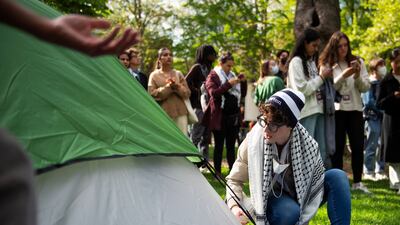
Students and faculty of Drexel University and University of Pennsylvania erect an encapment to protest against the war in Gaza, at the University of Pennsylvania campus, in Philadelphia. AFP -
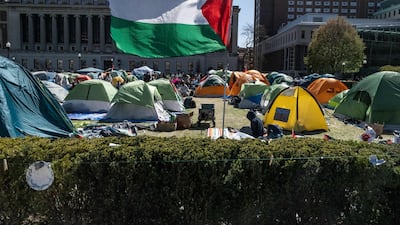
Columbia University students continue their demonstration on campus afterlast week's arrest of more than 100 protesters, in New York City. Getty Images -
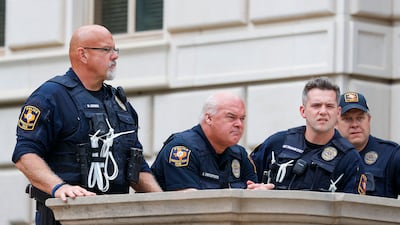
Police watch as students and faculty show support at a Protect Palestine Rally at the University of Texas, in Austin. EPA -
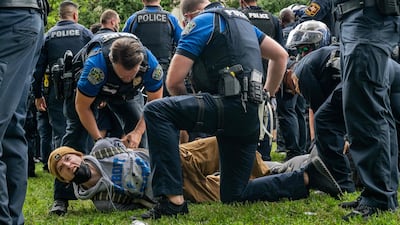
A student is arrested during a pro-Palestine demonstration at the University of Texas at Austin. Getty Images -
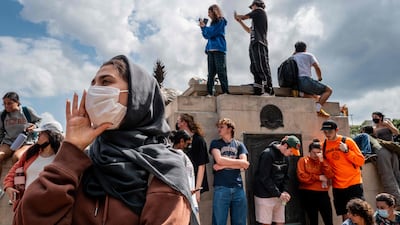
Students rally at the University of Texas at Austin, where police arrested scores of protesters. Getty images -
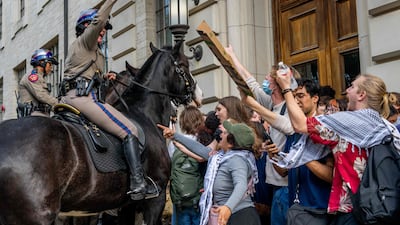
Mounted police confront students protesting against the war in Gaza, at the University of Texas at Austin. Getty Images -
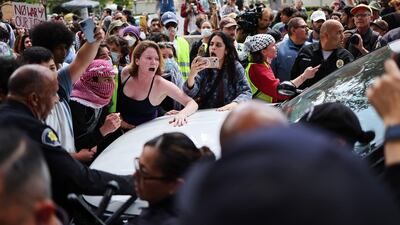
Pro-Palestine demonstrators argue with University of Southern California officials, who attempted to take down an encampment set up in support of Gaza, at the institution in Los Angeles. Getty images -
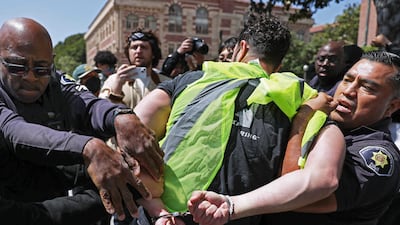
University of Southern California police officers detain a pro-Palestine demonstrator. Getty Images -
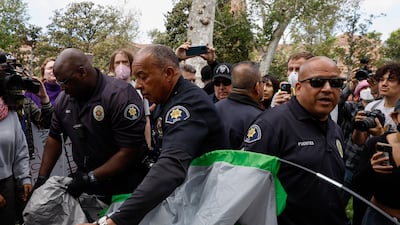
University of Southern California officers dismantle protesters' tents. EPA -
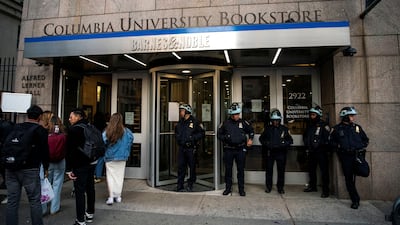
Police stand guard at an entrance to Columbia University, in New York City, where students continue to protest in support of Palestinians, amid the war in Gaza. Reuters -
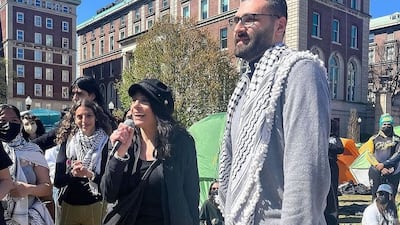
Najla Said, daughter of Palestinian-American academic and literary critic Edward Said, and Motaz Azaiza, a Palestinian photojournalist from Gaza, join the Gaza solidarity encampment at Columbia University. Photo: Columbia Students for Justice in Palestine -
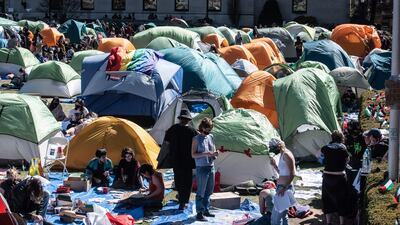
As the campus protests continue, Columbia has moved its classes online. AFP -
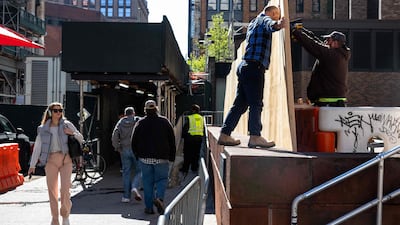
Workers erect a wooden barrier at New York University Stern School of Business after an encampment set up by students was cleared out on Monday night. Getty Images -
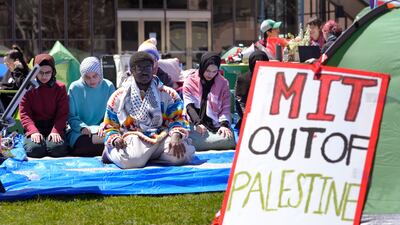
Massachusetts Institute of Technology student Isa Liggans, front left, takes part in Muslim prayer with others, at an encampment of tents at the college, in Cambridge, Massachusetts. AP -
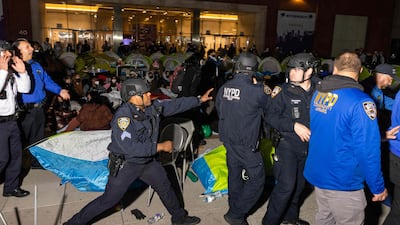
Police officers disperse pro-Palestinian students and protesters who set up an encampment on the campus of New York University. AFP -
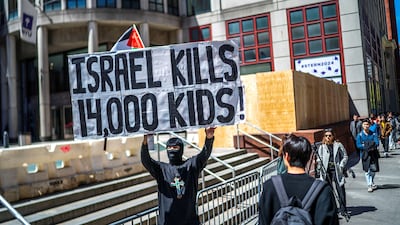
A protester outside New York University. Reuters -
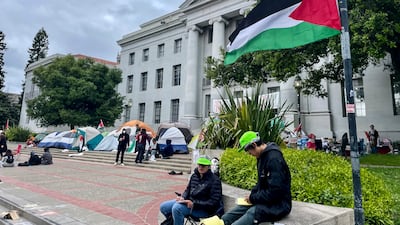
Pro-Palestinian protesters gather in front of Sproul Hall on the campus of the University of California, Berkeley. AP -
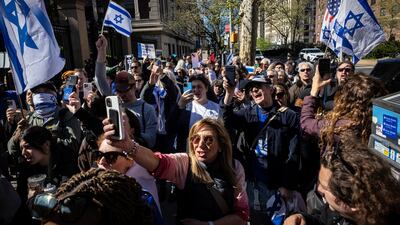
Pro-Israeli demonstrators chant 'shame' after Columbia University assistant professor Shai Davidai was denied access to the main campus. AP -
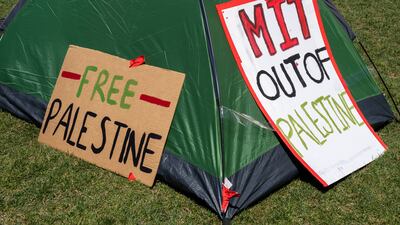
A tent used by pro-Palestinian demonstrators at MIT. Bloomberg -
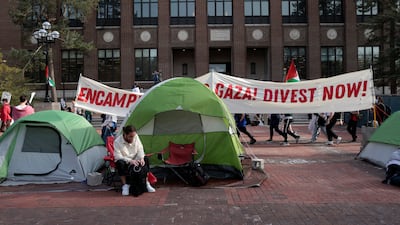
A coalition of University of Michigan students rally to pressure the university to divest its endowment from companies that support Israel. Reuters -
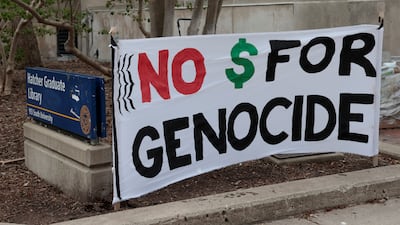
A sign at the University of Michigan. Reuters -
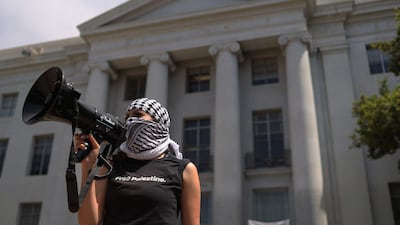
A pro-Palestinian protester in front of Sproul Hall in Berkeley, California. Getty Images / AP -
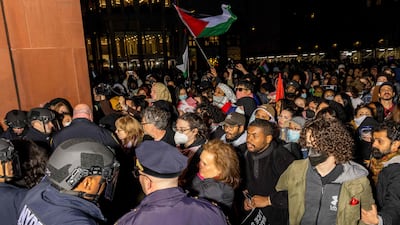
Police officers detain pro-Palestinian students and protesters at New York University. AFP -
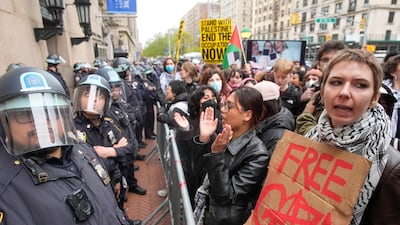
Police in Riot gear stand guard as demonstrators chant slogans outside the Columbia University campus. AP -
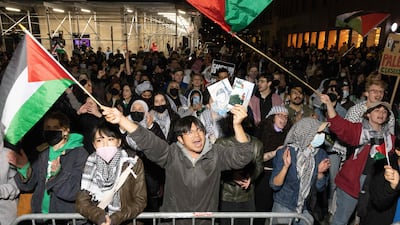
Pro-Palestinian students and activists protest against the Israel-Gaza war on the campus of New York University. AFP


Non-state actors are also having their say. In January, the ICJ delivered what The Economist called a “stinging rebuke” to Israel over Gaza, and the International Criminal Court is now said to be mulling an arrest warrant for Mr Netanyahu. Under pressure from protesters, many US universities, including Ivy League schools known for producing top American officials, have begun to discuss cutting financial ties to Israel. [Fittingly, one of the student leaders negotiating with Columbia University is a Turkey-born master’s student in human rights.]
Thus, Ankara’s decision was of a piece with growing global condemnation and isolation of Israel. The move may also better position Turkey to host Hamas. Several reports suggest that the US wants Qatar to eject the group, which would then have to find a new home. Hamas leader Ismail Haniyeh has been in Turkey since meeting Mr Erdogan and met several other political figures, hinting at a longer stay.
Regardless of the motivations, Ankara’s move is a clear criticism and a harsh punishment likely to undermine Israel’s war effort. Mr Erdogan said last week that in addition to forcing Israel to agree to a ceasefire, he hopes Turkey’s embargo can serve as an example.
Critics of Mr Erdogan and pro-Israel folk like to paint Turkey as morally bankrupt, while Palestinians and their supporters say much the same of Israel. One may now gain pariah status. Will other countries follow Turkey’s lead, or will the US and Europe show their embrace of Israel by finding ways to apply pressure on Ankara to reverse course?
Assuming Israeli forces enter and occupy Rafah, the answer may be yes, on both counts.

