


I remember the days immediately after the September 11 attacks. A group of Muslim women, we met in a coffee shop, to the backdrop of an eerily empty London. We wondered if we would be safe, but we also did not want to be cowed as Muslims by the threats in the air. In fact, we faced double threats: from the same people who perpetrated the attack, as well as those who now openly exhibited a menacing Islamophobia. That time is a collection of vignettes in my memory: my dad being jostled for being Muslim, a friend wearing a hijab having her nose broken while sitting on the train, Muslim friends and colleagues with “Muslim” names having their bank accounts frozen.
My public “coming of age” happened in the shadow of 9/11, as it did for a generation of Muslims. Before I felt more like a private individual minding my own business and getting on with living my life. Then, the post 9/11 world co-opted my whole identity. The choice was to disengage from everything I was and hide, or to step up and own my “Muslimness”, and challenge the horrible prejudice, discriminations and restrictions that loomed around us all.
In fact, my whole identity and activist work was shaped by the spotlight on Muslims at that time and the public discourse about Muslims. The declared War on Terror often felt like a euphemism for war on Muslims. Actual war ensued, with hundreds of thousands of deaths, including occupation and atrocities. I learnt a lot going through that phase about engagement with society, with business, culture, narratives, stereotypes, politics and the building of a global Muslim ummah through emergent internet technologies. I even wrote a book and coined an industry-defining phrase – Generation M: Young Muslims Changing the World – about those who were bringing faith and modernity together, proud of being Muslim and embracing new tech and societal changes.
-
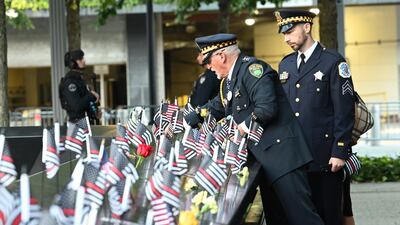
Retired Willow Springs, Illinois Chief of Police Sam Pulia and his nephew, Chicago Police Sgt Daniel Pulia, place flags at the South Tower ahead of ceremonies to mark the 20th anniversary of the 9/11 attacks. EPA -
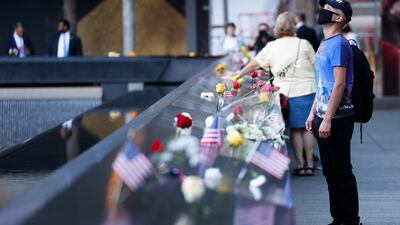
People visit the 9/11 memorial on the 20th anniversary of the September 11 attacks in Manhattan, New York. EPA -
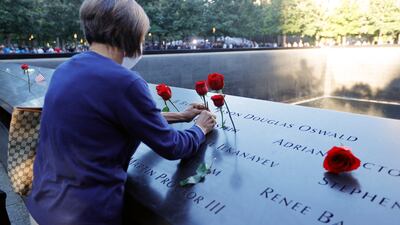
A woman places flowers on the 9/11 memorial. EPA -
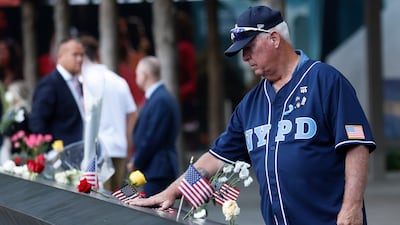
A man takes a moment to remember those who lost their lives in the attacks. EPA -

A woman places flowers at the South Tower ahead of ceremonies to mark the 20th anniversary of the 9/11 attacks. EPA -
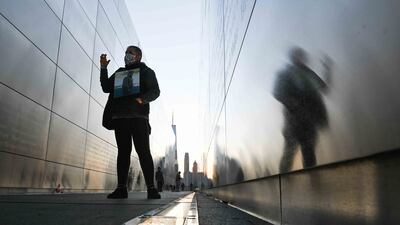
Claudia Castano speaks about her memory of her brother German who's name is etched at the Empty Sky 9/11 Memorial in Liberty State Park in Jersey City, New Jersey. AFP -
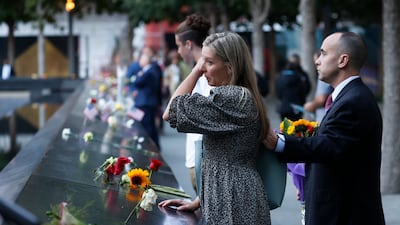
People mourn at the 9/11 Memorial on the 20th anniversary of the September 11 attacks in Manhattan, New York City, U. S. EPA -
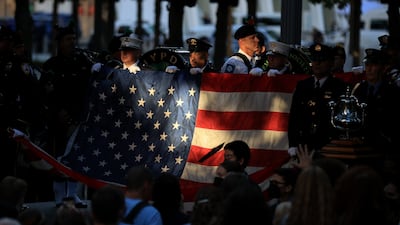
Members of the New York Police and Fire Department hold a flag for the national anthem during the annual 9/11 Commemoration Ceremony at the National 9/11 Memorial and Museum in New York City. AFP -
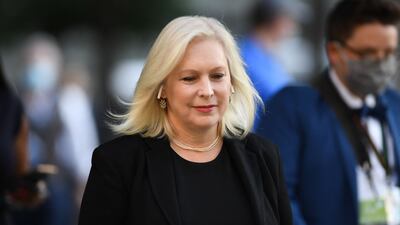
Kirsten Gillibrand arrives at a ceremony at Ground Zero held in commemoration of the 20th anniversary of the terrorist attacks on the World Trade Center, the Pentagon and the crash of United Airlines Flight 93 in Shanksville, PA, held in lower Manhattan, New York City. -
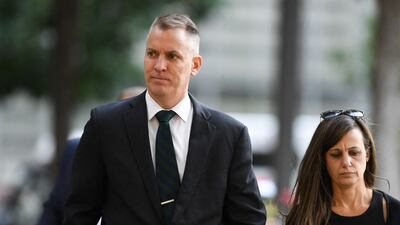
Police commissioner Dermot Shea arrives at a ceremony at Ground Zero held in commemoration of the 20th anniversary of the terrorist attacks on the World Trade Center, the Pentagon and the crash of United Airlines Flight 93 in Shanksville, PA, held in lower Manhattan, New York. AFP -
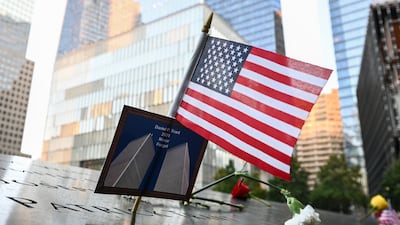
An American flag placed along with a photo of the Twin Towers and the name Daniel P. Trant, a Cantor Fitzgerald bond trader that died during 9/11, before ceremonies to commemorate the 20th anniversary of the Sept. 11 terrorist attacks at the National September 11 Memorial & Museum in New York. AP -
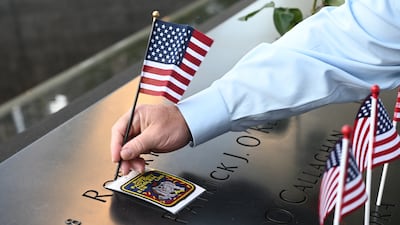
A 9. 11 Memorial staff member places a flag at the South Tower before ceremonies marking the 20th anniversary of the 9. 11 attack at the World Trade Center in New York which killed almost 3,000 people. EPA -
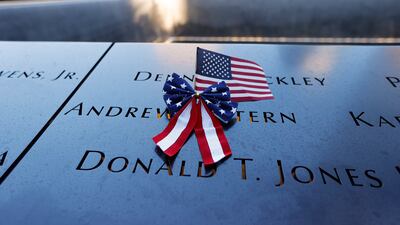
A U. S. flag is seen on the 9/11 Memorial on the 20th anniversary of the September 11 attacks in Manhattan, New York City, U. S. EPA -
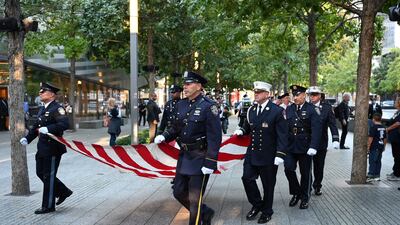
A NYPD Honor Guard marches in with a damaged American Flag at the South Tower before ceremonies marking the 20th anniversary of the 9. 11 attack at the World Trade Center in New York which killed almost 3,000 people. EPA -
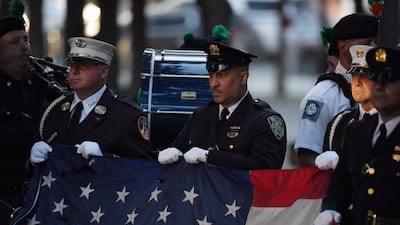
New York police and firefighters hold a US flag as a band plays the US National Anthem at the National 9/11 Memorial during a ceremony commemorating the 20th anniversary of the 9/11 attacks on the World Trade Center, in New York. AFP -
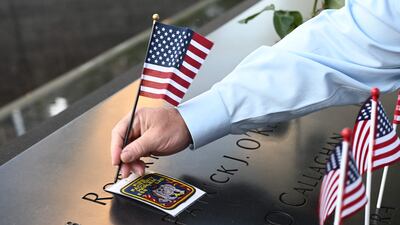
A 9. 11 Memorial staff member places a flag at the South Tower before ceremonies marking the 20th anniversary of the 9. 11 attack at the World Trade Center in New York which killed almost 3,000 people. AFP -
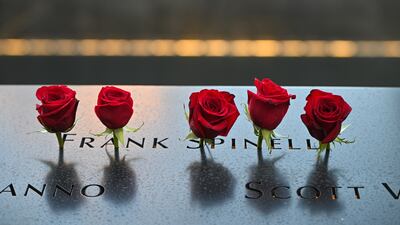
Flowers placed at the name of Frank Spinelli at the 9/11 memorial during a ceremony at Ground Zero held in commemoration of the 20th anniversary of the terrorist attacks on the World Trade Center, the Pentagon and the crash of United Airlines Flight 93 in Shanksville, PA, held in lower Manhattan, New York City, NY, USA. EPA -
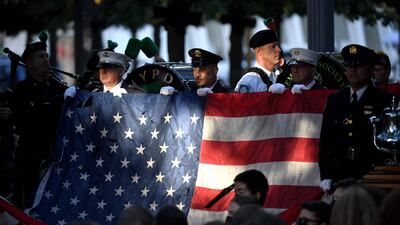
New York police and firefighters hold a US flag as a band plays the US National Anthem at the National 9/11 Memorial during a ceremony commemorating the 20th anniversary of the 9/11 attacks on the World Trade Center, in New York. AFP -

A man places American flags on the South Pool of the 9/11 Memorial during a ceremony marking the 20th anniversary of the 11 September 2001 terrorist attacks in New York, New York, USA,. EPA -
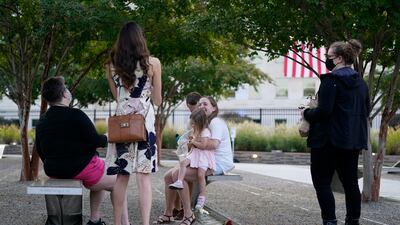
Family members sit on a bench that honors their loved one at the National 9/11 Pentagon Memorial opened in 2008, that commemorates the lives lost at the Pentagon and onboard American Airlines Flight 77, at the Pentagon in Washington. An American flag was unfurled at the Pentagon at sunrise on the morning of the 20th anniversary of the terrorist attacks and is draped over the site of impact at the Pentagon. AP -
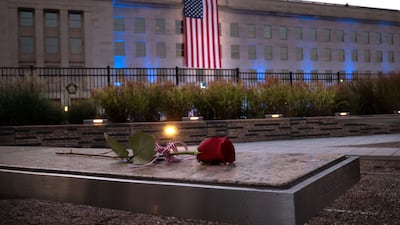
A rose lays on a bench at the National 9/11 Pentagon Memorial in Arlington, Virginia. The nation is marking the 20th anniversary of the terror attacks of September 11, 2001, when the terrorist group al-Qaeda flew hijacked airplanes into the World Trade Center, Shanksville, PA and the Pentagon, killing nearly 3,000 people. AFP -
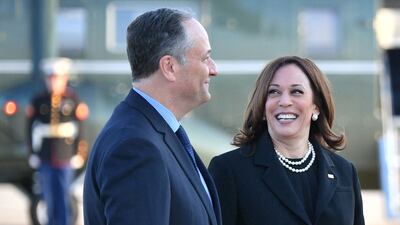
US Vice President Kamala Harris and her husband Doug Emhoff make their way to board a flight before departing from Andrews Air Force Base in Maryland . - Vice President Harris is heading to Shanksville, Pennsylvania to attend a 9/11 commemoration. AFP -
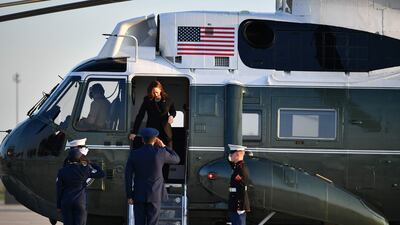
US Vice President Kamala Harris and her husband Doug Emhoff make their way to board a flight before departing from Andrews Air Force Base in Maryland. - Vice President Harris is heading to Shanksville, Pennsylvania to attend a 9/11 commemoration. AFP -
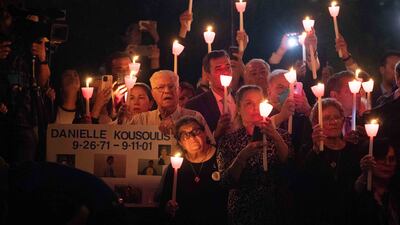
People attend a 9/11 commemoration ceremony at the Greek Orthodox St Nicholas National Shrine adjacent to the 9/11 Memorial and Museum in New York. AFP -
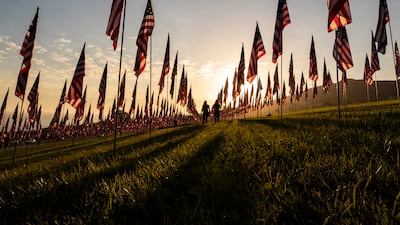
People walk among the flags of the commemorative installation 'Waves of Flags' on the eve of the 20th anniversary of 9/11 at the Pepperdine University in Malibu, California. EPA -
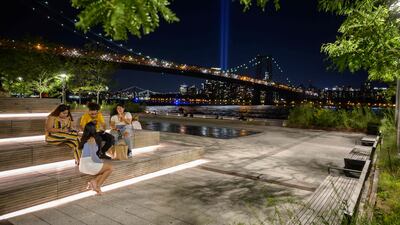
People sit in front of the 'Tribute in Light' installation in New York, commemorating the 9/11 terrorist attacks. AFP -
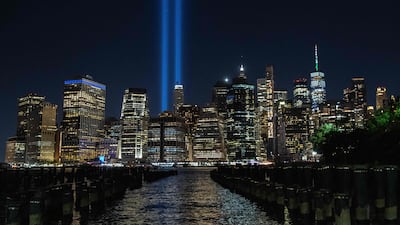
The annual 'Tribute in Light' marking the the 9/11 attacks on the World Trade Centre shines within lower Manhattan's skyline in New York. AFP -
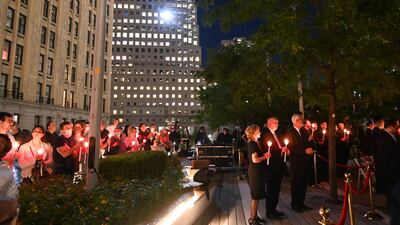
People hold candles in New York as they remember those who lost their lives in the attacks. AFP -
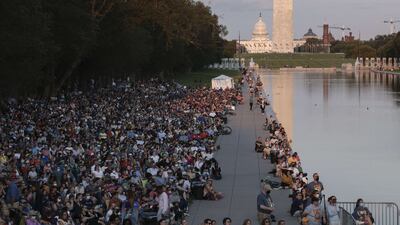
People watch the cast of the Broadway musical ‘Come From Away' perform a free concert in front of the Lincoln Memorial in Washington. AFP -
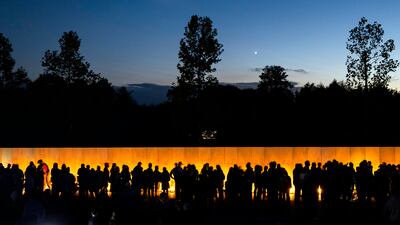
On the eve of the 20th anniversary of 9/11, the Friends of Flight 93 host the Luminaria Ceremony at Flight 93 National Memorial Plaza in Shanksville, Pennsylvania. EPA -
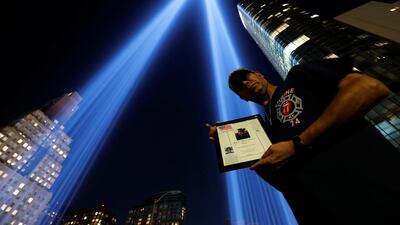
Sergeant Edwin Morales holds a photo of his cousin, Rubin Correa from Engine 74, by the Tribute in Light installation in New York. Reuters -
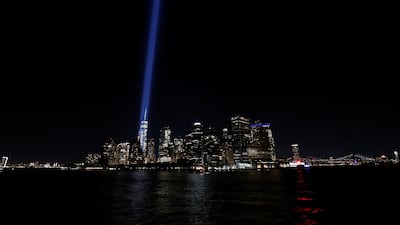
The Tribute in Light installation and World Trade Centre shine bright at night. Reuters -
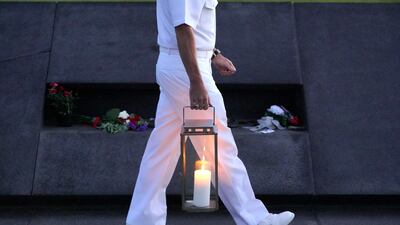
A candlelight memorial remembers the passengers and crew of United Flight 93 at the Flight 93 National Memorial in Shanksville. AP -
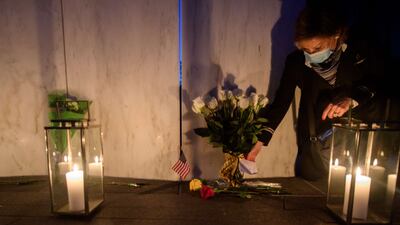
A flight attendant reads a card with flowers at the Wall of Names at the Flight 93 National Monument during the Luminaria Ceremony in Shanksville, Pennsylvania. AFP -
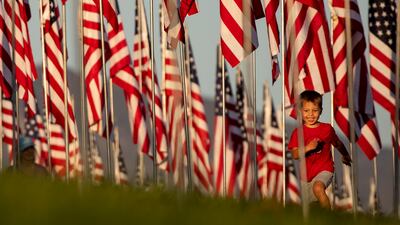
Finley, three, runs among the 'Waves of Flags' installation at the Pepperdine University in Malibu, California. EPA


Skip forward a generation, 22 years, to October 2023 and there feels like an echo. I see a generation of young people having a similar cataclysmic reaction to the events and public mood are unfolding after October 7. For these young people – not even born in 2001, or too young to remember it – the events of 9/11 and its aftermath for Muslims domestically and globally are not well known, or perhaps even something to read about in past history, something potentially irrelevant to them.
But what now I see are many similarities of the “wake up”: the anger, the protests, the scales falling from the eyes, the disappointment and the mobilisation. But the world is different, and I also see those differences playing out. After 9/11, as a generation of young Muslims reinterpreting the world, we were forced into a narrative against our will of “clash of civilisations”. Whereas now there are terms and intellectual frameworks to help us contextualise it more – post-colonialism, discussions of racism, imperialism as well as alignment of different justice-seeking groups. For younger people today, having their own framework brings power rather than forcing them onto the back foot.
The media and public discourse also ran differently before. After 9/11 there was control of the mainstream narrative by a small number of media and political gatekeepers, which is why so many of us, including me, started speaking up. Whereas now that flow of information and conversation is to a great extent in the hands of social media and “ordinary” people or experts. But in a further twist, the network distribution of conversation and influence has also allowed misinformation, disinformation and fake news to be woven copiously into those conversations.
Perhaps the biggest change is a coalition of young people extending beyond just Muslims. As Generation M Muslims emerged, my prediction was always an extension into the language and actions of “universal values”, and we have seen exactly that happen in this new generational reaction to October 7. It has embraced Gen Z, young Muslims and beyond, coalescing around these shared markers of equality, injustice and new forms of colonialism which have reinvented themselves from old forms. After September 11, these identities were forged in the newly emerging internet space. In today’s context, that is happening on social media.
Now, consumer power is being wielded for boycotts, as ordinary people feel governments are not doing enough and they should take things into their own hands. But more than that – individuals working collectively are achieving systemic change. And again, it’s not just Muslims. This new wave is engaging in this behaviour on universal values that don’t necessarily use Muslim language, but in a broader vocabulary of humanity.
However, as they say, plus ca change. And what is most depressing is how Islamophobic tropes about Muslims are emerging with their chest filled up once again now, just as they took hold after 9/11.
But what seems the most potent echo are the feelings that things have forever changed, that after the pivotal event and its immediate aftermath, the new perspectives are now the “new normal” with no return to how things ever were.

