Protesters calling for a ceasefire in Gaza raise their arms as US Secretary of State Antony Blinken testifies in Washington last October. EPA


What's missing from America's Palestine policy? The human element


  • English
  • Arabic

March 25, 2024

Officials in Washington and their counterparts in Israel are sitting around tables making plans for what they want to see after Israel ends its assault on Gaza.

From what I’ve read, their plans are either insensitive or delusional because they fail to consider that the issue isn’t who runs what and how it will be run. What must be understood is that the wounds inflicted by this war will last and will define reality for a generation or more.

These are the personal, not the political, consequences of this war. The loss and trauma inflicted in so many ways on millions of Palestinian victims are hardly ever factored into the calculations by Israeli policymakers or their enablers in Washington. To them Palestinians have always been mere pawns on a chessboard, objects to be moved or cast off, at will.

In a real sense, herein lies the root of the entire conflict. From the beginning, neither the British nor the early Zionist leaders saw the indigenous Arab population as full human beings.

When learning of the British plans to secure a Mandate and turn it over to the Zionist movement for a Jewish colony in Palestine, the Americans sent a team to survey the opinions of the Arabs. What they found was a near-total Arab rejection of both the Mandate and the Zionist enterprise.

On hearing of the results, the British Lord Balfour was quoted saying: “In Palestine, we do not propose … consulting the wishes of the present inhabitants of the country. Zionism, be it right or wrong, good or bad, is … of far profounder import than the desires and prejudices of the 700,000 Arabs who now inhabit that ancient land.”

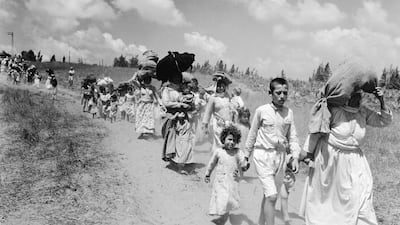
  • Women and children carry personal belongings on the five-kilometre journey through no man's land to the Arab lines in Tulkarim, June 1948. They were brought by lorry to this point from an Arab village near Haifa. Getty Images
    Women and children carry personal belongings on the five-kilometre journey through no man's land to the Arab lines in Tulkarim, June 1948. They were brought by lorry to this point from an Arab village near Haifa. Getty Images
  • An elderly Palestinian refugee in the Hussein refugee camp, also known as the Camp of Return. Reuters
    An elderly Palestinian refugee in the Hussein refugee camp, also known as the Camp of Return. Reuters
  • The day after the state of Israel was founded, a group of Haganah fighters celebrate after taking control of the Arab town of Jaffa, to the south of Tel Aviv. Reuters
    The day after the state of Israel was founded, a group of Haganah fighters celebrate after taking control of the Arab town of Jaffa, to the south of Tel Aviv. Reuters
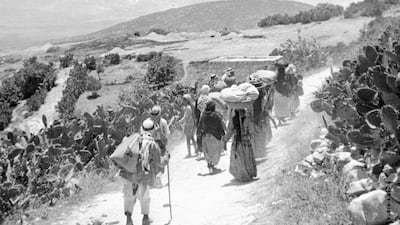
  • Arabs carrying possessions on their heads flee from a village in Galilee about five months after the creation of the state of Israel. Reuters
    Arabs carrying possessions on their heads flee from a village in Galilee about five months after the creation of the state of Israel. Reuters
  • Arabs fleeing from a village in Galilee pass a burnt-out vehicle on a mountain road about five months after the creation of the state of Israel. Reuters
    Arabs fleeing from a village in Galilee pass a burnt-out vehicle on a mountain road about five months after the creation of the state of Israel. Reuters
  • Arab refugees return to their village after its surrender during the 1948 war that followed the foundation of Israel. AFP
    Arab refugees return to their village after its surrender during the 1948 war that followed the foundation of Israel. AFP
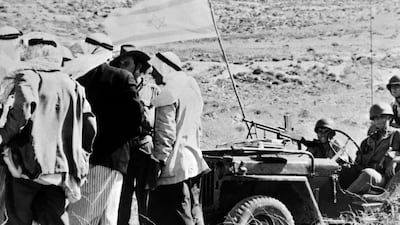
  • Palestinians speak with Israeli soldiers near a captured Arab village during the 1948 war. AFP
    Palestinians speak with Israeli soldiers near a captured Arab village during the 1948 war. AFP
I reminded a White House official that it wasn’t either Palestinian suffering or Israeli suffering. It was both

The founders of the Zionist movement shared this sentiment. Figures such as Max Nordau wrote that the Jewish people were “more industrious and more able than the average European, not to speak at all of the inert Asiatic and African”. And they believed that the colony they would build would be a “rampart of Europe against Asia, an outpost of civilisation as opposed to barbarism”.

This deeply racist mindset found its best expression in the 1960 film The Exodus that transposed the American “cowboys and Indians” storyline onto the Palestinian-Israeli conflict – with Israelis as pioneers seeking freedom for themselves and their families, facing hordes of savages who sought only to kill them. The conflict was thus reduced to “Israeli humanity versus the Palestinian problem”. And what was needed was a way to defeat, subdue, or solve the “problem” so that Israeli humanity could realise their dreams.

This remains the thinking of too many policymakers in Washington.

As they grieved with the Israelis over the trauma of October 7, they could see the Israelis as real people with whom they identified and for whom they mourned, while Palestinians remained an abstraction receiving little sympathy. This is why it has taken months for any real expressions of compassion for tens of thousands of Palestinians dead and the attendant devastation of Palestinian homes and cities.

Early in this war, I spoke with a senior White House official. After he expressed his pain at the horrors of October 7, I told him that I understood and asked him to also consider Palestinian trauma. He angrily dismissed my appeal as “whataboutism”, suggesting that my intent was to justify or diminish the suffering of Israelis. I reminded him that it wasn’t either Palestinian suffering or Israeli suffering. It was both.

Parachutes carrying humanitarian aid dropped from an aircraft into Beit Hanoun, northern Gaza Strip, seen from southern Israel on Monday. AP

Five months later, with more than 32,000 dead Palestinians and the entire population of Gaza on the brink of famine, attention is finally being paid by the administration. But it’s too little and too late.

Despite the White House focus on the humanitarian crisis – lack of food, water, medicine and housing – there is still no appreciation for the deeper toll inflicted on Palestinian lives. If the US, Israel’s strongest ally, recognised the true toll, it wouldn’t just be dropping in aid or building a pier, or thinking that a reformed Palestinian Authority doing the work of Israel’s occupation in Gaza was an acceptable “day after” scenario.

If they saw Palestinians as equal human beings, they would tell the Israelis to stop bombing. They would remove the block on UNRWA. They would support a UN resolution that would send international forces into Gaza and the West Bank, ending the illegal Israeli occupation of both. And they would set up an international relief and reconstruction effort not only to rebuild Gaza, but also to send in teams of doctors to address the physical and psychological wounds of this war.

They would, in other words, demonstrate the sense of urgency, compassion and care that human beings deserve.

My recommendation to the officials sitting around the tables in the White House is: “Before you start, think of how you would want your families treated if they have been subjected to the horrors of the past five months. Think of what they would need so that their wounds can heal and not fester. The losses they’ve endured can’t be forgotten, nor can the trauma they’ve experienced be erased. How would you want your families to be treated? If you are able to do that, then proceed. If you can’t, then step aside and find someone who can.”


Mercer, the investment consulting arm of US services company Marsh & McLennan, expects its wealth division to at least double its assets under management (AUM) in the Middle East as wealth in the region continues to grow despite economic headwinds, a company official said.

Mercer Wealth, which globally has $160 billion in AUM, plans to boost its AUM in the region to $2-$3bn in the next 2-3 years from the present $1bn, said Yasir AbuShaban, a Dubai-based principal with Mercer Wealth.

Within the next two to three years, we are looking at reaching $2 to $3 billion as a conservative estimate and we do see an opportunity to do so,” said Mr AbuShaban.

Mercer does not directly make investments, but allocates clients’ money they have discretion to, to professional asset managers. They also provide advice to clients.

“We have buying power. We can negotiate on their (client’s) behalf with asset managers to provide them lower fees than they otherwise would have to get on their own,” he added.

Mercer Wealth’s clients include sovereign wealth funds, family offices, and insurance companies among others.

From its office in Dubai, Mercer also looks after Africa, India and Turkey, where they also see opportunity for growth.

Wealth creation in Middle East and Africa (MEA) grew 8.5 per cent to $8.1 trillion last year from $7.5tn in 2015, higher than last year’s global average of 6 per cent and the second-highest growth in a region after Asia-Pacific which grew 9.9 per cent, according to consultancy Boston Consulting Group (BCG). In the region, where wealth grew just 1.9 per cent in 2015 compared with 2014, a pickup in oil prices has helped in wealth generation.

BCG is forecasting MEA wealth will rise to $12tn by 2021, growing at an annual average of 8 per cent.

Drivers of wealth generation in the region will be split evenly between new wealth creation and growth of performance of existing assets, according to BCG.

Another general trend in the region is clients’ looking for a comprehensive approach to investing, according to Mr AbuShaban.

“Institutional investors or some of the families are seeing a slowdown in the available capital they have to invest and in that sense they are looking at optimizing the way they manage their portfolios and making sure they are not investing haphazardly and different parts of their investment are working together,” said Mr AbuShaban.

Some clients also have a higher appetite for risk, given the low interest-rate environment that does not provide enough yield for some institutional investors. These clients are keen to invest in illiquid assets, such as private equity and infrastructure.

“What we have seen is a desire for higher returns in what has been a low-return environment specifically in various fixed income or bonds,” he said.

“In this environment, we have seen a de facto increase in the risk that clients are taking in things like illiquid investments, private equity investments, infrastructure and private debt, those kind of investments were higher illiquidity results in incrementally higher returns.”

The Abu Dhabi Investment Authority, one of the largest sovereign wealth funds, said in its 2016 report that has gradually increased its exposure in direct private equity and private credit transactions, mainly in Asian markets and especially in China and India. The authority’s private equity department focused on structured equities owing to “their defensive characteristics.”

What is a robo-adviser?

Robo-advisers use an online sign-up process to gauge an investor’s risk tolerance by feeding information such as their age, income, saving goals and investment history into an algorithm, which then assigns them an investment portfolio, ranging from more conservative to higher risk ones.

These portfolios are made up of exchange traded funds (ETFs) with exposure to indices such as US and global equities, fixed-income products like bonds, though exposure to real estate, commodity ETFs or gold is also possible.

Investing in ETFs allows robo-advisers to offer fees far lower than traditional investments, such as actively managed mutual funds bought through a bank or broker. Investors can buy ETFs directly via a brokerage, but with robo-advisers they benefit from investment portfolios matched to their risk tolerance as well as being user friendly.

Many robo-advisers charge what are called wrap fees, meaning there are no additional fees such as subscription or withdrawal fees, success fees or fees for rebalancing.

Jetour T1 specs

Engine: 2-litre turbocharged

Power: 254hp

Torque: 390Nm

Price: From Dh126,000

Available: Now

Living in...

This article is part of a guide on where to live in the UAE. Our reporters will profile some of the country’s most desirable districts, provide an estimate of rental prices and introduce you to some of the residents who call each area home.

How%20champions%20are%20made
%3Cp%3E%0D%3Cstrong%3EDiet%3C%2Fstrong%3E%20%0D%3Cbr%3E7am%20-%20Protein%20shake%20with%20oats%20and%20fruits%0D%3Cbr%3E10am%20-%205-6%20egg%20whites%0D%3Cbr%3E1pm%20-%20White%20rice%20or%20chapati%20(Indian%20bread)%20with%20chicken%0D%3Cbr%3E4pm%20-%20Dry%20fruits%20%0D%3Cbr%3E7.30pm%20-%20Pre%20workout%20meal%20%E2%80%93%20grilled%20fish%20or%20chicken%20with%20veggies%20and%20fruits%0D%3Cbr%3E8.30pm%20to%20midnight%20workout%0D%3Cbr%3E12.30am%20%E2%80%93%20Protein%20shake%20%0D%3Cbr%3E%3Cstrong%3ETotal%20intake%3A%3C%2Fstrong%3E%204000-4500%20calories%20%0D%3Cbr%3E%3Cstrong%3ESaidu%E2%80%99s%20weight%3A%3C%2Fstrong%3E%20110%20kg%0D%3Cbr%3E%3Cstrong%3EStats%3A%3C%2Fstrong%3E%20Biceps%2019%20inches.%20Forearms%2018%20inches%3C%2Fp%3E%0A
The National Archives, Abu Dhabi

Founded over 50 years ago, the National Archives collects valuable historical material relating to the UAE, and is the oldest and richest archive relating to the Arabian Gulf.

Much of the material can be viewed on line at the Arabian Gulf Digital Archive - https://www.agda.ae/en

Avatar: Fire and Ash

Director: James Cameron

Starring: Sam Worthington, Sigourney Weaver, Zoe Saldana

Rating: 4.5/5

Dengue%20fever%20symptoms
%3Cul%3E%0A%3Cli%3EHigh%20fever%3C%2Fli%3E%0A%3Cli%3EIntense%20pain%20behind%20your%20eyes%3C%2Fli%3E%0A%3Cli%3ESevere%20headache%3C%2Fli%3E%0A%3Cli%3EMuscle%20and%20joint%20pains%3C%2Fli%3E%0A%3Cli%3ENausea%3C%2Fli%3E%0A%3Cli%3EVomiting%3C%2Fli%3E%0A%3Cli%3ESwollen%20glands%3C%2Fli%3E%0A%3Cli%3ERash%3C%2Fli%3E%0A%3C%2Ful%3E%0A%3Cp%3EIf%20symptoms%20occur%2C%20they%20usually%20last%20for%20two-seven%20days%3C%2Fp%3E%0A
Tips to keep your car cool
  • Place a sun reflector in your windshield when not driving
  • Park in shaded or covered areas
  • Add tint to windows
  • Wrap your car to change the exterior colour
  • Pick light interiors - choose colours such as beige and cream for seats and dashboard furniture
  • Avoid leather interiors as these absorb more heat
Spec%20sheet
%3Cp%3E%3Cstrong%3EDisplay%3A%3C%2Fstrong%3E%204.7%22%20Retina%20HD%2C%201334%20x%20750%2C%20625%20nits%2C%201400%3A1%2C%20True%20Tone%2C%20P3%3Cbr%3E%3Cstrong%3EChip%3A%3C%2Fstrong%3E%20Apple%20A15%20Bionic%2C%206-core%20CPU%2C%204-core%20GPU%2C%2016-core%20Neural%20Engine%3Cbr%3E%3Cstrong%3ECamera%3A%3C%2Fstrong%3E%2012MP%2C%20f%2F1.8%2C%205x%20digital%20zoom%2C%20Smart%20HDR%2C%20Deep%20Fusion%3Cbr%3E%3Cstrong%3EVideo%3A%3C%2Fstrong%3E%204K%2B%40%2024%2F30%2F60fps%2C%20full%20HD%2B%40%2030%2F60fps%2C%20HD%2B%40%2030%20fps%3Cstrong%3E%3Cbr%3EFront%20camera%3A%20%3C%2Fstrong%3E7MP%2C%20f%2F2.2%2C%20Smart%20HDR%2C%20Deep%20Fusion%3B%20HD%20video%2B%40%2030fps%3Cbr%3E%3Cstrong%3EBattery%3A%3C%2Fstrong%3E%20Up%20to%2015%20hours%20video%2C%2050%20hours%20audio%3B%2050%25%20fast%20charge%20in%2030%20minutes%20with%2020W%20charger%3B%20wireless%20charging%3Cbr%3E%3Cstrong%3EBiometrics%3A%3C%2Fstrong%3E%20Touch%20ID%3Cbr%3E%3Cstrong%3EDurability%3A%3C%2Fstrong%3E%20IP67%2C%20dust%2C%20water%20resistant%20up%20to%201m%20for%2030%20minutes%3Cbr%3E%3Cstrong%3EPrice%3A%3C%2Fstrong%3E%20From%20Dh1%2C849%3C%2Fp%3E%0A


Updated: March 25, 2024, 4:58 PM