


With every year that passes, World Water Day and the UN’s annual World Water Development Report serve as a stark reminder that global water scarcity is fast outpacing our progress to address it. The World Economic Forum predicts that by 2030, global freshwater demand is expected to outstrip supply by 40 per cent.
Despite living on a “blue” planet, less than 1 per cent of Earth’s water is potable freshwater. The ripple effect of this water scarcity can significantly impact our health, well-being and social mobility.
In the UAE – a nation with limited freshwater sources – we are acutely aware of the challenges posed by meeting the potable water demand of our growing population. While the country has developed a major water desalination infrastructure and is one of the global leaders in this field, we know that the process, while effective, is also energy intensive.

Last month, President Sheikh Mohamed launched the Mohamed bin Zayed Water Initiative to enhance awareness of water scarcity and increase the pace of technological innovation. The new initiative builds on the recent discussion paper Ripple Effect Water Scarcity – The Hidden Threat to Global Security and Prosperity, which was published by the UAE government in September and identifies potential solutions to the ongoing crisis.
Utility companies play a pivotal role in contributing to the UAE’s targets set out in its Water Security Strategy 2036, which feeds into meeting the nation’s ambitious goal of reaching Net Zero by 2050.
Investing in reverse osmosis (RO) based water production, as EtihadWE has done, is one way to step up in achieving these objectives. The process uses significantly less energy than traditional thermal desalination. We recently inaugurated our NAQA’A plant in Umm Al Quwain– one of the largest RO seawater desalination plants in the world, and today EtihadWE is the only UAE utility with fully RO-based water production.
We also have an ambitious plan to reduce Non-Revenue Water (NRW) – water lost before it reaches the customer. Through a combination of rehabilitation programs in our networks, the implementation of smart metering, and advanced technology-based solutions to detect and correct leaks, we aim to reduce unnecessary water losses.
In our new water network control centre, operations at six locations will also become centralised, allowing for better monitoring and control, increased electrical efficiency in pumping and enhanced leak detection capability.
The Water Security Strategy 2036 aims to ensure a secure supply of water in various circumstances, including in normal conditions, an emergency and an extreme emergency. This is to ensure that the UAE is always fully prepared to meet the water security needs of the country in a sustainable way with minimal economic disruption.
EtihadWE has than 600 million imperial gallons per day (MIGD) of water storage capacity in its water distribution centres. Chief among them is the recently inaugurated Khuraijah water distribution centre in Ras Al Khaimah, which provides water security for both normal demand as well as in emergencies.
-
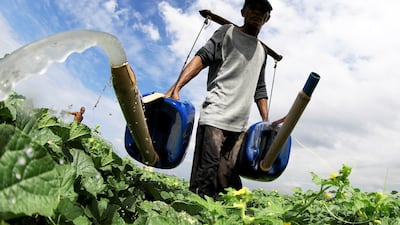
Watering vegetables in Taguig City, Philippines. Authorities say about 40 million Filipinos still lack access to a formal water supply while 74 million of the population have access to piped and potable water. World Water Day is observed annually on March 22, to highlight the global need for access to safe and clean water. EPA -
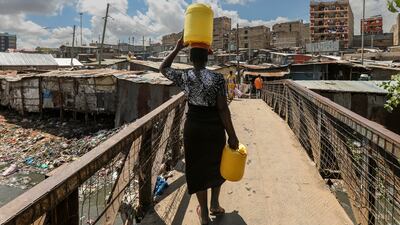
Fetching water in the Mathare slums of Nairobi, Kenya. Middlemen exploit shortages to sell water at exorbitant prices. PA -
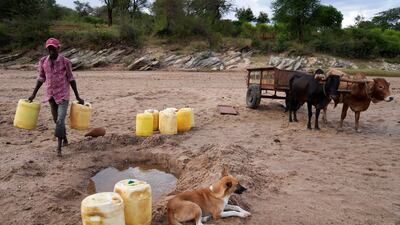
Drawing water from a hole in a sandy riverbed in Makueni County, Kenya. There have been fatal clashes between clans in the country who dispute each other’s access to water and pasturelands. AP -
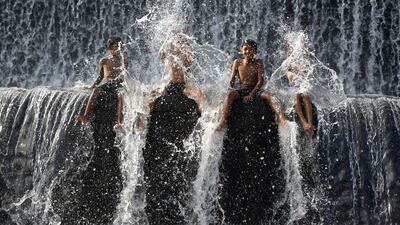
Residents bathe in a dam of the Unda river in Klungkung, Indonesia. AP -
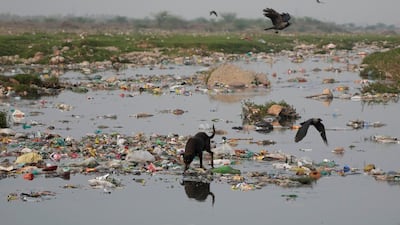
The polluted waters of the Tawi river in Jammu, India. AP -
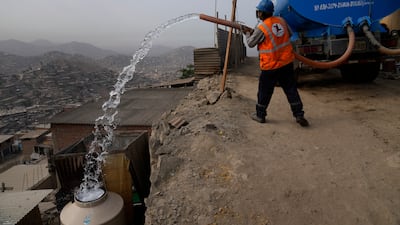
A water lorry worker fills tanks at houses in the Pamplona Alta area in Lima, Peru. Residents buy water for drinking, cooking and cleaning from private suppliers. AP -
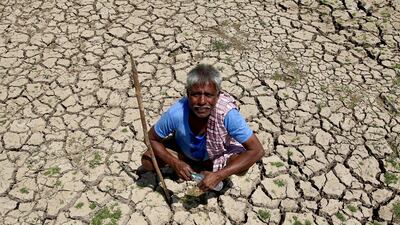
The dried Bheeman Lake bed on the outskirts of Bengaluru, India. EPA -

An internally displaced Palestinian girl carrying containers on the way to fetch water, in Khan Younis, southern Gaza Strip. EPA -
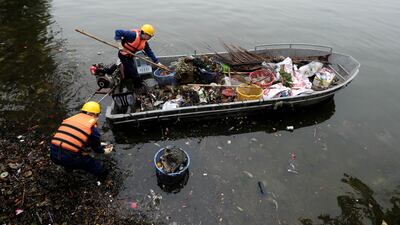
Workers remove waste from West Lake in Hanoi, Vietnam. EPA -

A communal well in Peshawar, Pakistan. The World Economic Forum predicts that by 2030, global freshwater demand is expected to outstrip supply by 40 per cent. EPA -
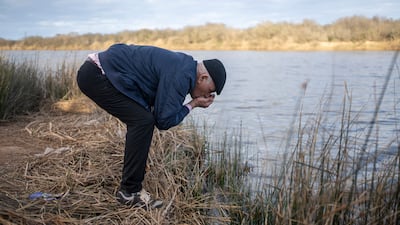
Mimoun Nadori tastes the water of the Moulouya River to check its salinity, in Nador, north of Morocco. Where the river once flowed from the mountains into the Mediterranean, it now sits stagnant, allowing seawater to creep inland and turning water from a source of life to a deadly poison. AP -
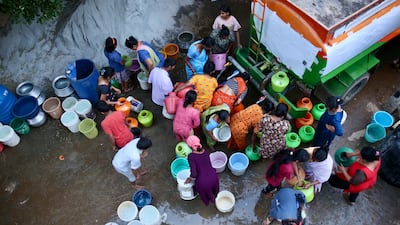
Residents collect clean drinking water from a free distribution water tanker in Rajarajeshwari Nagar, Bengaluru. EPA -
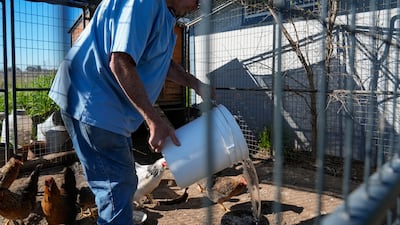
Fred Imfeld dumps water into a bowl for his chickens, in Corning, California. The US state is notorious for droughts and water shortages. AP -

Thousands of South Africans are lining up for water as the country's largest city, Johannesburg, confronts an unprecedented collapse of its water system affecting millions of people. AP -
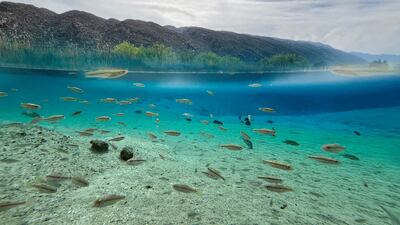
Mexico's pools of Poza de la Becerra. The 170 cactus-ringed pools contain important species of fish, snails, turtles, bacteria and unique living rock structures that offer important clues to life on Earth millions of years ago. Reuters -

A vessel cruises over the river Main in Frankfurt, Germany. AP -

Boats at Cardo Beach in Rio de Janeiro, Brazil. Reuters -

The polluted Dahisar River, passing through a residential district in Mumbai, India. EPA -
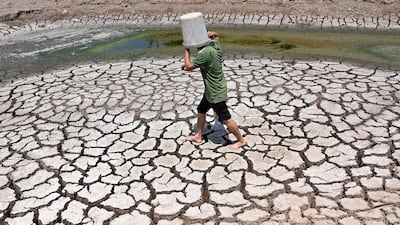
A dried-up pond in Vietnam's southern Ben Tre province. A blazing month-long heatwave has brought drought, parching the land in the region. AFP


But to ensure our approach is future-proof, we must bring everyone on the journey. This was the overwhelming message from Cop28 last year: collaboration is key to overcoming the climate crisis. At an industry level, this means a decisive, joined-up approach that engages customers, stakeholders, partners and employees.
Due to their scale, our extension and production projects demand a highly co-ordinated approach when it comes to building and operating storage and transmission infrastructure. Our strategic partners in the UAE are vital to helping us enhance the efficiency and sustainability of our networks.
Whilst investing heavily in innovation and pursuing high-level partnerships, we must not forget that social change essential to helping us reduce consumption.
We need to give consumers the tools to better manage and understand their usage so they have the power to reduce it. Our water conservation programmes have proved effective in reducing consumption through the installation of water-saving devices in schools, mosques and key government facilities.
The outcomes of Cop28 serve as evidence that great progress can be made when people have a shared vision. The power of collaboration is evident in the progress we have made to date but there is more work to be done. By transforming our own systems and processes we will inspire others to do the same.
This World Water Day let us work together across communities, sectors, regions and countries to share best practice and knowledge, make joint pledges, partner on projects and do the best we can for our planet and its people.

