A wildfire in Greece last July. If rising temperatures and extreme weather conditions suggest that our house is on fire, then the foundations we have built it on are close to collapse. AFP
Dr Nawal Al-Hosany is permanent representative of the UAE to the International Renewable Energy Agency
March 06, 2024
In the immediate aftermath of Cop28, I wrote in these pages that 2023 had been a dark year for diplomacy.
At the time, the rumbling of several geopolitical and humanitarian crises hung over the climate talks in Dubai. Two months into 2024, the skies of diplomacy look murkier than they did at the turn of the year, despite the UAE Consensus offering some light on the horizon.
As distressing headlines from the Middle East continue to dominate the news cycle, with deepening conflicts, the world’s multilateral institutions – the very entities designed to uphold international law – are creaking under pressure, exposing systemic inequities and inefficacies.
This decade was supposed to mark a turning point for inclusive and sustainable economic development for all. Instead, it is becoming a decade of humanitarian shortcomings. In our increasingly interconnected world, peace, stability and prosperity are inextricably linked to our ability to address the other existential threats we face – including climate change and energy security.
Our climate fight is a direct casualty of conflict. Indeed, conflicts complicate an already fractured global diplomatic landscape. They disrupt crucial but volatile markets, such as oil and gas. They tempt the world to secure their energy supplies from sources we must transition away from. They overshadow diplomacy efforts that require everyone’s buy-in – such as the ongoing climate talks. And they redirect vital expenditure away from climate solutions.
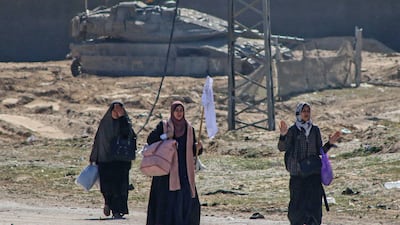
Displaced Palestinians hold a white flag as they pass an Israeli tank position while fleeing the Hamad Town district of Khan Younis. Bloomberg
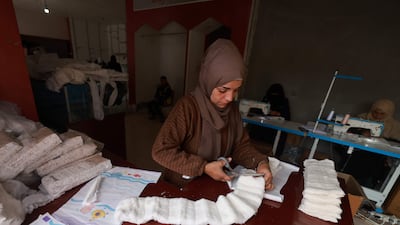
A Palestinian woman cuts material to be used for sewing nappies at a workshop in Rafah. AFP
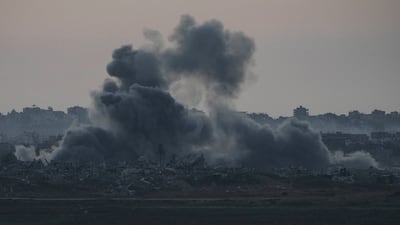
Smoke rises following an explosion in Gaza, as seen from southern Israel. AP
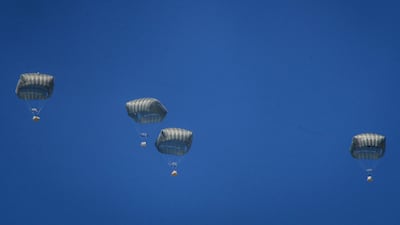
Parachutes carrying relief for Palestinians drop from an Egyptian Air Force cargo plane over central Gaza. Bloomberg
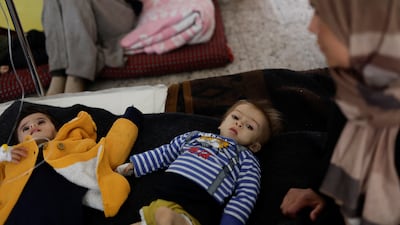
A Palestinian boy who is suffering from malnutrition is treated at a healthcare centre amid widespread hunger. Reuters
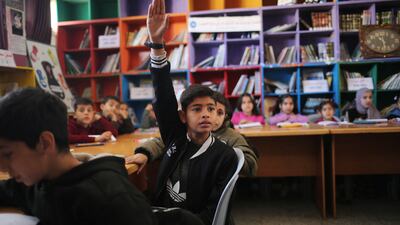
Palestinian children attend an English class in the library of the school housing displaced people in Rafah, the southern Gaza Strip. AFP
An UNRWA-run school housing displaced Palestinians in Rafah. AFP
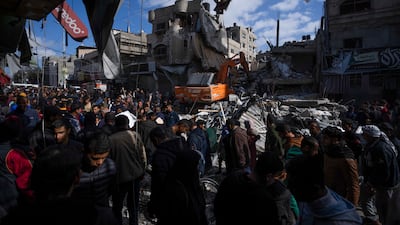
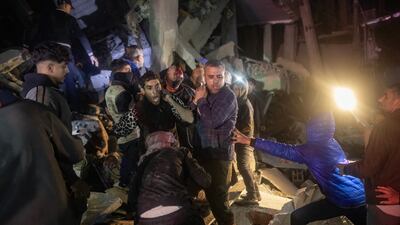
Palestinians search for bodies and survivors in the rubble of a residential building destroyed in an Israeli air strike in Rafah. AP
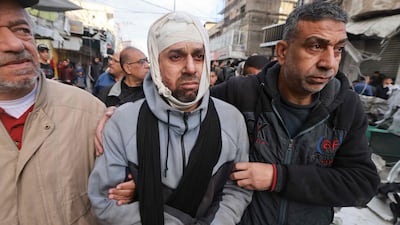
A wounded Palestinian man who lost his wife and daughter walks past a neighbours' house destroyed by Israeli bombing in Rafah. AFP
An injured man is rescued from the rubble after an Israeli air strike on the Rafah camp in Gaza. EPA
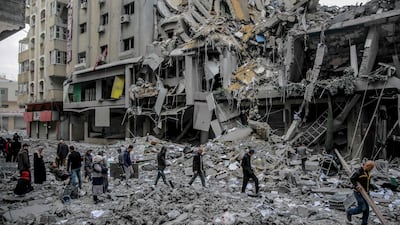
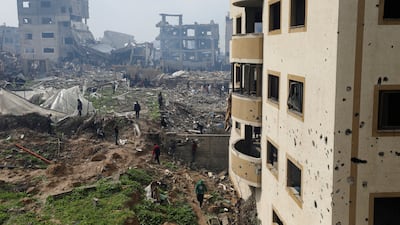
Palestinians walk amid the rubble of houses destroyed by the Israeli bombardment of Gaza city. AFP
Aid is dropped into Gaza from US military aircraft. Reuters
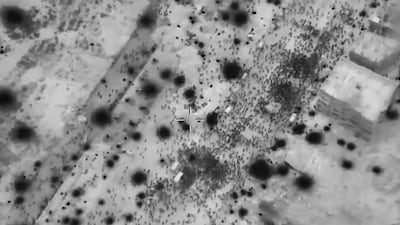
Palestinians gather at air lorries in Gaza. More than 100 were killed when Israeli troops opened fire. AP
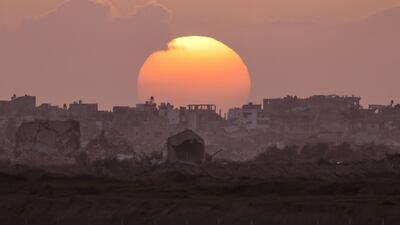
The sun sets behind destroyed buildings in Gaza. AFP
A Palestinian man enters a heavily damaged house following an Israeli strike in Rafah, in the southern Gaza Strip. AFP
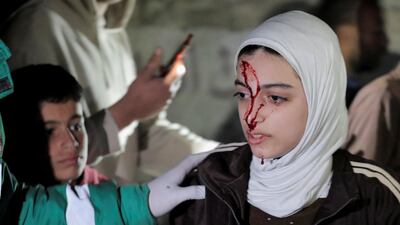
A wounded Palestinian is assisted at the site of an Israeli strike in Deir Al Balah, in the central Gaza Strip. Reuters
Palestinians gather in the hope of getting bags of flour carried by air lorries near an Israeli checkpoint in Gaza city, as the enclave's residents face crisis levels of hunger. Reuters
Palestinian children wait to receive food cooked by a charity kitchen as the conflict between Israel and Hamas continues in Gaza. Reuters
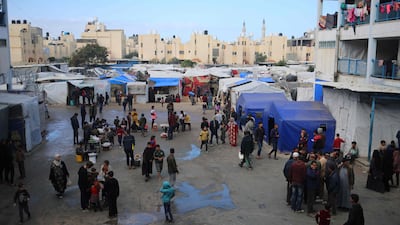
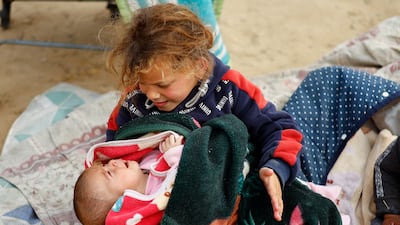
A displaced Palestinian child holds a crying baby in a camp in Rafah, in the southern Gaza Strip. Reuters
We need to invest north of $5 trillion globally, every year, into energy transition solutions to tackle climate change. And yet the cost of conflicts continues to spiral. Rising military expenditure and an increased focus on conflicts impede countries’ ability to invest in climate solutions. And that’s not to mention military emissions in conflict zones, which account for about 5.5 per cent of global emissions.
Rising military expenditure and an increased focus on conflicts impede countries’ ability to invest in climate solutions
If rising temperatures and intensifying extreme weather conditions suggest that our house is on fire, then the foundations we have built it on are close to collapse. Rebuilding them relies on an effective and collective push from the global community to put people above political interests.
In the UAE, our leaders are meeting this moment of fragility with a clear and concise path forward, towards prosperity, stability and sustainability. This is being done in a range of ways – by providing vital food and water supplies to those most in need, working on resolutions to end regional conflicts, and ensuring that political leaders lay the groundwork for peace so that climate action can follow.
Last December, the Cop28 Declaration on Climate Relief, Recovery and Peace represented a watershed moment in this regard. The declaration underscores the urgent need to create institutions that are more representative of global populations, emphasising the connection between climate resilience and global stability. It acknowledges that peace and recovery are not only outcomes of effective climate action but also prerequisites for its success. It espouses a much-needed humanitarian approach to climate action.
By prioritising the needs of the most vulnerable communities and countries, the declaration calls for an unprecedented level of international co-operation and solidarity, which is crucial for addressing the systemic inequities that have long hindered global climate action efforts.
Cop28 President Dr Sultan Al Jaber applauds after the UAE Consensus is reached in Dubai last December. The agreement offers some light on the horizon. AFP
More recently at the World Governments Summit in Dubai, the launch of the Cop Presidencies Troika, which includes the UAE, Azerbaijan and Brazil, marked a levelling-up for climate diplomacy. It sets the course for continuity in purpose and ambition from one Cop presidency to the next, laying the groundwork for a more cohesive and strategic global climate action framework.
By fostering a sense of shared responsibility and mutual support among successive Cop presidencies, the Troika agreement enables a more integrated and proactive approach to ensure that each Cop builds on the achievements of its predecessors to advance global climate goals.
As we carry the torch forward to Azerbaijan and then to Brazil, the path towards climate resilience requires a unified approach that transcends political and geographical boundaries. By aligning the efforts of successive Cop presidencies, we can create outcomes that benefit all, rather than a select few. This approach not only ensures that the ambitious goals set in Paris, and refined in subsequent Cops, are met, but also that they evolve to meet the changing needs of our planet and its inhabitants.
We cannot do this, however, if we do not have a bedrock of stability firmly in place. We must develop collaborative frameworks, such as the Troika, that recognise the fundamental interconnectedness of climate change, peace and recovery. We need structures and institutions that catalyse equitable and transformative change.
It is now down to our leaders to build bridges and the foundations for lasting and sustainable peace and prosperity. Without them, we cannot hope to meet the climate goals and ambitions we have set for ourselves in the near, medium or long-term future.

Wealth managers recommend late investors to have a balanced portfolio that typically includes traditional assets such as cash, government and corporate bonds, equities, commodities and commercial property.
They do not usually recommend investing in Bitcoin or other cryptocurrencies due to the risk and volatility associated with them.
“It has produced eye-watering returns for some, whereas others have lost substantially as this has all depended purely on timing and when the buy-in was. If someone still has about 20 to 25 years until retirement, there isn’t any need to take such risks,” Rupert Connor of Abacus Financial Consultant says.
He adds that if a person is interested in owning a business or growing a property portfolio to increase their retirement income, this can be encouraged provided they keep in mind the overall risk profile of these assets.
In the UAE’s arid climate, small shrubs, bushes and flower beds usually require about six litres of water per square metre, daily. That increases to 12 litres per square metre a day for small trees, and 300 litres for palm trees.
Horticulturists suggest the best time for watering is before 8am or after 6pm, when water won't be dried up by the sun.
A global report published by the Water Resources Institute in August, ranked the UAE 10th out of 164 nations where water supplies are most stretched.
The Emirates is the world’s third largest per capita water consumer after the US and Canada.
Is it worth it? We put cheesecake frap to the test.
The verdict from the nutritionists is damning. But does a cheesecake frappuccino taste good enough to merit the indulgence?
My advice is to only go there if you have unusually sweet tooth. I like my puddings, but this was a bit much even for me. The first hit is a winner, but it's downhill, slowly, from there. Each sip is a little less satisfying than the last, and maybe it was just all that sugar, but it isn't long before the rush is replaced by a creeping remorse. And half of the thing is still left.
The caramel version is far superior to the blueberry, too. If someone put a full caramel cheesecake through a liquidiser and scooped out the contents, it would probably taste something like this. Blueberry, on the other hand, has more of an artificial taste. It's like someone has tried to invent this drink in a lab, and while early results were promising, they're still in the testing phase. It isn't terrible, but something isn't quite right either.
So if you want an experience, go for a small, and opt for the caramel. But if you want a cheesecake, it's probably more satisfying, and not quite as unhealthy, to just order the real thing.
A UK report on youth social media habits commissioned by advocacy group Volteface found a quarter of young people were exposed to illegal drug dealers on social media.
The poll of 2,006 people aged 16-24 assessed their exposure to drug dealers online in a nationally representative survey.
Of those admitting to seeing drugs for sale online, 56 per cent saw them advertised on Snapchat, 55 per cent on Instagram and 47 per cent on Facebook.
Cannabis was the drug most pushed by online dealers, with 63 per cent of survey respondents claiming to have seen adverts on social media for the drug, followed by cocaine (26 per cent) and MDMA/ecstasy, with 24 per cent of people.
The Sand Castle
Director: Matty Brown
Stars: Nadine Labaki, Ziad Bakri, Zain Al Rafeea, Riman Al Rafeea
The two riders are among several riders in the UAE to receive the top payment of £10,000 under the Thank You Fund of £16 million (Dh80m), which was announced in conjunction with Deliveroo's £8 billion (Dh40bn) stock market listing earlier this year.
The £10,000 (Dh50,000) payment is made to those riders who have completed the highest number of orders in each market.
There are also riders who will receive payments of £1,000 (Dh5,000) and £500 (Dh2,500).
All riders who have worked with Deliveroo for at least one year and completed 2,000 orders will receive £200 (Dh1,000), the company said when it announced the scheme.
Who's who in Yemen conflict
Houthis: Iran-backed rebels who occupy Sanaa and run unrecognised government
Yemeni government: Exiled government in Aden led by eight-member Presidential Leadership Council
Southern Transitional Council: Faction in Yemeni government that seeks autonomy for the south
Habrish 'rebels': Tribal-backed forces feuding with STC over control of oil in government territory
A mark of Chatham House’s influence 100 years on since its founding, was Moscow’s formal declaration last month that it was an “undesirable organisation”.
The depth of knowledge and academics that it drew on following the Ukraine invasion had broadcast Mr Putin’s chicanery.
The institute is more used to accommodating world leaders, with Nelson Mandela, Margaret Thatcher among those helping it provide authoritative commentary on world events.
Chatham House was formally founded as the Royal Institute of International Affairs following the peace conferences of World War One. Its founder, Lionel Curtis, wanted a more scientific examination of international affairs with a transparent exchange of information and ideas.
That arena of debate and analysis was enhanced by the “Chatham House Rule” states that the contents of any meeting can be discussed outside Chatham House but no mention can be made identifying individuals who commented.
This has enabled some candid exchanges on difficult subjects allowing a greater degree of free speech from high-ranking figures.
These meetings are highly valued, so much so that ambassadors reported them in secret diplomatic cables that – when they were revealed in the Wikileaks reporting – were thus found to have broken the rule. However, most speeches are held on the record.
Its research and debate has offered fresh ideas to policymakers enabling them to more coherently address troubling issues from climate change to health and food security.
Score
Third Test, Day 2
New Zealand 274
Pakistan 139-3 (61 ov)
Pakistan trail by 135 runs with 7 wickets remaining in the innings
Individuals must register on UAE Drone app or website using their UAE Pass
Add all their personal details, including name, nationality, passport number, Emiratis ID, email and phone number
Upload the training certificate from a centre accredited by the GCAA
Submit their request
What are the regulations?
Fly it within visual line of sight
Never over populated areas
Ensure maximum flying height of 400 feet (122 metres) above ground level is not crossed
Users must avoid flying over restricted areas listed on the UAE Drone app
Only fly the drone during the day, and never at night
Should have a live feed of the drone flight
Drones must weigh 5 kg or less
Mercer, the investment consulting arm of US services company Marsh & McLennan, expects its wealth division to at least double its assets under management (AUM) in the Middle East as wealth in the region continues to grow despite economic headwinds, a company official said.
Mercer Wealth, which globally has $160 billion in AUM, plans to boost its AUM in the region to $2-$3bn in the next 2-3 years from the present $1bn, said Yasir AbuShaban, a Dubai-based principal with Mercer Wealth.
“Within the next two to three years, we are looking at reaching $2 to $3 billion as a conservative estimate and we do see an opportunity to do so,” said Mr AbuShaban.
Mercer does not directly make investments, but allocates clients’ money they have discretion to, to professional asset managers. They also provide advice to clients.
“We have buying power. We can negotiate on their (client’s) behalf with asset managers to provide them lower fees than they otherwise would have to get on their own,” he added.
Mercer Wealth’s clients include sovereign wealth funds, family offices, and insurance companies among others.
From its office in Dubai, Mercer also looks after Africa, India and Turkey, where they also see opportunity for growth.
Wealth creation in Middle East and Africa (MEA) grew 8.5 per cent to $8.1 trillion last year from $7.5tn in 2015, higher than last year’s global average of 6 per cent and the second-highest growth in a region after Asia-Pacific which grew 9.9 per cent, according to consultancy Boston Consulting Group (BCG). In the region, where wealth grew just 1.9 per cent in 2015 compared with 2014, a pickup in oil prices has helped in wealth generation.
BCG is forecasting MEA wealth will rise to $12tn by 2021, growing at an annual average of 8 per cent.
Drivers of wealth generation in the region will be split evenly between new wealth creation and growth of performance of existing assets, according to BCG.
Another general trend in the region is clients’ looking for a comprehensive approach to investing, according to Mr AbuShaban.
“Institutional investors or some of the families are seeing a slowdown in the available capital they have to invest and in that sense they are looking at optimizing the way they manage their portfolios and making sure they are not investing haphazardly and different parts of their investment are working together,” said Mr AbuShaban.
Some clients also have a higher appetite for risk, given the low interest-rate environment that does not provide enough yield for some institutional investors. These clients are keen to invest in illiquid assets, such as private equity and infrastructure.
“What we have seen is a desire for higher returns in what has been a low-return environment specifically in various fixed income or bonds,” he said.
“In this environment, we have seen a de facto increase in the risk that clients are taking in things like illiquid investments, private equity investments, infrastructure and private debt, those kind of investments were higher illiquidity results in incrementally higher returns.”
The Abu Dhabi Investment Authority, one of the largest sovereign wealth funds, said in its 2016 report that has gradually increased its exposure in direct private equity and private credit transactions, mainly in Asian markets and especially in China and India. The authority’s private equity department focused on structured equities owing to “their defensive characteristics.”
Friday, February 18: 10am - Oman v Nepal, Canada v Philippines; 2pm - Ireland v UAE, Germany v Bahrain
Saturday, February 19: 10am - Oman v Canada, Nepal v Philippines; 2pm - UAE v Germany, Ireland v Bahrain
Monday, February 21: 10am - Ireland v Germany, UAE v Bahrain; 2pm - Nepal v Canada, Oman v Philippines
Tuesday, February 22: 2pm – semi-finals
Thursday, February 24: 2pm – final
UAE squad: Ahmed Raza (captain), Muhammad Waseem, Chirag Suri, Vriitya Aravind, Rohan Mustafa, Kashif Daud, Zahoor Khan, Alishan Sharafu, Raja Akifullah, Karthik Meiyappan, Junaid Siddique, Basil Hameed, Zafar Farid, Mohammed Boota, Mohammed Usman, Rahul Bhatia