Moustafa Bayoumi is a climate research fellow at the Anwar Gargash Diplomatic Academy and the Centre for Climate Diplomacy
February 21, 2024
Building on the momentum that Cop28 has provided to the global climate fight, 2024 could be a pivotal year for environmental multilateralism. Indeed, the year presents unique opportunities as four important summits are scheduled to be held over the concluding three months – and decisions made in these meetings could be decisive.
Before that, Nairobi will host the sixth session of the UN Environment Assembly next week. As the world’s top decision-making body on the environment, the Assembly will shape the conversation on how to tackle the three-pronged planetary crisis of climate change, nature and biodiversity loss, and ever-increasing pollution and waste.
Given the ongoing debate on the effectiveness of multilateralism, recent successes such as the Kunming-Montreal global biodiversity framework of 2022 and the UAE Consensus of 2023 have somewhat restored trust in co-operation among the world’s nations. That said, strong agreements need to be delivered this year to ensure momentum on environmental action.
All eyes will be on Cop29, to be held in November in Baku. This is especially so because Cop28 in Dubai concluded with a number of positive outcomes, including a new fund for loss and damage, a global goal for adaptation, and the first mention of a transition away from fossil fuels in a UNFCCC agreement. Under its action agenda, 12 pledges, charters and declarations were issued, including the first-ever declarations on food systems transformation and health.
In Baku, the parties are expected to agree on a new post-2025 finance goal, which follows the $100 billion goal that was delayed by several years and which eroded trust in the negotiation process. An ambitious agreement on finance is much needed to restore the trust gap between developed and developing countries. Additionally, water security and clean technologies are expected to take centre stage in Azerbaijan.
People from all around the world, including the small island nation of Tuvalu, descend on Cop28 in Dubai. Chris Whiteoak / The National
Performance artist Marius Diaconu leads a Unity Dance on the opening day at Expo City. Chris Whiteoak / The National
British Foreign Secretary David Cameron at the second day of the summit. Chris Whiteoak / The National
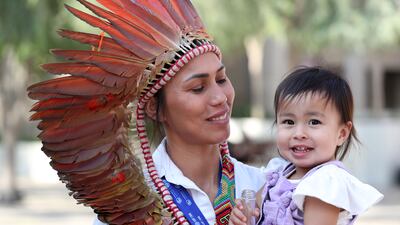
Visitors from Ecuador at the event. Chris Whiteoak / The National
The Saudi pavilion turned heads. Chris Whiteoak / The National
Protesters held flags reading: 'No climate justice without human rights.' Chris Whiteoak / The National
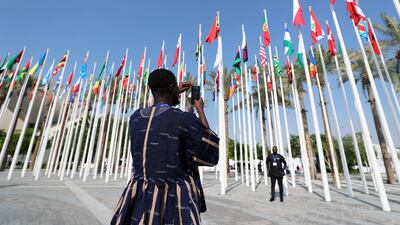
Global cultures on full display on day three. Chris Whiteoak / The National
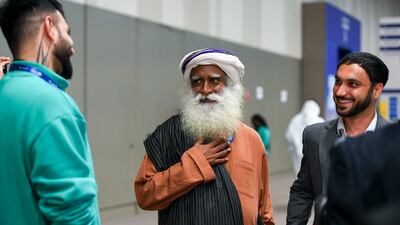
Sadhguru, founder and head of India's Isha Foundation, on day three. Khushnum Bhandari / The National
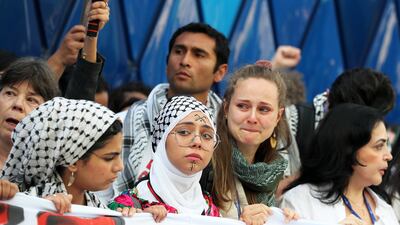
Cop28 demonstrators call for a ceasefire in Gaza. Pawan Singh / The National
Brazil's popular pavilion. Chris Whiteoak / The National
Expo City's impressive dome at night. Chris Whiteoak / The National
Commissioned artwork titled The Choice by Tristan Eaton at Expo City. Chris Whiteoak / The National
Visitors young and old at the site. Chris Whiteoak / The National
The summit is a global affair. Chris Whiteoak / The National
Activists air their hopes at the site. Chris Whiteoak / The National
Local and international communities are working together to secure a greener future. Chris Whiteoak / The National
Visitors arrive for day six of the summit. Chris Whiteoak / The National
Young activists from Engajamundo protest about smog being created from deforestation in the Amazon. Chris Whiteoak / The National
Colours on display on day six. Chris Whiteoak / The National
Members of a Sikh human rights group in attendence. Chris Whiteoak / The National
Egyptian comic Bassem Youssef attends a talk on the sixth day. Chris Whiteoak / The National
The Wake up experience with Sadhguru. Chris Whiteoak / The National
The first week of talks finished on a high, with hard negotiations planned for the second one. Khushnum Bhandari / The National
Protestors call for a ban on fossil fuels. Khushnum Bhandari / The National
Day seven's Sustainable Fashion show. Pawan Singh / The National
Talks resumed on day nine, after a one-day break. Chris Whiteoak / The National
Friends for Future protest to phase out fossil fuels on day nine. Chris Whiteoak / The National
Global Campaign to Demand Climate Justice also demonstrate. Chris Whiteoak / The National
International visitors at the site on day 11. Chris Whiteoak / The National
People protest about 'no climate justice without human rights'. Chris Whiteoak / The National
Mariam Almheiri, minister of Climate Change and Environment, speaks at the launch ceremony of the environmental identity. Chris Whiteoak / The National
Visitors watch the protests. Chris Whiteoak / The National
Day 11 at Cop28. Chris Whiteoak / The National
Indonesian dancers perform on day 12. Chris Whiteoak / The National
Day 12 at Cop28. Chris Whiteoak / The National
Negotiations remain under way on day 12. Chris Whiteoak / The National
Messages left at the Indonesian pavilion. Chris Whiteoak / The National
Protestors call for climate action to extend to food systems. Chris Whiteoak / The National
Nuclear for Climate demonstrators. Chris Whiteoak / The National
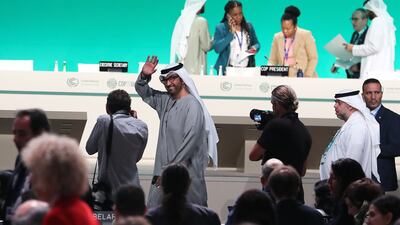
Dr Sultan Al Jaber, Cop28 President, arriving for the plenary session on day 14. Pawan Singh / The National
These negotiations take place in times of seemingly insurmountable geopolitical divisions and against a backdrop of alarming findings
Much focus will also be on Cop16, the next UN biodiversity summit, which is slated to be held in Colombia in October and November.
In 2022, an ambitious Global Biodiversity Framework was agreed at Cop15 in Montreal. The framework commits the world to halt and reverse biodiversity loss by the end of the decade, and it has been hailed by some as nature’s equivalent of the Paris Agreement. But there have been reports about insufficient progress, with most countries yet to submit their revised National Biodiversity Strategies and Action Plans that should reflect increased ambition and clear implementation plans.
In Colombia, participating countries have agreed to work towards developing a broad global action plan on biodiversity and human health, while recognising the issues of equity. There is a commitment to fair and equitable sharing of benefits from genetic resources, digital sequence information and traditional knowledge associated with genetic resources.
The meeting is expected to advance the discussion and, hopefully, expedite national action plans. Marine and coastal biodiversity benefits, and risks of marine biodiversity loss, are also expected to be on the table.
Meanwhile, in November and December, the South Korean city of Busan will host talks on another urgent issue, plastic pollution, which is reaching unprecedented levels with widespread and adverse effects on wildlife, the environment and human health. To address this problem, countries are negotiating a global treaty that should be completed by the end of the year.
In March 2022, a resolution was adopted at the UN Environment Assembly to develop an international, legally binding instrument on plastic pollution that requested the convening of an Intergovernmental Negotiating Committee on Plastic Pollution. The Committee is tasked with developing an instrument that comprehensively addresses the full life cycle of plastic, including its production, design and disposal.
A fish made from plastic waste on a beach in Chennai, India, last May. Almost half of the world’s plastic waste is landfilled and makes up 80 per cent of all marine pollution. EPA
Three sessions have already taken place over the past two years, with progress being slow. A fourth session will take place in Ottawa in April, but the final push is expected when countries meet in Busan to discuss a text that presents numerous options. Finalising an ambitious draft text is seen as a challenge. At the same time, a treaty that ends plastic pollution is considered vital.
Finally, there is the issue of land degradation that officials will be looking to tackle in Riyadh in December. Every year, 100 million hectares are degraded – that’s half the size of Greenland. A recent report by the UN Convention to Combat Desertification shows that desertification is progressing fast. Further, the World Economic Forum puts half of global gross domestic product at moderate-to-high risk due to degradation.
More than a hundred countries have already set voluntary targets for neutralising land degradation by 2030 and about $5 billion in funding have flowed into global efforts to tackle desertification, land degradation and drought between 2016 and 2019. Parties assembled in Riyadh will have a challenging discussion on how to reverse these trends and to accelerate efforts to restore 1 billion hectares of land by 2030.
All this is to underscore the fact that climate change, biodiversity, desertification and plastic pollution are interlinked. Failing to tackle one issue could result in failing to tackle the rest. Even separately, these are considered some of the most pressing – if not existential – threats of our time.
There is little doubt that the negotiations listed above take place in times of seemingly insurmountable geopolitical divisions and against a backdrop of alarming findings. For instance, 2023 was the hottest year on record, and it exceeded 1.5°C of warming on average for the first time. Species are disappearing faster than ever in human history, with biodiversity declining by an average of 69 per cent in the past 50 years alone. Almost half of the world’s plastic waste is landfilled and makes up 80 per cent of all marine pollution.
Recent years, however, have proved that environmental multilateralism is working. It remains our best shot at tackling the complex and interconnected environmental challenges. The hope, then, is that we see more of it in 2024.
Election pledges on migration
CDU: "Now is the time to control the German borders and enforce strict border rejections"
SPD: "Border closures and blanket rejections at internal borders contradict the spirit of a common area of freedom"
Key developments in maritime dispute
2000: Israel withdraws from Lebanon after nearly 30 years without an officially demarcated border. The UN establishes the Blue Line to act as the frontier.
2007: Lebanon and Cyprus define their respective exclusive economic zones to facilitate oil and gas exploration. Israel uses this to define its EEZ with Cyprus
2011: Lebanon disputes Israeli-proposed line and submits documents to UN showing different EEZ. Cyprus offers to mediate without much progress.
2018: Lebanon signs first offshore oil and gas licencing deal with consortium of France’s Total, Italy’s Eni and Russia’s Novatek.
2018-2019: US seeks to mediate between Israel and Lebanon to prevent clashes over oil and gas resources.
All people fleeing from Ukraine before the armed conflict are allowed to enter Poland. Our country shelters every person whose life is in danger - regardless of their nationality.
The dominant group of refugees in Poland are citizens of Ukraine, but among the people checked by the Border Guard are also citizens of the USA, Nigeria, India, Georgia and other countries.
All persons admitted to Poland are verified by the Border Guard. In relation to those who are in doubt, e.g. do not have documents, Border Guard officers apply appropriate checking procedures.
No person who has received refuge in Poland will be sent back to a country torn by war.
Stars: Abdulaziz Almadhi, Mohammed Al Akkasi, Ali Al Suhaibani
Rating: 4/5
Volunteers offer workers a lifeline
Community volunteers have swung into action delivering food packages and toiletries to the men.
When provisions are distributed, the men line up in long queues for packets of rice, flour, sugar, salt, pulses, milk, biscuits, shaving kits, soap and telecom cards.
Volunteers from St Mary’s Catholic Church said some workers came to the church to pray for their families and ask for assistance.
Boxes packed with essential food items were distributed to workers in the Dubai Investments Park and Ras Al Khaimah camps last week. Workers at the Sonapur camp asked for Dh1,600 towards their gas bill.
“Especially in this year of tolerance we consider ourselves privileged to be able to lend a helping hand to our needy brothers in the Actco camp," Father Lennie Connully, parish priest of St Mary’s.
Workers spoke of their helplessness, seeing children’s marriages cancelled because of lack of money going home. Others told of their misery of being unable to return home when a parent died.
“More than daily food, they are worried about not sending money home for their family,” said Kusum Dutta, a volunteer who works with the Indian consulate.
Tuesday's fixtures
Group A
Kyrgyzstan v Qatar, 5.45pm
Iran v Uzbekistan, 8pm
N Korea v UAE, 10.15pm
ESSENTIALS
The flights
Emirates flies direct from Dubai to Rio de Janeiro from Dh7,000 return including taxes. Avianca fliles from Rio to Cusco via Lima from $399 (Dhxx) return including taxes.
The trip
From US$1,830 per deluxe cabin, twin share, for the one-night Spirit of the Water itinerary and US$4,630 per deluxe cabin for the Peruvian Highlands itinerary, inclusive of meals, and beverages. Surcharges apply for some excursions.
Dates for the diary
To mark Bodytree’s 10th anniversary, the coming season will be filled with celebratory activities:
September 21 Anyone interested in becoming a certified yoga instructor can sign up for a 250-hour course in Yoga Teacher Training with Jacquelene Sadek. It begins on September 21 and will take place over the course of six weekends.
October 18 to 21 International yoga instructor, Yogi Nora, will be visiting Bodytree and offering classes.
October 26 to November 4 International pilates instructor Courtney Miller will be on hand at the studio, offering classes.
November 9 Bodytree is hosting a party to celebrate turning 10, and everyone is invited. Expect a day full of free classes on the grounds of the studio.
December 11 Yogeswari, an advanced certified Jivamukti teacher, will be visiting the studio.
February 2, 2018 Bodytree will host its 4th annual yoga market.
UAE v Gibraltar
What: International friendly
When: 7pm kick off
Where: Rugby Park, Dubai Sports City
Admission: Free
Online: The match will be broadcast live on Dubai Exiles’ Facebook page
UAE squad: Lucas Waddington (Dubai Exiles), Gio Fourie (Exiles), Craig Nutt (Abu Dhabi Harlequins), Phil Brady (Harlequins), Daniel Perry (Dubai Hurricanes), EsekaiaDranibota (Harlequins), Matt Mills (Exiles), JaenBotes (Exiles), KristianStinson (Exiles), Murray Reason (Abu Dhabi Saracens), Dave Knight (Hurricanes), Ross Samson (Jebel Ali Dragons), DuRandt Gerber (Exiles), Saki Naisau (Dragons), Andrew Powell (Hurricanes), EmosiVacanau (Harlequins), NikoVolavola (Dragons), Matt Richards (Dragons), Luke Stevenson (Harlequins), Josh Ives (Dubai Sports City Eagles), Sean Stevens (Saracens), ThinusSteyn (Exiles)
Tamkeen's offering
Option 1: 70% in year 1, 50% in year 2, 30% in year 3
Option 2: 50% across three years
Option 3: 30% across five years
Dust and sand storms compared
Sand storm
Particle size: Larger, heavier sand grains
Visibility: Often dramatic with thick "walls" of sand
Duration: Short-lived, typically localised
Travel distance: Limited
Source: Open desert areas with strong winds
Dust storm
Particle size: Much finer, lightweight particles
Visibility: Hazy skies but less intense
Duration: Can linger for days
Travel distance: Long-range, up to thousands of kilometres
Source: Can be carried from distant regions
What can you do?
Document everything immediately; including dates, times, locations and witnesses
Seek professional advice from a legal expert
You can report an incident to HR or an immediate supervisor
You can use the Ministry of Human Resources and Emiratisation’s dedicated hotline
In criminal cases, you can contact the police for additional support
Are non-fungible tokens a currency, asset, or a licensing instrument? Arnab Das, global market strategist EMEA at Invesco, says they are mix of all of three.
You can buy, hold and use NFTs just like US dollars and Bitcoins. “They can appreciate in value and even produce cash flows.”
However, while money is fungible, NFTs are not. “One Bitcoin, dollar, euro or dirham is largely indistinguishable from the next. Nothing ties a dollar bill to a particular owner, for example. Nor does it tie you to to any goods, services or assets you bought with that currency. In contrast, NFTs confer specific ownership,” Mr Das says.
This makes NFTs closer to a piece of intellectual property such as a work of art or licence, as you can claim royalties or profit by exchanging it at a higher value later, Mr Das says. “They could provide a sustainable income stream.”
This income will depend on future demand and use, which makes NFTs difficult to value. “However, there is a credible use case for many forms of intellectual property, notably art, songs, videos,” Mr Das says.
What vitamins do we know are beneficial for living in the UAE
Vitamin D: Highly relevant in the UAE due to limited sun exposure; supports bone health, immunity and mood. Vitamin B12: Important for nerve health and energy production, especially for vegetarians, vegans and individuals with absorption issues. Iron: Useful only when deficiency or anaemia is confirmed; helps reduce fatigue and support immunity. Omega-3 (EPA/DHA): Supports heart health and reduces inflammation, especially for those who consume little fish.
Golden Ball - best Emirati player: Khalfan Mubarak (Al Jazira)
Golden Ball - best foreign player: Igor Coronado (Sharjah)
Golden Glove - best goalkeeper: Adel Al Hosani (Sharjah)
Best Coach - the leader: Abdulaziz Al Anbari (Sharjah)
Fans' Player of the Year: Driss Fetouhi (Dibba)
Golden Boy - best young player: Ali Saleh (Al Wasl)
Best Fans of the Year: Sharjah
Goal of the Year: Michael Ortega (Baniyas)
Our family matters legal consultant
Name: Hassan Mohsen Elhais
Position: legal consultant with Al Rowaad Advocates and Legal Consultants.
Favourite car: Koenigsegg Agera RS or Renault Trezor concept car.
Favourite book:I Am Pilgrim by Terry Hayes or Red Notice by Bill Browder.
Biggest inspiration: My husband Nik. He really got me through a lot with his positivity.
Favourite holiday destination: Being at home in Australia, as I travel all over the world for work. It’s great to just hang out with my husband and family.
If you go:
Getting there:
Flying to Guyana requires first reaching New York with either Emirates or Etihad, then connecting with JetBlue or Caribbean Air at JFK airport. Prices start from around Dh7,000.
Getting around:
Wildlife Worldwide offers a range of Guyana itineraries, such as its small group tour, the 15-day ‘Ultimate Guyana Nature Experience’ which features Georgetown, the Iwokrama Rainforest (one of the world’s four remaining pristine tropical rainforests left in the world), the Amerindian village of Surama and the Rupununi Savannah, known for its giant anteaters and river otters; wildlifeworldwide.com
How to wear a kandura
Dos
Wear the right fabric for the right season and occasion
Always ask for the dress code if you don’t know
Wear a white kandura, white ghutra / shemagh (headwear) and black shoes for work
Wear 100 per cent cotton under the kandura as most fabrics are polyester
Don’ts
Wear hamdania for work, always wear a ghutra and agal
Buy a kandura only based on how it feels; ask questions about the fabric and understand what you are buying