


Over the past few months, much has been said about the relationship between the UAE and Saudi Arabia, some of it strikingly shallow and misinformed, with recent op-eds characterising it as a “rivalry” or a “rift”, and one going as far as calling it a “theatre of confrontation” as though their relations are a zero-sum game. Such alarmism led me to wonder if we were even discussing the same two countries.
That said, is there competition and differences of opinion and approach on some issues between the two Gulf powers? There certainly is. Competition, in fact, is one of the secret recipes of the UAE’s very own success. One emirate’s liberalisations of investment policies encourage the others to do the same. Today, the UAE itself has more than one leading airport, and airline, more than one leading ports operator and more than one financial hub. Can’t this be the case with Saudi Arabia, too? Furthermore, disagreements arise even among family businesses of the same generation (including my own family’s), which is where the ideas of conflict management and conflict resolutions are best utilised.
Last month, I had the opportunity to travel between Saudi Arabia and the UAE to co-teach a course titled “Leadership and Social Transformation” with Harvard professor Tarek Masoud, director of the Kennedy School’s Middle East Initiative. Over 10 packed days, we had the opportunity to meet with more than 30 senior leaders in both countries, in fields as varied as foreign policy, economics, culture and sport, and not a single one of them spoke even with the slightest hint of reservation about the growth of the other country.
In fact, on our first day at the Arab Strategy Forum, a panel discussion involving two senior leaders set the tone for the entire visit. The moderator of the session asked: “What we see on social media is [are references] to a tug of war between both sides [UAE and Saudi]. What is the story?”

Prince Turki Al Faisal, a former Saudi ambassador and head of intelligence, turned to Dr Anwar Gargash, Diplomatic Adviser to the UAE President, and asked in a friendly way, “Is there anything between us?” to the audience’s laughter and applause. Dr Gargash himself replied: “Everything that is happening in Saudi Arabia is positive for the UAE and everything that is happening in the UAE is positive for Saudi Arabia.”
A few days later, a panel at the World Economic Forum in Davos moderated by The National’s editor-in-chief, Mina Al-Oraibi, and composed of officials and industry leaders from across the Gulf, agreed that these states “complement, rather than compete” with each other.
To explore this issue further, I turned to the Emirati political science professor Abdulkhaleq Abdulla and asked him about the Saudi Arabia Regional Headquarters Programme, which aims to attract foreign companies to set up their regional bases in the kingdom. “Even if 10 per cent of the firms end up relocating to Saudi Arabia,” Dr Abdulla told me, “the rate at which Dubai attracts firms means this 10 per cent will be replenished within a short time.”
In fact, the social and economic liberalisation that Saudi Arabia is undergoing in recent years, partly to encourage initiatives such as the Regional Headquarters Programme, will only benefit the kingdom and the wider region, not least the UAE. Let’s go back in history to see the bigger picture.
Following the devastation of the Second World War, Jean Monnet, then commissioner general of the French National Planning Board, proposed what later became known as the “Monnet Plan”, which ultimately led to greater economic co-ordination between France and Germany and, eventually, to the EU. Although Mr Monnet was French and despite the fact that both states had just fought each other in a war, he considered German economic prosperity and closer economic ties between France and Germany as essential.
Similarly, and in the Gulf region itself, as documented in the 2021 book Building Sharjah, co-edited by Todd Reisz and I, in 1951 the state of Kuwait started a programme dedicated to the Trucial Coast emirates, in which it paid for doctors and teachers (including my own mother) to care for and educate the people of what later became the UAE.
-
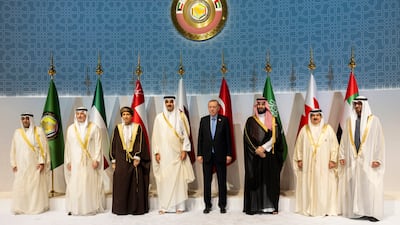
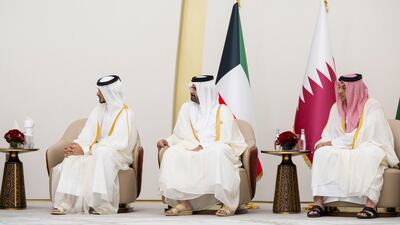
President Sheikh Mohamed, Bahrain's King Hamad, Saudi Arabia's Crown Prince Mohamed bin Salman, Turkish President Recep Tayyip Erdogan, Sheikh Tamim bin Hamad Al Thani, Emir of Qatar, Oman's Deputy Prime Minister Sayyed Fahd bin Mahmoud, Kuwaiti Foreign Minister Salem Abdullah Al Sabah and Jasem Mohamed Al Budaiwi, Secretary General of the GCC at the summit in Doha. Abdulla Al Neyadi / Presidential Court -
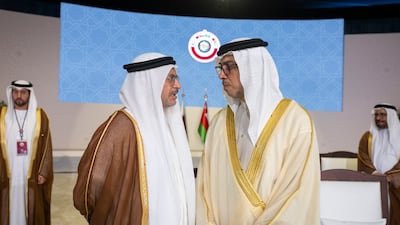
Dr Anwar Gargash, diplomatic adviser to the President, speaks to Sheikh Mansour bin Zayed, Vice President, Deputy Prime Minister and Chairman of the Presidential Court, at the 44th GCC Summit in Qatar. Abdulla Al Neyadi / Presidential Court -
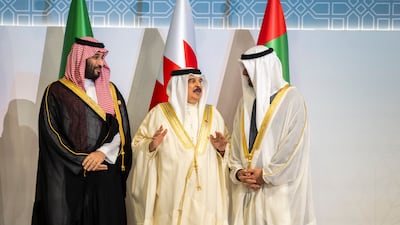
Sheikh Mohamed with King Hamad of Bahrain and Crown Prince Mohamed. Abdulla Al Neyadi / Presidential Court -
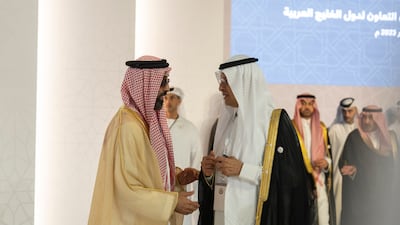
Sheikh Tahnoun bin Zayed, UAE National Security Adviser and Deputy Ruler of Abu Dhabi, speaks to Prince Abdulaziz bin Salman, Saudi Arabia's Minister of Energy. Abdulla Al Neyadi / Presidential Court -
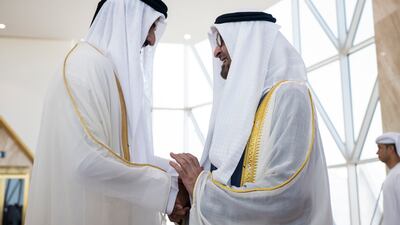
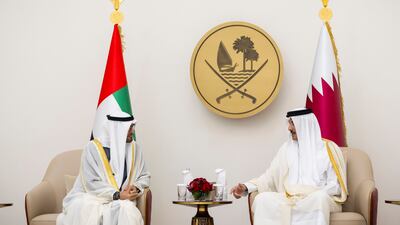
President Sheikh Mohamed is received by Qatari Emir Sheikh Tamim in Doha. Mohamed Al Hammadi / Presidential Court -
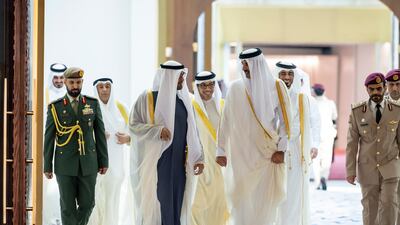
Recent Gulf diplomacy has focused on securing a quick end to Israel's war in Gaza and a return to a multilateral peace process. Mohamed Al Hammadi / Presidential Court -
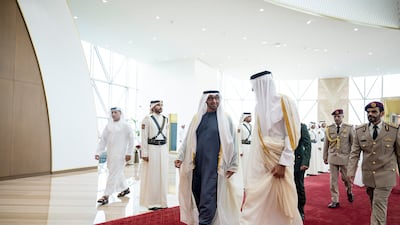
Sheikh Mohamed is leading the UAE delegation, which includes Sheikh Mansour bin Zayed, Vice President, Deputy Prime Minister and Chairman of the Presidential Court, Sheikh Tahnoun bin Zayed, National Security Adviser and Deputy Ruler of Abu Dhabi, and Sheikh Abdullah bin Zayed, Minister of Foreign Affairs. Mohamed Al Hammadi / Presidential Court -
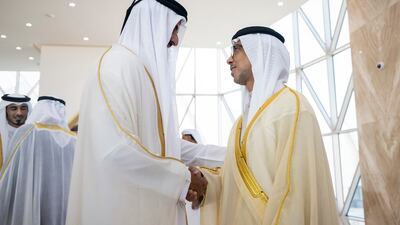
Sheikh Mansour is welcomed by Sheikh Tamim upon his arrival in Doha. Mohamed Al Hammadi / Presidential Court -
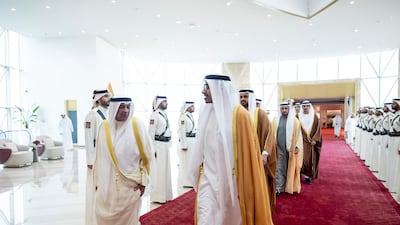
Sheikh Abdullah with GCC secretary general Jasem Al Budaiwi in Doha. Mohamed Al Hammadi / UAE Presidential Court -
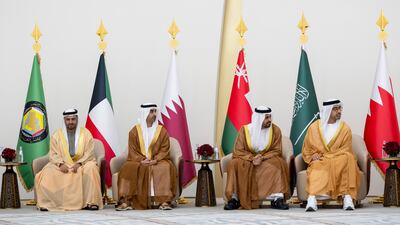
Sheikh Abdullah, Sheikh Theyab bin Mohamed, chairman of the Office of Development and Martyrs' Families Affairs at the Presidential Court, Sheikh Hamdan bin Mohamed and Sheikh Mohamed bin Hamad, private affairs adviser in the Presidential Court, attend a reception in Doha. Mohamed Al Hammadi / Presidential Court -
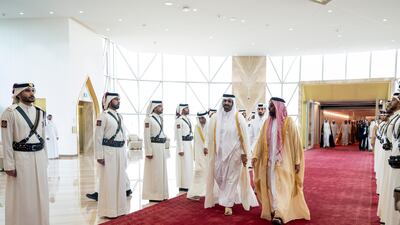
Sheikh Tahnoun is received by Sheikh Abdullah bin Hamad upon his arrival in Doha. Mohamed Al Hammadi / Presidential Court -
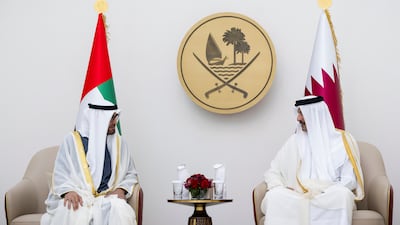
Other topics on the agenda of the GCC meeting include the Gulf railway project. Mohamed Al Hammadi / Presidential Court -
GCC leaders are also expected to discuss tourist visa strategies for the period 2023 to 2030. Mohamed Al Hammadi / Presidential Court -
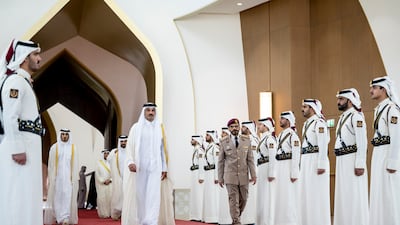
Sheikh Tamim urged the UN Security Council to press Israel to return to the negotiating table. Mohamed Al Hammadi / UAE Presidential Court -
Dr Khalid Al Attiyah, Qatar's Deputy Prime Minister and Minister of State for Defence Affairs, and Sheikh Jasem bin Hamad attend a reception for Sheikh Mohamed before the start of the GCC meeting. Mohamed Al Hammadi / Presidential Court


In a landmark speech in 1997, Mahathir Mohamad, then prime minister of Malaysia, coined the term “prosper-thy-neighbour”. The concept Dr Mahathir went on to explain basically means “if you help your neighbour to prosper, you will prosper along with it”. That stands in stark contrast to the infamous mercantilist economic concept of “beggar-thy-neighbour”, in which countries pursue self-interested economic policies even if they impoverish their neighbours. Countries that follow the “prosper-thy-neighbour” doctrine understand that their own long-term economic growth largely depends on being in a prosperous neighbourhood.
In The Bottom Billion, economist Paul Collier writes that one of the reasons that countries fail is having “bad neighbours” (especially if the country is landlocked). Improving one’s neighbourhood thus becomes key to one’s own prosperity. Even today, Norway, a Scandinavian oil-rich country that is not itself an EU member, supports the “European Neighbourhood Policy”, which aims to “promote economic, political and social development to the south and east of the EU’s borders”. Norway is one of the leading contributors to the European Economic Area Agreement, and through Norway Grants, has supported countries in Eastern Europe that later became members of the EU. Norway, being a major trader with the EU, understands that the more prosperous its European neighbourhood is, the more prosperous and safer its own people will be.
In recent years, economic integration between the Gulf states has only intensified with talk of a joint Gulf tourism visa, the $1.6 trillion GCC electricity interconnection grid and a GCC-wide rail network being but a few examples of this gathering pace that, in some cases such as the electrical grid, is also being opened to non-Gulf states such as Iraq, Jordan and Egypt.
Today, the Arab world is a region of 400 million people that will, according to the UN, need 33 million more jobs by 2030. Competition among Arab states to reform and invest in education and infrastructure as well as attract talent and foreign investment is essential. What is happening between Saudi Arabia and the UAE is not a zero-sum game, but a positive-sum game in which we can all be winners.

