Along with Abu Dhabi, Dubai is among the 10 wealthiest cities in the Brics+ grouping. Reuters


The West is turning inward. Here's how the Brics+ countries can surpass it


  • English
  • Arabic

February 08, 2024

A little more than a month into 2024 and it feels as if we have been holding our collective breath for weeks. It feels as if we are waiting to see how the many pressures – disruptions to Red Sea shipping, the risk of conflict spilling over from Gaza to Lebanon, Iraq, Iran and other parts of the region, and the rapid proliferation of artificial intelligence technology – will shape global trade and economic growth this year.

Observers are naturally watching the traditional great powers – the US, China and Russia – for indications of how such forces will be managed. To an extent, the American presidential election in November could have the most bearing on all of the above, as the dwindling field of candidates fight to dominate the minds of voters seemingly most concerned about how increased levels of migration over their southern borders will be managed.

The growing influx of migrants is, like climate change, not a single-country issue. These are examples of our 21st-century “Butterfly effect” and speak to the urgency with which we need to come up with multifaceted solutions.

Movement of people – legal and illegal – across regions and continents is nothing new, of course. The reasons that drive them to leave home are almost unchanged across history. What is different now is the ability of authorities, experts and the media to view this movement happening in real time and wherever it might be visible in the world.

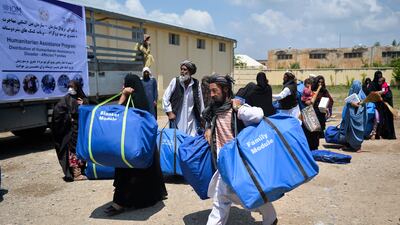
  • People carry aid distributed by the International Organisation for Migration and the United States Agency for International Development after flash floods triggered by heavy rains in Herat, Afghanistan. AFP
    People carry aid distributed by the International Organisation for Migration and the United States Agency for International Development after flash floods triggered by heavy rains in Herat, Afghanistan. AFP
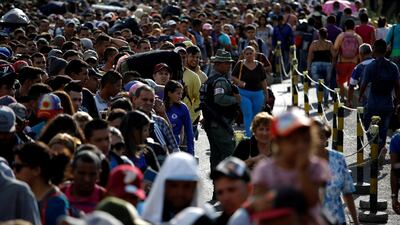
  • Venezuelans wait to cross into Colombia via the Simon Bolivar International Bridge. Reuters
    Venezuelans wait to cross into Colombia via the Simon Bolivar International Bridge. Reuters
  • A barren agricultural field in the Saadiya area, north of Diyala in eastern Iraq. The World Bank says reduced agricultural production, water scarcity, rising sea levels and other adverse effects of climate change could cause up to 216 million people to leave their homes and migrate within their own countries by 2050. AFP
    A barren agricultural field in the Saadiya area, north of Diyala in eastern Iraq. The World Bank says reduced agricultural production, water scarcity, rising sea levels and other adverse effects of climate change could cause up to 216 million people to leave their homes and migrate within their own countries by 2050. AFP
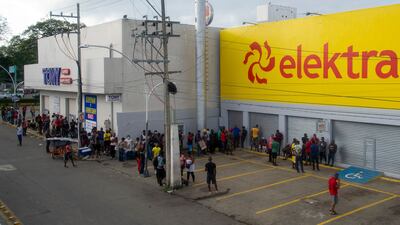
  • Haitian and Central American migrants wait for remittance banks to open to withdraw money sent by their relatives in Tapachula, Mexico. AFP
    Haitian and Central American migrants wait for remittance banks to open to withdraw money sent by their relatives in Tapachula, Mexico. AFP
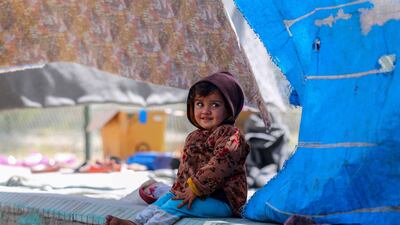
  • An Afghan child at a temporary shelter at a park in Kabul, Afghanistan. EPA
    An Afghan child at a temporary shelter at a park in Kabul, Afghanistan. EPA
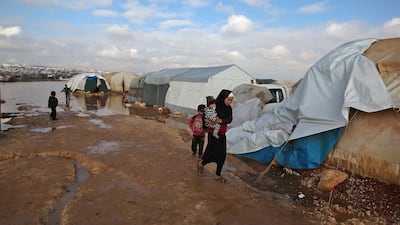
  • A Syrian woman at a camp for the internally displaced near the town of Kafr Lusin in the rebel-held north-west province of Idlib, near the border with Turkey. AFP
    A Syrian woman at a camp for the internally displaced near the town of Kafr Lusin in the rebel-held north-west province of Idlib, near the border with Turkey. AFP
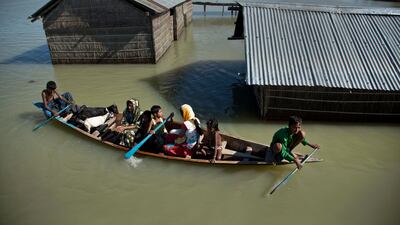
  • A family with their goats in north-east Assam state, India. AP
    A family with their goats in north-east Assam state, India. AP
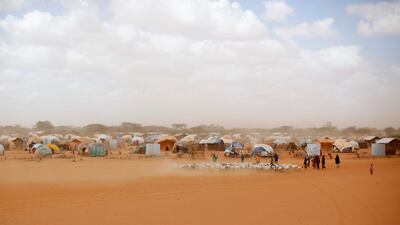
  • Somali refugees herd goats at the Ifo refugee camp outside Dadaab, eastern Kenya. AP
    Somali refugees herd goats at the Ifo refugee camp outside Dadaab, eastern Kenya. AP
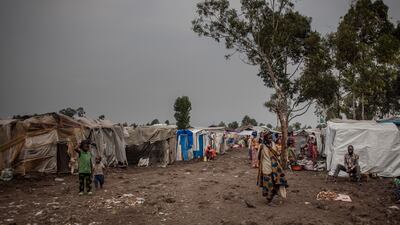
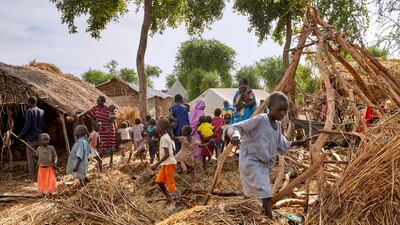
  • Kayembe camp near Goma. Thousands of families moved there after the eruption of the Nyiragongo volcano in Democratic Republic of Congo. AFP
    Kayembe camp near Goma. Thousands of families moved there after the eruption of the Nyiragongo volcano in Democratic Republic of Congo. AFP
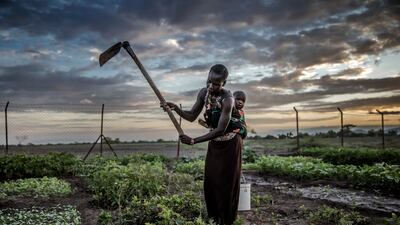
  • A woman from South Sudan tends her vegetable crops in Kalobeyei settlement for refugees in Turkana County, Kenya. AFP
    A woman from South Sudan tends her vegetable crops in Kalobeyei settlement for refugees in Turkana County, Kenya. AFP
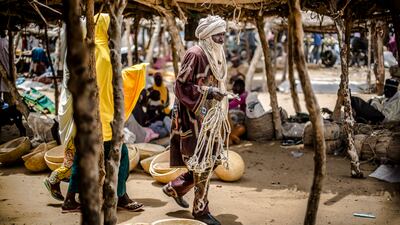
  • A Tuareg man sells rope at the market in Tanout, Niger. In the Sahel, the climate has long been inhospitable. AFP
    A Tuareg man sells rope at the market in Tanout, Niger. In the Sahel, the climate has long been inhospitable. AFP
  • Flood damage in Yusuf Batir refugee camp in Maban, South Sudan. AFP
    Flood damage in Yusuf Batir refugee camp in Maban, South Sudan. AFP
  • A girl in a displacement camp for people affected by flooding in Beledweyne, Somalia. AFP
    A girl in a displacement camp for people affected by flooding in Beledweyne, Somalia. AFP
An anti-migration atmosphere dampens the movement of wealthier people while doing little to deter those without those financial means

The knee-jerk response to this migration trend is to try to stop it. In the UK, the US and Europe, this has proved to be an unsuccessful approach. Yet it is unlikely that policymakers will stop trying, given the political realities of being accused of supporting migration.

One consequence of an anti-migration atmosphere in the West is that it dampens the movement of wealthier people while doing little to deter those without those financial means, who have little choice but to seek sanctuary so far from home in order to find security, stability and economic opportunity.

A recent report highlighted how the citizens of the Brics+ grouping of nations, for example, have significantly less economic mobility than those residing in the most advanced economies. That is despite Brics – originally Brazil, Russia, India, China and South Africa – together having more purchasing power than the G7 and the rising number of wealthy individuals residing within those five countries.

According to the Henley Passport Index, passport holders from Brics’s original member countries can access, visa-free, just 21 per cent of the world, on average, compared to those from G7 nations who combined can access more than 80 per cent without requiring a prior visa.

Saudi Arabia along with the UAE, Egypt, Iran and Ethiopia joined Brics on January 1, doubling its membership to 10. This has boosted the wealth that it contains. Dubai hosts 72,500 millionaires, of whom 212 are centi-millionaires and 15 are billionaires, while Abu Dhabi is home to 22,700 resident millionaires, including 68 centi-millionaires and five billionaires.

Dubai has been ranked the third-wealthiest city in Brics+, while Abu Dhabi placed 10th on the list, according to the report by Henley & Partners and New World Wealth. Five Chinese cities figured among the 10 wealthiest metropolises in the grouping, with the capital Beijing ranked the wealthiest Brics+ city, home to 125,600 millionaires, including 347 centi-millionaires and 42 billionaires, the research showed.

Shanghai ranked second with 123,400 ultra-wealthy residents, while Mumbai and Shenzhen round out the top five list.

The result of this strange contradiction regarding the lower mobility of Brics+ citizens will be that wealthier nations will also lose investment opportunities that they might otherwise have obtained. When people put their money in a country, regardless of the project and sector, they like to be able to easily visit and see first-hand how that funding is being put to work. If they cannot or are discouraged from doing so, they will keep their money elsewhere. In an era of high interest rates, it is no easy thing to make up the investment gap that could emerge as a result of these trends.

Dominic Volek, group head of private clients at Henley & Partners, says that the extended Brics community will probably create new opportunities for themselves going forward at the expense of other regions. It’s important to note that over the next 10 years, private wealth is projected to grow very quickly in India, Saudi Arabia, the UAE, China, Ethiopia, South Africa and Egypt.

Yet wealth is only one side of the argument. To meet the challenge of rising levels of economic and political migration, there will have to be a total focus on prosperity. This is far more than wealth; it is when all people have the opportunity and freedom to thrive, according to the Legatum Prosperity Index. For prosperity to be sustained and inclusive – which it must be to attract investment and talent – it should conserve the environment, emphasise well-being of people, and prioritise culture.

The Legatum ranking annually puts northern European nations at the top of their list. Such data only adds to the belief that to find prosperity, one would do best to seek it out there rather than in other regions. Yet it is clear that immigrants are not encouraged to go there any more under all but the narrowest circumstances.

But a vacuum must be filled, and the cold shoulder being offered in the West could ultimately spur a greater emphasis on prosperity that is led by the emerging economies.


Who was Alfred Nobel?

The Nobel Prize was created by wealthy Swedish chemist and entrepreneur Alfred Nobel.

  • In his will he dictated that the bulk of his estate should be used to fund "prizes to those who, during the preceding year, have conferred the greatest benefit to humankind".
  • Nobel is best known as the inventor of dynamite, but also wrote poetry and drama and could speak Russian, French, English and German by the age of 17. The five original prize categories reflect the interests closest to his heart.
  • Nobel died in 1896 but it took until 1901, following a legal battle over his will, before the first prizes were awarded.
Ten tax points to be aware of in 2026

1. Domestic VAT refund amendments: request your refund within five years

If a business does not apply for the refund on time, they lose their credit.

2. E-invoicing in the UAE

Businesses should continue preparing for the implementation of e-invoicing in the UAE, with 2026 a preparation and transition period ahead of phased mandatory adoption. 

3. More tax audits

Tax authorities are increasingly using data already available across multiple filings to identify audit risks. 

4. More beneficial VAT and excise tax penalty regime

Tax disputes are expected to become more frequent and more structured, with clearer administrative objection and appeal processes. The UAE has adopted a new penalty regime for VAT and excise disputes, which now mirrors the penalty regime for corporate tax.

5. Greater emphasis on statutory audit

There is a greater need for the accuracy of financial statements. The International Financial Reporting Standards standards need to be strictly adhered to and, as a result, the quality of the audits will need to increase.

6. Further transfer pricing enforcement

Transfer pricing enforcement, which refers to the practice of establishing prices for internal transactions between related entities, is expected to broaden in scope. The UAE will shortly open the possibility to negotiate advance pricing agreements, or essentially rulings for transfer pricing purposes. 

7. Limited time periods for audits

Recent amendments also introduce a default five-year limitation period for tax audits and assessments, subject to specific statutory exceptions. While the standard audit and assessment period is five years, this may be extended to up to 15 years in cases involving fraud or tax evasion. 

8. Pillar 2 implementation 

Many multinational groups will begin to feel the practical effect of the Domestic Minimum Top-Up Tax (DMTT), the UAE's implementation of the OECD’s global minimum tax under Pillar 2. While the rules apply for financial years starting on or after January 1, 2025, it is 2026 that marks the transition to an operational phase.

9. Reduced compliance obligations for imported goods and services

Businesses that apply the reverse-charge mechanism for VAT purposes in the UAE may benefit from reduced compliance obligations. 

10. Substance and CbC reporting focus

Tax authorities are expected to continue strengthening the enforcement of economic substance and Country-by-Country (CbC) reporting frameworks. In the UAE, these regimes are increasingly being used as risk-assessment tools, providing tax authorities with a comprehensive view of multinational groups’ global footprints and enabling them to assess whether profits are aligned with real economic activity. 

Contributed by Thomas Vanhee and Hend Rashwan, Aurifer

What can victims do?

Always use only regulated platforms

Stop all transactions and communication on suspicion

Save all evidence (screenshots, chat logs, transaction IDs)

Report to local authorities

Warn others to prevent further harm

Courtesy: Crystal Intelligence

The burning issue

The internal combustion engine is facing a watershed moment – major manufacturer Volvo is to stop producing petroleum-powered vehicles by 2021 and countries in Europe, including the UK, have vowed to ban their sale before 2040. The National takes a look at the story of one of the most successful technologies of the last 100 years and how it has impacted life in the UAE.

Read part three: the age of the electric vehicle begins

Read part two: how climate change drove the race for an alternative 

Read part one: how cars came to the UAE

The Vile

Starring: Bdoor Mohammad, Jasem Alkharraz, Iman Tarik, Sarah Taibah

Director: Majid Al Ansari

Rating: 4/5

UAE currency: the story behind the money in your pockets
Tips to keep your car cool
  • Place a sun reflector in your windshield when not driving
  • Park in shaded or covered areas
  • Add tint to windows
  • Wrap your car to change the exterior colour
  • Pick light interiors - choose colours such as beige and cream for seats and dashboard furniture
  • Avoid leather interiors as these absorb more heat
AS%20WE%20EXIST
%3Cp%3EAuthor%3A%20Kaoutar%20Harchi%C2%A0%3C%2Fp%3E%0A%3Cp%3EPublisher%3A%20Other%20Press%3C%2Fp%3E%0A%3Cp%3EPages%3A%20176%3C%2Fp%3E%0A%3Cp%3EAvailable%3A%20Now%3C%2Fp%3E%0A
Updated: February 08, 2024, 2:00 PM