


Our world is dominated by news stories of those in power – economic, military and, ultimately, political power. From the historic Ottoman Empire to the US and China today, great powers have always been measured by their resources, their armed forces, the size of their territory and so on.
But there’s another kind of power that plays a part in how we see the world, and it’s the power of stories. Two recent examples illustrate the power of some stories to make us sit up and pay attention, while other stories and news reports remain merely a kind of background noise.
Story one is the battle for the soul of the US Republican Party in this presidential election year. This story is not just about Donald Trump. In the US Congress, Republican Speaker Mike Johnson is trying to keep the federal government functioning. A group of zealots within his own party threatens a government shutdown. The story of what’s at stake involves numbers that are almost unimaginable. In the 2023 fiscal year, the government spent more than $6 trillion.
Trying to grasp what a multi-trillion-dollar US government shutdown might mean is impossible for most of us to comprehend. But while the Republican-led House of Representatives wants to cut budget spending on the American people, those same politicians decided to spend $40,000 on new identification pins for themselves. These pins are small metal badges put on the clothing of House members to identify them and signify their importance. The old pins were green. The new pins are blue and gold.

The story about the trillions of dollars in the US government budget is difficult to explain. The story of $40,000 to change green pins to blue while politicians talk of cutting government spending is easy to grasp. It caused an outcry.
Something similar happened in the 1980s. President Ronald Reagan spent almost unimaginable amounts of public money on the US Defence Department. He refused to countenance any military cuts. Billions were spent, some on ambitious high-tech projects. But Pentagon documents were leaked showing the Defence Department also spent $640 on a new lavatory seat and $7,600 on some kind of coffee pot. Most Americans had no idea how much a state-of-the-art air force bomber should cost, but everyone in the 1980s knew that $640 was a very bad price for a toilet seat.
Stories, in other words, have power when we understand how they relate to our ordinary lives. And that brings us to the second story – one that has rocked Britain this month.
Every British town has a local post office. Over the past two decades, hundreds of people running British post offices were prosecuted for stealing money. More than 900 were wrongly convicted of theft. Lives were ruined, in what was a huge miscarriage of justice. But nothing much changed until this month.
-
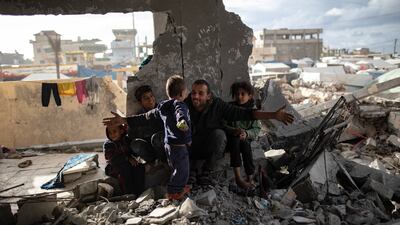
Palestinian Muhammad Al Durra with his children in the ruins of a house in Rafah where they sheltered on January 11, 2024. EPA -
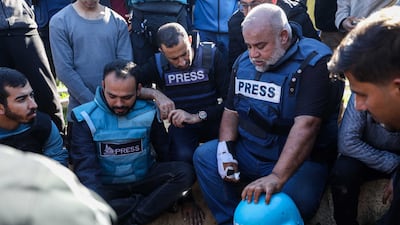
Family and friends at the funerals of journalists Hamza Al Dahdouh and Mustafa Thuraya on January 7, 2024 in Rafah, Gaza. Getty Images -
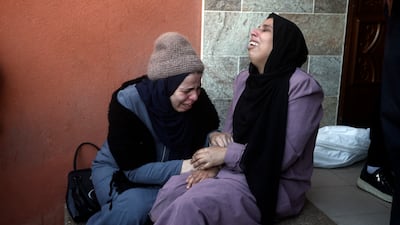
Palestinians mourn relatives killed by Israeli bombardment of the Gaza Strip outside a mortuary in Khan Younis January 4, 2024. AP Photo -
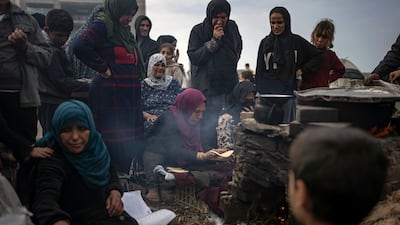
Displaced Palestinians queue to bake bread at a camp in the Muwasi area of Rafah, Gaza Strip, on December 23, 2023. AP Photo -
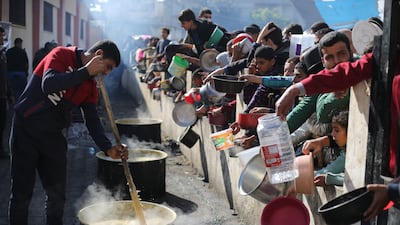
Palestinians queue for food in Rafah, the Gaza Strip, on December 20, 2023. AP Photo -

The ruins of Rafah on December 14, 2023. AFP -
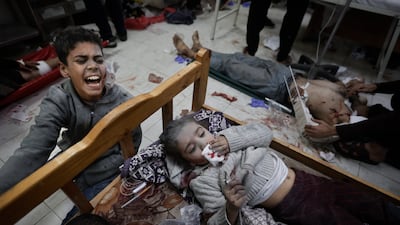
Palestinians wounded in the Israeli bombardment of the Gaza Strip arrive at a hospital in Khan Younis on December 8, 2023. AP Photo -
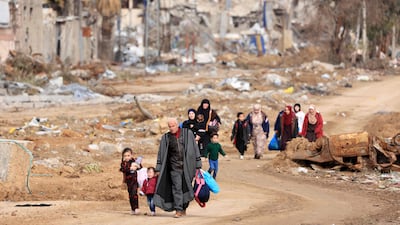
Palestinians flee Israeli bombing along the Salaheddine Road in the Zeitoun district of Gaza city on November 28, 2023. AFP -

A Red Cross vehicle takes Israeli hostages from the Gaza Strip into Egypt in Rafah on November 25, 2023. AP -
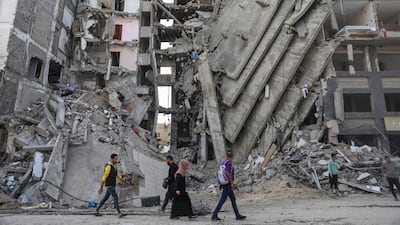
The ruins of buildings in Gaza city on November 24, 2023, as a temporary truce between Israel and Hamas took effect. AP Photo -

A woman and her cat return home to eastern Khan Younis in the southern Gaza Strip during the first hours of a four-day truce between Israel and Hamas forces on November 24, 2023. AFP -
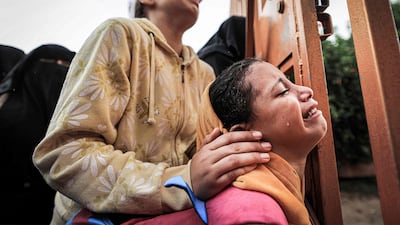
Mourning the dead of Israeli bombardment outside the mortuary at Nasser Hospital in Khan Younis on November 14, 2023. AFP -

Civilians and rescuers look for survivors in the rubble of a building after Israeli bombing of Khan Younis in the southern Gaza Strip on November 12, 2023. AFP -

November 7, 2023, a month to the day after Hamas attacked Israel, a victim of an Israeli bombardment in Rafah is moved from the rubble. AFP -
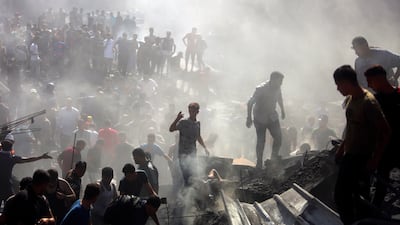
Searching the rubble after Israeli air strikes on the town of Khan Younis, southern Gaza Strip, on October 26, 2023. AP Photo -

Mourning the Kotz family at their funeral in Gan Yavne, Israel, on October 17, 2023. AP Photo -
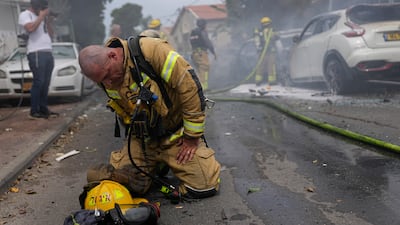
An Israeli firefighter composes himself after he and his colleagues extinguished cars set on fire by a rocket fired from the Gaza Strip in Ashkelon, Israel, on October 9, 2023. AP Photo -

Palestinians with the wreckage of an Israeli tank at the Gaza Strip fence east of the city of Khan Younis on October 7, 2023, the day Hamas forces swept unopposed into Israel. AP Photo -
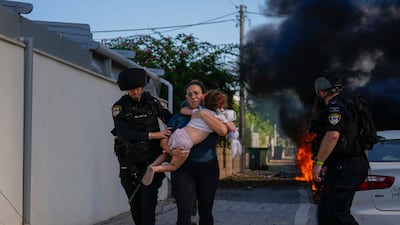
Israeli police officers evacuate a woman and a child from a site hit by a rocket fired from the Gaza Strip, in Ashkelon, southern Israel, on October 7, 2023. AP Photo


A British TV drama demonstrated the power of stories by telling the story of one postmaster: Mr Bates vs The Post Office. The programme humanised the miscarriage of justice and made clear that computer software failures and the post office leadership were to blame. The result has been such a significant public reaction that the government has done more in a week than it achieved in the past decade to put right this terrible miscarriage of justice.
The key point in these wildly different stories is not so much about the facts. It’s about how stories provide empathy and understanding. When journalists tell human stories in ways that engage and matter to readers or TV viewers, those stories can change societies and political decisions. Budget shutdowns in America, miscarriages of justice in Britain, famine and war and killings from Sudan to Gaza and Israel, Yemen and elsewhere all matter. But simply to be informed of the statistics of suffering is pointless until those stories also have a human face.
Like most people, I have no idea what to do about the US federal budget, but I do know that spending $40,000 on giving members of Congress shiny new jewellery to wear on their business suits does sound crazy in supposedly hard times. Similarly, the story of 900 people convicted of cheating the Post Office in Britain was, for years, mostly just a headline without a human face. Once the story was not merely about numbers, but about a man called Mr Bates, every British TV viewer could imagine what it must have been like for him, his family and that community to go through the injustice he suffered.
The same is true for the death and suffering we hear about from around the world every day. Newspapers need to report statistics. But every story – from Gaza to the local British post office – only has a significant impact when it has a human face. Once a story has a human face, that story also has a voice, and then the world may listen.

