


As we are set to navigate the uncertainties of 2024, made worse by the imprudence and strategic manoeuvrings of both major and minor players using dangerous, even ruthless, means to secure their positions and ambitions, we must reckon with the anxiety, anticipation and fear lying ahead. Indeed, all rules have been broken, and the laws of war and peace have been stripped of their humanitarian obligations.
Let us first delve into the region’s most significant event of 2023 – the Israel-Gaza war. It has become evident that a siege mentality dominates Israel’s past, present and future. The notion of co-existence with Arab neighbours is distorted in the minds of many. Regrettably, it is squandering a historic opportunity for co-existence and normalisation, not only with Arab countries but also with other Islamic nations, including Iran. The magnitude of this mistake is substantial and potentially irreversible if not rectified.
A war characterised by brutality, extermination and violations of international laws and humanitarian treaties, all under the pretext of seeking revenge for Hamas’s actions on October 7, is self-defeating in the long run. Conversely, those who sympathise with the actions of the Qassam Brigades are also part of the problem.
So what will happen to Gaza?
Despite behind-the-scenes talks, it is unlikely that the world will unite to impose a ceasefire on Israel and force it into comprehensive settlement negotiations. What is remarkable is the simplicity of the equation that could give both the Palestinian and Israeli people a prosperous future – the equation of the two-state solution. Israel’s rejection of this solution means rejecting the Arab-Islamic offer of prosperity, co-operation and the construction of a peaceful future for the Middle East.
Strategically, Israel is losing. This is the case even if it makes tactical gains against Hamas, having turned itself into a counterpart of a militant group, not a state, in war and peace, and reducing its own stature. Hamas is also losing strategically, as all it wants after all this destruction and killing is to not cease to exist. It has little chance of realising its objective of controlling the West Bank and it is unlikely to play a significant role in any comprehensive settlement deal to follow the challenging transitional phase.
It is evident that the administration of US President Joe Biden is determined to continue preventing Israel from drawing Lebanon or dragging America into a regional conflict.
Mr Biden’s team is also indirectly engaging with Iran to restrain Hezbollah while the US restrains Israel's actions towards Lebanon. It is the equation of provocation and counter-provocation that Washington is working to prevent – and so far, it is succeeding. The Biden administration does not want the war to expand and become regional, but it does not yet have the formula to ensure avoiding the terrifying loop of provocation.
Meanwhile, freedom of navigation has come under threat due to constant provocations from the Houthis in Yemen – and its attacks on ships may lead to an escalation with the US. Perhaps one safety valve is the Chinese insistence on ensuring navigation security. However, the continued provocation by Iran-backed groups against the US in Syria, Iraq and the strategic waterways may lead to qualitative American operations in the region.
A global war that many fear, and experts discuss, is neither entirely ruled out, nor is it looming over the Middle East, in 2024. That’s the current outlook. There is a fear, however, that a nuclear war will come to Europe’s doorstep after the US delivers F-16 jets, possibly in January, to assist Ukraine in its war with Russia.
-
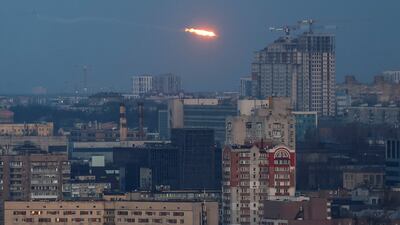
A missile explodes over Kyiv during a Russian attack involving missiles and drones. Reuters -
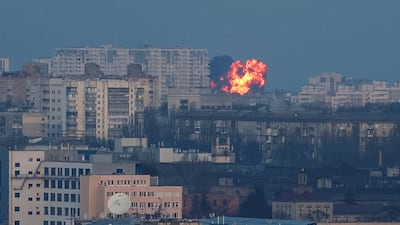
At least 10 people were killed and dozens injured in strikes across Ukraine. Reuters -
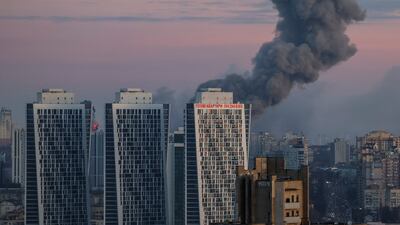
Smoke rises over Kyiv, one of several cities hit in the attack. Reuters -

A medical worker helps a survivor of the strike in Kyiv. Reuters -
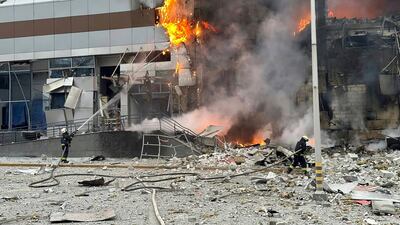
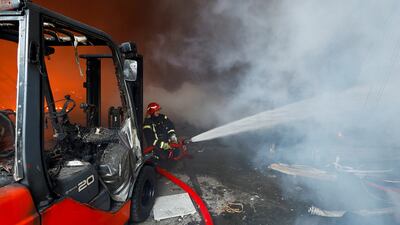
Firefighters tackle a blaze in Kyiv. AP -
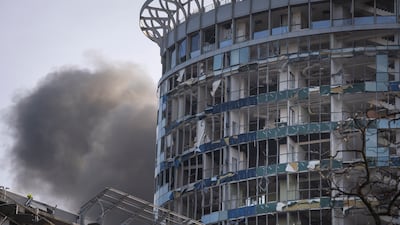
Buildings, including a maternity hospital and a shopping centre, were damaged in the strikes. Reuters -
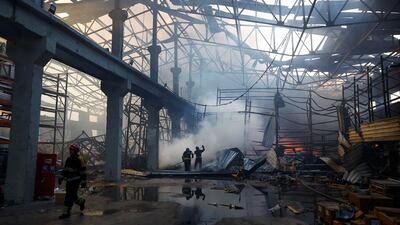
A warehouse in the Ukrainian capital was heavily damaged in the Russian attack. Reuters -
Russia launched about 110 missiles, as well as drones, Ukrainian President Volodymyr Zelenskyy said. AP -

People take shelter inside a Kyiv metro station during the Russian missile and drone attack. Reuters -

Major cities including major cities including Kyiv, Odesa and Kharkiv were targets in the attack. Reuters -

People gather in the city of Dnipro following the attack. EPA -
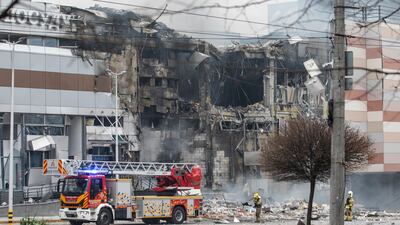
The strikes damaged a shopping mall in Dnipro. EPA


These aircraft will be delivered to bases in Poland and Romania, and Russia has issued official statements considering these bases as legitimate targets. Meanwhile, Deputy Foreign Minister Sergei Ryabkov, in charge of North and South America relations, stated that Moscow is ready to sever diplomatic relations with the US.
The worst-case scenario is that Russia decides to strike these bases and force Nato to respond militarily. In other words, the fear of a nuclear confrontation between Russia and Nato is not just a theory. The challenge is made all the more potent by the fact that 2024 is an election year in the US, Russia and the European Parliament.
It is not wars and reckless leadership alone that evoke our fears but also rapid scientific and technological progress with unknown implications, especially the extraordinary capabilities of AI, which could pose a threat to our mastery over our own destinies.
Despite all this, we must hold on to our aspirations and the belief that faith remains the faint light in the pitch darkness. Perhaps wisdom, logic and reason will guide world leaders and their peoples to ensure peace, stability and continued prosperity.

