


Even as a four-day truce in the Israel-Gaza war provides much-needed respite to Palestinian civilians living in the Strip and the families of Israeli hostages held by Hamas for more than a month, the question of what this means for the long term is being contemplated.
There are two scenarios. One is that the harrowing humanitarian toll of the war will usher in enduring and transformative settlements among most or all players in the Middle East. Commonly referred to as a “grand bargain”, this scenario usually follows a monumental event in which major global powers, led by the US, play a central role.
Alternatively, this conflict might further fuel Israeli extremism that would not only defy the international community but also challenge the interests of the US. This could then give rise to extremism in the occupied territories, propelling the world into a vortex of reprisal.
There are those, particularly in the West, who believe that a return to the pre-October 7 status quo ante is possible – perhaps even probable – as the world wearies of the war. They anticipate that the public outcry in the West towards Israeli actions will be short-lived, allowing politicians to revert to their conventional calculations.
A western participant in the recently held Manama Dialogue in Bahrain told me that neither the US nor the European countries can alter their approach to Israel due to the latter’s considerable influence in their domestic politics. He said that any empathy in the West towards the Palestinian people living under occupation will, therefore, not translate into substantial pressure on Israel, regardless of its actions.
He went a step further, stating that even the threat and fear of another wave of violence in response to western complacency will not induce the US or Europe to exert substantial pressure on Israel. According to him, the political landscape within these countries constrains their actions and hinders the courage required to make the necessary leap in dealing with Israel.
In such a scenario, it is logical to conclude that Israel will not yield to international demands, which include accepting the two-state solution, refraining from reoccupying Gaza, and abandoning the forced displacement of Palestinians from the territory’s north.
-
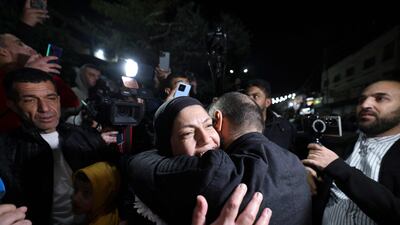
Rawda Abu Ajamieh is greeted by relatives and friends in the occupied West Bank after her release from Israeli detention as part of a temporary truce deal in the Gaza war. AFP -

Hamas militants release some hostages to the International Committee of the Red Cross as part of the deal. Reuters -
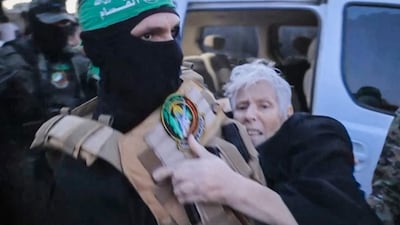
Hamas freed 13 Israeli hostages under the deal, which has brought a pause of fighting in the Israel-Gaza war. AFP -

A Thai woman who was among the hostages released, before being taken to the Shamir Medical Centre in Israel. AP -
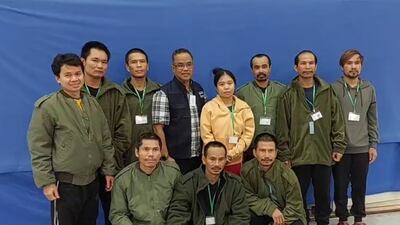
The 10 freed Thai hostages at the Shamir Medical Centre. They were seized during the attack on Israel on October 7. AP -
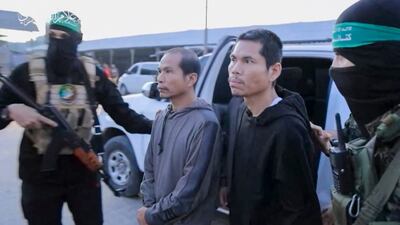
Some of the hostages held by Hamas are handed over to the International Committee of the Red Cross in Gaza. AFP -
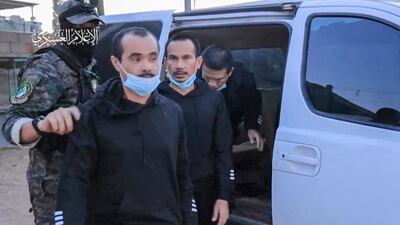
The exchange was part of a temporary truce deal that took effect in Gaza on November 24. AFP -
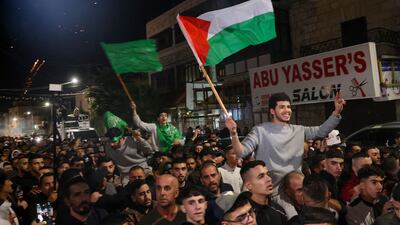
Palestinian detainees released under the deal are carried along a street in Baytunia, in the occupied West Bank. AFP -
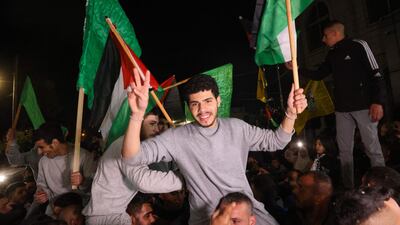
The Palestinians are among 39 released from Israeli jails under the agreement between Hamas and Israel. AFP -
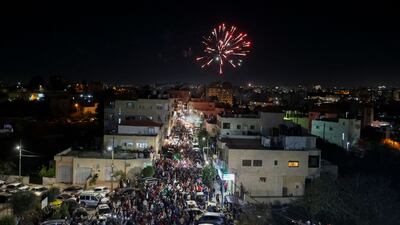
Fireworks light up the sky as Palestinians celebrate the release of the detainees, in the occupied West Bank. AFP -

A Palestinian is greeted by her family in Baytunia after being freed from jail. AFP -
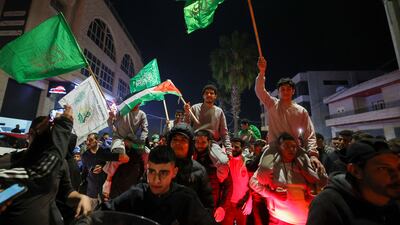
Palestinians released by Israel are carried along a street as crowds celebrate. AFP -
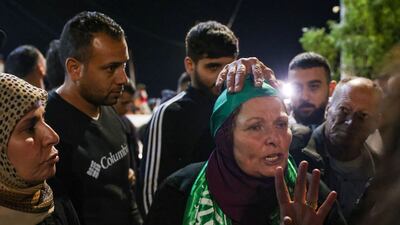
Freed detainee Hanin Barghouti, centre, speaks to loved ones. AFP -

The group of Israeli hostages were handed over to aid workers, before being taken to Israel's military. Reuters -

Nour Al Taher in Baytunia after her release from an Israeli prison, as part of a deal that brought a pause of the fighting in Gaza. AFP -

Fatima Amarneh is welcomed by loved ones, near Jenin in the West Bank, after leaving jail. Reuters -
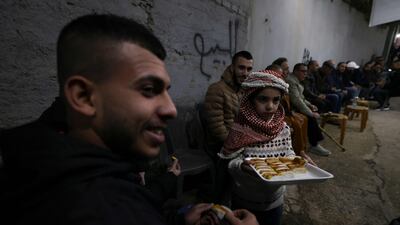
The released Palestinian detainees comprised 24 women and 15 children. AFP -
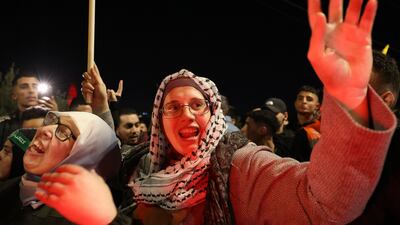
Palestinians in Beitonia, near Ramallah, celebrate the release of the group from Israeli detention. EPA -

Medical workers at Israel's Schneider-Children's Medical Centre receive some of the hostages released by Hamas. EPA -
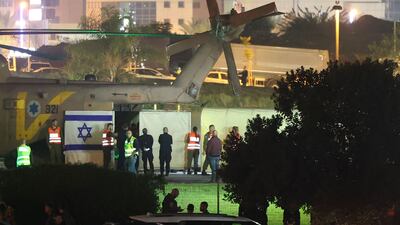
An Israeli helicopter with released hostages lands at the medical centre in Tel Aviv. AFP -
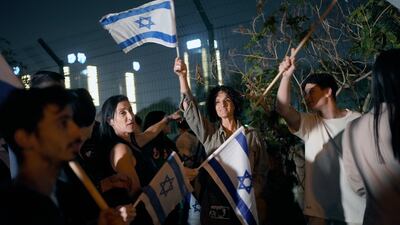
Family and friends gather as a helicopter arrives with hostages released by Hamas. Getty Images -

Israelis look on as a helicopter with released hostages prepares to land in Tel Aviv. AFP -
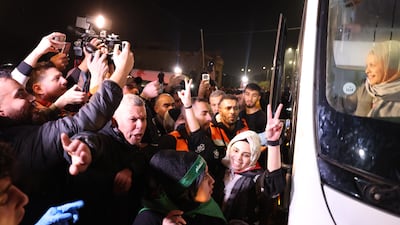
Crowds in the West Bank celebrate the arrival of Palestinians released from Israeli jails. EPA -
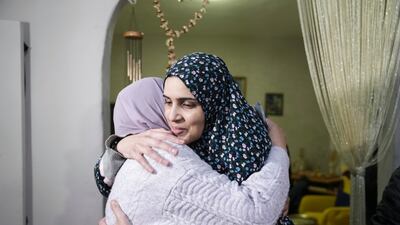
Marah Bakir, right, was among the first Palestinian detainees to be released by Israeli authorities in a swap between Israel and Hamas. AP -

Released Palestinian detainees leave jail near Ramallah in the occupied West Bank. Reuters -

Ms Bakir is reunited with her family through the swap deal between Hamas and Israel. Reuters -

Ms Bakir embraces a family member after her release. Reuters -

Ms Bakir with a family member in Jerusalem. Reuters -

A vehicle carrying hostages abducted by Hamas arrives at the Rafah border crossing amid a hostage-prisoner swap deal between the militant group and Israel. Reuters -

The hostages had been held in Gaza since the Hamas attack of October 7. Reuters -

A vehicle carrying hostages. Reuters -

An International Red Cross vehicle reportedly carrying Israeli hostages released by Hamas crosses the Rafah border point in the Gaza Strip towards Egypt. AFP -
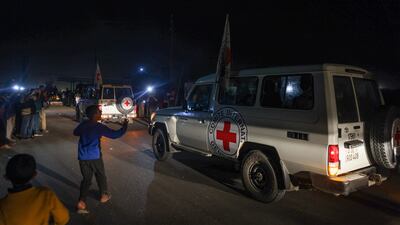
The hostages will be taken to Israel and reunited with their families. AFP -

Under the temporary truce agreement with Israel, Hamas will release at least 50 Israeli hostages over four days. Reuters -

The hostages will be flown to Israel to be reunited with their families. AFP -
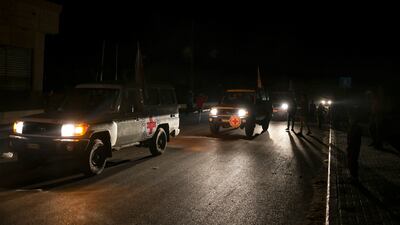
After 48 days of a bombardment that has claimed thousands of lives, a four-day truce in the Israel-Gaza war began on Friday. AFP -

The hostages were taken into Gaza following Hamas's attack on Israel on October 7. Reuters -

Once the hostages have been transferred, 39 Palestinian detainees are set to be released from several Israeli prisons. Reuters


A sentiment that has gained traction among some influential Israelis today, including former officials, is that the solution for Gaza lies in the relocation of its 2.3 million residents with European and American “humanitarian” assistance, including their accommodation of 20,000 or 50,000 Palestinians each through imposed quotas on these countries.
One Israeli politician, Danny Danon, has urged the international community to “assist Palestinians in having a better life” than the one that was “already bad” before the war and that has become “worse” after, by agreeing to host them.
In essence, they are framing this forced displacement as a “humanitarian” initiative towards Palestinians. This confidence, perhaps even audacity, on their part comes from being accustomed to imposing facts on the ground and escaping accountability.
As Israel’s ally, the US should be mindful of any such attempts – and recent remarks made by the Biden administration suggest that is indeed the case.
What Washington will also do well to take seriously is a warning that Bahrain’s Crown Prince Salman bin Hamad Al Khalifa recently issued. Pointing out that the Russian invasion of Afghanistan and the US invasion of Iraq led to the creation of Al Qaeda and ISIS, respectively, Prince Salman argued that accepting the current dire situation for Palestinians would only “create conditions for the spread of violence worldwide”.
At a time when every step the US makes is being scrutinised, it’s important to not overlook its efforts to ensure that the Israel-Gaza war does not expand to Lebanon and Iran.
Amos Hochstein, US Special Presidential Co-ordinator, has been explicit about the importance of containing the war. “At this moment, we cannot afford to escalate this conflict into another front,” he told me last week. “The Lebanese people cannot risk entering a war. [They] have the right to live in peace within their borders with Israel.”
Mr Hochstein also emphasised that this might be the opportune moment “to think about a vision for a conflict-free region – at least with as fewer conflicts as we hope”.
This is where American co-operation with GCC member states across fields could have an impact, as the latter remain engaged either in the transitional arrangements or in formulating the aforementioned “vision” and studying the options available.
Saudi Arabia, for instance, is leading an initiative by Arab and key Islamic nations, aimed at pressuring Israel, alongside the US and Europe, to revise its strategy fundamentally, and not just halt its military offensive in Gaza.
Behind the scenes, Riyadh is orchestrating a diplomatic effort based on a demand that the US and Israel’s allies in Europe persuade it to adopt an approach that aligns with the international consensus – which includes working towards the two-state solution, ending forced displacement, recognition of Israel’s right to live in security and stability, and normalisation of relations with Arab and Islamic nations. Achieving this requires a paradigm shift in the mindset, policy and approach of the Israeli leadership.
Saudi Arabia is collaborating with Egypt, Jordan, Palestine, Indonesia and the Organisation of Islamic Co-operation within the framework of a ministerial committee established following an Arab-Islamic summit presided over by Foreign Minister Prince Faisal bin Farhan.
The committee has become a pivotal mechanism for conveying Arab and Islamic stands to major global players. The committee’s engagements began with a visit to China, followed by Russia, the UK and France, with the crucial focal point being the US.
The process of shaping the vision, settlement parameters, and the nature of incentives for Israel will unfold during discussions at these diplomatic stops if Israel recognises its strategic interests. Should the US succeed in securing Israeli commitments, the ministerial committee would be ready to ensure corresponding commitments from the Palestinian side, which is in dire need of a fresh, dynamic and pragmatic leadership.
The contours of the roadmap for the day after are contingent on an Israeli decision. Persistence in the current approach risks undermining all prospects for a secure future, not only for Israel but for the Middle East and the international community.
Israel’s best interests necessitate decisive action from the West, including applying substantial pressure. An imminent opportunity exists, and it would be imprudent not to capitalise on it.
Live updates: Follow the latest news on Israel-Gaza

