Workers install solar panels at a photovoltaic solar park situated on the outskirts of the coastal town of Lamberts Bay, South Africa. AP


How the Gulf can help African countries meet their climate-finance targets


Jared Haddon
Jared Haddon
  • English
  • Arabic

November 23, 2023

As global leaders convene for Cop28 later this month, the urgency to pivot financial flows towards sustainable development has never been more critical. Climate finance is the backbone of the entire climate action agenda. Yet there is a stark contrast between the global commitment articulated in high-level discussions and the tangible actions being taken on the ground.

Therefore, the importance placed by the UAE’s Cop28 Presidency is the correct one. Dr Sultan Al Jaber, Minister of Industry and Advanced Technology, and Cop28 President-designate, has articulated a clear stance towards it and has emphasised the necessity of addressing the gaps in current climate change targets and forming a comprehensive response to address these issues. He has also called for a transformation of international financial institutions to increase capital flow for tackling climate change, resonating with proposals like the Barbados-led Bridgetown Initiative.

Climate finance is crucial for reaching our global net-zero goals. There is a widely held recognition that we urgently need to boost spending further and more quickly to keep on track.

Still, unlocking climate resilience will require more than a focus on expanding investment and redirecting it to the areas most in need. Indeed, climate finance is less effective without viable projects that are ready for investment. The development of a reliable pipeline of climate-responsive infrastructure projects – those involving renewable energy, natural resources, utilities, or waste management – is the forgotten element of energy transition that has the potential to bottleneck financial action.

Recent studies from the Tony Blair Institute for Global Change have revealed that in emerging markets, the number of climate-responsive infrastructure projects funded by private sources of capital has been decreasing by 10 per cent per year since 2015. Climate-finance targets require these projects to increase by 30 per cent per year by 2030.

The GCC countries understand the complexities and long-term nature of energy transition efforts and can effectively navigate these challenges

Nowhere is the gap in climate finance more severe than in Africa. To adhere to its commitments under the Paris Agreement, the continent needs $2.8 trillion by 2030, an amount almost equal to its current gross domestic product. Yet with public debt hitting $1.8 trillion in 2022, African countries are finding it increasingly difficult to tap into their financial reserves for climate action.

With their deepening roots in Africa, GCC countries are well-positioned to take a leadership role in facilitating the continent’s energy transition.

GCC investments in Africa have seen a substantial upswing in recent years. Between 2012 and 2022, more than $100 billion of foreign direct investment flowed from the Gulf into Africa, spanning over 600 projects. With $59.4 billion of total investment, the UAE is the fourth-largest global investor in Africa, after China, Europe and the US. It is followed by Saudi Arabia, which has pumped $25.6 billion of capital into the regional market.

This prominent position enables the Gulf countries to function not just as financiers but as partners of energy transition – a domain yet to see its full potential.

What makes the GCC and Africa ideal partners in this endeavour?

The GCC countries have significant financial resources and a history of transformative domestic policies that can be leveraged to assist Africa’s energy transition. They understand the complexities and long-term nature of such efforts and can effectively navigate these challenges.

Africa offers a vast potential for green industrialisation, with unparalleled solar and hydropower capacities. These renewable resources can be harnessed to develop green industrial zones, such as the one nearing completion in Mozambique, to produce essential materials such as steel, aluminium and hydrogen. When the GCC invests in such initiatives, it not only propels Africa’s transition to sustainable energy but also secures essential materials that are critical to its own domestic industrial activities.

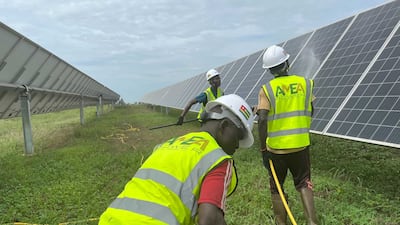
  • The Amea Power solar project in Togo has been built for with a $25 million loan provided by the Abu Dhabi Exports Office. All photos: Andy Scott / The National
    The Amea Power solar project in Togo has been built for with a $25 million loan provided by the Abu Dhabi Exports Office. All photos: Andy Scott / The National
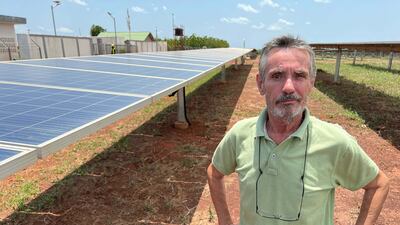
  • Herve Rioux, operations manager at Amea's solar plant
    Herve Rioux, operations manager at Amea's solar plant
  • The Blitta solar plant is a joint venture between UAE-based Amea Power and the Togo government
    The Blitta solar plant is a joint venture between UAE-based Amea Power and the Togo government
  • Nearly 95 per cent of the Blitta population are subsistence farmers - the power plant has brought some much-needed regular work
    Nearly 95 per cent of the Blitta population are subsistence farmers - the power plant has brought some much-needed regular work
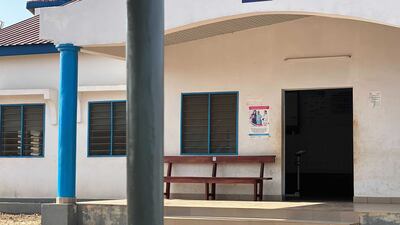
  • Amea also provided a new clinic that has given the 20,000 strong population a dedicated health centre
    Amea also provided a new clinic that has given the 20,000 strong population a dedicated health centre
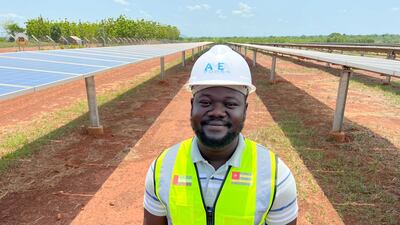
  • Raouf Damtare is the health and safety manager at the 130,000-panel solar plant
    Raouf Damtare is the health and safety manager at the 130,000-panel solar plant

Africa’s strategic position makes it an ideal hub for green industries, perfectly situated to access key emerging markets. Consider the case of East Africa, where countries such as Tanzania and Mozambique have already served as important export bases. Here, GCC investors, in collaboration with their African partners, can distribute green energy products efficiently to vital global markets such as South Asia and the Gulf itself. This capability is crucial to fulfilling the GCC’s vision of becoming a global nexus for commerce and connectivity.

Most importantly, the partnership presents the GCC with an opportunity to solidify its position as a global leader in climate action, enhancing its international reputation by driving forward a shared global agenda.

The UAE is already leading by example in this space. At the African Climate Summit in September, Dr Al Jaber announced a $4.5 billion commitment to fast-track Africa’s energy transition. The pledge, supported by leading entities such as the Abu Dhabi Fund for Development, Etihad Credit Insurance and Masdar, showcases the remarkable inroads the GCC is making in this dynamic field of progress.

As Cop28 approaches, there is a real sense of urgency in this space. Climate investment is vital, and words must become action. A pivot towards strategic, targeted investment in Africa can catalyse global transition to renewable energy and foster sustainable economic growth.

The landscape of global investment is also shifting. Where the latter part of the 20th century was marked by a focus on private market forces, the past decade has witnessed the emergence of substantial state-led overseas development initiatives.

Now, the world is looking towards the Gulf nations to establish new paradigms of investment. As they expand their global influence, there is an opportunity to chart a course that not only advances their interests but also carries along the global community towards a more sustainable and equitable future.


Ten tax points to be aware of in 2026

1. Domestic VAT refund amendments: request your refund within five years

If a business does not apply for the refund on time, they lose their credit.

2. E-invoicing in the UAE

Businesses should continue preparing for the implementation of e-invoicing in the UAE, with 2026 a preparation and transition period ahead of phased mandatory adoption. 

3. More tax audits

Tax authorities are increasingly using data already available across multiple filings to identify audit risks. 

4. More beneficial VAT and excise tax penalty regime

Tax disputes are expected to become more frequent and more structured, with clearer administrative objection and appeal processes. The UAE has adopted a new penalty regime for VAT and excise disputes, which now mirrors the penalty regime for corporate tax.

5. Greater emphasis on statutory audit

There is a greater need for the accuracy of financial statements. The International Financial Reporting Standards standards need to be strictly adhered to and, as a result, the quality of the audits will need to increase.

6. Further transfer pricing enforcement

Transfer pricing enforcement, which refers to the practice of establishing prices for internal transactions between related entities, is expected to broaden in scope. The UAE will shortly open the possibility to negotiate advance pricing agreements, or essentially rulings for transfer pricing purposes. 

7. Limited time periods for audits

Recent amendments also introduce a default five-year limitation period for tax audits and assessments, subject to specific statutory exceptions. While the standard audit and assessment period is five years, this may be extended to up to 15 years in cases involving fraud or tax evasion. 

8. Pillar 2 implementation 

Many multinational groups will begin to feel the practical effect of the Domestic Minimum Top-Up Tax (DMTT), the UAE's implementation of the OECD’s global minimum tax under Pillar 2. While the rules apply for financial years starting on or after January 1, 2025, it is 2026 that marks the transition to an operational phase.

9. Reduced compliance obligations for imported goods and services

Businesses that apply the reverse-charge mechanism for VAT purposes in the UAE may benefit from reduced compliance obligations. 

10. Substance and CbC reporting focus

Tax authorities are expected to continue strengthening the enforcement of economic substance and Country-by-Country (CbC) reporting frameworks. In the UAE, these regimes are increasingly being used as risk-assessment tools, providing tax authorities with a comprehensive view of multinational groups’ global footprints and enabling them to assess whether profits are aligned with real economic activity. 

Contributed by Thomas Vanhee and Hend Rashwan, Aurifer

The%20Emperor%20and%20the%20Elephant
%3Cp%3E%3Cstrong%3EAuthor%3A%20%3C%2Fstrong%3ESam%20Ottewill-Soulsby%3C%2Fp%3E%0A%3Cp%3E%3Cstrong%3EPublisher%3A%20%3C%2Fstrong%3EPrinceton%20University%20Press%3C%2Fp%3E%0A%3Cp%3E%3Cstrong%3EPages%3A%20%3C%2Fstrong%3E392%3C%2Fp%3E%0A%3Cp%3E%3Cstrong%3EAvailable%3A%20%3C%2Fstrong%3EJuly%2011%3C%2Fp%3E%0A

Sting & Shaggy

44/876

(Interscope)

2020 Oscars winners: in numbers
  • Parasite – 4
  • 1917– 3
  • Ford v Ferrari – 2
  • Joker – 2
  • Once Upon a Time ... in Hollywood – 2
  • American Factory – 1
  • Bombshell – 1
  • Hair Love – 1
  • Jojo Rabbit – 1
  • Judy – 1
  • Little Women – 1
  • Learning to Skateboard in a Warzone (If You're a Girl) – 1
  • Marriage Story – 1
  • Rocketman – 1
  • The Neighbors' Window – 1
  • Toy Story 4 – 1
The%20specs%3A%20Taycan%20Turbo%20GT
%3Cp%3E%3Cstrong%3EEngine%3A%20%3C%2Fstrong%3EDual%20synchronous%20electric%20motors%0D%3Cbr%3E%3Cstrong%3EPower%3A%20%3C%2Fstrong%3E1%2C108hp%0D%3Cbr%3E%3Cstrong%3ETorque%3A%20%3C%2Fstrong%3E1%2C340Nm%0D%3Cbr%3E%3Cstrong%3ETransmission%3A%20%3C%2Fstrong%3ESingle-speed%20automatic%20(front%20axle)%3B%20two-speed%20transmission%20(rear%20axle)%0D%3Cbr%3E%3Cstrong%3ETouring%20range%3A%20%3C%2Fstrong%3E488-560km%0D%3Cbr%3E%3Cstrong%3EPrice%3A%20%3C%2Fstrong%3EFrom%20Dh928%2C400%0D%3Cbr%3E%3Cstrong%3EOn%20sale%3A%20%3C%2Fstrong%3EOrders%20open%3C%2Fp%3E%0A
German intelligence warnings
  • 2002: "Hezbollah supporters feared becoming a target of security services because of the effects of [9/11] ... discussions on Hezbollah policy moved from mosques into smaller circles in private homes." Supporters in Germany: 800
  • 2013: "Financial and logistical support from Germany for Hezbollah in Lebanon supports the armed struggle against Israel ... Hezbollah supporters in Germany hold back from actions that would gain publicity." Supporters in Germany: 950
  • 2023: "It must be reckoned with that Hezbollah will continue to plan terrorist actions outside the Middle East against Israel or Israeli interests." Supporters in Germany: 1,250 

Source: Federal Office for the Protection of the Constitution

Terror attacks in Paris, November 13, 2015

- At 9.16pm, three suicide attackers killed one person outside the Atade de France during a foootball match between France and Germany- At 9.25pm, three attackers opened fire on restaurants and cafes over 20 minutes, killing 39 people- Shortly after 9.40pm, three other attackers launched a three-hour raid on the Bataclan, in which 1,500 people had gathered to watch a rock concert. In total, 90 people were killed- Salah Abdeslam, the only survivor of the terrorists, did not directly participate in the attacks, thought to be due to a technical glitch in his suicide vest- He fled to Belgium and was involved in attacks on Brussels in March 2016. He is serving a life sentence in France

Winners

Ballon d’Or (Men’s)
Ousmane Dembélé (Paris Saint-Germain / France)

Ballon d’Or Féminin (Women’s)
Aitana Bonmatí (Barcelona / Spain)

Kopa Trophy (Best player under 21 – Men’s)
Lamine Yamal (Barcelona / Spain)

Best Young Women’s Player
Vicky López (Barcelona / Spain)

Yashin Trophy (Best Goalkeeper – Men’s)
Gianluigi Donnarumma (Paris Saint-Germain and Manchester City / Italy)

Best Women’s Goalkeeper
Hannah Hampton (England / Aston Villa and Chelsea)

Men’s Coach of the Year
Luis Enrique (Paris Saint-Germain)

Women’s Coach of the Year
Sarina Wiegman (England)

Who's who in Yemen conflict

Houthis: Iran-backed rebels who occupy Sanaa and run unrecognised government

Yemeni government: Exiled government in Aden led by eight-member Presidential Leadership Council

Southern Transitional Council: Faction in Yemeni government that seeks autonomy for the south

Habrish 'rebels': Tribal-backed forces feuding with STC over control of oil in government territory

Key products and UAE prices

iPhone XS
With a 5.8-inch screen, it will be an advance version of the iPhone X. It will be dual sim and comes with better battery life, a faster processor and better camera. A new gold colour will be available.
Price: Dh4,229

iPhone XS Max
It is expected to be a grander version of the iPhone X with a 6.5-inch screen; an inch bigger than the screen of the iPhone 8 Plus.
Price: Dh4,649

iPhone XR
A low-cost version of the iPhone X with a 6.1-inch screen, it is expected to attract mass attention. According to industry experts, it is likely to have aluminium edges instead of stainless steel.
Price: Dh3,179

Apple Watch Series 4
More comprehensive health device with edge-to-edge displays that are more than 30 per cent bigger than displays on current models.

Tightening the screw on rogue recruiters

The UAE overhauled the procedure to recruit housemaids and domestic workers with a law in 2017 to protect low-income labour from being exploited.

 Only recruitment companies authorised by the government are permitted as part of Tadbeer, a network of labour ministry-regulated centres.

A contract must be drawn up for domestic workers, the wages and job offer clearly stating the nature of work.

The contract stating the wages, work entailed and accommodation must be sent to the employee in their home country before they depart for the UAE.

The contract will be signed by the employer and employee when the domestic worker arrives in the UAE.

Only recruitment agencies registered with the ministry can undertake recruitment and employment applications for domestic workers.

Penalties for illegal recruitment in the UAE include fines of up to Dh100,000 and imprisonment

But agents not authorised by the government sidestep the law by illegally getting women into the country on visit visas.

UAE v Ireland

1st ODI, UAE win by 6 wickets

2nd ODI, January 12

3rd ODI, January 14

4th ODI, January 16

The specs

Engine: four-litre V6 and 3.5-litre V6 twin-turbo

Transmission: six-speed and 10-speed

Power: 271 and 409 horsepower

Torque: 385 and 650Nm

Price: from Dh229,900 to Dh355,000

Match info

Champions League quarter-final, first leg

Liverpool v Porto, Tuesday, 11pm (UAE)

Matches can be watched on BeIN Sports

Updated: November 23, 2023, 7:18 AM