


With more than 10,000 people dead in Gaza – nearly half of them children – and many Israeli hostages still missing, it is hard to envisage an endgame to the current conflict. What will the landscape of the embattled Gaza Strip look like when the war ends, not just from a political or governance point of view, but from a societal?
How wars end is crucial because it determines how sustainable the future peace will be. Transitional justice is meant to connect the present to a traumatic past. Consider it psychotherapy for countries, allowing societies to rebuild and heal by addressing their past trauma.
It seems counterproductive to think about how transitional justice will look when the Israeli military is still carpet-bombing Gaza, and millions are seeking refuge. However, it is imperative to at least try because this is how people will come together in the future to address the legacies of large-scale human rights violations.
Transitional justice takes several forms: youth initiatives; peace processes; truth and memory; gender justice; institutional reform and criminal justice. However, at the core of transitional justice is prevention. This is a priority for any peace, development or governance.
We can look at past examples of conflicts and what happened when the fighting ended. Argentina, for instance, went through the horrific Dirty War from 1973 to 1984 during which 30,000 people disappeared.
Thousands of citizens – including mothers who wore white headscarves in memory of their lost children – would fill the streets of Buenos Aires to remind people of exactly what had happened. But it was also a reminder of what must never occur again.
An important healing process after this terrible period was the country’s “Never Again” report for the National Commission on the Disappearance of Persons. It was a crucial piece of Argentina’s Truth Commissions, and a window on dealing with the past.
The aim of transitional justice is to break the cycle of impunity and violence. Studies done by the International Centre for Transitional Justice in the Philippines, Sierra Leone, Morocco and other countries showed how transitional justice can prevent future conflict. But to do this, there must also be policy reform to ensure that it never happens again.
-
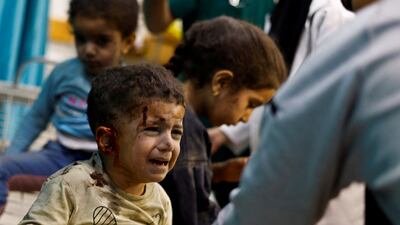
Palestinian children wounded in Israeli strikes amid the Israel-Gaza war wait for treatment at Nasser Hospital. Reuters -
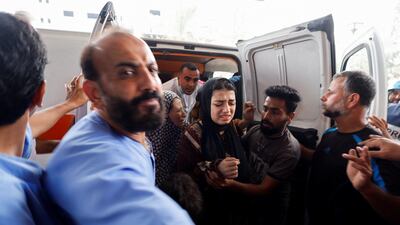
Wounded Palestinians are assisted out of an ambulance to receive treatment at Nasser Hospital in Khan Younis. Reuters -
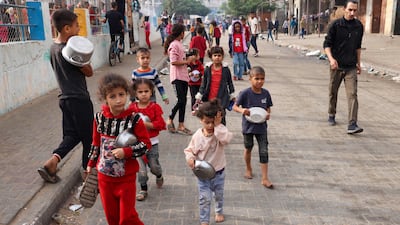
Displaced Palestinian children gather for breakfast at a refugee camp in Rafah. AFP -
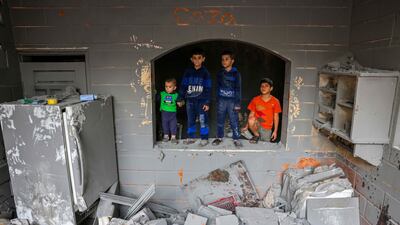
Children inside a damaged building following strikes on Rafah in the southern Gaza Strip. AFP -
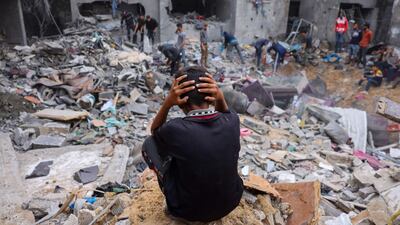
People salvage belongings from a damaged building following strikes on Rafah. AFP -
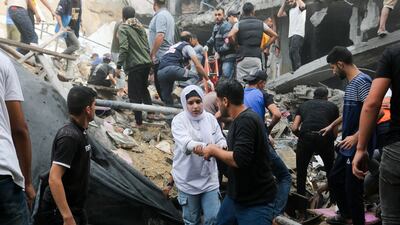
A girl is assisted as Palestinians search for casualties after an Israeli strike on a house, in Rafa in the southern Gaza Strip. Reuters -
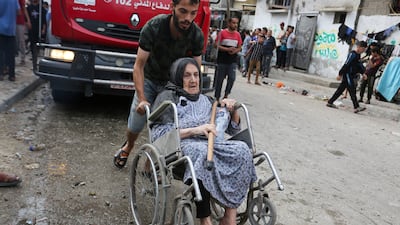
A Palestinian woman is evacuated at the site of an Israeli strike on a house, in Rafah. Reuters -
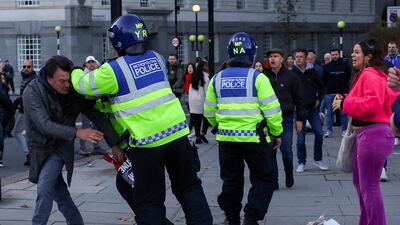
Police officers push back a counter protester who snatched a pro-Palestinian placard from a woman during a demonstration in solidarity with Gazans, London. Reuters -
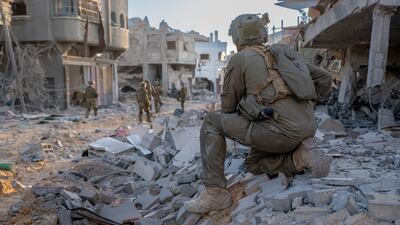
Israeli soldiers inside the Gaza Strip, amid the continuing ground operation. Reuters -
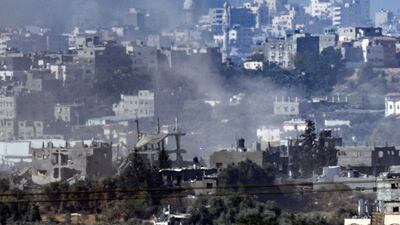
An Israeli flag can be seen inside the Gaza Strip, from the Israeli side of the border. Reuters -
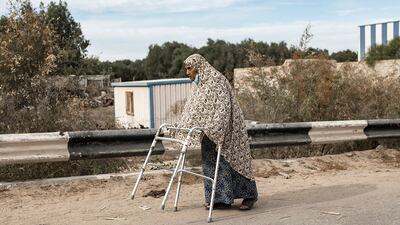
A Palestinian woman evacuates her home, heading to the southern Gaza Strip. EPA -
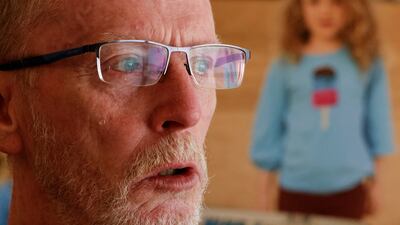
Thomas Hand, the father of Irish-Israeli Emily Hand, 8, who was announced dead following the October 7 attack, then later confirmed as one of the hostages held in Gaza, speaks from his hotel where he was evacuated to in Israel. Reuters -
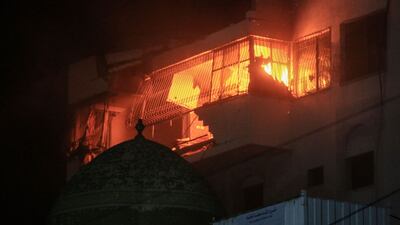
A residential building on fire following Israeli air strikes in Gaza city. Bloomberg -
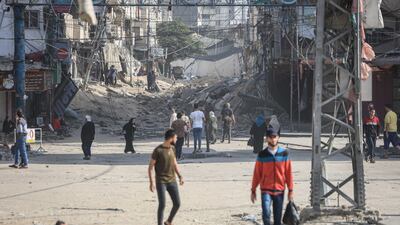
The rubble from destroyed residential buildings fills a street in Gaza city. Bloomberg -
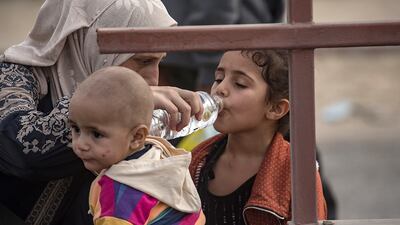
A Palestinian child drinks water as they evacuate to the southern Gaza Strip. EPA -
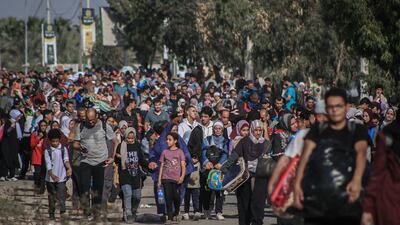
Palestinians displaced from Gaza city head towards the south. Bloomberg -
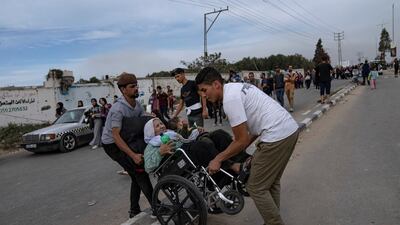
Palestinians flee to the southern Gaza Strip. AP -
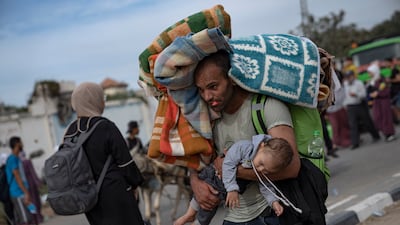
Palestinians flee to the southern Gaza Strip on Salah al-Din Street in Bureij, Gaza Strip. AP -
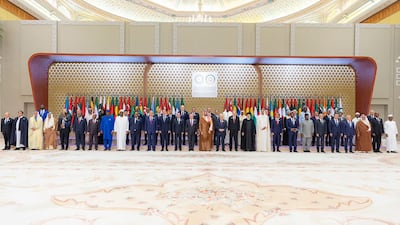
A group picture ahead of an emergency meeting of the Arab League and the Organisation of Islamic Co-operation in Riyadh. AFP


Germany has also done extensive work on healing and coming to terms with the past. The German word often associated with looking backwards to find answers is “vergangenheitsbewaltigung”, which translates to “struggling to come to terms with the past”. Extensive work has been done in modern Germany to try to understand the Nazi period. How did it happen? Is there collective culpability? By analysing the Holocaust, the belief that by learning from the bleak past, one will not repeat such terrible mistakes.
Perhaps it helps us to look at examples of where justice has not worked. This is a way of illustrating what must be done in current wars, such as in Ukraine and Palestine-Israel.
In Bosnia, the International Tribunal for the Former Yugoslavia estimated that between 20,000 to 50,000 women were believed to have been raped during the 1992-1995 war. More than 80 per cent of them were held for long periods of imprisonment.
Tadeusz Mazowiecki, the UN special rapporteur on human rights at the time, whose research cited a figure of 12,000 victims of sexual violence, concluded that “rape has been used as an instrument of ethnic cleansing”. Yet very few of the rapists were ever presented for trial at The Hague.
I once interviewed a woman whose life had been utterly broken by what happened to her in those camps. And yet she went back to live in her village and had to face her rapists every single day in the streets. Chillingly, she told me that it was she who dropped her eyes in shame, not them.
Another example of a pain that was never healed is Iraq. According to Nadim Houry, in a report on transitional justice for the Brookings Institution think tank, said “Iraq’s failed approach to transitional justice post-2003 illustrates the dangers of tackling the past without addressing the present”.
“Policies that were adopted to address violations committed during Saddam Hussein’s dictatorship did not heal, but rather fuelled new cycles of violence,” he added.
Sometimes justice can take decades. In El Salvador, which endured a horrific conflict in the 1980s, survivors and families have spent years fighting for recognition. In 2016, El Salvador’s Supreme Court struck down an amnesty law that made it impossible to prosecute those involved in massacres as well as other gross human rights abuses. This meant it was finally possible to investigate crimes that took place decades before, but which were still raw in the survivors’ memories.
The Attorney General’s office, working together with civil society, helped human rights defenders fight for reparations and justice. Miriam Abrego, a victim who was shot twice, is one of these advocates. “The government and others keep telling us to shut up. But me, I won’t shut up. We victims are tired. We want to be recognised as victims. We want to be heard,” she told a UN report.
Looking at Gaza being bombed and millions being made homeless makes me wonder whether any kind of justice will ever emerge. The crimes of both Hamas and the Israeli military will have to be carefully investigated. Yet so many Palestinians have become used to not seeing justice, having endured the misery of the Nakba since 1948.
Perhaps one of the most effective transitional justice tools is engagement with the youth. My last trip to Gaza, in 2021, was spent with young people such as the impressive coding institute, Gaza Sky Geeks. Most probably it is rubble now, but back then it was a clear example of empowerment.
Some of the young people I spoke with there were trying to meet their Israeli counterparts to begin back-channel engagement, to feed into eventual peace processes. This is known as Track 2 and Track 3 diplomacy. Will they be able to rebuild these processes and restore trust after October 7 and the destruction of Gaza?
The sorrow of war is that the same mistakes are endlessly repeated. But cycles of violence can and must be broken. The philosopher George Santayana’s best-known quote is perhaps the clearest illustration of transitional justice in action: “Those who cannot remember the past are condemned to repeat it.”

