A drop of water falls off a melting iceberg in the Nuup Kangerlua Fjord near Nuuk in south-western Greenland. Greenland’s ice sheet is melting four times faster than in 2003 and is losing 270 billion tonnes of ice mass a year. AP
A drop of water falls off a melting iceberg in the Nuup Kangerlua Fjord near Nuuk in south-western Greenland. Greenland’s ice sheet is melting four times faster than in 2003 and is losing 270 billion


How climate change unites Greenland and the UAE


Laila Mostafa Abdullatif
  • English
  • Arabic

November 15, 2023

Sitting in the UAE, it’s hard to visualise the terrain of Greenland, which is home to the world’s second-largest ice sheet, endless icebergs, pristine natural landscapes and many more boats than cars. Photos and videos couldn’t prepare me for what I was about to experience during my five-day climate change expedition in September to one of the northernmost parts of the world.

Along with my colleague Manal, who leads operations at Emirates Nature-WWF, and a group of vibrant, inspiring female climate leaders from around the world, I made my way to the village of Ilulissat, 250 kilometres north of the Arctic Circle, for an update on the latest status of climate change and to explore high-impact solutions with scientists, experts and the local Inuit community of Greenland.

Why go all the way to Greenland for this? Let me answer with a question: what is the one thing that Greenland and the UAE have in common? Both are experiencing climate change faster than other parts of the world.

While average global surface temperatures have risen to 1.2°C since pre-industrial times, temperatures have risen to 1.5°C in Greenland and 1.8°C in the Emirates. As the planet’s surface temperatures continue to rise, both countries will experience temperatures inching even higher, disproportionate to the global average.

Greenland’s ice sheet is melting four times faster than in 2003 and is losing 270 billion tonnes of ice mass a year, making it one of the largest contributors to rising sea levels. Scientists say that the ice sheet is close to tipping point, beyond which melting would become inevitable, regardless of global temperatures. This would trigger numerous knock-on effects such as rising sea levels and coastal inundation. It would also involve thawing permafrost releasing greenhouse gases; increasing amounts of water vapour that could evolve into destructive typhoons and cold glacial melt that would interact with warmer oceans and slow down ocean currents. A diminished ice sheet would also reduce the reflection of incoming solar energy and radiation. These are just some of the innumerable consequences that scientists in the Arctic Circle are still deciphering.

This aerial photograph taken on August 11 shows a severely melted glacier along the Scoresby Sound Fjord, in eastern Greenland. Scientists say that Greenland's ice sheet is close to tipping point, beyond which melting would become inevitable. AFP

The Greenland ice sheet is a treasure trove for scientists. It has existed for more than 100,000 years – some portions have existed for even longer – there is much to learn. Scientists have been able to drill out cylinders of ice – “ice cores” – and measure the atmospheric composition of the air pockets trapped within. This data holds insights about historic temperature levels and atmospheric composition of carbon dioxide, methane and other heat-trapping gasses. Scientists have been able to corelate these to different eras such as pre-historic times, the last Ice Age and the Industrial Revolution. Most importantly, they verify that atmospheric carbon dioxide is increasing at a much faster rate than ever before.

However, although carbon emissions have increased greatly, temperatures have not caught up yet. This points to a narrow window of opportunity in which we can act to prevent irreversible change – seven years, according to climate scientists at the Intergovernmental Panel on Climate Change.

But the most shocking thing I experienced during the expedition wasn’t the data, charts or timelines – it was something else. One of the most striking things about Ilulissat is the abundance of icebergs. Everywhere we looked, we saw mountains of ice that blended into the clouds – and were quickly informed that these towers of ice were quite tiny compared to how large they used to be.

During our travels by land and boat, we found ourselves surrounded by smaller chunks of ephemeral ice that floated around, relatively briefly, before they dissolved into the sea for good. As we marvelled at the silence and immense beauty of Mother Nature, we were jarred by the realities of climate change – the crashing sound of chunks of ice calving off the glaciers and falling into the sea, time and time again. Every few minutes, we felt sound vibrations run through our nervous systems, as nature reminded us of the raw power, the sheer scale and unimaginable speed of climate change.

As we get closer to Cop28, it is important that we – residents of the UAE – and around the world, stay focused on achieving a credible pathway for a 1.5°C world

As the day ended, we were each left with profound thoughts about the lasting physical impact of our every choice and action. The next morning, we woke up with renewed conviction and commitment to tackle the climate-nature crisis once and for all.

A moment that I will forever cherish is our walk through Ilulissat Icefjord to visit an old settlement where the indigenous Inuit first settled 4,500 years ago. They passed down their traditions and knowledge for generations, teaching younger Inuit how to survive off the land by hunting for whales, seals and reindeer, as well as foraging for berries. The community would use sled dogs as their main mode of transportation.

I found comfort in the familiarity of tradition; it reminded me of how our Emirati ancestors taught us how to survive in the harsh desert, hunt for pearls and fully utilise the limited natural resources we had access to before industrialisation and modernisation. I also found solace in the spirit of the Greenlandic people, who have turned to entrepreneurship, renewable energy and innovation to ensure food, transport and livelihoods. They have been forced by climate change to learn how to adapt within a generation and have so much progress to show for it.

As we get closer to the critical Cop28 climate change conference in Dubai, it is of paramount importance that we – residents of the UAE – and around the world, stay focussed on achieving a credible pathway for a 1.5°C world, in line with the Paris Agreement. The journey will be challenging, but I can say with experience and confidence that collective action can shape a better, sustainable future. The journey entails several things.

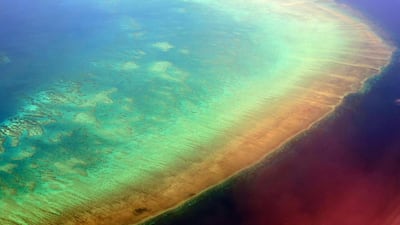
  • An aerial shot of the Great Barrier Reef in Australia, showing parts of the reef that has been subjected to coral bleaching.
    An aerial shot of the Great Barrier Reef in Australia, showing parts of the reef that has been subjected to coral bleaching.
  • A house located on land that has been deformed by permafrost thaw at a former airfield in Churapcha, Russia. Reuters
    A house located on land that has been deformed by permafrost thaw at a former airfield in Churapcha, Russia. Reuters
  • Native vegetation has been cut down to give space for eucalyptus plantations in the Setubinha region in Brazil. AFP
    Native vegetation has been cut down to give space for eucalyptus plantations in the Setubinha region in Brazil. AFP
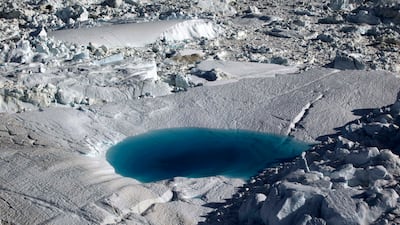
  • A large melt pool forms in the Ilulissat ice fjord below the Jakobshavn Glacier at the fringe of the Greenland ice sheet. AP
    A large melt pool forms in the Ilulissat ice fjord below the Jakobshavn Glacier at the fringe of the Greenland ice sheet. AP
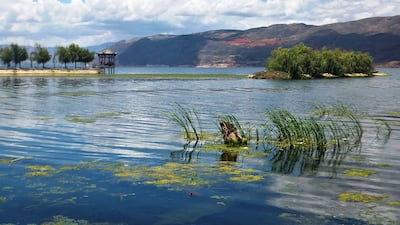
  • Lake Erhai in China has become eutrophic (where an entire body of water becomes enriched with nutrients and minerals) which caused algal growth that destroyed other life. Photo: Ronan O'Connell
    Lake Erhai in China has become eutrophic (where an entire body of water becomes enriched with nutrients and minerals) which caused algal growth that destroyed other life. Photo: Ronan O'Connell
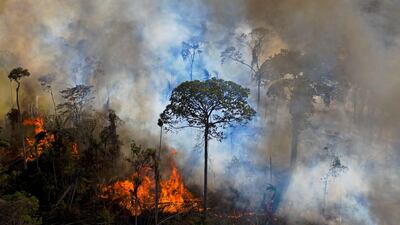
  • Deforestation in Para state, Brazil. AFP
    Deforestation in Para state, Brazil. AFP
  • Moai statues in Easter Island, Chile, were damaged after a wildfire. Reuters
    Moai statues in Easter Island, Chile, were damaged after a wildfire. Reuters

First, we need to have broader awareness about the urgency of climate change. This crisis will not resolve itself. Authentic storytelling will be critical to mobilise society to act. This includes government and non-state actors such as businesses and organisations, as well as civil society, young people and local communities.

We need to see greater collaboration across sectors and industries on climate mitigation and adaptation, and especially the transition towards renewable energy. The science is clear on the pathway to net zero: we need to work together to halve emissions, triple renewable energy and double energy efficiency by 2030 to secure a 1.5°C future.

There needs to be a recognition of nature and nature-based solutions as some of our greatest allies against climate change, with the potential to absorb emissions from the atmosphere, build adaptive capacity to protect us against the impacts of climate change, and improve biodiversity and human well-being through innovative projects around food security and ecotourism. Nature has already played a pivotal role in slowing down warming by absorbing 54 per cent of human-related carbon emissions over the past 10 years.

Also necessary is a holistic approach that prioritises technology that removes carbon and methane from our atmosphere. We must also realise this is not a standalone solution – it must be part of a larger pool of solutions. Collaboration with local communities and the inherent knowledge they have of their land is also a must.

Increased willingness and action to transform our approach to food, agriculture and land use is important because it is responsible for a quarter of greenhouse gas emissions, including the highly potent methane that is fuelling near-term temperature rises.

Last and certainly not least, we need to swiftly mobilise financing for impactful investments that can lead to co-benefits for society, the environment and the economy.

Everyone has a role to play in tackling the greatest challenge to people and planet. I urge you to find your role within the system and be part of the global movement to act faster and smarter, so that we can restore nature and get ahead of climate change once and for all.

A great way to start is by looking at platforms that are readily available, such as Leaders of Change in the UAE, which provides people with the opportunity to participate in conservation field work and projects that are linked to national and global climate and nature targets.


UK’s AI plan
  • AI ambassadors such as MIT economist Simon Johnson, Monzo cofounder Tom Blomfield and Google DeepMind’s Raia Hadsell
  • £10bn AI growth zone in South Wales to create 5,000 jobs
  • £100m of government support for startups building AI hardware products
  • £250m to train new AI models
It Was Just an Accident

Director: Jafar Panahi

Stars: Vahid Mobasseri, Mariam Afshari, Ebrahim Azizi, Hadis Pakbaten, Majid Panahi, Mohamad Ali Elyasmehr

Rating: 4/5

Zimbabwe v UAE, ODI series

All matches at the Harare Sports Club:

1st ODI, Wednesday, April 10

2nd ODI, Friday, April 12

3rd ODI, Sunday, April 14

4th ODI, Tuesday, April 16

UAE squad: Mohammed Naveed (captain), Rohan Mustafa, Ashfaq Ahmed, Shaiman Anwar, Mohammed Usman, CP Rizwan, Chirag Suri, Mohammed Boota, Ghulam Shabber, Sultan Ahmed, Imran Haider, Amir Hayat, Zahoor Khan, Qadeer Ahmed

ULTRA PROCESSED FOODS

- Carbonated drinks, sweet or savoury packaged snacks, confectionery, mass-produced packaged breads and buns 

- margarines and spreads; cookies, biscuits, pastries, cakes, and cake mixes, breakfast cereals, cereal and energy bars;

- energy drinks, milk drinks, fruit yoghurts and fruit drinks, cocoa drinks, meat and chicken extracts and instant sauces

- infant formulas and follow-on milks, health and slimming products such as powdered or fortified meal and dish substitutes,

- many ready-to-heat products including pre-prepared pies and pasta and pizza dishes, poultry and fish nuggets and sticks, sausages, burgers, hot dogs, and other reconstituted meat products, powdered and packaged instant soups, noodles and desserts.

Mobile phone packages comparison
The specs

Engine: 5.2-litre V10

Power: 640hp at 8,000rpm

Torque: 565Nm at 6,500rpm

Transmission: 7-speed dual-clutch auto

Price: From Dh1 million

On sale: Q3 or Q4 2022 

Story of 2017-18 so far and schedule to come

Roll of Honour

Who has won what so far in the West Asia rugby season?


Western Clubs Champions League

Winners: Abu Dhabi Harlequins

Runners up: Bahrain


Dubai Rugby Sevens

Winners: Dubai Exiles

Runners up: Jebel Ali Dragons


West Asia Premiership

Winners: Jebel Ali Dragons

Runners up: Abu Dhabi Harlequins


UAE Premiership Cup

Winners: Abu Dhabi Harlequins

Runners up: Dubai Exiles


Fixtures

Friday

West Asia Cup final

5pm, Bahrain (6pm UAE time), Bahrain v Dubai Exiles


West Asia Trophy final

3pm, The Sevens, Dubai Hurricanes v Dubai Sports City Eagles


Friday, April 13

UAE Premiership final

5pm, Al Ain, Dubai Exiles v Abu Dhabi Harlequins

Company Profile

Name: Thndr
Started: 2019
Co-founders: Ahmad Hammouda and Seif Amr
Sector: FinTech
Headquarters: Egypt
UAE base: Hub71, Abu Dhabi
Current number of staff: More than 150
Funds raised: $22 million

Mercer, the investment consulting arm of US services company Marsh & McLennan, expects its wealth division to at least double its assets under management (AUM) in the Middle East as wealth in the region continues to grow despite economic headwinds, a company official said.

Mercer Wealth, which globally has $160 billion in AUM, plans to boost its AUM in the region to $2-$3bn in the next 2-3 years from the present $1bn, said Yasir AbuShaban, a Dubai-based principal with Mercer Wealth.

Within the next two to three years, we are looking at reaching $2 to $3 billion as a conservative estimate and we do see an opportunity to do so,” said Mr AbuShaban.

Mercer does not directly make investments, but allocates clients’ money they have discretion to, to professional asset managers. They also provide advice to clients.

“We have buying power. We can negotiate on their (client’s) behalf with asset managers to provide them lower fees than they otherwise would have to get on their own,” he added.

Mercer Wealth’s clients include sovereign wealth funds, family offices, and insurance companies among others.

From its office in Dubai, Mercer also looks after Africa, India and Turkey, where they also see opportunity for growth.

Wealth creation in Middle East and Africa (MEA) grew 8.5 per cent to $8.1 trillion last year from $7.5tn in 2015, higher than last year’s global average of 6 per cent and the second-highest growth in a region after Asia-Pacific which grew 9.9 per cent, according to consultancy Boston Consulting Group (BCG). In the region, where wealth grew just 1.9 per cent in 2015 compared with 2014, a pickup in oil prices has helped in wealth generation.

BCG is forecasting MEA wealth will rise to $12tn by 2021, growing at an annual average of 8 per cent.

Drivers of wealth generation in the region will be split evenly between new wealth creation and growth of performance of existing assets, according to BCG.

Another general trend in the region is clients’ looking for a comprehensive approach to investing, according to Mr AbuShaban.

“Institutional investors or some of the families are seeing a slowdown in the available capital they have to invest and in that sense they are looking at optimizing the way they manage their portfolios and making sure they are not investing haphazardly and different parts of their investment are working together,” said Mr AbuShaban.

Some clients also have a higher appetite for risk, given the low interest-rate environment that does not provide enough yield for some institutional investors. These clients are keen to invest in illiquid assets, such as private equity and infrastructure.

“What we have seen is a desire for higher returns in what has been a low-return environment specifically in various fixed income or bonds,” he said.

“In this environment, we have seen a de facto increase in the risk that clients are taking in things like illiquid investments, private equity investments, infrastructure and private debt, those kind of investments were higher illiquidity results in incrementally higher returns.”

The Abu Dhabi Investment Authority, one of the largest sovereign wealth funds, said in its 2016 report that has gradually increased its exposure in direct private equity and private credit transactions, mainly in Asian markets and especially in China and India. The authority’s private equity department focused on structured equities owing to “their defensive characteristics.”

Profile

Company name: Jaib

Started: January 2018

Co-founders: Fouad Jeryes and Sinan Taifour

Based: Jordan

Sector: FinTech

Total transactions: over $800,000 since January, 2018

Investors in Jaib's mother company Alpha Apps: Aramex and 500 Startups

McLaren GT specs

Engine: 4-litre twin-turbo V8

Transmission: seven-speed

Power: 620bhp

Torque: 630Nm

Price: Dh875,000

On sale: now

Company%20profile
%3Cp%3E%3Cstrong%3EName%3A%20%3C%2Fstrong%3EPurpl%3C%2Fp%3E%0A%3Cp%3E%3Cstrong%3ECo-founders%3A%20%3C%2Fstrong%3EKarl%20Naim%2C%20Wissam%20Ghorra%2C%20Jean-Marie%20Khoueir%3C%2Fp%3E%0A%3Cp%3E%3Cstrong%3EBased%3A%20%3C%2Fstrong%3EHub71%20in%20Abu%20Dhabi%20and%20Beirut%3C%2Fp%3E%0A%3Cp%3E%3Cstrong%3EStarted%3A%20%3C%2Fstrong%3E2021%3C%2Fp%3E%0A%3Cp%3E%3Cstrong%3ENumber%20of%20employees%3A%20%3C%2Fstrong%3E12%3C%2Fp%3E%0A%3Cp%3E%3Cstrong%3ESector%3A%20%3C%2Fstrong%3EFinTech%3C%2Fp%3E%0A%3Cp%3E%3Cstrong%3EFunding%3A%20%3C%2Fstrong%3E%242%20million%26nbsp%3B%3C%2Fp%3E%0A
Indoor cricket in a nutshell

Indoor Cricket World Cup – Sep 16-20, Insportz, Dubai

16 Indoor cricket matches are 16 overs per side

8 There are eight players per team

There have been nine Indoor Cricket World Cups for men. Australia have won every one.

5 Five runs are deducted from the score when a wickets falls

Batsmen bat in pairs, facing four overs per partnership

Scoring In indoor cricket, runs are scored by way of both physical and bonus runs. Physical runs are scored by both batsmen completing a run from one crease to the other. Bonus runs are scored when the ball hits a net in different zones, but only when at least one physical run is score.

Zones

A Front net, behind the striker and wicketkeeper: 0 runs

B Side nets, between the striker and halfway down the pitch: 1 run

Side nets between halfway and the bowlers end: 2 runs

Back net: 4 runs on the bounce, 6 runs on the full

Know your cyber adversaries

Cryptojacking: Compromises a device or network to mine cryptocurrencies without an organisation's knowledge.

Distributed denial-of-service: Floods systems, servers or networks with information, effectively blocking them.

Man-in-the-middle attack: Intercepts two-way communication to obtain information, spy on participants or alter the outcome.

Malware: Installs itself in a network when a user clicks on a compromised link or email attachment.

Phishing: Aims to secure personal information, such as passwords and credit card numbers.

Ransomware: Encrypts user data, denying access and demands a payment to decrypt it.

Spyware: Collects information without the user's knowledge, which is then passed on to bad actors.

Trojans: Create a backdoor into systems, which becomes a point of entry for an attack.

Viruses: Infect applications in a system and replicate themselves as they go, just like their biological counterparts.

Worms: Send copies of themselves to other users or contacts. They don't attack the system, but they overload it.

Zero-day exploit: Exploits a vulnerability in software before a fix is found.

The bio:

Favourite holiday destination: I really enjoyed Sri Lanka and Vietnam but my dream destination is the Maldives.

Favourite food: My mum’s Chinese cooking.

Favourite film: Robocop, followed by The Terminator.

Hobbies: Off-roading, scuba diving, playing squash and going to the gym.


%E2%80%98White%20Elephant%E2%80%99
%3Cp%3E%3Cstrong%3EDirector%3A%3C%2Fstrong%3E%20Jesse%20V%20Johnson%3Cbr%3E%3Cstrong%3EStars%3A%3C%2Fstrong%3E%20Michael%20Rooker%2C%20Bruce%20Willis%2C%20John%20Malkovich%2C%20Olga%20Kurylenko%3Cbr%3E%3Cstrong%3ERating%3A%3C%2Fstrong%3E%203%2F5%3C%2Fp%3E%0A
Tips for entertaining with ease

·         Set the table the night before. It’s a small job but it will make you feel more organised once done.

·         As the host, your mood sets the tone. If people arrive to find you red-faced and harried, they’re not going to relax until you do. Take a deep breath and try to exude calm energy.

·         Guests tend to turn up thirsty. Fill a big jug with iced water and lemon or lime slices and encourage people to help themselves.

·         Have some background music on to help create a bit of ambience and fill any initial lulls in conversations.

·         The meal certainly doesn’t need to be ready the moment your guests step through the door, but if there’s a nibble or two that can be passed around it will ward off hunger pangs and buy you a bit more time in the kitchen.

·         You absolutely don’t have to make every element of the brunch from scratch. Take inspiration from our ideas for ready-made extras and by all means pick up a store-bought dessert.


Dubai Bling season three

Cast: Loujain Adada, Zeina Khoury, Farhana Bodi, Ebraheem Al Samadi, Mona Kattan, and couples Safa & Fahad Siddiqui and DJ Bliss & Danya Mohammed 

Rating: 1/5

DUNGEONS%20%26%20DRAGONS%3A%20HONOR%20AMONG%20THIEVES
%3Cp%3EDirectors%3A%20John%20Francis%20Daley%20and%20Jonathan%20Goldstein%3Cbr%3EStars%3A%20Chris%20Pine%2C%20Michelle%20Rodriguez%2C%20Rege-Jean%20Page%2C%20Justice%20Smith%2C%20Sophia%20Lillis%3Cbr%3ERating%3A%203%2F5%3C%2Fp%3E%0A

Age 26

Born May 17, 1991

Height 1.80 metres

Birthplace Sydney, Australia

Residence Eastbourne, England

Plays Right-handed

WTA titles 3

Prize money US$5,761,870 (Dh21,162,343.75)

Wins / losses 312 / 181

Updated: November 22, 2023, 5:56 AM