


In Washington, most Israeli issues operate at two distinct registers: the political battles over partisan interests and power, and foreign policy involving US national interest and power. Those two registers are frequently at odds, and when it comes to Israeli dealings with Palestinians and Lebanese, in particular, partisan politics generally trumps foreign policy and the national interest.
That’s why President Joe Biden concluded last week that it would be a good idea for him to visit Israel in the midst of the unfolding war against Hamas in Gaza, but only on the assumption that he could also take the opportunity to meet with a range of friendly Arab leaders, including Palestinian President Mahmoud Abbas in Jordan immediately after leaving Israel.
That’s definitely good politics in an America that is currently gripped by tremendous sympathy for Israel and identification with Israelis as fellow victims of Islamist extremism following the gruesome Hamas killing spree in southern Israel two weeks ago. But it’s looking very much like a foreign policy mistake, and possibly a blunder.
It’s true enough that Mr Biden and his officials could not have specifically anticipated the explosion at Al Ahli Arab Hospital in Gaza that killed hundreds of Palestinians. But they cannot have been surprised that a mass casualty event suddenly occurred in the midst of this already atrocious conflict.
Israel and Palestinian groups are exchanging blame for the carnage, and western media and intelligence appear united in saying it’s too early to tell exactly who was responsible. Indeed, it may never be fully resolved.
But in most of the Arab world, the operating assumption, which would be extremely difficult to reverse, is that Israel, which has been engaged in huge bombing of any number of targets in Gaza, including many civilian areas, must have been responsible. After all, in its various conflicts in Gaza and Lebanon, Israel has a track record of deliberately or inadvertently bombing hospitals, ambulances, refugee centres, UN camps, and so on.
There really are no safe places when the Israeli military is “restoring deterrence”, which is a euphemism for exacting vengeance.
-

Lebanese security forces use water cannons as they clash with protesters outside the US embassy in Awkar. AFP -

Thousands rallied to protest the deaths of hundreds of people in a strike on a Gaza hospital that they blamed on Israel, which has denied responsibility. AFP -
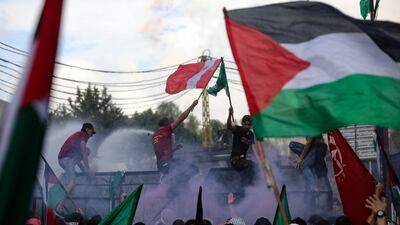
Protesters gathered outside the US embassy in Awkar east of Beirut to express solidarity with the Palestinians in Gaza. AFP -

Security forces have used water cannon and tear gas to disperse hundreds of protesters outside the US embassy. AP -

Officers retaliated and sought to break up crowds in the northern suburb of Awkar. AFP -

Many that took place in the protest waved Palestinian flags outside the US embassy. AFP -
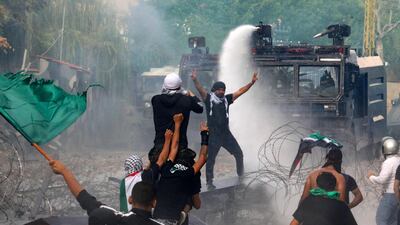
Demonstrators were seen covering their faces as they fled the gas, while others ran. AFP -
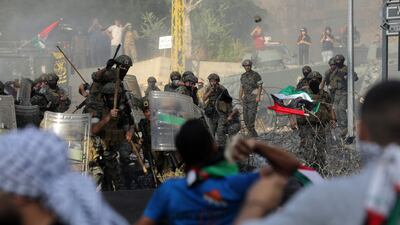
The protest came after hundreds of demonstrators swarmed around the hilltop embassy, as news of hundreds of deaths in a Gaza hospital strike emerged. AFP


As a consequence, all of Mr Biden’s meetings scheduled for Jordan with Arab leaders, and not just with Mr Abbas, were abruptly cancelled. This makes him look isolated and somewhat foolish, and his trip seem like a significant miscalculation in terms of US diplomacy, however beneficial it may be in terms of partisan politics at home.
Mr Biden, then, made matters worse by publicly telling Israeli Prime Minister Benjamin Netanyahu: “Based on what I’ve seen, it appears as though it was done by the other team, not you.”
Not only does this further identify the US with Israel at a moment of extreme outrage and anxiety about Israeli treatment of millions of innocent Palestinians in Gaza who are being collectively attacked and deliberately deprived of all of the necessities of daily life including water, food, fuel, medicines and just about anything else.
It also is harmfully vague. It takes Israel’s side but based not on an assertion of clear information but rather “what I’ve seen”, which could simply mean that he was taking Mr Netanyahu’s word for it.
Additionally, referring to the conflict as one between “teams”, as if Hamas really did represent the Palestinians of Gaza or as if this were a matter of sports rather than mass carnage, was exceptionally jarring to the ear of anyone acutely attuned to the ongoing suffering in Gaza and the potential looming deaths of numerous thousands of innocent Palestinian civilians.
If he has any specific information, he needed to say that he does. No one expects him to lay out a case in a news conference with the Israeli Prime Minister, having arrived just hours after the tragedy. But it would have been very different if he had said “according to the information passed along to me by our intelligence services”, or, conversely, “based on what the Israelis tell me”, or something else that made clear what, exactly, he was trying to convey by the extremely and damaging leave vague phrase “what I’ve seen”.
In that case, at least his fundamental meaning would have been clear.
But as it stands, policymakers and ordinary citizens alike throughout the Arab and broader Islamic worlds who are sympathetic with the innocent people of Gaza can take the dimmest possible view of his comment, while Israelis can cite it as the US President confirming their own allegations when it’s entirely possible that he meant nothing of the kind.
Mr Biden has never been a particularly adept speaker, and his age is showing. He’s unlikely to ever match the inanity regularly spouted by Donald Trump. But this remark inflicted additional and unnecessary damage on US interests, exacerbating the unwise gamble of seeking to show rock-solid support for Israel while attempting to have significant and important conversations with America’s Arab partners.
Instead, all that was left was rock-solid support for Israel at a time when Palestinians are dying by the hundreds and appear on the brink of dying by the many thousands. It’s not a good look for Washington.
That’s all the more regrettable because, alone among world leaders, Mr Biden has the ability to conduct two crucial conversations with Middle Eastern leaders. He, alone, can credibly warn Israel about the dangers of going too far in Gaza, and he has already cautioned against what he has called the “mistake” of a sustained reoccupation of the population centres there.
But Mr Biden is also in a unique position to closely confer with Saudi Arabia about if and how Israel can avoid permanently scuppering the potential triangular deal involving Saudi normalisation with Israel and a new US defence commitment to Saudi Arabia.
So he’s a key player if Hamas is to be denied what it really wants (many years of close-quarter urban combat with Israeli conscripts on which it would base a new claim to primacy in the Palestinian national movement), and simultaneously failed to prevent what it is seeking to thwart (a US-Saudi-Israeli agreement). That Mr Biden’s trip might have failed on both fronts, unless he succeeded in persuading Israel to exercise restraint, may be one of the first pieces of “good news” to reach Hamas in recent days.

