


There's not a lot that US politicians like to agree on these days, but this week has seen a rare glimpse of public bonhomie between Democrats and Republicans that harkens back to pre-polarised times where bipartisanship was routine.
Driving this show of collegiality in Washington are the Abraham Accords, the landmark deals establishing relations between Israel and the UAE and a number of Arab countries, which this week mark their third anniversary.
The accords have ushered in an unprecedented era of co-operation between Israel and parts of the Arab world. For instance, there are now more than 150 flights each week between the UAE and Israel, attesting to the mushrooming business and tourist connections between the countries. A year ago guests from around the world flew into Abu Dhabi to join celebrations of the biggest Jewish wedding held in the UAE.
US President Joe Biden’s administration was initially tepid in its public praise of the Abraham Accords, a signature achievement of the Trump era, but soon embraced the agreements and sought to build on them by including other countries.

All eyes are now on Saudi Arabia to see whether it will forge its own agreement to establish relations with a country it has never formally recognised. There are indications Riyadh may be open to a deal with Israel, but it has long said it will not establish formal ties until Israel makes progress in attaining peace with the Palestinians.
At an event hosted by the Atlantic Council at the US Capitol on Wednesday, Israel's Ambassador to Washington, Michael Herzog, repeated his country's enthusiasm for a deal with Saudi Arabia.
“There is a window of opportunity right now,” said Israel’s ambassador to the US, Michael Herzog.
“The [Biden] administration would like to do it, our government would like to do it, I understand there is Saudi openness to doing it.”
Several recent media reports have sketched the outlines of a potential grand bargain that would see Saudi Arabia secure Palestinian support for a deal with Israel by resuming funding for the Palestinian Authority. In return for a deal, the reports claim, the US would provide security guarantees to Riyadh.
A Saudi-Israeli rapprochement would be a game-changer for the region, serving as a green light for more countries to forge their own relations with Israel.
At Wednesday's event, however, Terry Wolff, Senior Director for the Middle East at the National Security Council, signalled that a Saudi-Israeli deal is still a ways off.
“There is a pathway for this and the details will come together over time. I think it will take a lot of serious discussion,” said the retired three-star general. “We're at the discussion phase now, not really the negotiation phase.”
A US-orchestrated deal would be considered a key foreign policy win for President Joe Biden ahead of the 2024 presidential election and would no doubt be championed as proof that the US retains influence in the Middle East even as it reduces its regional presence and Gulf countries play a larger role on the global stage.
Largely absent from Wednesday's discussions, though, were the actions of the far-right government of Israeli Prime Minister Benjamin Netanyahu, which has increased its occupation of the West Bank, with the government accelerating the construction of new settlements. An ensuing surge in violence has been accompanied by domestic chaos as Mr Netanyahu seeks to push through judicial reforms that critics say threaten the country's democracy.
Still, Daniel Shapiro, special advisor for regional integration at the US State Department, described the moment as “a real opportunity regarding the potential for normalisation between Israel and Saudi Arabia”. Speaking via video link from Israel, he noted that there was “potentially a Palestinian component” to a future deal.
The real unknown in all this, of course, is Riyadh. There were no Saudi speakers at Wednesday's event and the country is playing its cards close to its chest in terms of any future deal with Israel.
“The Abraham Accords, we all believe, have been transformational for the region. If Saudi Arabia joins, it will be even that much more transformational,” said Congresswoman Kathy Manning, who sits on the House Foreign Affairs Committee.
-
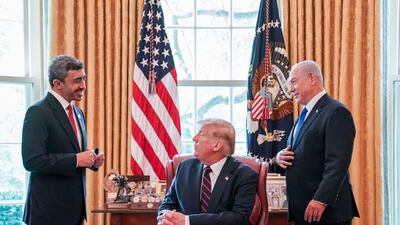
Sheikh Abdullah bin Zayed, UAE Minister of Foreign Affairs and International Co-operation, speaks to Donald Trump, US president at the time, and Israeli Prime Minister Benjamin Netanyahu in the Oval Office in September 2020. Ministry of Foreign Affairs and International Co-operation -
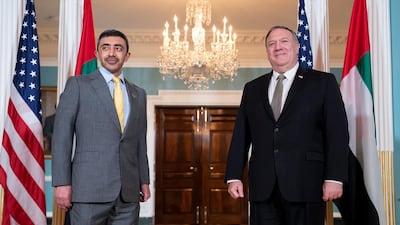
Sheikh Abdullah bin Zayed, UAE Minister of Foreign Affairs and International Co-operation, meets Mike Pompeo, US secretary of state at the time. Wam -
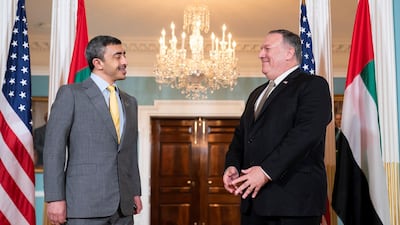
Sheikh Abdullah and Mr Pompeo in Washington. Wam -
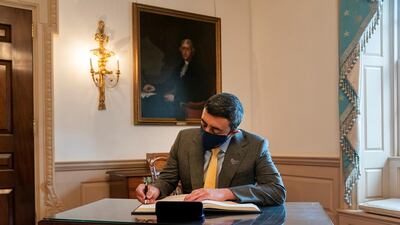
Sheikh Abdullah visits Washington in September last year. Wam -
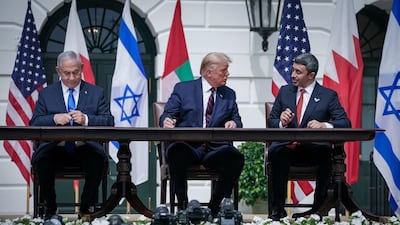
Sheikh Abdullah, UAE Minister of Foreign Affairs and International Co-operation, US President Donald Trump, centre, and Israeli Prime Minister Benjamin Netanyahu sign the Abraham Accord at the White House South Lawn. MOFAIC -
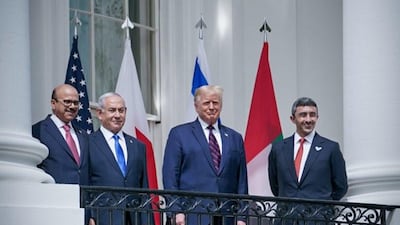
Sheikh Abdullah and, from left, Bahrain's Foreign Minister Abdullatif Al Zayani, Israeli Prime Minister Benjamin Netanyahu and US President Donald Trump at the White House. MOFAIC -
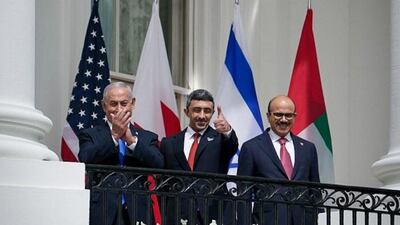
Sheikh Abdullah, Mr Al Zayani and Mr Netanyahu at the White House during the Abraham Accord signing ceremony. MOFAIC -
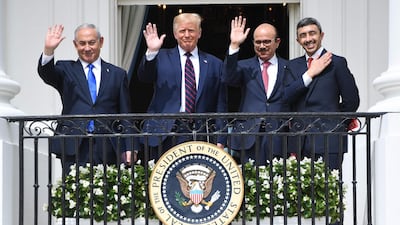
Sheikh Abdullah and, from left, Mr Netanyahu, Mr Trump and Mr Al Zayani wave from the Truman Balcony at the White House. AFP -
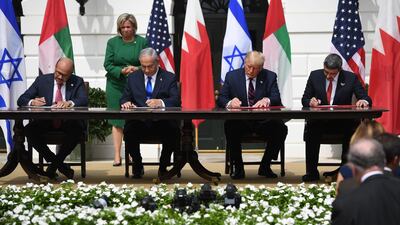
Sheikh Abdullah and, from left, Mr Al Zayani, Mr Netanyahu and Mr Trump sign the Abraham Accord. AFP -
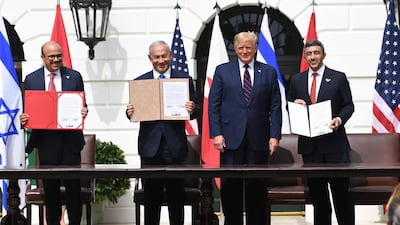
Sheikh Abdullah and, from left, Mr Al Zayani, Mr Netanyahu and Mr Trump after the signing ceremony. AFP -
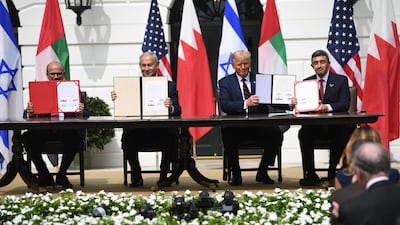
Sheikh Abdullah and, from left, Mr Al Zayani, Mr Netanyahu and Mr Trump after the signing ceremony. AFP -
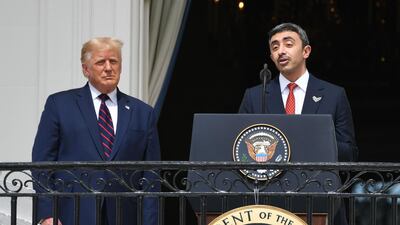
Sheikh Abdullah speaks from the Truman Balcony at the White House during the signing ceremony of the Abraham Accord. AFP -
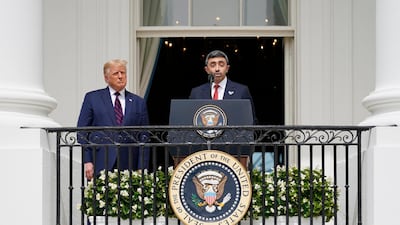
Sheikh Abdullah speaks as Mr Trump looks on before the signing of Abraham Accord on the South Lawn of the White House. AP -
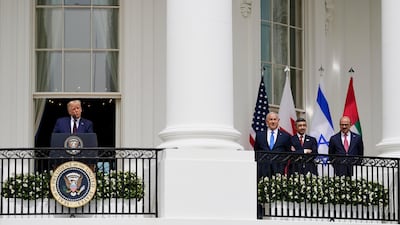
Sheikh Abdullah looks on from the White House as Mr Trump speaks at the Abraham Accord signing ceremony, also attended by Mr Al Zayani and Mr Netanyahu. AP -

Sheikh Abdullah bin Zayed, UAE Minister of Foreign Affairs and International Co-operation, Israeli Prime Minister Benjamin Netanyahu, left, and Bahraini Foreign Minister Abdullatif Al Zayani stand on the Blue Room Balcony during the signing ceremony. AP -
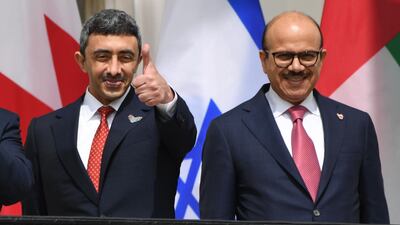
Sheikh Abdullah and Mr Al Zayani shortly before participating in the signing of the Abraham Accord. AFP -
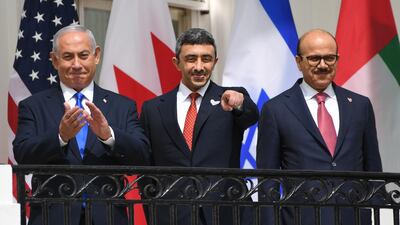
Sheikh Abdullah, with Mr Netanyahu, left, and Mr Al Zayani at the signing of the Abraham Accord on the South Lawn of the White House. AFP -
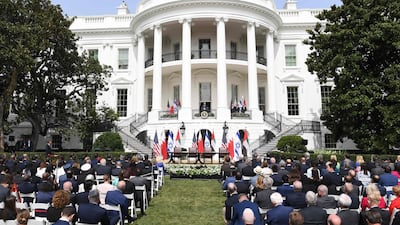
US President Donald Trump speaks from the Truman Balcony at the White House during the signing ceremony of the Abraham Accord. AFP -
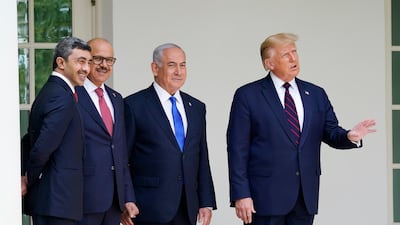
President Donald Trump walks to the Abraham Accord signing ceremony at the White House with Sheikh Abdullah bin Zayed, UAE Minister of Foreign Affairs and International Co-operation, Israeli Prime Minister Benjamin Netanyahu, and Bahrain's Foreign Minister Abdullatif Al Zayani. AP -
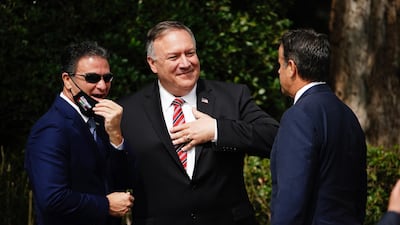
US Secretary of State Mike Pompeo arrives at the White House to attend the Abraham Accord signing ceremony hosted by President Donald Trump. EPA -
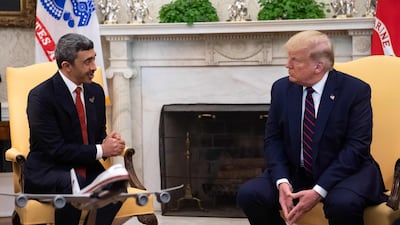
Sheikh Abdullah bin Zayed, UAE Minister of Foreign Affairs and International Co-operation, meets US President Donald Trump in the Oval Office of the White House before the signing of Abraham Accord. AFP -
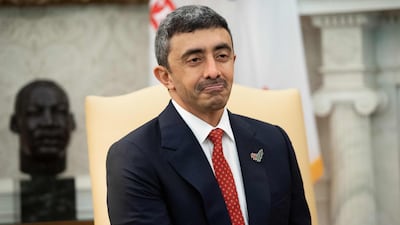
Sheikh Abdullah bin Zayed, UAE Minister of Foreign Affairs and International Co-operation, in the Oval Office. AFP -
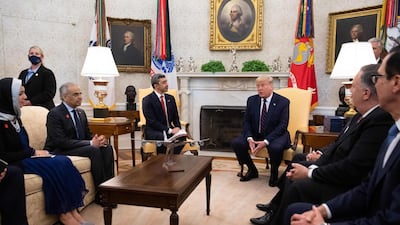
Sheikh Abdullah bin Zayed, UAE Minister of Foreign Affairs and International Co-operation, meets US President Donald Trump in the Oval Office of the White House. AFP -
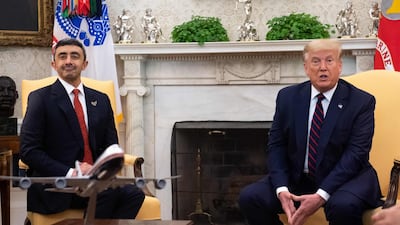
Sheikh Abdullah with Mr Trump in the Oval Office. AFP -
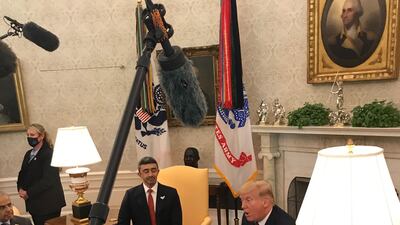
Sheikh Abdullah bin Zayed, UAE Minister of Foreign Affairs and International Co-operation, with by President Donald Trump at the White House. Mustafa Alrawi / The National -
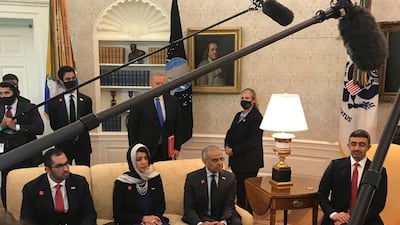
The UAE delegation led by Sheikh Abdullah bin Zayed, Minister of Foreign Affairs and International Co-operation, with US President Donald Trump at the White House. Mustafa Alrawi / The National -
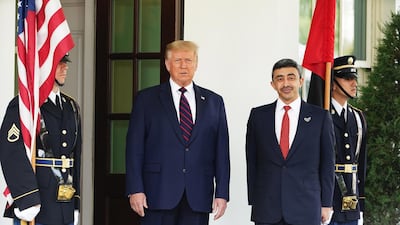
Sheikh Abdullah bin Zayed, UAE Minister of Foreign Affairs and International Co-operation, is welcomed to the White House by US President Donald Trump. EPA -
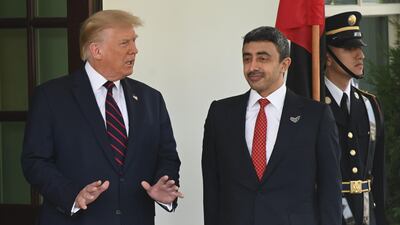
Sheikh Abdullah and Mr Trump outside the White House. AFP -
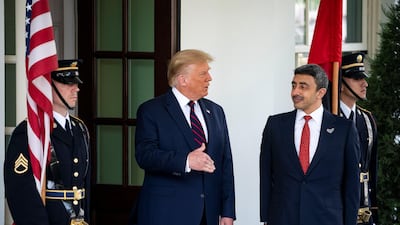
Sheikh Abdullah bin Zayed speaks to Mr Trump after arriving at the White House. Reuters -
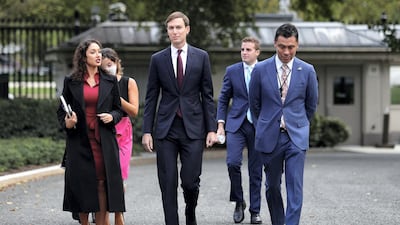
White House Senior Adviser Jared Kushner walks away following a television interview on the North Lawn at the White House in Washington. Reuters -
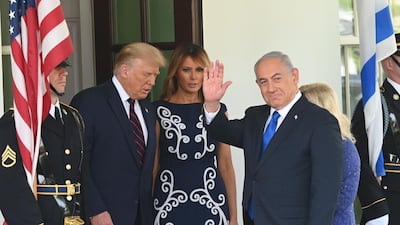
US President Donald Trump and First Lady Melania Trump welcome the arrival of Prime Minister of Israel Benjamin Netanyahu and his wife Sara on the North Lawn of the White House in Washington DC. AFP -
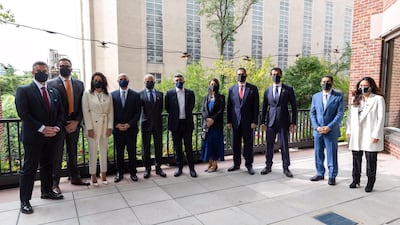
A delegation of senior UAE officials led by Sheikh Abdullah bin Zayed, UAE Minister of Foreign Affairs and International Co-operation, prepares to depart for the White House to sign the Abraham Accord. MOFAIC -
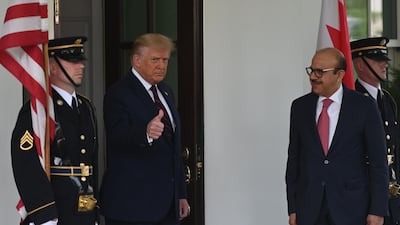
US President Donald Trump welcomes Bahraini Foreign Minister Abdullatif Al Zayani. AFP -

Bahraini Foreign Minister Abdullatif Al Zayani arrives at the White House in Washington DC. AFP -
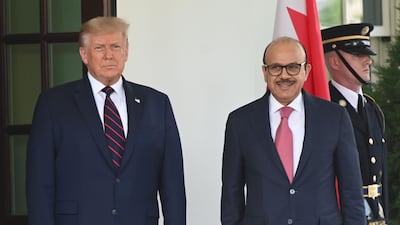
US President Donald Trump welcomes Bahraini Foreign Minister Abdullatif Al Zayani on the North Lawn of the White House in Washington, DC. AFP -
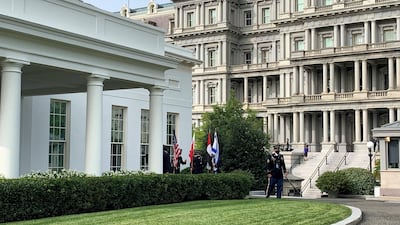
Preparations at the White House for the signing of the Abraham Accord. -
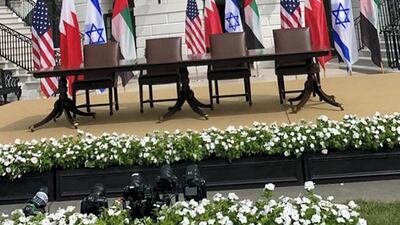
Preparations under way at the White House for the signing of the Abraham Accord. -
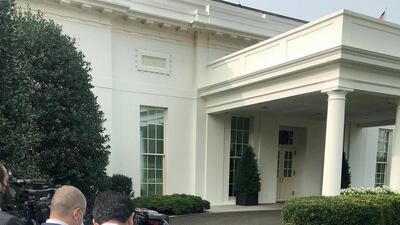
Preparations under way at the White House for the signing of the Abraham Accord. -

Preparation at the White House for the signing of the Abraham Accord. The National



