


The case of the Crooked House, a visibly wonky pub situated in the English Midlands, has been dominating the news cycle in the UK – an example of the summer’s silly season tendencies.
It also has the makings of a salutary tale of how dysfunctional the UK has become as a state at the everyday level. It is a trend that catalysed with 2016’s Brexit vote and crystallised during the Covid-19 lockdowns.
The Crooked House somehow stood for centuries, but after a recent change of ownership burnt down in a fire.
This common man’s Leaning Tower of Pisa was then quickly demolished by the owners, and the local English midland museum says it can’t now be restored to its essential features.
Newspaper exposes have said that the owners have other property developments where planners have cast doubt that applications to destroy and rebuild venerable establishments – following redevelopment that would allow new dwellings to be built – would ultimately be fulfilled.
There is often a failure of the UK authorities to follow through on enforcement of undertakings. So it would not be surprising if time elapses, the caravan moves on and this blitz of national attention comes to naught.
Across a gamut of the UK business scene, there is official inertia bordering on neglect. More openly than ever before, there is acceptance that something is wrong in particular ways but also a candid refusal to address the obvious problems. Faced with this kind of void, there is a spreading tendency to fall into cynicism.

Examples are myriad. In recent days, the country’s financial regulator has moved to investigate banks after months of growing pressure over “debanking” of individuals by the sector.
Nigel Farage, the campaigner who delivered Brexit, gained a new lease on public life by being one of those expelled by his bank after failing a test he did not know was facing him.
The manifest inequity of the banks stems from a wrong-headed approach to policing their own customers for issues such as money-laundering or other violations.
Ultimately, the financial regulator should have tracked how the banks were setting these standards and intervened to set down principles that were not anti-client. The fact that it is now moving to look at the complaints is not encouraging. What it should be doing is set out how the banks should treat their customers fairly and properly in line with the changing laws. Instead, the regulators remain happy to be captured by the industry and come under the lobbyists’ thumb.
The UK police are in the same desperate situation.
Last week, officers had intelligence of an organised flash mob-style raid on London’s Oxford Street shops. Just eight policemen were on duty on one of the world’s premier shopping strips when the maelstrom struck. The following night when the videos of the previous day were viral around the world, scores of policemen were sent to the area to prove that they were up to the task. Except this amounted merely to closing the stable door when the horse had already bolted.
Then again this is a force that still hasn’t addressed how one of its elite officers killed a woman to satisfy his openly exhibited demons. The commissioner is still seeking power to dismiss individual “wrong-uns”.
Meanwhile over in Belfast, no one has resigned after a list bearing the names of its police service personnel was published online, amounting to a data breach. This in a place where every officer is advised to check under their vehicles for car bombs before clicking the key fob every morning, given Northern Ireland’s violent past.
-
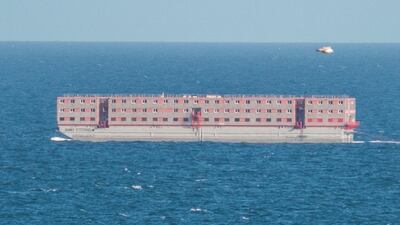
The Bibby Stockholm accommodation barge passes Prawle Point Cliffs near Salcombe, Devon during transportation by tug boat from dry dock in Falmouth, Cornwall to Portland in Dorset. PA -

Tug boat Mercia pulls the Bibby Stockholm accommodation barge into Portland in Dorset. PA -
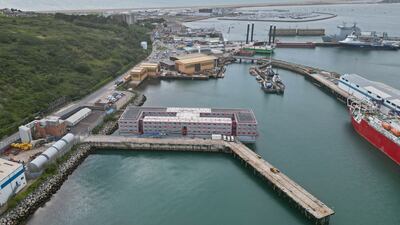
Bibby Stockholm barge moored at Portland Port. Reuters -

People board the Bibby Stockholm immigration barge. Getty -
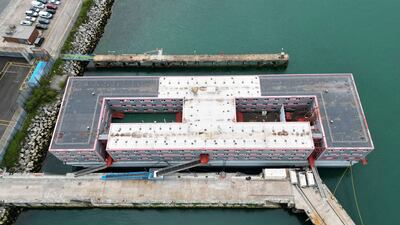
Bibby Stockholm barge moored at Portland Port. Reuters -
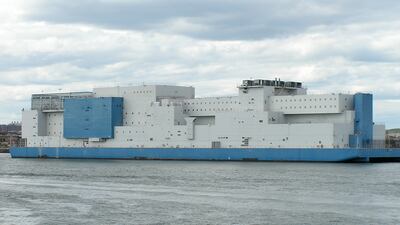
Vernon C. Bain Correctional Center has become a permanent fixture on New York City’s East River. Photo: Wikipedia -

HMP Weare floating prison was eventually closed in 2005 as too expensive to maintain. -

During Northern Ireland’s Troubles, nearly 50 years later, the submarine support ship HMS Maidstone became a floating “internment holding area” in 1969, holding Irish Republicans without trial. Photo: Wikipedia


The UK’s Home Office is tied in so many knots over its migration crackdown that it is hard to know which instance provides the greatest indictment.
After weeks of trying to get people who have arrived in the UK on boats to be housed on an offshore barge, the 24-hour news broadcast last weekend showed them lining up to be taken off because bacteria was discovered onboard. A news ticker reported the deaths of six people on Saturday in an overturned dinghy trying to make the same journey. The government is reportedly reviving a proposal to push back these small boats with jet skis.
The screens and newspaper front pages are exposing the lack of competence at the top. The machinery of government has ceased to deliver seamless and sensible outcomes. Its impact is pervading all walks of life.
One of the great myths that powered Brexit was the newspaper line that the UK was dealt with unfairly in the EU because it supposedly implemented all the regulations coming out of Brussels – while other countries were claimed to be mixing the laws they took from the centre. So, as the claim went, the UK was bearing an overly heavy burden handed down by the eurocrats.
Since Brexit, however, the country has not turned to a lighter touch nor has it discovered any talent for addressing its own individual problems.
There is a slow dawning that the country is not run well nor smartly administered. While I mention that this accounts for the spread of cynicism, that is not the whole story.
Prime Minister Rishi Sunak is so deep in a hole in the polls that the next election must seem like an oncoming train crash. The polls are telling him the scale of change people want to see, led from the top. If they can’t get it with him, then the other side will win the next general election.
The only real card available to him is show competence at a dramatic scale in the next 12 or so months.

