


The various meetings held in the Arab Gulf last week represent a qualitative leap towards a new era of self-security and collective security for the region and the world.
From the visits made by Japanese Prime Minister Fumio Kishida and Turkish President Recep Tayyip Erdogan, to the summit involving GCC leaders and those of the five Central Asian countries, attention is being given to the Gulf’s vision on security matters and how to shape them locally and regionally.
This new and significant development is not only crucial for the GCC, but also for security relations between its member states and their traditional allies, as well as security relations with countries that have recently entered into strategic relations with the Gulf region, such as China and Russia.
Equally important, the Arab Gulf countries have taken it upon themselves to deal with their concerns regarding Iran and Turkey, and they are working to solve their problems independently.
The concept of collective security has changed since the Ukraine war began, with international security no longer the fundamental pillar of international relations, especially after the globalisation of Nato and its expansion into Asia.
The blocs that emerged during the Cold War, such as the Non-Aligned Movement, have faded away (although G7 remains a cohesive entity). The Brics grouping had initially emerged as a challenge to the West, but its aspirations to become an alternative economic and security bloc that could lead on international security have not proved to be realistic. The G20 has had troubles due to irreconcilable differences among its members over the war in Ukraine.
-

As the war in Ukraine approaches the 500-day mark, 'The National' looks back at the conflict. All photos: AP -
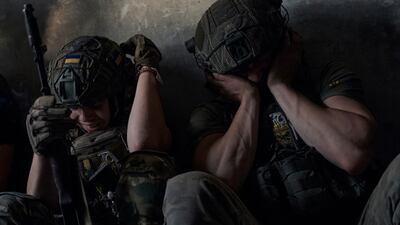
Ukrainian soldiers cover their ears to protect from Russian tank shelling in a shelter on the front line in the Zaporizhzhia region in July -

A cemetery in evening sunlight near Lviv in July -
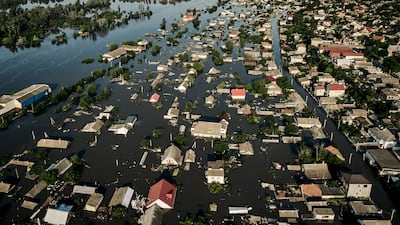
Flooded streets in Kherson in June after the walls of the Kakhovka dam collapsed -
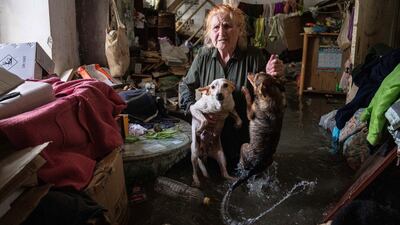
Tetiana with her pets, Tsatsa and Chunya, in her house that was flooded when the Kakhovka dam in Kherson was breached -
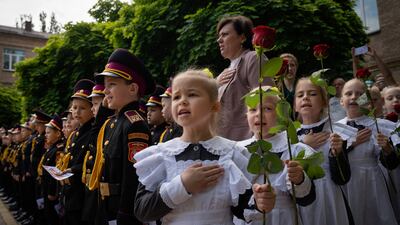
Young cadets sing the national anthem during a graduation ceremony at a cadet lyceum in Kyiv in June -
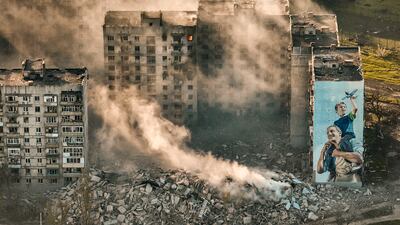
Bakhmut in April, the site of the heaviest battles in the Donetsk region -

A message on a mirror reads 'Ukraine will prevail' in a badly damaged school in Kharkiv in February -
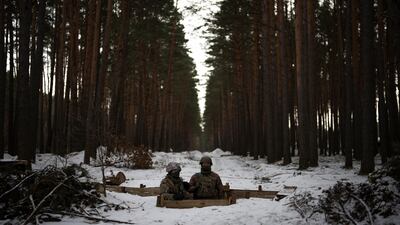
Ukrainian servicemen in position close to the border with Belarus in February -

Hospital staff in Kherson with orphaned children at the regional hospital maternity ward in November 2022 -
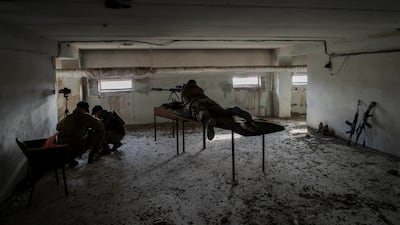
A sniper unit aims at Russian positions in the Kherson region during an operation in November 2022 -

Ukrainian artillerymen fire at Russian positions near Bakhmut in November 2022 -

A Ukrainian serviceman near Oskil village in October 2022 -
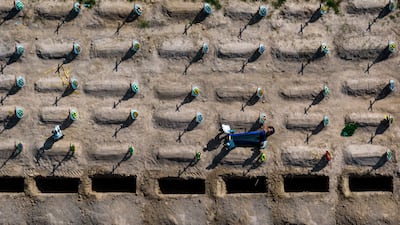
Funeral workers carry the coffin of an unidentified civilian who died in the Bucha community during the Russian occupation period in February-March 2022 -
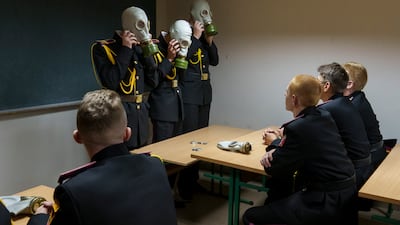
Cadets practise with gas masks in a bomb shelter on the first day of school at a cadet lyceum in Kyiv, Ukraine, in September -

A young girl with her dog waves goodbye to her grandparents from an evacuation train leaving Pokrovsk in August 2022 -

A child looks up at a building destroyed during attacks in Irpin in May 2022 -
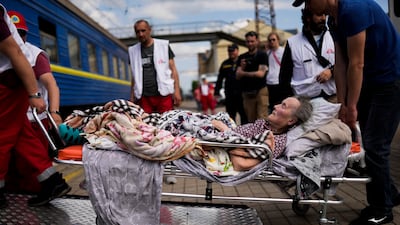
An elderly patient boards a medical evacuation train in Pokrovsk in May 2022 -

Nila Zelinska holds a doll belonging to her granddaughter that she found in her destroyed house in Potashnya, on the outskirts of Kyiv, in May 2022 -
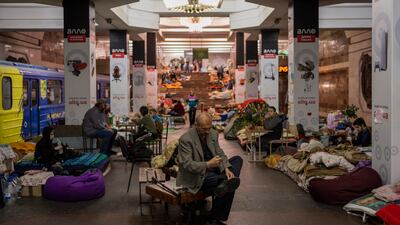
Residents shelter in the city subway of Kharkiv in May 2022 -
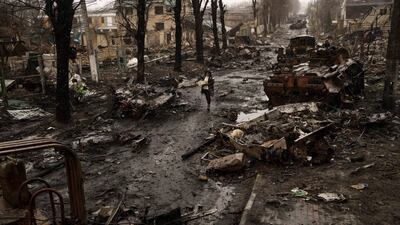
Destroyed Russian tanks in Bucha, April 2022 -

A family fleeing the village of Ruska Lozova in April 2022 arrive in their shrapnel-riddled car at a screening point in Kharkiv -
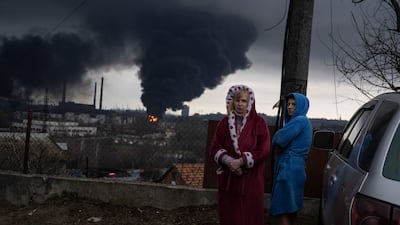
Smoke fills the air after shelling in Odesa in April -
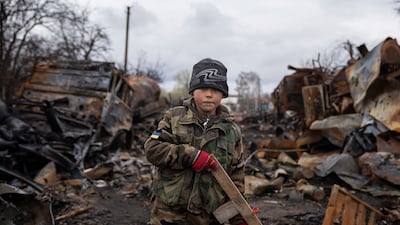
Yehor, 7, with a wooden toy rifle next to destroyed Russian military vehicles near Chernihiv in April 2022 -
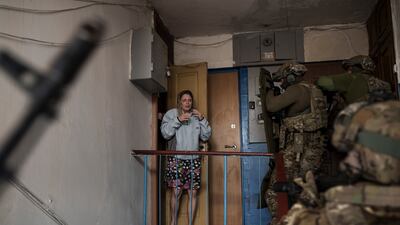
Security Service of Ukraine servicemen enter a building during an operation to arrest suspected Russian collaborators in Kharkiv in April 2022 -

A Ukrainian soldier during a pick-up game of football in Irpin in April 2022 -
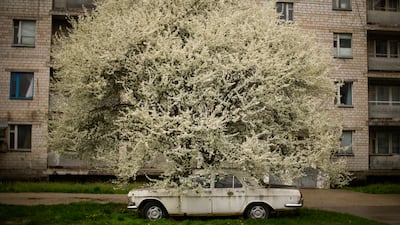
The partially abandoned town of Chernobyl in April 2022 -
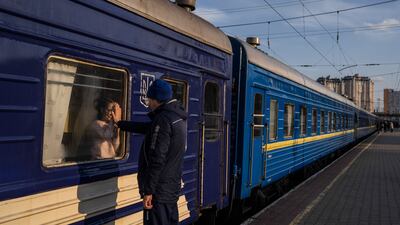
Ruslan Mishanin, 36, bids farewell to his nine-year-old daughter as the train with his family leaves Odesa for Poland in April -
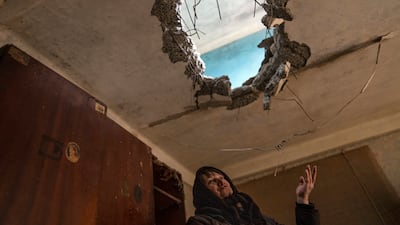
Halyna Falko, 52, talks to reporters in March 2022 while looking at the destruction caused to her house near Brovary after a Russian attack -

Anti-tank barricades on a street in preparation for a possible Russian offensive in Odesa in March 2022 -
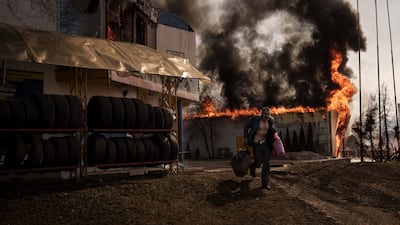
A man recovering items from a burning shop after a Russian attack in Kharkiv in March 2022 -
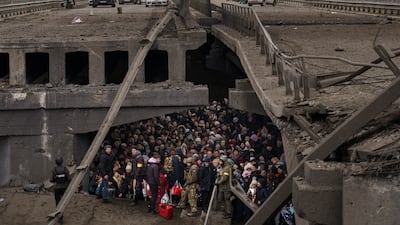
Ukrainians under a destroyed bridge as they as they cross the Irpin river on the outskirts of Kyiv in March 2022


Nato has become perhaps the most important military alliance in the world, with the Ukraine war serving to reinforce its technological and strategic superiority. The conflict appears to have provided an opportunity for American and European defence industries to battle-test their weapons and military technology for further development.
It has also provided an opportunity for regional blocs to reinvent themselves, or at least hasten further integration. A strategic vision, for instance, is emerging among GCC countries that includes a multi-layered and multi-dimensional regional security concept.
To be clear, the grouping is not inclined to ally with China or Russia in opposition to Nato’s globalisation. In fact, there are no indications that Nato intends to globalise in the direction of the Gulf, nor are the GCC countries ready to join an alliance against Russia and China.
Nato’s globalisation might be a cause for concern in China and Russia because of their inability to respond in kind.
Russia cannot establish a bloc on the lines of the now-defunct Warsaw Pact. And while China might be capable of mounting a military response to Nato’s globalisation, particularly in the South China Sea, it cannot create and scale up a bloc like it. This is important, and it is a matter that the GCC countries are taking into account when making their own security choices.
There used to be a belief that Brics could counter Nato, and some countries, including in the Gulf, had expressed an interest in joining it. But the Ukrainian conflict has put the grouping’s rise on hold, even though a summit is scheduled to take place in South Africa next month.
The most significant phase of Brics’s political solidarity had emerged at the UN when these countries co-ordinated their positions against Nato’s military operations in Libya. It had taken similarly unanimous positions on other issues, including the Syrian civil war – sometimes even opposing positions taken by the Gulf countries – although things have changed since, with both groupings’ positions on various issues more aligned today.

The GCC’s pragmatism has liberated it from constraining policies, as it has charted a new course to address disagreements without abandoning core principles. An example of this can be seen in its member states’ improving relations with Turkey in recent months.
The Jeddah summit involving the Central Asian republics of Tajikistan, Uzbekistan, Kyrgyzstan, Kazakhstan and Turkmenistan is also a testament to the GCC countries’ long-term strategic thinking regarding their relationship with the rest of the world.
These former Soviet republics were once in the Soviet and later Russian sphere of influence, but given their significance, they were never far off the radar of the interests of the US and Iran. The Jeddah summit came at an opportune time, and was perhaps possible to convene due to Russia’s preoccupation with the Ukrainian war.
At the summit, the leaders addressed all aspects of economic, political and security co-operation to enhance stability in Central Asia, given its geopolitical and strategic importance and its vast natural resources. The summit also underscored the importance of fighting religious extremism and various forms of violence, boldly emphasising their identity as modern and moderate Islamic countries.
The geopolitical landscape is undergoing almost daily changes. The Arab Gulf countries are carefully assessing their options, observing developments among major powers, and pursuing their own programmes and priorities. They are fully aware of the bigger picture and are receptive to it. They are not willing to get caught in great-power competitions but rather are reading the evolution of their alliances and challenges carefully.
Not long ago, there was a simpler equation between the US and the erstwhile Soviet Union. Today, it is not merely a matter of America versus China. Instead, we are in a phase in which regional players are not working to replace great powers but, rather, are seeking to take their rightful spots in the new concept of global security.

