


This summer’s must-see movie is shaping up as the newly released Hollywood feature film Oppenheimer, about the scientist J Robert Oppenheimer who developed the atomic bomb.
It is the zeitgeist not least because the Zaporizhzhia nuclear power plant is in the middle of Ukraine’s hot war front line. The risk of war damage is just one danger to it. The plant could yet go into meltdown like the Fukushima power plant in Japan, where the radiation was released from the spent fuel ponds. Or there could be a radioactive release at Chernobyl-scale if more than one of the six reactors melts.
The destruction of the Kakhovka Dam in June destroyed the reservoir that fed the cooling systems from the Dnipro River.
My email inbox doesn’t usually heavily feature new Hollywood releases, but there has been some significant traffic about Oppenheimer. The engagement of the arms-control experts and strategic influencers with the release tells its own story, reinforcing the movie’s importance at this time.

A panel discussion after a private screening of the film in London’s Battersea Power Station is scheduled for later this week. The organiser and nuclear risks expert Andreas Persbo points out that Mr Oppenheimer wrestled with the profound implications of bringing these weapons into the world. Mr Persbo says we now face “perhaps the gravest nuclear threat since the Cuban Missile Crisis”.
At this point, we are all in some way Mr Oppenheimer’s children, and his moral choice may be our moral choice.
Joseph Cirincione, another well-credentialed nuclear arms expert and author of Bomb Scare: The History and Future of Nuclear Weapons, points to the stakes that surrounded Mr Oppenheimer when he gathered his team at Los Alamos National Laboratory in the US to start the race towards atomic weapons.
Albert Einstein was a promoter, as Mr Cirincione recalls he was among the scientists in 1939 who wrote to then-US president Franklin D Roosevelt advising the launch of what was to become the Manhattan Project. Work on nuclear fusion and fission very much stemmed from Mr Einstein, as it relied on proving his famous formulation E = mc2.
However, the most famous scientist of all practically disavowed Los Alamos before he died in 1955. He said if he had known that Germany would not get the bomb, he would “have done nothing”.
James Cameron, the BBC journalist who was invited to Bikini Atoll in the Marshall Islands to witness the test of an atomic bomb in the 1940s, later had a different take when asked about Mr Oppenheimer’s work. The atomic bomb at that stage was akin to the later conquest of Mount Everest – it had to be conquered because it was there.

At the BBC’s Reith Lectures in 1953, Mr Oppenheimer observed that our ends have little to do with our beginnings, as today’s civilisation goes through rapid transformation in the course of just one lifetime.
No one is immune from the fact that what we learn at school is rendered inadequate by new discoveries and new inventions.
A new age was born at the Los Alamos buildings on a New Mexico plateau. “We knew the world would not be the same,” Mr Oppenheimer said, when the first blast happened on the July 16, 1945. He recalled the Hindu scripture: “Now I am become death, the destroyer of worlds.”
-
Cillian Murphy plays the titular J Robert Oppenheimer in the film written, produced and directed by Christopher Nolan. All Photos: Universal Pictures -
Matt Damon plays Leslie Groves in Oppenheimer -
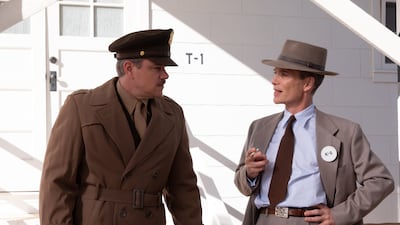
Damon, left, and Murphy in the film -
Florence Pugh as Jean Tatlock and Murphy -

Robert Downey Jr plays Lewis Strauss -
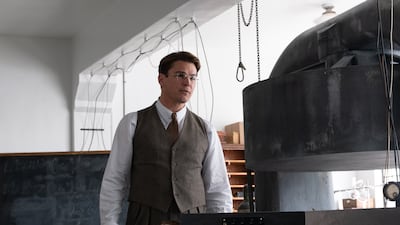
Josh Hartnett as Ernest Lawrence -
Emily Blunt as Kitty Oppenheimer -
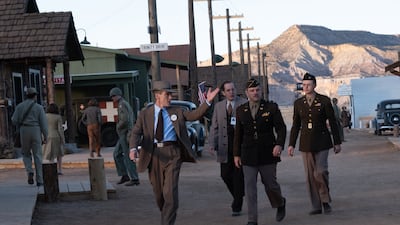
From left, Murphy, Olli Haaskivi as Edward Condon, Damon and Dane DeHaan as Kenneth Nichols -

DeHaan in the film -
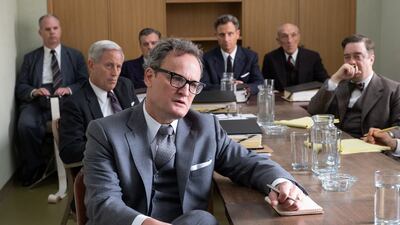
Jason Clarke as Roger Robb -

Robert Downey Jr, left, as Lewis Strauss and Matthew Modine as Vannevar Bush


The Oppenheimer postscript to making the bomb was his advice on how not to get annihilated. In fact, he lost his security clearance in 1954.
His oversight of the US-based Institute of Advanced Study for two decades from 1947 has also provided an enduring legacy. At a time when the world worries that advances such as ChatGPT threatens the future of humanity, Mr Oppenheimer’s work on how technology should work for human interests – and not against humanity – is enduringly relevant.
When I first studied computer science in the mid-1980s, the creation of the stored-programme computer was one of the foundational parts of the course. This computer was created by the Hungarian-American mathematician John von Neumann next to Mr Oppenheimer’s office at the Institute. Mr Von Neumann worried privately that computing machines were a monster that people could not keep pace with.
Advances in game theory involving Mr Oppenheimer have allowed humans to, so far, keep pace with the technology. He recognised that humans cannot just rely on technological advances alone. Instead, thought work across a range of disciplines must set the pace.
This allows researchers, such as those behind the new AI models, to maximise progress within a greater context. It ensures that humanity can adjust and thrive on technological change through more technology and more innovation.
The Institute was not just home to Mr Einstein and Mr Oppenheimer but philosophy experts and Cold War strategists. In the Common Room, if there was one, many of these figures might have easily recognised the dilemmas and debates raging over ChatGPT and rival Bard today.
Is the optimal response algorithms that enforce fairness? Or UN Security Council meetings on how to set ground rules for AI applications? Or debates in parliaments about how to make laws to govern the developments?
A fundamental truth from Mr Oppenheimer’s work on the bomb is that the development of atomic weapons was already in sight when he started it. His team was the first to create it.
The Mount Everest factor is always there. Mr Oppenheimer tells us how to best adapt in the face of change.

