


During his visit to Moscow last week, Chinese President Xi Jinping sought to balance Beijing’s strategic co-operation with Russia with a determination to preserve relations with the US-led West. While his visit brought the Russian government good economic and political tidings, Mr Xi’s messaging will also have been reassuring for the Biden administration.
The Chinese president cemented economic ties with Moscow that included trade agreements worth billions of dollars, crucial energy deals, and agreements to expand technical-military co-operation. He, however, was keen to make it clear to everyone that Beijing would not supply arms to Russia to be used in the war in Ukraine. He also made a distinction between co-operation between two countries with shared political outlooks, especially vis-a-vis the West, and appearing as though they are converging towards unity.
Mr Xi and Russian President Vladimir Putin agreed on the broad outlines of co-operation in international forums such as the UN and the G20. But they avoided issuing joint statements that the US might interpret as hostile. Rather, the communiques were vague and did not include any vows to stand up to Washington.
No agreement was reached or concrete steps were taken in the context of the Chinese peace plan for Ukraine. Instead, the two leaders reaffirmed general principles connected to the Beijing initiative. The two presidents did not tackle the details of the China-Russia-Iran friendship either, and stopped at reaffirming co-operation with Tehran, with Mr Putin welcoming the Chinese initiative for Saudi-Iranian normalisation.
All this means that Mr Xi is a skilled navigator determined to adhere to China’s strategic priorities, led by the Belt and Road Initiative that requires expanding the scope of global co-operation and narrowing the prospects of antagonistic blocs and axes.
-
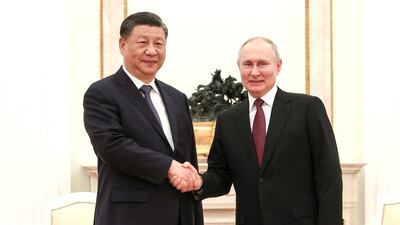
China's President Xi Jinping with Russian President Vladimir Putin in Moscow. Reuters -

Mr Xi's motorcade drives toward the Kremlin. AP -

Mr Xi, accompanied by Russian Deputy Prime Minister Dmitry Chernyshenko, at a welcome ceremony at Moscow's Vnukovo Airport. AFP -
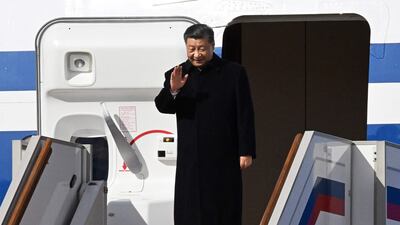
Mr Xi arrives at Moscow's Vnukovo Airport. AFP -
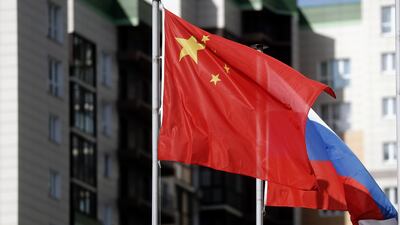
Both countries' national flags wave at the Russian-Chinese Greenwood business district in Moscow. EPA -
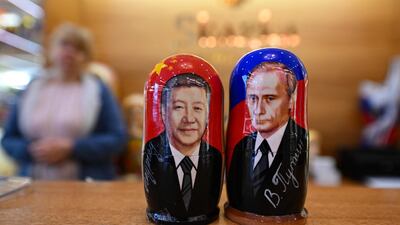
Traditional Russian dolls depicting the presidents at a gift shop in central Moscow. AFP


China’s sponsorship of the Saudi-Iranian agreement, built on respect for states’ sovereignty, good neighbourly relations, and non-interference in others’ internal affairs, will come under intense regional and international scrutiny. If Beijing is unable to adequately monitor the implementation of the agreement, it will be vulnerable to diplomatic, political and economic accountability.
This is the bet made by those convinced about China’s commitment to the implementation of the Saudi-Iranian guarantees. From the Saudi standpoint, there are almost no impediments in the agreement. But from the Iranian standpoint, it depends on whether its regime intends to merely embellish its behaviour and soften its rhetoric, or change its approach and ideology, which will require abandoning its regional projects extending across Iraq, Lebanon, Syria and Yemen.
The first test will be in Yemen, where the war currently under way directly affects Saudi national security – and on which Beijing will need to be firm with the Iranian leadership. It will need to press Tehran to stop providing military support to the Houthi rebels, without the duplicity of public denials coupled with continued covert support. This requires putting a clear timetable for a comprehensive resolution on the Yemen crisis that has, so far, eluded American and UN-led efforts. If China fails in this endeavour, it will be exposed to criticism.
China has leverage over the Iranian regime, however some questions need answering: to what extent is Beijing willing to use this leverage? How willing is Tehran to abandon its raison d’etre, and whose policy in Yemen reflects the foundational core of its doctrine?
Then there is Lebanon, which does not appear to be at the top of anyone’s list of priorities. However, Hezbollah in and of itself is an obvious component in the process of de-escalation, accord-building and softening of behaviour that Iran possibly undertakes. The Tehran-backed proxy in Lebanon is at the heart of the test of whether the Iranian regime will modify the logic of its existence or merely embellish its behaviour temporarily, in order to buy itself time and survive.
China might not invest its full weight in a small country such as Lebanon. But it is not ignorant of the weight of Beirut’s relations with the Gulf countries, particularly Saudi Arabia. Accordingly, Beijing could be forced to expand its political and diplomatic compass if it is serious about being a guarantor of the Saudi-Iranian agreement.

Syria could pose a test for Arab-Iranian co-existence and compromises, with Damascus partially reliant on Tehran for its survival. And while its politics is complicated, thereby meriting a separate analysis, the bottom line is that this country could become the arena for much bargaining between the two sides.
Beijing will need Moscow’s help in its quest to influence Tehran, given the nature of the Russia-Iran military alliance in Syria and Ukraine. However, Chinese-Iranian relations themselves are deep and extensive, and Tehran needs Beijing’s support, economically, politically and strategically.
Moreover, neither China nor Russia is willing to fall into any trap that could hurt their relations with Saudi Arabia and the Gulf states. Logically, therefore, they will have indicated to Iran that it needs to seriously adapt to the imperatives of their key interests, which in process will accrue benefits to Tehran too.
Statements made following the Xi-Putin meeting in Moscow indicate that the three-way partnership, at least as previously conceived by the Iranian leadership, is no longer on the table. Rather, political realism has turned this arrangement from an axis of defiance, assertiveness and ideological expansion into a co-operative one. The big question here is whether the Iranian regime will accept this arrangement and opt for a radical shift, and not just soften its behaviour temporarily.
The softening of behaviour and rhetoric, and avoiding provocation and confrontation, would of course be welcomed by everybody, including the US, which seeks de-escalation of tensions in the region. But for Saudi Arabia, the goal of the rapprochement with Tehran would ideally be to bring about a radical shift in relations with the country, as well as in the Iranian regime’s approach to the Arab world.
China has undoubtedly made an important foray into a complicated region. So far, there are reasons to be optimistic about its role in sponsoring the Saudi-Iranian agreement. But the challenge lies in inducing real change going forward.

