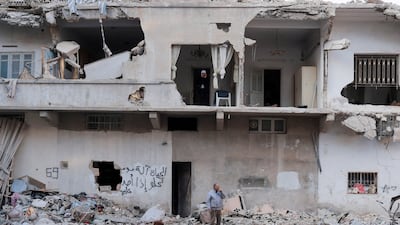
Fatmagul Arslan, 19, visits what is left of her home, where she was trapped for five days with her parents and two siblings, after the earthquake, in Nurdagi, Turkey. Reuters


Ramadan for Turkey-Syria earthquake survivors carries a different meaning


Weam Ghazal
Weam Ghazal
  • English
  • Arabic

March 22, 2023

After the loss and destruction caused by the February 6 earthquake in Turkey and Syria, this year's Ramadan will be difficult for everyone in the region, including myself. During night time in Gaziantep, Turkey, I still feel the world shaking. I watch the lightbulbs to see whether they are moving, to make sure another earthquake is not happening. I might keep thinking this way and not sleep well for a while.

During past Ramadans, waking up for suhoor, the pre-dawn meal, used to be a beautiful thing. Today, when I wake up before dawn, it is because of the tremors that I imagine, knowing fully well that those are in my head, but the fear just will not go away.

Iftar will also be strange this time around because I will spend this Ramadan alone, away from my family who moved away to another place, a relatively safer place. My sister's house, where we used to have iftar together, is now scheduled for demolition and we had to move out in a hurry. I feel a mix of fear, sadness and anxiety.

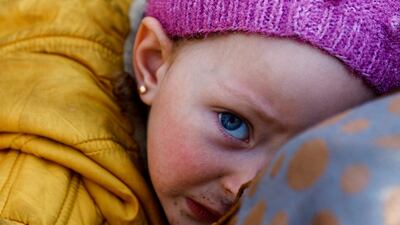
Khalil Al Suwadi holds his niece Afraa, a Syrian baby born under the rubble. The earthquake killed her parents and siblings. AFP

Ramadan is a special time for Muslims. I remember earlier when the days were filled with memories of family, being together, food and traditions. I don’t know if there will come a time when these memories will once again be a part of my life, and not mere feelings from the past.

I used to love sharing suhoor and I think about the way we would sit around, all sleepy, eating white cheese, oil and thyme. I loved the way we would get together to break our fast, at sunset, slightly cranky from hunger, making jokes and laughing. My mother prepared the types of food and dishes that we liked, but she would always say she couldn’t finish everything before the call to prayer. My father would bring the famous Ramadan maarouk, the sweet bread, which we ate with tea after ending our fast, and then we all gathered to watch television as a family.

Our communities across southern Turkey and Syria are broken

Like most of the Syrian population in Turkey, I know what it is like to lose my home. I lost it once already when I had to leave the country that I loved. As hard as it was, in Turkey, I found a place I could again call home, and now it has been taken away from me again.

What has happened here feels too cruel. Some might think that we Syrians are used to it, but we are not. I think about my Turkish friends and those suffering. It is a very difficult feeling. I wouldn’t wish it on anyone.

During the holy month, an intense sense of family, and of social rituals, exists among us Muslims and emphasises our sense of community; it gives us a sense of belonging, an increased feeling of sharing and it is a unique experience. I don’t know what Ramadan this year is going to be like. I find myself thinking about how many of us have lost family, friends, neighbours. Our communities across southern Turkey and Syria are broken, our families are lost, our sense of belonging shattered. Millions across the areas destroyed by the earthquake last month are in the same situation as me. I think about them all the time. I have lost a lot, but so many others have lost so much more.

We are still living in a state of fear, panic and sadness. Each of the aftershocks – which are still happening regularly – take away what is left of our sense of safety and stability.

  • A woman walks among destroyed buildings in Hatay, Turkey. Getty Images
    A woman walks among destroyed buildings in Hatay, Turkey. Getty Images
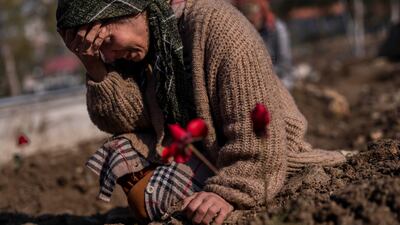
  • A woman mourns a relative during the burial of one of the earthquake victims in Antakya, southeastern Turkey. AP Photo
    A woman mourns a relative during the burial of one of the earthquake victims in Antakya, southeastern Turkey. AP Photo
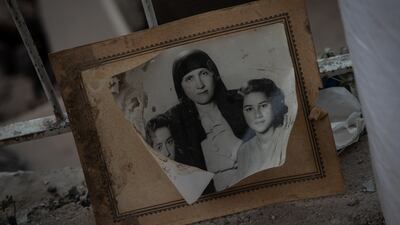
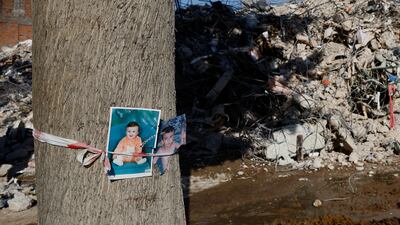
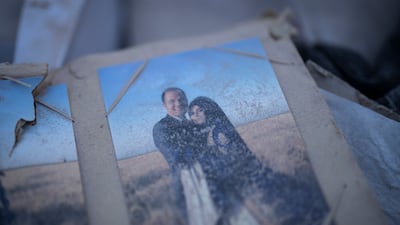
  • A family photo is seen amid the rubble in Hatay. Getty Images
    A family photo is seen amid the rubble in Hatay. Getty Images
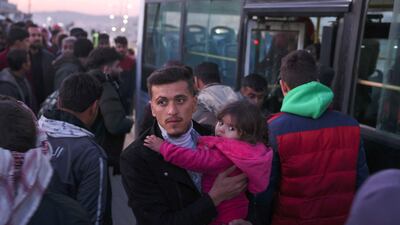
  • Syrian refugees in Turkey return to their home country following the deadly earthquake. AFP
    Syrian refugees in Turkey return to their home country following the deadly earthquake. AFP
  • Members of NGOs Deathcare Embalming Team and Turkish Kurt-Ar inspect the bucket of an excavator as they search for bodies in Kahramanmaras, Turkey. AP Photo
    Members of NGOs Deathcare Embalming Team and Turkish Kurt-Ar inspect the bucket of an excavator as they search for bodies in Kahramanmaras, Turkey. AP Photo
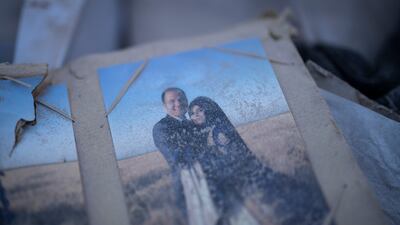
  • Dust covers a family photo album found in Antakya. AP Photo
    Dust covers a family photo album found in Antakya. AP Photo
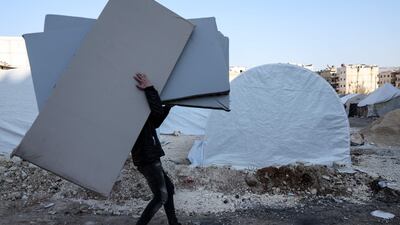
  • A man made homeless by the 7.8-magnitude quake carries mattresses distributed by an NGO at a makeshift camp in Afrin, in Syria's Aleppo province. AFP
    A man made homeless by the 7.8-magnitude quake carries mattresses distributed by an NGO at a makeshift camp in Afrin, in Syria's Aleppo province. AFP
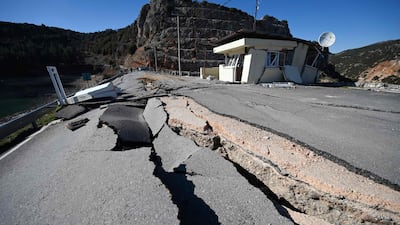
  • A cracked road near the quake’s epicentre in Kahramanmaras, Turkey. AFP
    A cracked road near the quake’s epicentre in Kahramanmaras, Turkey. AFP
  • A rescuer stands near the site where Aleyna Olmez, 17, was rescued from the rubble of a collapsed building in Kahramanmaras, about 10 days after the quake struck. AFP
    A rescuer stands near the site where Aleyna Olmez, 17, was rescued from the rubble of a collapsed building in Kahramanmaras, about 10 days after the quake struck. AFP
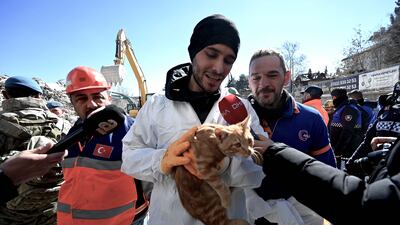
  • A rescuer holds a cat after it was rescued from the ruins of a collapsed building in Kahramanmaras. AFP
    A rescuer holds a cat after it was rescued from the ruins of a collapsed building in Kahramanmaras. AFP
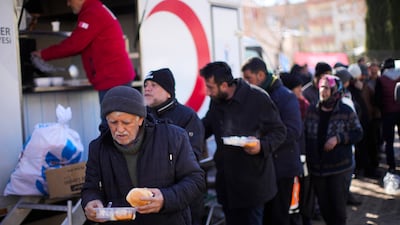
  • Quake survivors queue for food amid the rubble in Kahramanmaras. Reuters
    Quake survivors queue for food amid the rubble in Kahramanmaras. Reuters
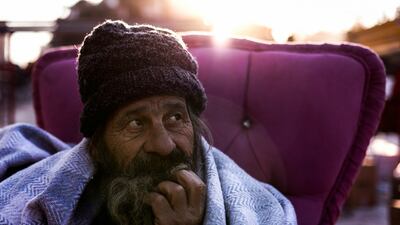
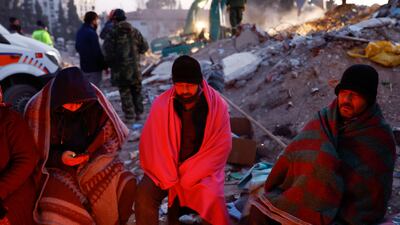
  • Bedran, a local resident who lost his house in the earthquake, keeps warm in Antakya, Turkey. Reuters
    Bedran, a local resident who lost his house in the earthquake, keeps warm in Antakya, Turkey. Reuters
  • A girl carries a box of water bottles next to a damaged mosque in Antakya. Reuters
    A girl carries a box of water bottles next to a damaged mosque in Antakya. Reuters
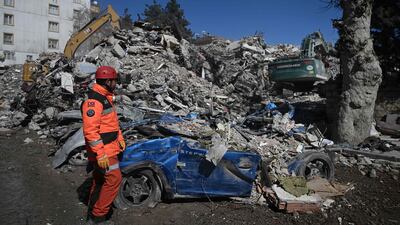
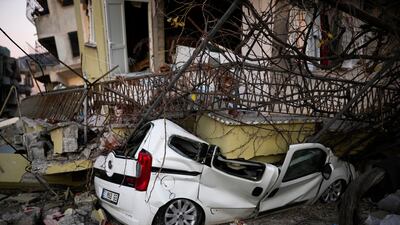
  • A car lies crushed by parts of a badly damaged building in Samandag, Turkey. AP
    A car lies crushed by parts of a badly damaged building in Samandag, Turkey. AP
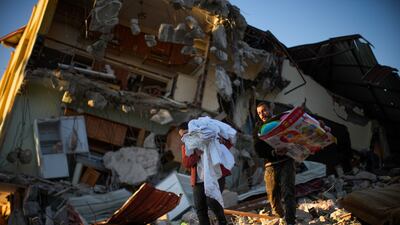
  • Residentes remove their belongings from their destroyed house in Samandag. AP
    Residentes remove their belongings from their destroyed house in Samandag. AP
  • Aleyna Olmez, 17, is rescued after being trapped for 10 days in Kahramanmaras. Getty
    Aleyna Olmez, 17, is rescued after being trapped for 10 days in Kahramanmaras. Getty
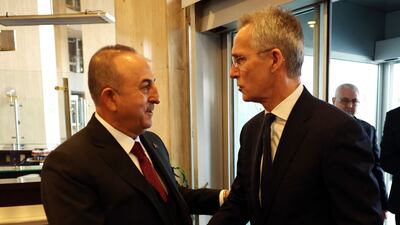
  • Turkish Foreign Minister Mevlut Cavusoglu, left, with Nato Secretary General Jens Stoltenberg in Ankara. AFP
    Turkish Foreign Minister Mevlut Cavusoglu, left, with Nato Secretary General Jens Stoltenberg in Ankara. AFP
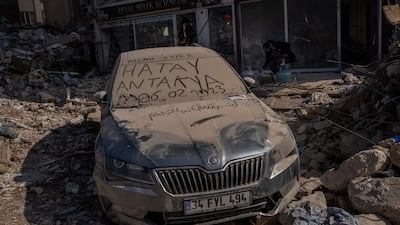
  • A message scrawled on a car covered in dust from collapsed buildings in Antakya, Turkey. AP
    A message scrawled on a car covered in dust from collapsed buildings in Antakya, Turkey. AP
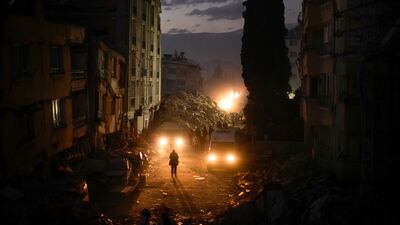
  • Destruction in Antakya. AP
    Destruction in Antakya. AP
  • A cracked road leads to a flooded area in Antakya. AP
    A cracked road leads to a flooded area in Antakya. AP
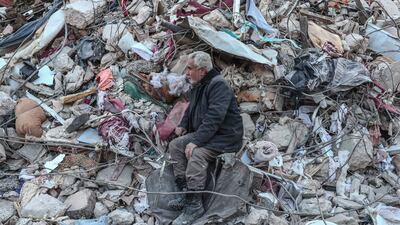
  • A man looks bewildered at the site of collapsed buildings in Hatay, Turkey. EPA
    A man looks bewildered at the site of collapsed buildings in Hatay, Turkey. EPA
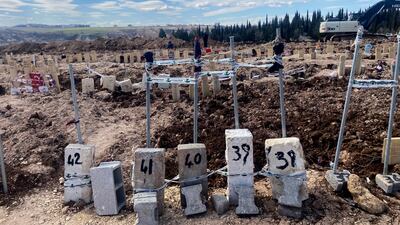
  • Numbered stones near graves of earthquake victims at a cemetery in Adiyaman, Turkey. EPA
    Numbered stones near graves of earthquake victims at a cemetery in Adiyaman, Turkey. EPA
  • A makeshift camp set up amid the rubble in Antakya, south of Hatay. AFP
    A makeshift camp set up amid the rubble in Antakya, south of Hatay. AFP
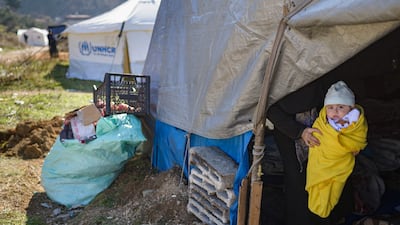
  • A woman holds her baby inside a tent in a camp in Antakya, Hatay. AFP
    A woman holds her baby inside a tent in a camp in Antakya, Hatay. AFP
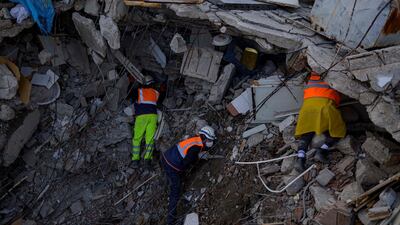
  • Greek and Turkish rescuers are at work to extract bodies of victims from the rubble in Antakya. AFP
    Greek and Turkish rescuers are at work to extract bodies of victims from the rubble in Antakya. AFP
  • Samar Hamouda, 44, recalls her experience of the earthquake destroying her home, at Tishreen Hospital in Latakia, Syria. Reuters
    Samar Hamouda, 44, recalls her experience of the earthquake destroying her home, at Tishreen Hospital in Latakia, Syria. Reuters
  • A damaged house in Jableh, Syria. Reuters
    A damaged house in Jableh, Syria. Reuters
  • Photos of missing children left in hope in Kahramanmaras, Turkey. Reuters
    Photos of missing children left in hope in Kahramanmaras, Turkey. Reuters
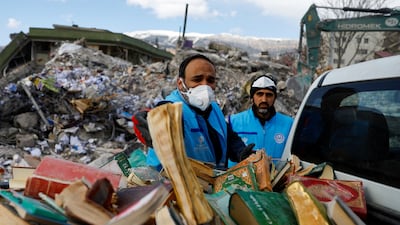
  • People collect copies of holy books from the rubble in Kahramanmaras. Reuters
    People collect copies of holy books from the rubble in Kahramanmaras. Reuters
  • Rescuers search for survivors under the rubble of a collapsed building in Kahramanmaras. Reuters
    Rescuers search for survivors under the rubble of a collapsed building in Kahramanmaras. Reuters
  • People carry a bodybag as residents wait for their relatives to be pulled out from the rubble in Hatay. AFP
    People carry a bodybag as residents wait for their relatives to be pulled out from the rubble in Hatay. AFP
  • Dust covers a family photo album found in the debris of a building in Antakya. AP
    Dust covers a family photo album found in the debris of a building in Antakya. AP
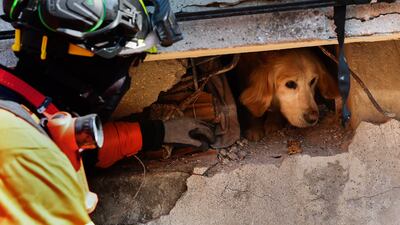
  • Portuguese rescue team members try to free the dog named Tarcin from the rubble in Antakya in Hatay. EPA
    Portuguese rescue team members try to free the dog named Tarcin from the rubble in Antakya in Hatay. EPA
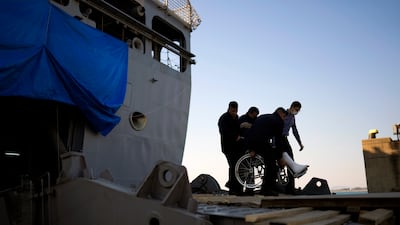
  • An injured survivor at a makeshift hospital set up at Turkish Bayraktar warship anchored near Iskenderun city, southern Turkey. AP
    An injured survivor at a makeshift hospital set up at Turkish Bayraktar warship anchored near Iskenderun city, southern Turkey. AP
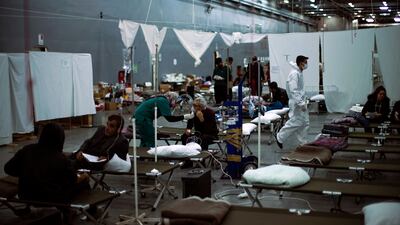
  • A makeshift hospital set up at Turkish Bayraktar warship anchored near Iskenderun city, southern Turkey. AP
    A makeshift hospital set up at Turkish Bayraktar warship anchored near Iskenderun city, southern Turkey. AP
  • Britain's King Charles III (C) meets with members of the Turkish diaspora community who have been collecting, packaging and organising the transportation of food, blankets and warm clothing for people who have recently been affected by the earthquakes in Turkey and Syria, during a visit to the West London Turkish Volunteers, in Hounslow, greater London. AFP
    Britain's King Charles III (C) meets with members of the Turkish diaspora community who have been collecting, packaging and organising the transportation of food, blankets and warm clothing for people who have recently been affected by the earthquakes in Turkey and Syria, during a visit to the West London Turkish Volunteers, in Hounslow, greater London. AFP
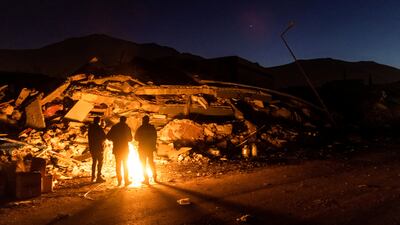
  • People stand by the fire next to the ruins of a collapsed building in Elbistan, Turkey. Reuters
    People stand by the fire next to the ruins of a collapsed building in Elbistan, Turkey. Reuters
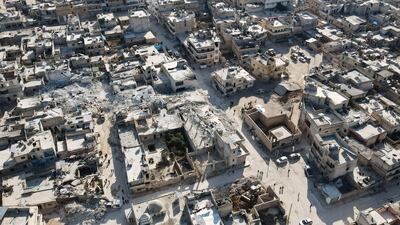
  • Destroyed buildings in Syria's rebel-held village of Atarib, in the north-western Aleppo province. AFP
    Destroyed buildings in Syria's rebel-held village of Atarib, in the north-western Aleppo province. AFP
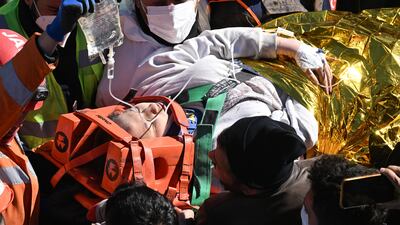
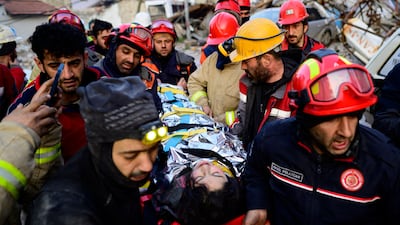
  • Rescuers carry Fatma, 15, who was pulled out from the rubble in Hatay, Turkey. Reuters
    Rescuers carry Fatma, 15, who was pulled out from the rubble in Hatay, Turkey. Reuters
  • A displaced woman receives food inside a stadium in Kahramanmaras, Turkey. Reuters
    A displaced woman receives food inside a stadium in Kahramanmaras, Turkey. Reuters
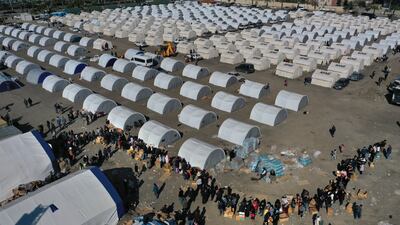
  • People lineup to receive aid supplies at a makeshift camp in Iskenderun city in southern Turkey. AP
    People lineup to receive aid supplies at a makeshift camp in Iskenderun city in southern Turkey. AP
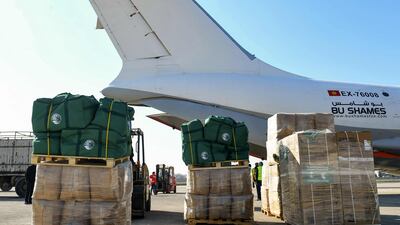
  • Humanitarian aid provided by Saudi Arabia for survivors of the February 6 earthquake are unloaded at Aleppo Airport in northern Syria. AFP
    Humanitarian aid provided by Saudi Arabia for survivors of the February 6 earthquake are unloaded at Aleppo Airport in northern Syria. AFP
  • Turkish President Recep Tayyip Erdogan addresses the World Government Summit in Dubai via video link. Antonie Robertson/The National
    Turkish President Recep Tayyip Erdogan addresses the World Government Summit in Dubai via video link. Antonie Robertson/The National
  • A man walks between trains being using as shelters in Iskenderun, southern Turkey. AP Photo
    A man walks between trains being using as shelters in Iskenderun, southern Turkey. AP Photo
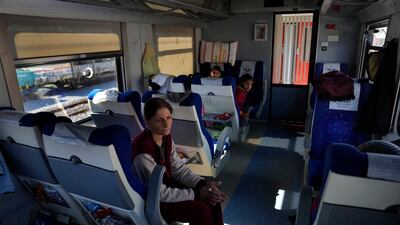
  • A woman and children inside a train being used as shelter after the earthquake, in Iskenderun. AP Photo
    A woman and children inside a train being used as shelter after the earthquake, in Iskenderun. AP Photo
  • Tents erected in a school yard for Syrians who have lost their homes after the deadly quake, in the rebel-held town of Harem in Syria. Reuters
    Tents erected in a school yard for Syrians who have lost their homes after the deadly quake, in the rebel-held town of Harem in Syria. Reuters
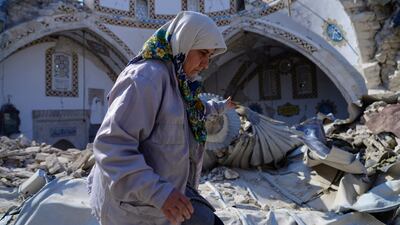
  • A woman walks by the destroyed Habib-i Neccar mosque in the historic southern city of Antakya in Hatay, Turkey. AFP
    A woman walks by the destroyed Habib-i Neccar mosque in the historic southern city of Antakya in Hatay, Turkey. AFP
  • Rescuers pull out a 12-year-old Syrian girl, Cudi, from the rubble in Hatay. AFP
    Rescuers pull out a 12-year-old Syrian girl, Cudi, from the rubble in Hatay. AFP
  • Amar, a Syrian refugee living in Turkey, looks on as search for survivors continues in Kahramanmaras. Reuters
    Amar, a Syrian refugee living in Turkey, looks on as search for survivors continues in Kahramanmaras. Reuters
  • Displaced people keep warm by a fire in Kahramanmaras, Turkey. Reuters
    Displaced people keep warm by a fire in Kahramanmaras, Turkey. Reuters
  • Earthquake survivors receive distributed meals in Golbasi, Turkey. AP
    Earthquake survivors receive distributed meals in Golbasi, Turkey. AP
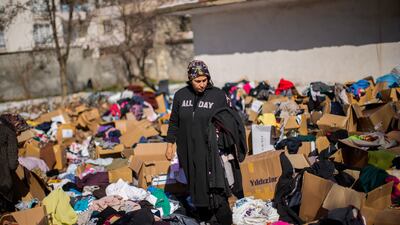
  • A woman stands amid boxes of donated clothes in Golbasi, Turkey. AP
    A woman stands amid boxes of donated clothes in Golbasi, Turkey. AP
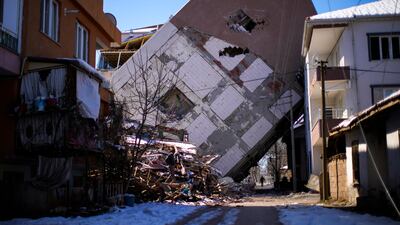
  • A man walks near a damaged building that leans on a neighbouring house in Golbasi, Turkey. AP
    A man walks near a damaged building that leans on a neighbouring house in Golbasi, Turkey. AP
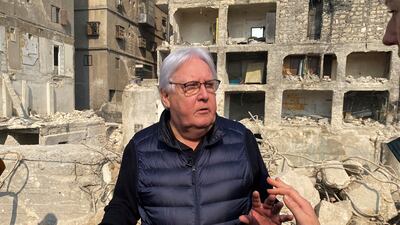
  • UN emergency relief co-ordinator Martin Griffiths stands amid quake-damaged buildings in Aleppo, Syria. Reuters
    UN emergency relief co-ordinator Martin Griffiths stands amid quake-damaged buildings in Aleppo, Syria. Reuters
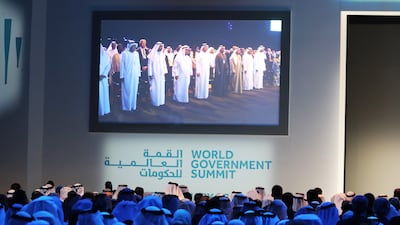
  • Delegates observe a moment of silence for the Turkey–Syria earthquake before the start of the World Government Summit in Dubai. Pawan Singh / The National
    Delegates observe a moment of silence for the Turkey–Syria earthquake before the start of the World Government Summit in Dubai. Pawan Singh / The National
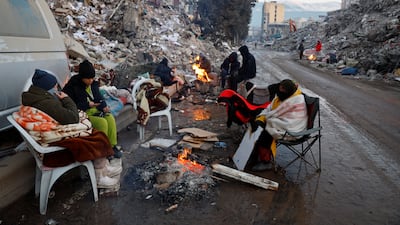
  • People keep warm by a fire as the search for survivors continues a week after the earthquake in Kahramanmaras, Turkey. Reuters
    People keep warm by a fire as the search for survivors continues a week after the earthquake in Kahramanmaras, Turkey. Reuters
  • A child receives food in Kahramanmaras, Turkey. Reuters
    A child receives food in Kahramanmaras, Turkey. Reuters
  • A dog is seen through a glass door in Kahramanmaras, Turkey. Reuters
    A dog is seen through a glass door in Kahramanmaras, Turkey. Reuters
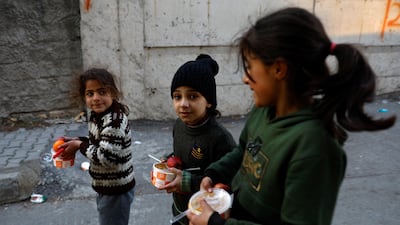
  • Children walk in the street with food boxes in Kahramanmaras, Turkey. Reuters
    Children walk in the street with food boxes in Kahramanmaras, Turkey. Reuters
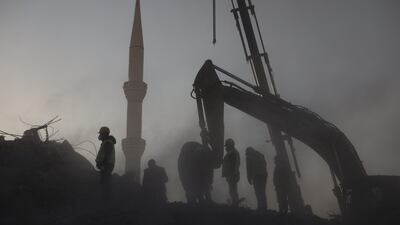
  • A minaret stands as the sun rises over the earthquake-hit city of Kahramanmaras, Turkey. Reuters
    A minaret stands as the sun rises over the earthquake-hit city of Kahramanmaras, Turkey. Reuters

Gathering is what gives Ramadan its value as a social ritual among Muslims, as it gives us a sense of belonging to a community, where you can find social support, and leave sadness and isolation behind.

In my capacity as a case management officer at International Network for Aid, Relief and Assistance, particularly during our field work responding to this disaster, I met many families who told me about their feelings of deprivation.

Rawan was one such, who lost her mother in the earthquake. She lives in a state of sadness thinking about Ramadan starting and remembering her mother, who used to prepare the most delicious dishes, including a favourite dish of every family member. She says that without her mother, Ramadan no longer had meaning for her.

Umm Hani’s family had just moved to their new home in Islahiye, in southern Turkey, when the earthquake struck. After years of displacement following the loss of their home in Syria and spending years in refugee camps before moving to Turkey, the walls shook violently and everything in the house fell to the ground.

Amira and her children survived with minor injuries, but they left their new home in ruins. As Ramadan approached, Amira and her family could only feel one thing, a deep sadness. They were always looking forward to spending Ramadan together in their new home. Today they have gone back to living in a tent, struggling to make ends meet.

Leyla Ogural, 52, says goodbye to mental health workers Busra Isik and Ayse Tugcedemir in Antakya, Turkey, on March 3. Reuters

Yara is a volunteer in humanitarian work, who used to wait for the weekend to share Ramadan rituals with her family. Now she is unable to do so because her family moved away, after losing their home in Antakya to the earthquake.

Ramadan is the most distinguished season of the year for Muslims, during which they remember the values of love and solidarity while learning what it means to truly belong to a community. However, earthquake victims may not be able to experience this feeling. Those who are luckier can use this time to give back to their communities, support earthquake victims, and show compassion and support those who are struggling. Ramadan can also be an opportunity for Muslims to meet and support each other, even if they are physically distant.

This Ramadan will carry a completely different meaning and flavour. This year will be very different for me as well. I will be fasting while working in the field. I will help people who really need it. Maybe I will put myself to work because this is the time for giving. Although I am already giving everything I can, I will find the strength to give more. I see the smiles of gratitude on the faces of families and hear the laughter of children, and after a long and hard day of work, when I hear the maghrib call for prayer, I too will say I gave something of myself today.

HOW DO SIM CARD SCAMS WORK?

Sim swap frauds are a form of identity theft.

They involve criminals conning mobile phone operators into issuing them with replacement Sim cards, often by claiming their phone has been lost or stolen 

They use the victim's personal details - obtained through criminal methods - to convince such companies of their identity.

The criminal can then access any online service that requires security codes to be sent to a user's mobile phone, such as banking services.

How Tesla’s price correction has hit fund managers

Investing in disruptive technology can be a bumpy ride, as investors in Tesla were reminded on Friday, when its stock dropped 7.5 per cent in early trading to $575.

It recovered slightly but still ended the week 15 per cent lower and is down a third from its all-time high of $883 on January 26. The electric car maker’s market cap fell from $834 billion to about $567bn in that time, a drop of an astonishing $267bn, and a blow for those who bought Tesla stock late.

The collapse also hit fund managers that have gone big on Tesla, notably the UK-based Scottish Mortgage Investment Trust and Cathie Wood’s ARK Innovation ETF.

Tesla is the top holding in both funds, making up a hefty 10 per cent of total assets under management. Both funds have fallen by a quarter in the past month.

Matt Weller, global head of market research at GAIN Capital, recently warned that Tesla founder Elon Musk had “flown a bit too close to the sun”, after getting carried away by investing $1.5bn of the company’s money in Bitcoin.

He also predicted Tesla’s sales could struggle as traditional auto manufacturers ramp up electric car production, destroying its first mover advantage.

AJ Bell’s Russ Mould warns that many investors buy tech stocks when earnings forecasts are rising, almost regardless of valuation. “When it works, it really works. But when it goes wrong, elevated valuations leave little or no downside protection.”

A Tesla correction was probably baked in after last year’s astonishing share price surge, and many investors will see this as an opportunity to load up at a reduced price.

Dramatic swings are to be expected when investing in disruptive technology, as Ms Wood at ARK makes clear.

Every week, she sends subscribers a commentary listing “stocks in our strategies that have appreciated or dropped more than 15 per cent in a day” during the week.

Her latest commentary, issued on Friday, showed seven stocks displaying extreme volatility, led by ExOne, a leader in binder jetting 3D printing technology. It jumped 24 per cent, boosted by news that fellow 3D printing specialist Stratasys had beaten fourth-quarter revenues and earnings expectations, seen as good news for the sector.

By contrast, computational drug and material discovery company Schrödinger fell 27 per cent after quarterly and full-year results showed its core software sales and drug development pipeline slowing.

Despite that setback, Ms Wood remains positive, arguing that its “medicinal chemistry platform offers a powerful and unique view into chemical space”.

In her weekly video view, she remains bullish, stating that: “We are on the right side of change, and disruptive innovation is going to deliver exponential growth trajectories for many of our companies, in fact, most of them.”

Ms Wood remains committed to Tesla as she expects global electric car sales to compound at an average annual rate of 82 per cent for the next five years.

She said these are so “enormous that some people find them unbelievable”, and argues that this scepticism, especially among institutional investors, “festers” and creates a great opportunity for ARK.

Only you can decide whether you are a believer or a festering sceptic. If it’s the former, then buckle up.

Teri%20Baaton%20Mein%20Aisa%20Uljha%20Jiya
%3Cp%3E%3Cstrong%3EDirectors%3A%3C%2Fstrong%3E%20Amit%20Joshi%20and%20Aradhana%20Sah%3C%2Fp%3E%0A%3Cp%3E%3Cstrong%3ECast%3A%3C%2Fstrong%3E%20Shahid%20Kapoor%2C%20Kriti%20Sanon%2C%20Dharmendra%2C%20Dimple%20Kapadia%2C%20Rakesh%20Bedi%3C%2Fp%3E%0A%3Cp%3E%3Cstrong%3ERating%3A%3C%2Fstrong%3E%204%2F5%3C%2Fp%3E%0A

Mercer, the investment consulting arm of US services company Marsh & McLennan, expects its wealth division to at least double its assets under management (AUM) in the Middle East as wealth in the region continues to grow despite economic headwinds, a company official said.

Mercer Wealth, which globally has $160 billion in AUM, plans to boost its AUM in the region to $2-$3bn in the next 2-3 years from the present $1bn, said Yasir AbuShaban, a Dubai-based principal with Mercer Wealth.

Within the next two to three years, we are looking at reaching $2 to $3 billion as a conservative estimate and we do see an opportunity to do so,” said Mr AbuShaban.

Mercer does not directly make investments, but allocates clients’ money they have discretion to, to professional asset managers. They also provide advice to clients.

“We have buying power. We can negotiate on their (client’s) behalf with asset managers to provide them lower fees than they otherwise would have to get on their own,” he added.

Mercer Wealth’s clients include sovereign wealth funds, family offices, and insurance companies among others.

From its office in Dubai, Mercer also looks after Africa, India and Turkey, where they also see opportunity for growth.

Wealth creation in Middle East and Africa (MEA) grew 8.5 per cent to $8.1 trillion last year from $7.5tn in 2015, higher than last year’s global average of 6 per cent and the second-highest growth in a region after Asia-Pacific which grew 9.9 per cent, according to consultancy Boston Consulting Group (BCG). In the region, where wealth grew just 1.9 per cent in 2015 compared with 2014, a pickup in oil prices has helped in wealth generation.

BCG is forecasting MEA wealth will rise to $12tn by 2021, growing at an annual average of 8 per cent.

Drivers of wealth generation in the region will be split evenly between new wealth creation and growth of performance of existing assets, according to BCG.

Another general trend in the region is clients’ looking for a comprehensive approach to investing, according to Mr AbuShaban.

“Institutional investors or some of the families are seeing a slowdown in the available capital they have to invest and in that sense they are looking at optimizing the way they manage their portfolios and making sure they are not investing haphazardly and different parts of their investment are working together,” said Mr AbuShaban.

Some clients also have a higher appetite for risk, given the low interest-rate environment that does not provide enough yield for some institutional investors. These clients are keen to invest in illiquid assets, such as private equity and infrastructure.

“What we have seen is a desire for higher returns in what has been a low-return environment specifically in various fixed income or bonds,” he said.

“In this environment, we have seen a de facto increase in the risk that clients are taking in things like illiquid investments, private equity investments, infrastructure and private debt, those kind of investments were higher illiquidity results in incrementally higher returns.”

The Abu Dhabi Investment Authority, one of the largest sovereign wealth funds, said in its 2016 report that has gradually increased its exposure in direct private equity and private credit transactions, mainly in Asian markets and especially in China and India. The authority’s private equity department focused on structured equities owing to “their defensive characteristics.”

COMPANY%20PROFILE
%3Cp%3E%3Cstrong%3EName%3A%3C%2Fstrong%3E%20Floward%0D%3Cbr%3E%3Cstrong%3EBased%3A%20%3C%2Fstrong%3ERiyadh%2C%20Saudi%20Arabia%0D%3Cbr%3E%3Cstrong%3EFounders%3A%20%3C%2Fstrong%3EAbdulaziz%20Al%20Loughani%20and%20Mohamed%20Al%20Arifi%0D%3Cbr%3E%3Cstrong%3ESector%3A%20%3C%2Fstrong%3EE-commerce%0D%3Cbr%3E%3Cstrong%3ETotal%20funding%3A%20%3C%2Fstrong%3EAbout%20%24200%20million%0D%3Cbr%3E%3Cstrong%3EInvestors%3A%20%3C%2Fstrong%3EAljazira%20Capital%2C%20Rainwater%20Partners%2C%20STV%20and%20Impact46%0D%3Cbr%3E%3Cstrong%3ENumber%20of%20employees%3A%20%3C%2Fstrong%3E1%2C200%3C%2Fp%3E%0A
What is blockchain?

Blockchain is a form of distributed ledger technology, a digital system in which data is recorded across multiple places at the same time. Unlike traditional databases, DLTs have no central administrator or centralised data storage. They are transparent because the data is visible and, because they are automatically replicated and impossible to be tampered with, they are secure.

The main difference between blockchain and other forms of DLT is the way data is stored as ‘blocks’ – new transactions are added to the existing ‘chain’ of past transactions, hence the name ‘blockchain’. It is impossible to delete or modify information on the chain due to the replication of blocks across various locations.

Blockchain is mostly associated with cryptocurrency Bitcoin. Due to the inability to tamper with transactions, advocates say this makes the currency more secure and safer than traditional systems. It is maintained by a network of people referred to as ‘miners’, who receive rewards for solving complex mathematical equations that enable transactions to go through.

However, one of the major problems that has come to light has been the presence of illicit material buried in the Bitcoin blockchain, linking it to the dark web.

Other blockchain platforms can offer things like smart contracts, which are automatically implemented when specific conditions from all interested parties are reached, cutting the time involved and the risk of mistakes. Another use could be storing medical records, as patients can be confident their information cannot be changed. The technology can also be used in supply chains, voting and has the potential to used for storing property records.

Brief scores:

Barcelona 3

Pique 38', Messi 51 (pen), Suarez 82'

Rayo Vallecano 1

De Tomas Gomez 24'

Other acts on the Jazz Garden bill

Sharrie Williams
The American singer is hugely respected in blues circles due to her passionate vocals and songwriting. Born and raised in Michigan, Williams began recording and touring as a teenage gospel singer. Her career took off with the blues band The Wiseguys. Such was the acclaim of their live shows that they toured throughout Europe and in Africa. As a solo artist, Williams has also collaborated with the likes of the late Dizzy Gillespie, Van Morrison and Mavis Staples.
Lin Rountree
An accomplished smooth jazz artist who blends his chilled approach with R‘n’B. Trained at the Duke Ellington School of the Arts in Washington, DC, Rountree formed his own band in 2004. He has also recorded with the likes of Kem, Dwele and Conya Doss. He comes to Dubai on the back of his new single Pass The Groove, from his forthcoming 2018 album Stronger Still, which may follow his five previous solo albums in cracking the top 10 of the US jazz charts.
Anita Williams
Dubai-based singer Anita Williams will open the night with a set of covers and swing, jazz and blues standards that made her an in-demand singer across the emirate. The Irish singer has been performing in Dubai since 2008 at venues such as MusicHall and Voda Bar. Her Jazz Garden appearance is career highlight as she will use the event to perform the original song Big Blue Eyes, the single from her debut solo album, due for release soon.

Updated: March 22, 2023, 9:18 AM