


This month, the world reached 8 billion people. If that's not a big enough deal, there is every indication we will reach 9 billion in the next 15 years. To put the population growth in perspective, according to OurWorldinData, there were 1 billion in 1804, 2 billion in 1927, 3 billion in 1960, 4 billion in 1974, 5 billion in 1987, 6 billion in 1998, and 7 billion in 2010.
A world population chart over the long run shows a low population growth rate until about 1500, following which it started to pick up slowly. In the 1800s and 1900s, populations exploded as medical and health advances, industrial and agricultural improvements, and more effective and efficient energy, communications, and transport systems began to take hold in many parts of the world.
The idea of boiling and treating water probably saved uncountable people. Other potent examples are polio and smallpox vaccines and an improved understanding of the cardiovascular systems and cancers. Energy use, industry and agriculture improved the world’s output, too. And as time went on, more people benefited from this in a significant way.
Before these inventions and improvements, life was harsh, brutish and very short for most people. Most lived in underdeveloped and unhealthy rural areas. Most did not understand why people got sick and what could cure them. Only a tiny few were not dreadfully poor rural peasants.
-
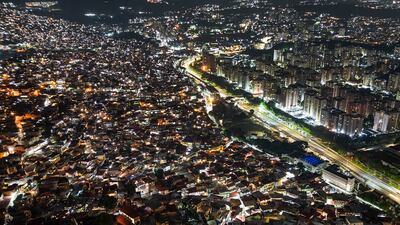
Houses cover a hillside in the Petare neighbourhood of Caracas, Venezuela. The world's population hit an estimated eight billion people on November 15, according to the United Nations. AP -
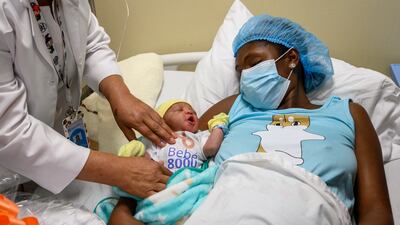
Damaris Ferrera with her baby at Damian Ferrera Altagracia Hospital – in Santo Domingo, Dominican Republic – which symbolically named him the eight billionth inhabitant of the world. AP -
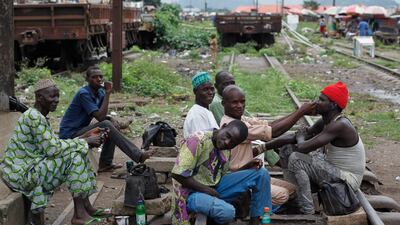
Barbers on an abandoned train track in Abeokuta, about 70km outside Lagos, Nigeria. More than half of the projected increase in the global population up to 2050 will be concentrated in eight countries: the Democratic Republic of Congo, Egypt, Ethiopia, India, Nigeria, Pakistan, the Philippines and Tanzania. EPA -

Newborn babies at Hotel Dieu hospital in Beirut, Lebanon, as the world population surges past eight billion. Reuters -
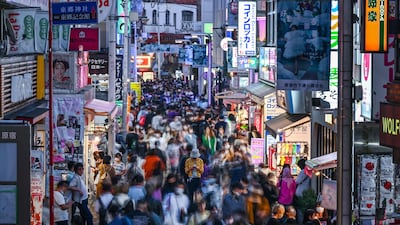
Crowds on Takeshita Street in Tokyo, considered to be the world's most populous metropolitan area. AFP -
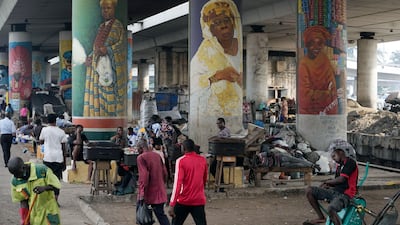
Nigeria is a significant contributor to world population growth. Countries in sub-Saharan Africa are expected to contribute more than half of the increase anticipated up to 2050, according to the UN. AP -

A packed Ipanema beach in Rio de Janeiro, Brazil. AP -
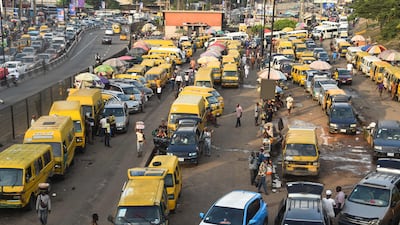
Traffic chaos at Ojodu-Berger bus station in Lagos, Nigeria's commercial capital, which has a population of about 15 million. AFP -
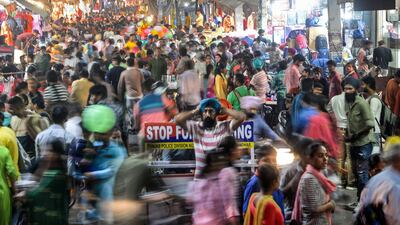
A crowded market in Jalandhar, India. AFP -
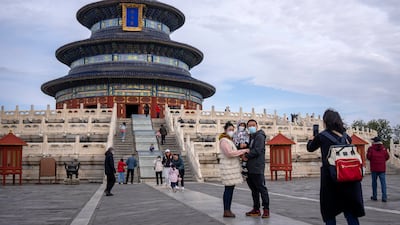
A family taking pictures at the Temple of Heaven in Beijing. AP -
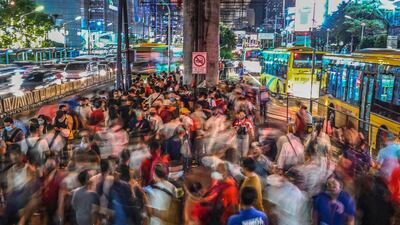
Commuters waiting for buses in Manila, Philippines, where the city's 12 million population swells by three million during working hours. AFP -
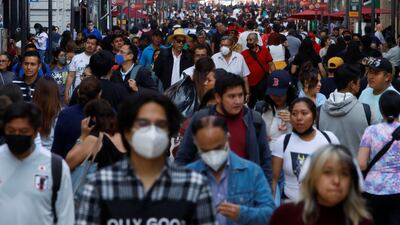
Mexico City is home to more than 20 million people. Reuters -
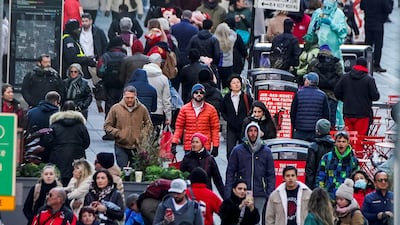
Times Square in Manhattan. About nine million people live in New York's five boroughs. Reuters -
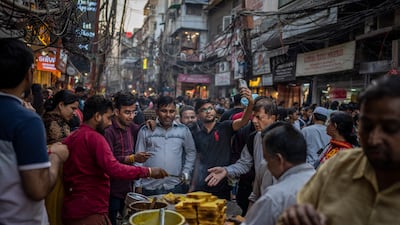
A busy market in New Delhi, India, part of an urban area where the population is estimated to be 32 million. AP -
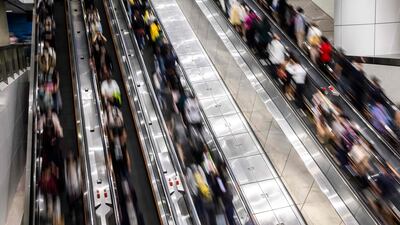
Commuters at a train station in Hong Kong. AFP -
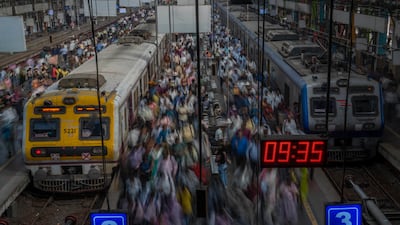
Indian commuters get off trains at the Church Gate railway station in Mumbai, India. AP -
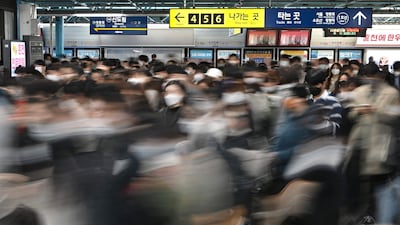
A subway station in Seoul. The South Korean capital has a population approaching 10 million. AFP


The average lifespan averaged under 40 before 1800, according to OurWorldinData. By 1950, many parts of the world saw lifetimes increase by 20 years. However, there remained places where life expectancy continued to be much lower, such as in sub-Saharan Africa, South-East Asia and Latin America. Improvements were uneven and unequal.
Significant changes for most parts of the world, including Asia and Africa, happened only in the past 70 years. India and China, in particular, have made great strides towards longer and healthier lives since the 1970s. A baby born now in almost all places in the world should expect a much longer and healthier life, on average, than their grandparents and certainly better than earlier generations.
However, there has been a flip side to development.
Global population growth since the Industrial Revolution drove emissions of greenhouse gases, air, water and land pollution, the denuding of forests, a reduction in fish stocks, and the massive increases in monoculture farming and livestock management. It also drove the movement of people from rural areas to cities. Of course, urbanisation has often led to higher incomes and wealth for many, but it has also bred problems such as instability, crime and violence.
Urbanisation continues to grow worldwide, with 56 per cent of humanity living in cities today, according to the World Bank's Urban Development Overview released last month. The development of megacities with huge shanty towns attached to them, especially in sub-Saharan Africa and South Asia, can lead to social problems.
There is, certainly, the counterargument that our population isn't growing as fast as it once did. UN statistics collated in 2021 show that about 60 per cent of the world population live in countries that are at or below the replacement rate of 2.1 children per woman. It was 40 per cent just two years earlier. This lessens the economic, resource and environmental stresses considerably.
The problem, however, is that population growth is uneven across the globe. In fact, we have a somewhat bifurcated world, with some parts having youthful societies and growing populations, such as Nigeria, India and Egypt, while others are ageing societies with declining populations, such as Japan, Italy and Portugal. Most of the coming 1 billion added over the next 15 years are expected to come from India, China, Nigeria, Egypt, Pakistan, and some struggling countries in South Asia and Africa.
When there are too many younger people or too many older people, there are increased stresses on economies and societies due to the very high “dependency ratios", which measure how much the working populations need to take care of the non-working younger and older people. Old-age dependency is highest in the more developed North America, Europe, Australia and Japan. Youth dependency is highest in the less developed sub-Saharan Africa, Yemen, Iraq and Afghanistan.
Both issues could pose significant problems as we head to the 9 billion mark.
Ageing populations put pressure on social insurance schemes, inflation, investments and medical systems. Ageing countries will, therefore, need to adjust as their societies get older. The budgets required to make that happen might not be available due to the unfavourable demographics.

Youthful and growing populations, on the other hand, offer countries a chance to develop with the numbers and energy of those people. However, how successful they will be will depend on how those young people will be educated and trained, where the investments will come from to absorb those youthful workers, and how they can keep the per capita incomes and wealth growing to keep peace in their countries.
Rapidly growing and young populations also put stress on food systems. Inheritance laws can also break up farms and other properties into smaller, less efficient ones. Increased youthful populations can cause more, not less, poverty if not appropriately handled. Having a growing young population, therefore, is no guarantee of future success.
When we consider the environmental problems that could result from 1 billion more people globally, climate change could be moving faster towards tipping points when those new 1 billion arrive and begin maturing. Challenges related to economic justice and environmental justice will no doubt arise, particularly for people living in the younger but poorer countries. The lack of a framework to deal with these challenges could pose as constant threats to world peace and prosperity.
Given how interconnected we are, what happens in faraway places can significantly affect our countries, cities, towns and families. This makes dealing with global issues for the sake of the greater good, ourselves and the next billion all the more urgent.

