

“Did you lose your ships in the Black Sea?” asks an old Turkish expression. It’s traditionally directed at a friend lost in thought or struggling with some mental conundrum, but it might be posed to Istanbul Mayor Ekrem Imamoglu in a slightly more literal way.
Much like Istanbul, Turkey’s north-eastern Black Sea region has an outsized impact on the country’s discourse and political fortunes. President Recep Tayyip Erdogan and several of his fellow AKP founders, along with many of their top deputies and staunchest supporters, hail from the region, as does the Istanbul Mayor.
Back in May, Mr Imamoglu toured his home province of Trabzon, as well as neighbouring Rize, Mr Erdogan’s home province, over the Eid Al Fitr holiday. He drew adoring crowds, but came under sharp criticism when a photo of his press pool revealed that he had brought along a former pro-AKP journalist widely thought to have unfairly persecuted government critics.
The Mayor probably made matters worse with his response to the complaints. “There may be some people who want to sacrifice me over one photo,” he said. “I do not care at all.”
Mr Imamoglu’s political star – for years the brightest in the opposition firmament – has since seemed to fade with each passing day. Weeks later, during Eid Al Adha, he was again away from Istanbul – this time on holiday along the Turkish Riviera – when the city was hit with major floods, and again faced strong criticism from his supporters.
Around that time, reports emerged that the longtime leader of Mr Imamoglu’s main opposition CHP, Kemal Kilicdaroglu, would run as the party’s candidate in next year’s presidential election. Mr Imamoglu and his fellow CHP Mayor, Mansur Yavas of Ankara, have consistently outperformed their boss, as well as Mr Erdogan, in head-to-head polls.

In fact, none of the likely opposition candidates has polled as poorly against Mr Erdogan as Mr Kilicdaroglu. The CHP and its six-party opposition alliance have yet to choose their candidate, and just last week a top opposition MP expressed concerns that Mr Kilicdaroglu would be unable to win. So there may still be hope for Mr Imamoglu.
Yet, he happens to be on trial at the moment, facing a potential political ban and up to four years in prison for insulting Turkey’s top election board. The verdict could come any day, and many expect the popular Istanbul Mayor to be found guilty despite the questionable charges.
As if all this weren’t enough, two days after his trial began, Istanbul’s main pedestrian thoroughfare was struck with a bomb blast that killed six people and injured dozens, recalling for many the politically driven violence that shook the country in 2015-16.
Istanbul and Turkey suffered half a dozen major attacks in this period, as well as intense fighting between the government and the Kurdistan Workers’ Party (PKK), which has led a decades-long insurgency in the country’s south-east and is labelled a terror group by the US, EU and Turkey.
In June 2015, weeks before the violence began, the AKP lost its parliamentary majority for the first time since coming to power. But the vote resulted in a hung parliament, so Mr Erdogan called for a redo. Five months later, with the militant PKK under military assault and nationalist sentiment running high, the AKP regained its majority.
Within hours of the latest bombing, Turkish authorities arrested a Syrian Arab woman as the main suspect and blamed the attack on the PKK and its Syrian ally, the YPG. Both have denied involvement, and observers have wondered why a trained terrorist would be caught on camera planting a bomb then return to her home rather than flee, and why an Arab woman would commit such a brazen and deadly crime for a Kurdish group.
-
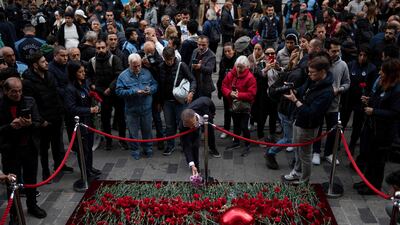
A mourner lays flowers on Istiklal Avenue in Turkey's capital Istanbul, where a bomb blast killed six people on Sunday. AFP -

A shrine has been created on the popular pedestrianised shopping street. AFP -
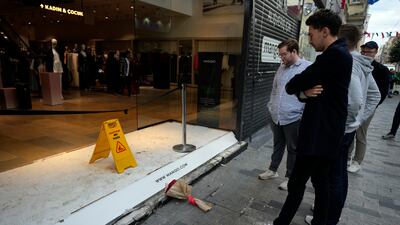
Mourners at the site where the bomb exploded. AP -
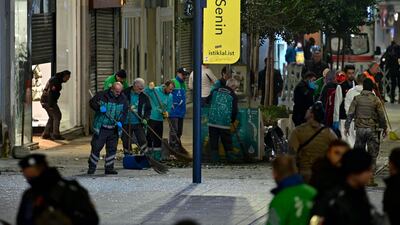
Municipal workers clear up after the blast. AFP -

Police officers block an entrance to Istiklal Avenue after Sunday's blast. AP -
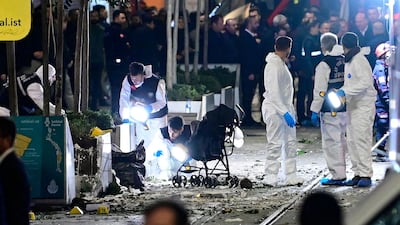
Forensics experts examine the bomb site. AFP -
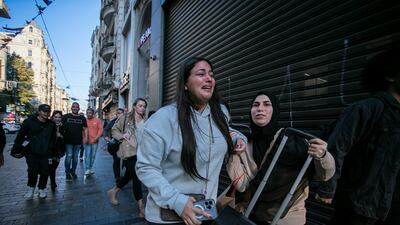
People leave the area after an explosion on Istanbul's popular pedestrian Istiklal Avenue Sunday. AP -
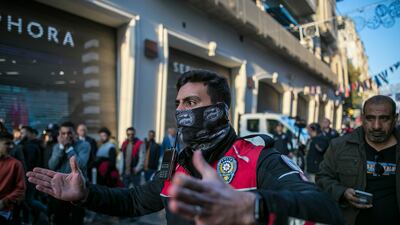
Security officers move crowds away from the scene of the explosion. AP -
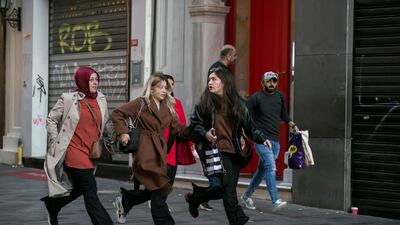
Shoppers run away from the busy shopping street. AP -
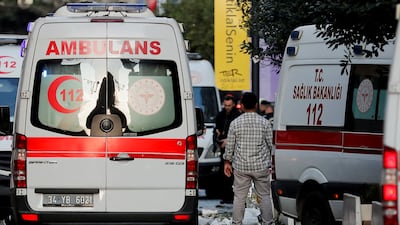
Ambulances and police at the scene of the explosion. Reuters -

Bodies of unidentified people lay on the ground after the blast. Reuters -

The Turkish Red Crescent has said blood has been sent to hospitals in the vicinity and there is currently no "urgent need" for donations. Reuters -
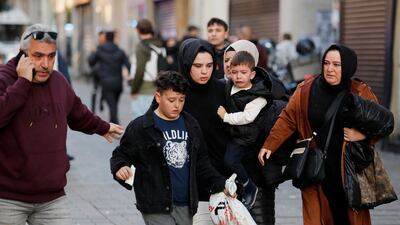
Video footage showed panicked residents fleeing after a loud bang was heard, with multiple people lying on the ground. Reuters -
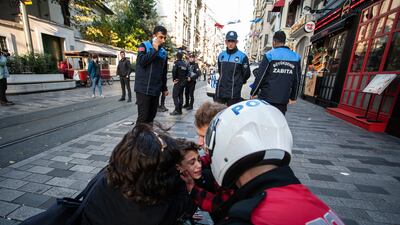
A boy is cared for after the explosion. Getty -
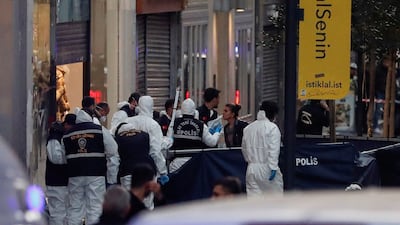
Police work at the scene after the explosion. Reuters -
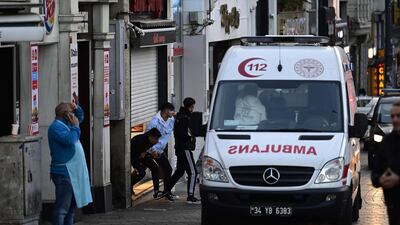
An ambulance passes people leaving a store. AFP -
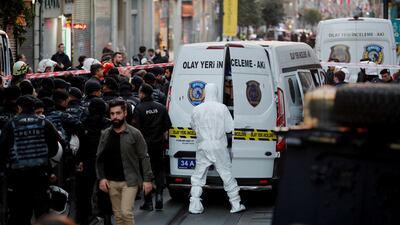
Forensic teams on the scene. Reuters -
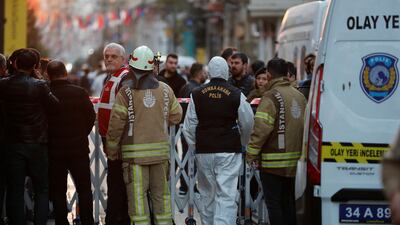
Police and emergency service members near where the blast happened. Reuters -
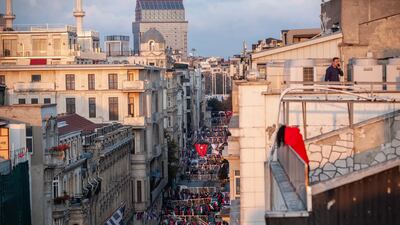
Istiklal is one of the busiest streets in Istanbul. Getty


On Saturday authorities made further arrests, including a few Moldovans, which would seem to point in another direction. Even so, early on Sunday Ankara launched fresh strikes on northern Syria, killing at least two YPG fighters. On Monday, the YPG appeared to retaliate, as Turkish outlets reported three civilians killed in strikes in the border province of Gaziantep.
Many also expect the government to move against the Kurdish-led HDP, with arrests or even a blanket ban, and Interior Minister Suleyman Soylu has vowed to reveal links between terror groups and the Imamoglu-run Istanbul municipality this week. However cynical all this might seem, it’s also politically astute. Amid rampant inflation and growing poverty, an election based on security issues, as in 2015, favours the governing coalition a great deal more than one centred on the economy.
The AKP will gain a further boost from its newly enhanced ability to control the flow of information. Immediately after the bombing, authorities blocked top social media platforms Twitter, Instagram, YouTube and Facebook for more than 10 hours. Along with a recently passed censorship law that makes just about any troubling statement a potentially jailable offence, the space for public discussion and debate has shrunk.
Add it all up and the outlook for the Istanbul Mayor, and perhaps the opposition more broadly, is dimmer than it’s been since his June 2019 electoral victory. Of course, this would all turn around in an instant if Mr Imamoglu is acquitted then named the opposition candidate.
For now that seems unlikely. A year ago, I detailed the many parallels between Mr Erdogan and Mr Imamoglu. We may soon add one more: banned from politics while serving as Istanbul Mayor and sent to prison. That would surely mark Mr Imamoglu’s political ship being lost at sea.
But in Mr Erdogan’s case, the conviction and four-month jail stint gave him the heroic air of a martyr, and three years after his release his new party came to power. Could lightning strike in prison again? In Turkish politics, anything is possible.

