


October is Black History Month in the UK; the US and Canada celebrate it in February. The occasion is a time to remember significant people and events in the history of Africa and its diaspora. The event can be a valuable catalyst, sparking or renewing year-round interest in history. After all, it is through telling and retelling our histories we come to know and value ourselves and each other.
As a child of African heritage attending school in Liverpool, UK, during the 1980s, I learned nothing about Black history or the broader story of Africa even though I learnt about the Roman empire, the Venerable Bede, the battle of Hastings, the Tudors and Stuarts. Africa, however, was a deafening silence, an untold story. Fortunately, my favourite teacher, Mr Gurnham, also taught me that learning is lifelong and can be pursued beyond the school walls.
My connection to Black history became an extracurricular activity, a topic of much independent study. Conveniently, I lived near a book shop, Source Books, that specialised in the history of Africa and its diaspora. The shelves were stocked with titles such as The African Origin of Civilisation: Myth or Reality by the Senegalese historian and anthropologist Cheikh Anta Diop. I also got my hands on the writings of Ivan van Sertima, professor of Africana Studies at Rutgers University. With fascination, I read many of Van Sertima's works: The Golden Age of the Moor, African Presence in Early Europe and Black Women in Antiquity.
Being immersed in these histories introduced me to impressive Africans, for example, Abul-Hasan Ali Ibn Nafi, also known as Ziryab, meaning blackbird. Ziryab was a celebrated polymath (chemist, linguist, astronomer, geographer, poet and master musician) at the 9th century Umayyad court of Abd ar-Rahman II in Cordoba. I was also introduced to the story of Mansa Musa, a contender for the wealthiest man in human history, and more contemporary notables such as El-Hajj Malik El-Shabazz (Malcolm X). Beyond individuals, my reading also awakened me to the historical and cultural significance of African Kingdoms such as Timbuktu (Mali) and Benin (Nigeria). I laugh now, but as a young child, I thought Timbuktu was an imaginary land like Narnia or Mordor.
History is vitally important. It goes way beyond the dry academics of knowing facts and dates. The repeated telling of our stories strengthens social identities and our sense of belonging to valued social groups. Such knowledge is deeply enriching. It keeps us well and helps us flourish.
In recent decades, psychologists have become increasingly aware of how critical social identities are for our health and well-being. For example, Alexander Haslam, a professor of psychology renowned for his work on social identity, writes: "Social identities — and the notions of 'us-ness' that they embody and help create—are central to health and well-being."
A rapidly growing body of research demonstrates how a deeper sense of belonging to a valued social group (national, ethnic, religious etc) leads to better health outcomes across a broad range of complainants, including depression, heart disease and stroke. The evidence supporting the "belonging effect" is now so strong that psychologists are currently discussing a "Social Cure". This is the idea that strengthening social identity accelerates recovery, promotes resilience and reduces rates of illness reoccurrence or relapse.
-
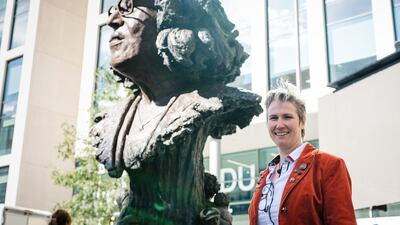
The statue of Betty Campbell MBE by sculptor Eve Sherpherd (seen in the picture) unveiled in Cardiff last year. Betty Campbell was Wales' first black headteacher and a community activist, championing multiculturalism. Nelson Mandela asked to meet her on his only visit to Wales. Throughout her teaching career, she encouraged pupils to learn about the positive contribution of people of colour to British life and helped create Black History Month. Getty -
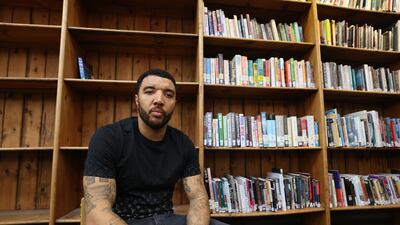
Footballer Troy Deeney, at Brixton Library in south London, in front of a book case, the book on the left hand side represents the extent of diverse history taught at Key stage 3 compared to the right section which forms part of the Brixton library's black history section. Deeney has launched a petition calling for the teaching of Black, Asian and Minority Ethnic histories and experiences to be made mandatory in the school curriculum, on February 23. -
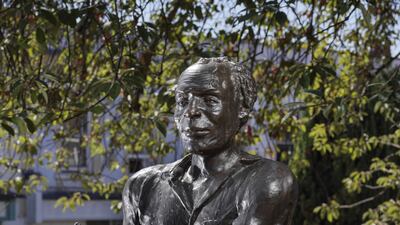
A statue of Black British playwright Alfred Fagon in Bristol, UK which is among the memorials that have been given Grade II-listed status during Black History Month. -
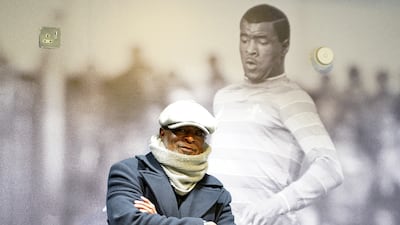
Chelsea's first Black player, Paul Canoville, in front of a photograph of his in his playing days, in London on November 28, 2021. -
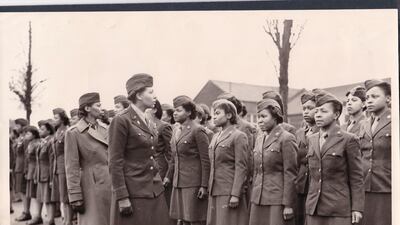
Members of the 6888th battalion stand in formation in Birmingham, England, in 1945. The Women's Army Corps battalion, which made history as the only all-female Black unit to serve in Europe during World War II. US Army Women's Museum via AP -
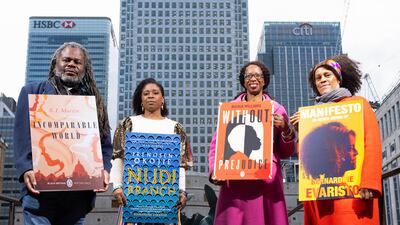
Authors Steven Ian Martin, Irenosen Okojie, Nicola Williams and Bernardine Evaristo mark Black History Month last October in London -
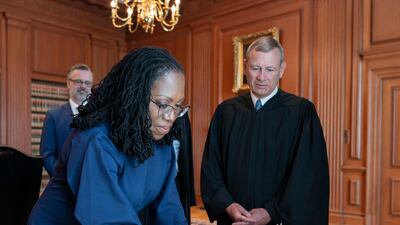
Justice Ketanji Brown Jackson signs the Oaths of Office in the Justices' Conference Room at the Supreme Court in Washington, DC, on June 30. The US made history this year as Ketanji Brown Jackson was sworn in as the first Black woman to serve on the Supreme Court. AFP -
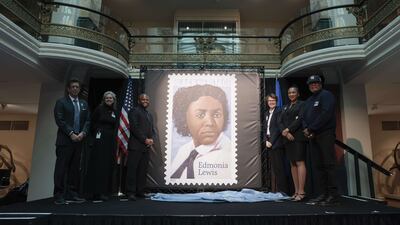
The unveiling of the a US Postal Service stamp featuring famous sculptor Edmonia Lewis at the Smithsonian American Art Museum on January 26 in Washington. The Edmonia Lewis Forever stamp is the 45th stamp in the Black Heritage series and honours Lewis, who was the first African American and Native American sculptor to earn international recognition. Getty / AFP -

L-R: Former Supreme Court Associate Justices Ruth Bader Ginsburg and Stephen Breyer, then Vice President Joe Biden, former first lady Michelle Obama, and former US President Barack Obama, listen to Regina Spektor perform at an event honouring Jewish American Heritage Month, in the White House, on May 27, 2010. When Breyer was retiring, President Joe Biden pledged to name the first Black woman to the high court. Justice Ketanji Brown Jackson was appointed this year. AP


The prevalence of mental health problems among Black people in the UK is higher than that of other groups. For example, the UK Government's 2017 Race Disparity Audit reported that Black women were the group most likely to have experienced a common mental health problem such as anxiety or depression. Similarly, Black men in the UK were the group most likely to have experienced a psychotic disorder – 10 times more likely than white men. Black people are also at least four times more likely to be detained under the mental health act (kept in hospital, whether they like it or not) than their white counterparts. Similar data exist for Black people in other European countries and the US.
Many social factors contribute to elevated mental health problems in the UK's Black communities. Leading contenders include elevated rates of deprivation (a lack of money, resources and access to life opportunities) and victimisation experiences (bullying, discriminatory harassment, social exclusion). These are issues that must be addressed across the board if we hope to reduce the rate of mental health problems. However, in addition to meaningful/ethical social change, strengthening social identities can also improve our mental health and resilience.
Black History Month can be a catalyst, launching individuals on lifelong voyages of historical discovery and rediscovery. History is storytelling, and storytelling is psychotherapeutic. With October being Black History Month and October 10 marked as World Mental Health Day, this is a time to remind people that it is worth reflecting on history's critical role in promoting and preserving psychological well-being of all people.

