Former British prime minister Clement Attlee addresses the first session of the UN General Assembly in the Methodist Central Hall, London, on January 10, 1946. Getty Images


Can the UN save itself by downsizing?


  • English
  • Arabic

September 11, 2022

A collective sigh of relief was almost palpable following a recent media briefing by the International Atomic Energy Agency (IAEA). It was not because its director general brought good news from the Zaporizhzhia nuclear plant on the frontline of the Russia-Ukraine war, but because trusted experts from the UN watchdog had verified what was going on and had given advice on how to avoid catastrophe.

Of course, that does not necessarily mean that the protagonists will listen. That is the UN’s central paradox and problem. In an interconnected world where our biggest challenges know no borders, the UN is our agreed forum to settle differences and enhance the collective good. But this depends on co-operation among sovereign states that are driven, above all, by national self-interests.

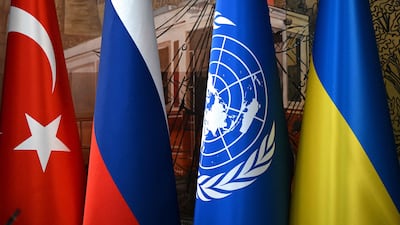
A few days earlier, a ship carrying 23,000 tonnes of wheat for the World Food Programme (WFP) docked in Djibouti. Although a drop in an ocean of what is needed, it is an important moment for 22 million food-stressed people in the Horn of Africa, not least because it raised hope of more shipments, thanks to a UN-brokered agreement that unblocked grain exports from Ukraine.

These examples illustrate the utility of the UN system. But the IAEA mission was only possible because two member states – Russia and Ukraine – agreed after other members pressured them. The resumption of grain exports happened only when African countries lobbied Moscow and Turkey took the lead in negotiations.

The UN facilitated these achievements, rather like a priest blessing a marriage that requires the consent of two people. It shows that the UN is only as effective as the sum of its parts.

When they pull together, the UN impacts our daily lives in myriad ways. We fly safely across national air spaces because of its International Civil Aviation Organisation. When our letters or money orders arrive in some distant part of the globe, thank the UN’s Universal Postal Union. When we use the phone or internet to connect anywhere, acknowledge the UN’s International Telecommunication Union.

Invented a new gadget that needs protection in multiple countries? Register with the World Intellectual Property Organisation. Seeking dignified livelihoods through decent work? Engage with the International Labour Organisation, the only global body that gives equal voice to governments, employers and workers. Concerned with restoring stressed ecosystems? Get inspired by the UN Environment Programme.

When they pull together, the UN impacts our daily lives in myriad ways

Setting norms and standards and establishing best practices is the UN’s most vital global service as it would be tedious and costly for every nation – especially the smaller and poorer ones – to do this.

The UN is also at the forefront of raising humanity’s aspirations. The Universal Declaration of Human Rights, adopted by the UN General Assembly in 1948, is available now in 360 languages. It is the world’s most translated document. It is a yardstick to assess right and wrong and provides enduring hope and inspiration, even if we don’t live up to its powerful exhortations.

More recently, the Sustainable Development Goals, unanimously adopted by the UN in 2015, is a stirring call to eliminate poverty and protect the planet that needs the orchestration of massive resources; fortunately, we have the World Bank to do that. This is self-evidently good, even if the world is hopelessly lagging in delivering on the 2030 targets.

It is easy to scoff at the UN’s idealism, but it provides the framework for national development strategies. These efforts are trusted and respected because they are inclusive. They draw on worldwide knowledge and expertise to help all countries without threatening any of them. A good illustration is the success against the once-lethal HI, thanks to UNAIDS and the Global Fund to Fight Aids.

However, when the common good collides with national self-interest, the UN finds itself in the hot seat attempting to facilitate agreement while ensuring that compromises do not stray too far from the norms that it must uphold.

Inevitably, no one emerges unbruised from trying to square such contradictions. The efficacy of Cop26, for example, is being questioned by recent disaster victims in Pakistan, who are awaiting long-promised climate mitigation funds. The UN is blamed for non-delivery although it can’t create money and still relies on wealthier countries to provide it.

The Covid-19 response provides further illustration. Some blame the World Health Organisation for the huge social and economic costs of lockdowns, although its advice was much more nuanced than what some nations practised. The UN’s Global Vaccine Alliance also gets the blame for gross inequities in the sharing of life-saving vaccines, although it is producer nations that hoarded supplies. Meanwhile, arguments over intellectual property rage at the World Trade Organisation to allow patent waivers and expand manufacturing of life saving therapeutics, thereby saving more lives.

That the UN is destined to dwell permanently between a rock and a hard place is exemplified by its Office of the High Commissioner for Human Rights. Did the previous high commissioner refuse to extend her tenure because she was worn down by abuse and blame as human rights declined and human wrongs multiplied? She can hardly be blamed that her time in office coincided with an increase in authoritarianism around the world.

A displaced Yemeni carries a relief box donated by Unicef at a camp on the outskirts of Sanaa in June. EPA

The UN attracts even greater criticism for not realising its core mission on peace and security, the raison d’etre for its foundation in 1945 after the Second World War. Nearly eight decades later, the world is deadlier than it has ever been since, with two billion – a quarter of humanity – living alongside conflict. And yet, it has nearly 100,000 peacekeepers and dozens of peace envoys around the world. But how can the UN be effective if its supreme body, the Security Council, is paralysed due to seemingly unbridgeable difference between its most powerful, permanent members.

To some extent, UN agencies must shoulder blame for getting lulled by their own noble-sounding rhetoric and over-selling themselves to mobilise resources in a competitive world. The UN’s humanitarian system – including household names such as Unicef and the WFP – provides a salutary tale of constant endeavour falling short. That is because they have no influence over the causes behind accelerating humanitarian needs, even as they peddle inadequate solutions, however well-intentioned.

Meanwhile instances of corruption, fraud, misconduct and mismanagement are now being identified frequently among its agencies and programmes. This is a consequence of the UN’s outdated governance and accountability safeguards and a sense of impunity that comes out of historically granted privileges and immunities.

This undermines trust at a time when the world needs multilateralism critically. However, prospects for reform of the UN’s political arrangements, especially Security Council, are non-existent, and improvements in its oversight and control mechanisms will take a long time.

The UN has achieved much but is it now too big to succeed? While it remains indispensable in several areas, must it still do all that it is doing? After all, the world has evolved many additional capabilities over past decades. That should allow the UN to retire honourably out of certain endeavours.

It does not mean that the UN should retreat. On the contrary, it must advance to higher ground through developing the ideas and aspirations needed in our age of crisis and uncertainty. In the same way that it inspired us to repair the broken world of the 1940s. To do so, the friends of the UN must help to de-clutter its muddled mind and clear out its overflowing cupboard.


Profile box

Founders: Michele Ferrario, Nino Ulsamer and Freddy Lim
Started: established in 2016 and launched in July 2017
Based: Singapore, with offices in the UAE, Malaysia, Hong Kong, Thailand
Sector: FinTech, wealth management
Initial investment: $500,000 in seed round 1 in 2016; $2.2m in seed round 2 in 2017; $5m in series A round in 2018; $12m in series B round in 2019; $16m in series C round in 2020 and $25m in series D round in 2021
Current staff: more than 160 employees
Stage: series D 
Investors: EightRoads Ventures, Square Peg Capital, Sequoia Capital India

Timeline

2012-2015

The company offers payments/bribes to win key contracts in the Middle East

May 2017

The UK SFO officially opens investigation into Petrofac’s use of agents, corruption, and potential bribery to secure contracts

September 2021

Petrofac pleads guilty to seven counts of failing to prevent bribery under the UK Bribery Act

October 2021

Court fines Petrofac £77 million for bribery. Former executive receives a two-year suspended sentence 

December 2024

Petrofac enters into comprehensive restructuring to strengthen the financial position of the group

May 2025

The High Court of England and Wales approves the company’s restructuring plan

July 2025

The Court of Appeal issues a judgment challenging parts of the restructuring plan

August 2025

Petrofac issues a business update to execute the restructuring and confirms it will appeal the Court of Appeal decision

October 2025

Petrofac loses a major TenneT offshore wind contract worth €13 billion. Holding company files for administration in the UK. Petrofac delisted from the London Stock Exchange

November 2025

180 Petrofac employees laid off in the UAE

Syria squad

Goalkeepers: Ibrahim Alma, Mahmoud Al Youssef, Ahmad Madania.
Defenders: Ahmad Al Salih, Moayad Ajan, Jehad Al Baour, Omar Midani, Amro Jenyat, Hussein Jwayed, Nadim Sabagh, Abdul Malek Anezan.
Midfielders: Mahmoud Al Mawas, Mohammed Osman, Osama Omari, Tamer Haj Mohamad, Ahmad Ashkar, Youssef Kalfa, Zaher Midani, Khaled Al Mobayed, Fahd Youssef.
Forwards: Omar Khribin, Omar Al Somah, Mardik Mardikian.

Abu Dhabi racecard

5pm: Maiden (Purebred Arabians); Dh80,000; 1,400m.
5.30pm: Maiden (PA); Dh80,00; 1,400m.
6pm: Sheikh Zayed bin Sultan Al Nahyan National Day Cup (PA); Group 3; Dh500,000; 1,600m.
6.30pm: Sheikh Zayed bin Sultan Al Nahyan National Day Cup (Thoroughbred); Listed; Dh380,000; 1,600m
7pm: Wathba Stallions Cup for Private Owners Handicap (PA); Dh70,000; 1,400m.
7.30pm: Handicap (PA); Dh80,000; 1,600m

Conservative MPs who have publicly revealed sending letters of no confidence
  1. Steve Baker
  2. Peter Bone
  3. Ben Bradley
  4. Andrew Bridgen
  5. Maria Caulfield​​​​​​​
  6. Simon Clarke 
  7. Philip Davies
  8. Nadine Dorries​​​​​​​
  9. James Duddridge​​​​​​​
  10. Mark Francois 
  11. Chris Green
  12. Adam Holloway
  13. Andrea Jenkyns
  14. Anne-Marie Morris
  15. Sheryll Murray
  16. Jacob Rees-Mogg
  17. Laurence Robertson
  18. Lee Rowley
  19. Henry Smith
  20. Martin Vickers 
  21. John Whittingdale
UK’s AI plan
  • AI ambassadors such as MIT economist Simon Johnson, Monzo cofounder Tom Blomfield and Google DeepMind’s Raia Hadsell
  • £10bn AI growth zone in South Wales to create 5,000 jobs
  • £100m of government support for startups building AI hardware products
  • £250m to train new AI models
Email sent to Uber team from chief executive Dara Khosrowshahi

From: Dara

To: Team@

Date: March 25, 2019 at 11:45pm PT

Subj: Accelerating in the Middle East

Five years ago, Uber launched in the Middle East. It was the start of an incredible journey, with millions of riders and drivers finding new ways to move and work in a dynamic region that’s become so important to Uber. Now Pakistan is one of our fastest-growing markets in the world, women are driving with Uber across Saudi Arabia, and we chose Cairo to launch our first Uber Bus product late last year.

Today we are taking the next step in this journey—well, it’s more like a leap, and a big one: in a few minutes, we’ll announce that we’ve agreed to acquire Careem. Importantly, we intend to operate Careem independently, under the leadership of co-founder and current CEO Mudassir Sheikha. I’ve gotten to know both co-founders, Mudassir and Magnus Olsson, and what they have built is truly extraordinary. They are first-class entrepreneurs who share our platform vision and, like us, have launched a wide range of products—from digital payments to food delivery—to serve consumers.

I expect many of you will ask how we arrived at this structure, meaning allowing Careem to maintain an independent brand and operate separately. After careful consideration, we decided that this framework has the advantage of letting us build new products and try new ideas across not one, but two, strong brands, with strong operators within each. Over time, by integrating parts of our networks, we can operate more efficiently, achieve even lower wait times, expand new products like high-capacity vehicles and payments, and quicken the already remarkable pace of innovation in the region.

This acquisition is subject to regulatory approval in various countries, which we don’t expect before Q1 2020. Until then, nothing changes. And since both companies will continue to largely operate separately after the acquisition, very little will change in either teams’ day-to-day operations post-close. Today’s news is a testament to the incredible business our team has worked so hard to build.

It’s a great day for the Middle East, for the region’s thriving tech sector, for Careem, and for Uber.

Uber on,

Dara

THE POPE'S ITINERARY

Sunday, February 3, 2019 - Rome to Abu Dhabi
1pm: departure by plane from Rome / Fiumicino to Abu Dhabi
10pm: arrival at Abu Dhabi Presidential Airport


Monday, February 4
12pm: welcome ceremony at the main entrance of the Presidential Palace
12.20pm: visit Abu Dhabi Crown Prince at Presidential Palace
5pm: private meeting with Muslim Council of Elders at Sheikh Zayed Grand Mosque
6.10pm: Inter-religious in the Founder's Memorial


Tuesday, February 5 - Abu Dhabi to Rome
9.15am: private visit to undisclosed cathedral
10.30am: public mass at Zayed Sports City – with a homily by Pope Francis
12.40pm: farewell at Abu Dhabi Presidential Airport
1pm: departure by plane to Rome
5pm: arrival at the Rome / Ciampino International Airport

if you go

The flights 

Etihad and Emirates fly direct to Kolkata from Dh1,504 and Dh1,450 return including taxes, respectively. The flight takes four hours 30 minutes outbound and 5 hours 30 minute returning. 

The trains

Numerous trains link Kolkata and Murshidabad but the daily early morning Hazarduari Express (3’ 52”) is the fastest and most convenient; this service also stops in Plassey. The return train departs Murshidabad late afternoon. Though just about feasible as a day trip, staying overnight is recommended.

The hotels

Mursidabad’s hotels are less than modest but Berhampore, 11km south, offers more accommodation and facilities (and the Hazarduari Express also pauses here). Try Hotel The Fame, with an array of rooms from doubles at Rs1,596/Dh90 to a ‘grand presidential suite’ at Rs7,854/Dh443.

Takreem Awards winners 2021

Corporate Leadership: Carl Bistany (Lebanon)

Cultural Excellence: Hoor Al Qasimi (UAE)

Environmental Development and Sustainability: Bkerzay (Lebanon)

Environmental Development and Sustainability: Raya Ani (Iraq)

Humanitarian and Civic Services: Women’s Programs Association (Lebanon)

Humanitarian and Civic Services: Osamah Al Thini (Libya)

Excellence in Education: World Innovation Summit for Education (WISE) (Qatar)

Outstanding Arab Woman: Balghis Badri (Sudan)

Scientific and Technological Achievement: Mohamed Slim Alouini (KSA)

Young Entrepreneur: Omar Itani (Lebanon)

Lifetime Achievement: Suad Al Amiry (Palestine)

Banned items
Dubai Police has also issued a list of banned items at the ground on Sunday. These include:
  • Drones
  • Animals
  • Fireworks/ flares
  • Radios or power banks
  • Laser pointers
  • Glass
  • Selfie sticks/ umbrellas
  • Sharp objects
  • Political flags or banners
  • Bikes, skateboards or scooters
Generational responses to the pandemic

Devesh Mamtani from Century Financial believes the cash-hoarding tendency of each generation is influenced by what stage of the employment cycle they are in. He offers the following insights:

Baby boomers (those born before 1964): Owing to market uncertainty and the need to survive amid competition, many in this generation are looking for options to hoard more cash and increase their overall savings/investments towards risk-free assets.

Generation X (born between 1965 and 1980): Gen X is currently in its prime working years. With their personal and family finances taking a hit, Generation X is looking at multiple options, including taking out short-term loan facilities with competitive interest rates instead of dipping into their savings account.

Millennials (born between 1981 and 1996): This market situation is giving them a valuable lesson about investing early. Many millennials who had previously not saved or invested are looking to start doing so now.

Mercer, the investment consulting arm of US services company Marsh & McLennan, expects its wealth division to at least double its assets under management (AUM) in the Middle East as wealth in the region continues to grow despite economic headwinds, a company official said.

Mercer Wealth, which globally has $160 billion in AUM, plans to boost its AUM in the region to $2-$3bn in the next 2-3 years from the present $1bn, said Yasir AbuShaban, a Dubai-based principal with Mercer Wealth.

Within the next two to three years, we are looking at reaching $2 to $3 billion as a conservative estimate and we do see an opportunity to do so,” said Mr AbuShaban.

Mercer does not directly make investments, but allocates clients’ money they have discretion to, to professional asset managers. They also provide advice to clients.

“We have buying power. We can negotiate on their (client’s) behalf with asset managers to provide them lower fees than they otherwise would have to get on their own,” he added.

Mercer Wealth’s clients include sovereign wealth funds, family offices, and insurance companies among others.

From its office in Dubai, Mercer also looks after Africa, India and Turkey, where they also see opportunity for growth.

Wealth creation in Middle East and Africa (MEA) grew 8.5 per cent to $8.1 trillion last year from $7.5tn in 2015, higher than last year’s global average of 6 per cent and the second-highest growth in a region after Asia-Pacific which grew 9.9 per cent, according to consultancy Boston Consulting Group (BCG). In the region, where wealth grew just 1.9 per cent in 2015 compared with 2014, a pickup in oil prices has helped in wealth generation.

BCG is forecasting MEA wealth will rise to $12tn by 2021, growing at an annual average of 8 per cent.

Drivers of wealth generation in the region will be split evenly between new wealth creation and growth of performance of existing assets, according to BCG.

Another general trend in the region is clients’ looking for a comprehensive approach to investing, according to Mr AbuShaban.

“Institutional investors or some of the families are seeing a slowdown in the available capital they have to invest and in that sense they are looking at optimizing the way they manage their portfolios and making sure they are not investing haphazardly and different parts of their investment are working together,” said Mr AbuShaban.

Some clients also have a higher appetite for risk, given the low interest-rate environment that does not provide enough yield for some institutional investors. These clients are keen to invest in illiquid assets, such as private equity and infrastructure.

“What we have seen is a desire for higher returns in what has been a low-return environment specifically in various fixed income or bonds,” he said.

“In this environment, we have seen a de facto increase in the risk that clients are taking in things like illiquid investments, private equity investments, infrastructure and private debt, those kind of investments were higher illiquidity results in incrementally higher returns.”

The Abu Dhabi Investment Authority, one of the largest sovereign wealth funds, said in its 2016 report that has gradually increased its exposure in direct private equity and private credit transactions, mainly in Asian markets and especially in China and India. The authority’s private equity department focused on structured equities owing to “their defensive characteristics.”

The specs

Engine: 3.8-litre twin-turbo flat-six

Power: 650hp at 6,750rpm

Torque: 800Nm from 2,500-4,000rpm

Transmission: 8-speed dual-clutch auto

Fuel consumption: 11.12L/100km

Price: From Dh796,600

On sale: now

Russia's Muslim Heartlands

Dominic Rubin, Oxford

The specs

Engine: 4.0-litre, six-cylinder

Transmission: six-speed manual

Power: 395bhp

Torque: 420Nm

Price: from Dh321,200

On sale: now

Updated: September 27, 2022, 10:35 AM