The US Capitol is seen past the US Marine Corps War Memorial in Arlington, Virginia, on May 29. AFP


What it means to lead in a multipolar world


Marc Le Menestrel
Horacio Falcão
  • English
  • Arabic

June 19, 2022

Until not too long ago, those of us who subscribed to a dominant western narrative lived in the illusion of a unipolar world. We wanted to believe that we had arrived at the “end of history” where, with just a bit more time and innovation, we would enjoy peace and prosperity forever. War, terrorism, discrimination, autocracy, nationalism, intolerance as well as other forms of social, economic and political divide were the unfortunate legacies of an undesirable past, a small bump on our road towards global enlightenment.

As a result of such thinking, we may have become self-righteous and closed our minds. Many of us believed that the world was moving towards a single objective, as if history was pre-ordained. We trusted that our mission was so holy that any detractor would eventually see the light. Even as we embraced volatility, uncertainty, complexity and ambiguity (Vuca), it was mostly applied to short-term challenges framed within a single and stable narrative that, while not linear, was based on inviolable rules of right and wrong.

And yet, for a couple of decades now, we have seen the emergence of those who challenge that narrative. After all, narratives are often self-serving; they shape our thinking in ways that benefit us more than others.

In a not-so-subtle way, we resurrected the distinction between civilised and “savage” people rampant in the 18th and 19th centuries. Those who were not yet like us, we reckoned, would eventually be edified and assimilated, or weeded out by evolutionary imperatives that we had mastered.

From our vantage point, the international world order was stable, the EU project would only move forward, China would eventually become a liberal democracy and accept the leadership of the US. We had little doubt that terrorism and religious extremism would be eradicated once the superiority of secular democratic principles was recognised. Russia would eventually accept a much reduced international role as a commodity provider. And should a pandemic break out, our unified world would quickly co-ordinate to defeat it.

Former Chinese President Jiang Zemin addresses delegates following the raising of the Chinese and Hong Kong SAR flags on July 1, 1997, as Hong Kong returns to China after more than 156 years under British rule. AFP
In a multipolar world, respect and tolerance are a prerequisite

We were also confident that hunger and poverty would end within a couple of decades. Political consensus and scientific innovation would save us from global warming. Big internet giants could remain completely unregulated as they had vowed to do no evil. The list goes on.

Then the surprises started to emerge.

Britain said no to the EU. People began to turn their back on globalisation. Covid-19 shows how we still stick to our flags before reaching out to others, and how quickly we distrust science and democracy. Big Tech became the latest exhibit of the constant trade-off between unrestrained corporate profit-seeking and social priorities.

Military budgets everywhere are growing. Millions of refugees are denied refuge in other countries. The US exit from Afghanistan shows that years of fighting and investment are no panacea for extremism, nor are they a shortcut to democracy. France is arguing that it needs to become energy-independent and that French industries should move their overseas facilities home to boost the country’s resilience to supply chain shocks and bolster its independence in international disputes. Most recently Russia, as we all know, started its “special operation” in Ukraine.

How did those of us who sign up to this western narrative fail to anticipate this?

For one thing, we just did not want to see it. Maybe we were afraid that our narrative was wrong or not the only good option. Because we have a comfortable life and do not want to risk it. Because we do not want to sacrifice money today for money tomorrow.

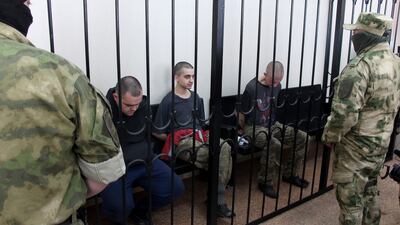
  • British citizens Aiden Aslin, left, and Shaun Pinner, right, and Moroccan Saaudun Brahim, centre, sit behind bars in a courtroom in the breakaway eastern Ukrainian enclave of Donetsk. The three were sentenced to death by pro-Moscow rebels for fighting on Ukraine's side. AP
    British citizens Aiden Aslin, left, and Shaun Pinner, right, and Moroccan Saaudun Brahim, centre, sit behind bars in a courtroom in the breakaway eastern Ukrainian enclave of Donetsk. The three were sentenced to death by pro-Moscow rebels for fighting on Ukraine's side. AP
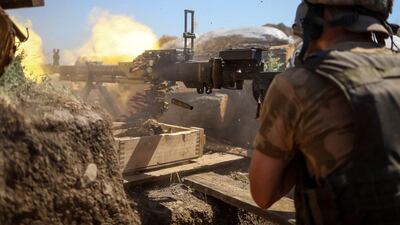
  • A Ukrainian soldier fires a machine gun near the town of New York in the breakaway Donetsk enclave. Reuters
    A Ukrainian soldier fires a machine gun near the town of New York in the breakaway Donetsk enclave. Reuters
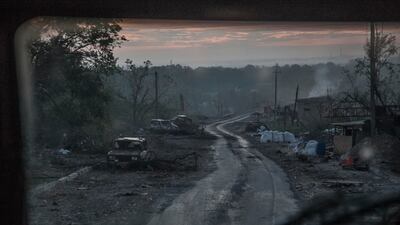
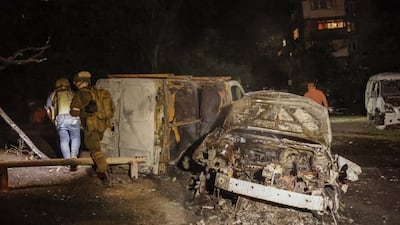
  • The gutted remains of cars lie along a road during heavy fighting in Severodonetsk. AP
    The gutted remains of cars lie along a road during heavy fighting in Severodonetsk. AP
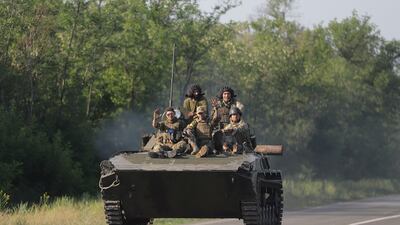
  • Ukrainian soldiers ride an armoured vehicle near the city of Bakhmut, in the breakaway Donetsk enclave. EPA
    Ukrainian soldiers ride an armoured vehicle near the city of Bakhmut, in the breakaway Donetsk enclave. EPA
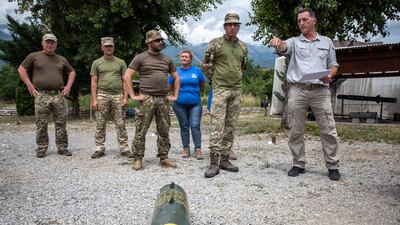
  • Ukrainian soldiers and members of civilian demining organisations take part in a training exercise for bomb disposal experts in Peja, Kosovo. Getty
    Ukrainian soldiers and members of civilian demining organisations take part in a training exercise for bomb disposal experts in Peja, Kosovo. Getty
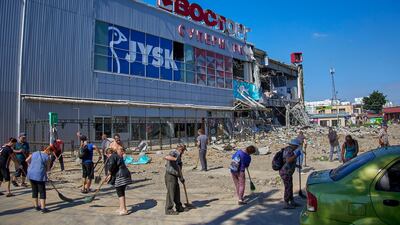
  • Volunteers clear debris near a damaged shopping mall after night shelling in Kharkiv, Ukraine. EPA
    Volunteers clear debris near a damaged shopping mall after night shelling in Kharkiv, Ukraine. EPA
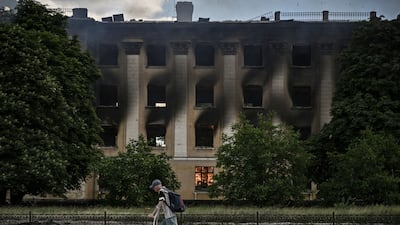
  • A man walks past a college on fire after a strike in Lysychansk in the eastern Ukrainian region of Donbas. AFP
    A man walks past a college on fire after a strike in Lysychansk in the eastern Ukrainian region of Donbas. AFP
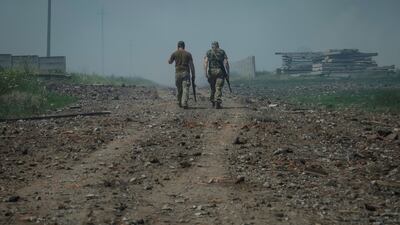
  • Ukrainian service members near the town of Soledar. Reuters
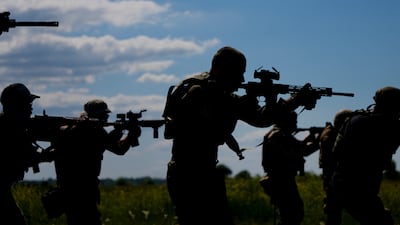
    Ukrainian service members near the town of Soledar. Reuters
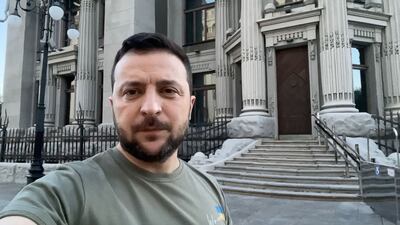
  • Ukrainian President Volodymyr Zelenskyy in Kyiv. AFP
    Ukrainian President Volodymyr Zelenskyy in Kyiv. AFP
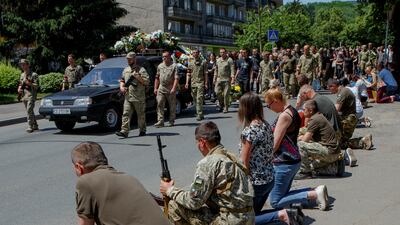
  • Residents kneel during a funeral procession for senior lieutenant Vasyl Herych, 31, of the 15th Separate Mountain Assault Battalion, who was killed in Perechyn, Ukraine. Reuters
    Residents kneel during a funeral procession for senior lieutenant Vasyl Herych, 31, of the 15th Separate Mountain Assault Battalion, who was killed in Perechyn, Ukraine. Reuters
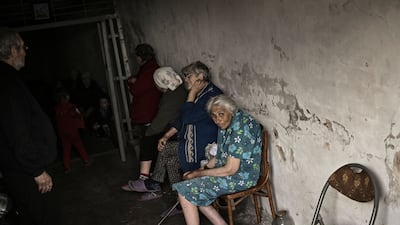
  • People hide in a bomb shelter in the city of Lysychansk in the Donbas region. AFP
    People hide in a bomb shelter in the city of Lysychansk in the Donbas region. AFP
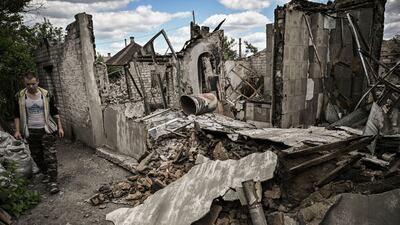
  • Ivan Sosnin, 19, surveys the damage to his home in Lysychansk. AFP
    Ivan Sosnin, 19, surveys the damage to his home in Lysychansk. AFP
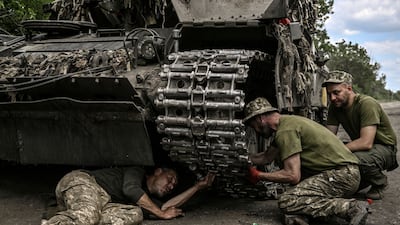
  • Ukrainian troops repair a tank in the Donbas region. AFP
    Ukrainian troops repair a tank in the Donbas region. AFP
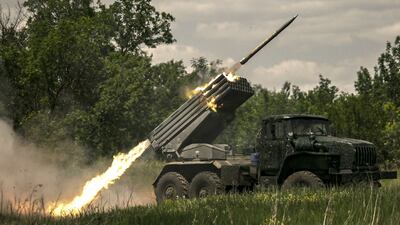
  • Ukrainian troops fire rockets towards Russian positions at a front line in the Donbas region. AFP
    Ukrainian troops fire rockets towards Russian positions at a front line in the Donbas region. AFP
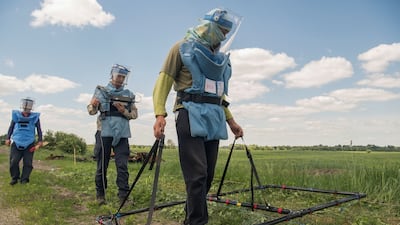
  • Volunteers from a Danish NGO demonstrate how to search for explosive devices with help of a loop metal detector, outside the town of Ichnia in Ukraine. Reuters
    Volunteers from a Danish NGO demonstrate how to search for explosive devices with help of a loop metal detector, outside the town of Ichnia in Ukraine. Reuters
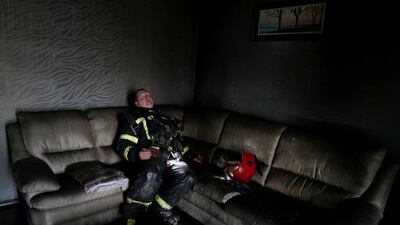
  • A firefighter takes a break after putting out a fire at a house in a district of Kharkiv that was bombed by Russian forces. Reuters
    A firefighter takes a break after putting out a fire at a house in a district of Kharkiv that was bombed by Russian forces. Reuters
  • Plumes of smoke rise from a house on fire after a military strike by Russian forces in Kharkiv. Reuters
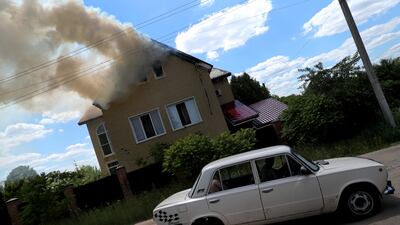
    Plumes of smoke rise from a house on fire after a military strike by Russian forces in Kharkiv. Reuters
  • The damaged house of Inna Bobryntseva, a woman who died during Russian shelling, in Kharkiv. Ukrainian officials exhumed her body from her backyard as part of an investigation into war crimes. Reuters
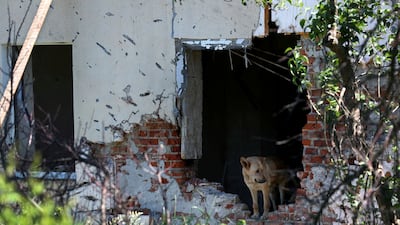
    The damaged house of Inna Bobryntseva, a woman who died during Russian shelling, in Kharkiv. Ukrainian officials exhumed her body from her backyard as part of an investigation into war crimes. Reuters
  • A man moves items from a damaged shop in Kharkiv after a Russian military strike the night before. Reuters
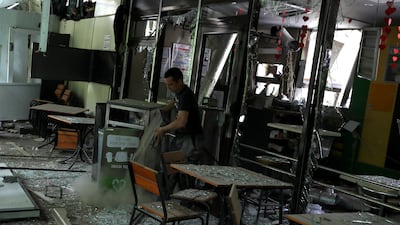
    A man moves items from a damaged shop in Kharkiv after a Russian military strike the night before. Reuters
  • Civilian militia men hold shotguns during training at a shooting range on the outskirts of Kyiv, Ukraine. AFP
    Civilian militia men hold shotguns during training at a shooting range on the outskirts of Kyiv, Ukraine. AFP
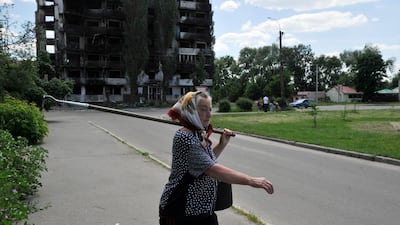
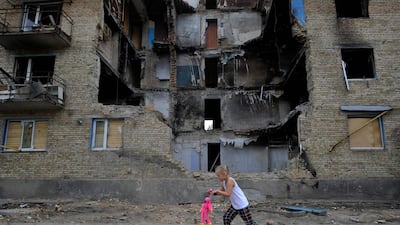
  • A woman walks by a destroyed apartment building in the town of Borodyanka. AFP
    A woman walks by a destroyed apartment building in the town of Borodyanka. AFP
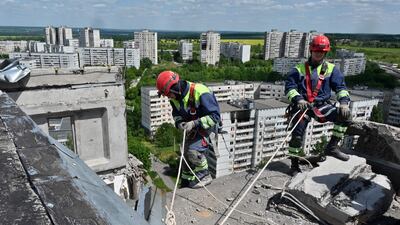
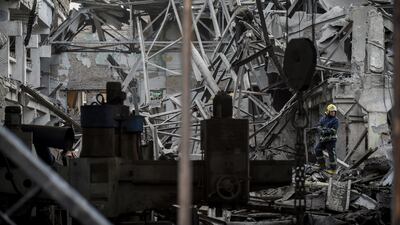
  • Rescuers dismantle collapsing structures of a heavily damaged 16-storey residential building in the Saltivka district of Kharkiv. AFP
    Rescuers dismantle collapsing structures of a heavily damaged 16-storey residential building in the Saltivka district of Kharkiv. AFP
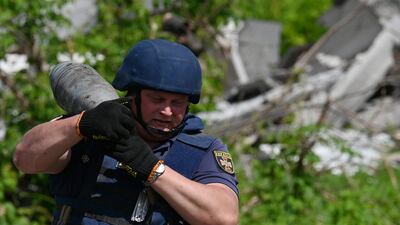
  • A Ukrainian bomb disposal worker carries unexploded ordnance during mine clearance work in the village of Yahidne, in the liberated territories of the Chernihiv region. AFP
    A Ukrainian bomb disposal worker carries unexploded ordnance during mine clearance work in the village of Yahidne, in the liberated territories of the Chernihiv region. AFP
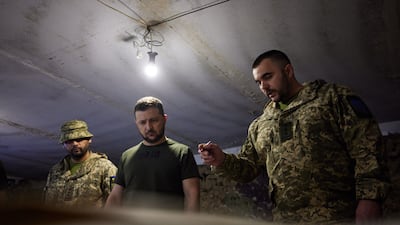
  • Ukrainian President Volodymyr Zelenskyy, centre, visits the military during a trip to the Zaporizhzhia region. AFP
    Ukrainian President Volodymyr Zelenskyy, centre, visits the military during a trip to the Zaporizhzhia region. AFP
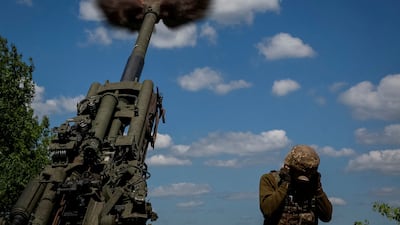
  • Ukrainian service members fire a shell from a M777 Howitzer in the Donetsk region as Russia's attack on Ukraine continues. Reuters
    Ukrainian service members fire a shell from a M777 Howitzer in the Donetsk region as Russia's attack on Ukraine continues. Reuters
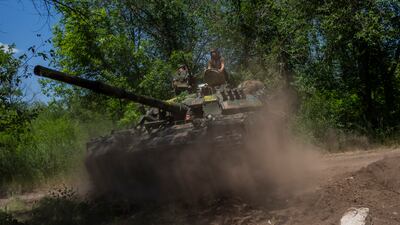
  • Ukrainian servicemen manoeuvre a tank near the frontline in the Donetsk region. AP Photo
    Ukrainian servicemen manoeuvre a tank near the frontline in the Donetsk region. AP Photo
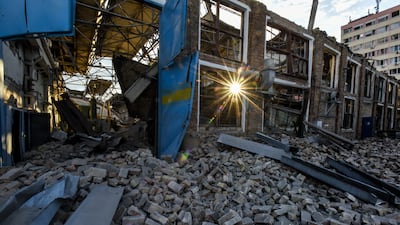
  • The remains of the Darnytsia Car Repair Plant damaged by missile strikes in Kyiv. EPA
    The remains of the Darnytsia Car Repair Plant damaged by missile strikes in Kyiv. EPA
  • A couple embrace on Maidan square in Kyiv. AP Photo
    A couple embrace on Maidan square in Kyiv. AP Photo
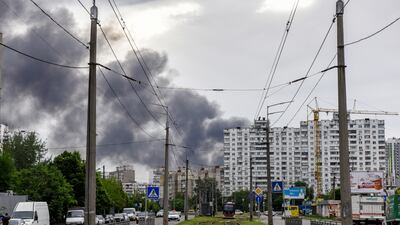
  • Smoke rises from a residential area in Kyiv. Mayor Vitali Klitschko said several explosions occurred following missile strikes in the Darnytskyi and Dniprovskyi districts of the capital with no casualties reported. EPA
    Smoke rises from a residential area in Kyiv. Mayor Vitali Klitschko said several explosions occurred following missile strikes in the Darnytskyi and Dniprovskyi districts of the capital with no casualties reported. EPA
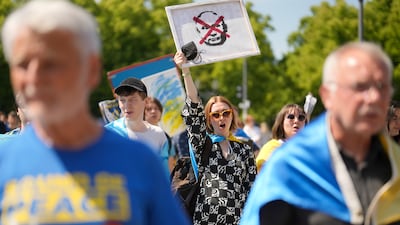
  • A woman holds a poster showing Russian President Vladimir Putin during a protest against the war in Ukraine at the Brandenburg Gate in Berlin. AP
    A woman holds a poster showing Russian President Vladimir Putin during a protest against the war in Ukraine at the Brandenburg Gate in Berlin. AP
  • Smoke rises in the background after Russian missile strikes in Kyiv. AP
    Smoke rises in the background after Russian missile strikes in Kyiv. AP
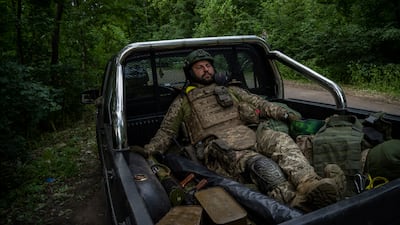
  • A Ukrainian serviceman pauses before going back to the frontline in the Donetsk region of eastern Ukraine. AP
    A Ukrainian serviceman pauses before going back to the frontline in the Donetsk region of eastern Ukraine. AP
  • Firefighters dampen down a rail facility in the Darnytsia district of Kyiv after a Russian air strike. EPA
    Firefighters dampen down a rail facility in the Darnytsia district of Kyiv after a Russian air strike. EPA
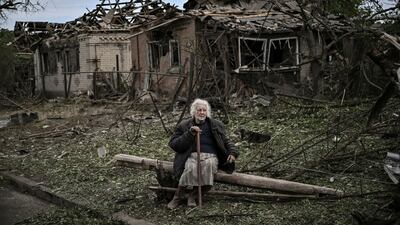
  • An elderly woman sits in front of destroyed houses after a missile strike, which killed a civilian, in the city of Druzhkivka in the eastern Ukrainian region of Donbas. AFP
    An elderly woman sits in front of destroyed houses after a missile strike, which killed a civilian, in the city of Druzhkivka in the eastern Ukrainian region of Donbas. AFP
  • A man examines an apartment destroyed during shelling in Donetsk, eastern Ukraine. Five civilians were killed and 20 were injured. EPA
    A man examines an apartment destroyed during shelling in Donetsk, eastern Ukraine. Five civilians were killed and 20 were injured. EPA
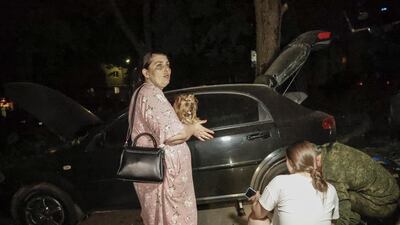
  • Residents examine cars destroyed during shelling in Donetsk. EPA
    Residents examine cars destroyed during shelling in Donetsk. EPA
  • Civilians are evacuated from apartments destroyed during shelling in Donetsk. EPA
    Civilians are evacuated from apartments destroyed during shelling in Donetsk. EPA
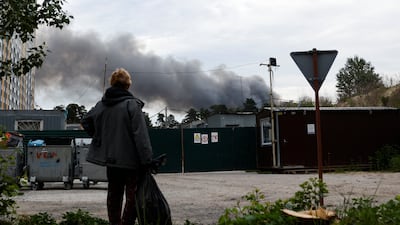
  • A man looks on as smoke rises after explosions were heard in Kyiv. Reuters
    A man looks on as smoke rises after explosions were heard in Kyiv. Reuters
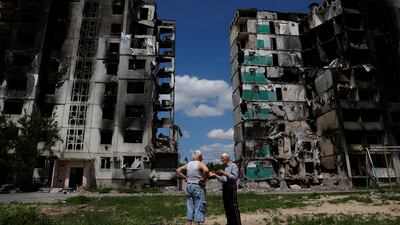
  • Residents chat in front of a destroyed building in Borodianka, as Russia's attacks on Ukraine continue. Reuters
    Residents chat in front of a destroyed building in Borodianka, as Russia's attacks on Ukraine continue. Reuters
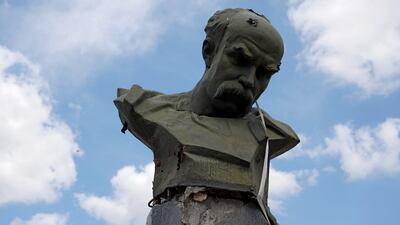
  • A monument to Ukrainian poet Taras Shevchenko, damaged by shelling in Borodianka. Reuters
    A monument to Ukrainian poet Taras Shevchenko, damaged by shelling in Borodianka. Reuters
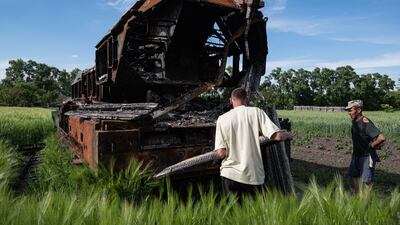
  • Men scavenge a burnt Russian military vehicle for parts and scrap metal in Novyi Bykiv. Getty
    Men scavenge a burnt Russian military vehicle for parts and scrap metal in Novyi Bykiv. Getty
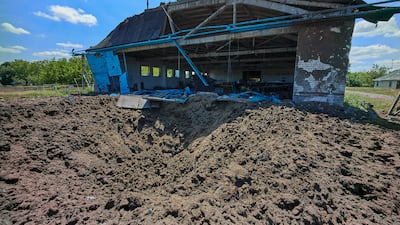
  • A crater and a destroyed building after a rocket attack on a small airfield near Kharkiv. EPA
    A crater and a destroyed building after a rocket attack on a small airfield near Kharkiv. EPA
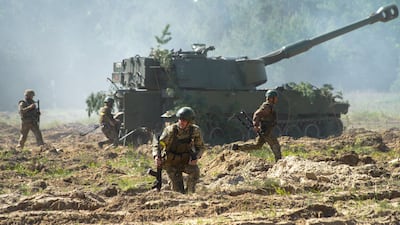
  • Ukrainian howitzers in action at an undisclosed location. AFP
    Ukrainian howitzers in action at an undisclosed location. AFP
  • A girl rides a scooter past a destroyed building in the village of Horenka, Kyiv. AFP
    A girl rides a scooter past a destroyed building in the village of Horenka, Kyiv. AFP
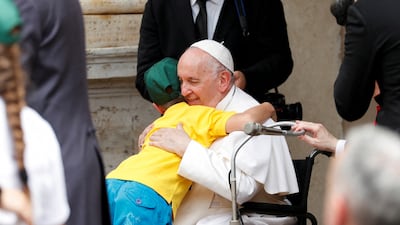
  • Pope Francis hugs a child during a meeting at the Vatican with children with disabilities and Ukrainian children who fled their country. Reuters
    Pope Francis hugs a child during a meeting at the Vatican with children with disabilities and Ukrainian children who fled their country. Reuters
  • Ukrainian emergency works at a damaged building following shelling in Kharkiv. AP
    Ukrainian emergency works at a damaged building following shelling in Kharkiv. AP
  • Members of a medical rescue team gather inside their temporary base in the Donetsk region of eastern Ukraine. AP
    Members of a medical rescue team gather inside their temporary base in the Donetsk region of eastern Ukraine. AP
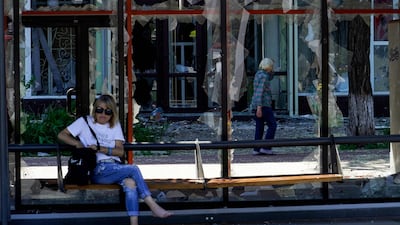
  • A woman sits at a destroyed bus station in the city of Mariupol. AFP
    A woman sits at a destroyed bus station in the city of Mariupol. AFP
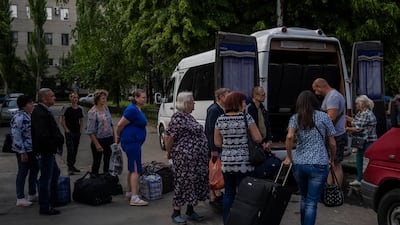
  • Residents are evacuated from Slovyansk, eastern Ukraine. AP
    Residents are evacuated from Slovyansk, eastern Ukraine. AP

The multipolar dynamics of power has implications for the way we think about leadership and governance. In a multipolar world, a functional use of power requires a way of thinking beyond the unipolar. Rational behaviour does not just accomplish goals; it also leads to unintended and interdependent consequences. Multipolar leaders acknowledge that each actor is anchored in a set of values and contexts and thus have their own, often different, purposes.

In a multipolar world, respect and tolerance are a prerequisite. Accepting others’ values and ways of thinking without necessarily agreeing with them is a sign of strength rather than weakness. We need that strength to be able to hold conflicting ideas without succumbing to the comfort of an easy answer. We are not advocating for moral relativism but what we call multipolar morality.

In a multipolar world, embracing diversity means being open to opposing or different views, genuinely accepting and learning from them, and facilitating efforts to arrive at mutually acceptable outcomes. We need to let go of unipolar thinking or risk the world passing us by, or worse, risk believing that we are entitled to use power or violence to bend others to our will. Companies must also take this reality into account.

Fear is the biggest emotional obstacle to a multipolar leader. To be a leader is to have the courage to go first and show the way, in spite of fears.

There is enough space inside ourselves to choose our perspective freely. Exploration forces us to mature our emotional reactions and develop the courage to be ourselves while aiding others to contain their own fears. It allows us to be even sharper in our decisions because we take them in full conscience.

European Council President Charles Michel, centre right, and European Commission President Ursula von der Leyen, centre left, leave the Europa building after an extraordinary meeting of EU leaders to discuss Ukraine, energy and food security in Brussels on May 31. AP Photo

We can learn to be grateful and humble about our imperfections. We can learn to express our point of view without expecting others to change theirs. We can also learn to apologise. In so doing, we become better at identifying right and wrong in more nuanced and accurate ways. The more risks we face, the more we ought to engage in collective multipolar processes that embrace our inevitable shortcomings.

The dominant western narrative owes its success to its emphasis on individual freedom, fair process and tolerance of beliefs. It is founded on secular representative government that protects citizens from religious or political persecution, ensures equal opportunities (not results) and upholds rules to protect those who think or act differently than the majority. This narrative is based on an evolutionary and self-correcting process that constantly scans for weaknesses or different ideas and then attempts to improve on them.

The problem is not the western narrative but its current unipolar leadership. Every narrative, organisation or person can fall into this trap. We can reduce the distance between polarities by facilitating dialogue and giving everyone a voice. In a multipolar world, multipolar leadership may help to bring about peace and prosperity, for one and for all.

A version of this article first appeared in Insead Knowledge

Marc Le Menestrel is Affiliate Professor of Decision Sciences at Insead

Horacio Falcao is Professor of Management Practice at Insead

HEADLINE HERE
  • I would recommend writing out the text in the body 
  • And then copy into this box
  • It can be as long as you link
  • But I recommend you use the bullet point function (see red square)
  • Or try to keep the word count down
  • Be wary of other embeds lengthy fact boxes could crash into 
  • That's about it
2018 ICC World Twenty20 Asian Western Sub Regional Qualifier

Event info: The tournament in Kuwait is the first phase of the qualifying process for sides from Asia for the 2020 World T20 in Australia. The UAE must finish within the top three teams out of the six at the competition to advance to the Asia regional finals. Success at regional finals would mean progression to the World T20 Qualifier.

Teams: UAE, Bahrain, Saudi Arabia, Kuwait, Maldives, Qatar

Friday fixtures: 9.30am (UAE time) - Kuwait v Maldives, Qatar v UAE; 3pm - Saudi Arabia v Bahrain

The Matrix Resurrections

Director: Lana Wachowski

Stars:  Keanu Reeves, Carrie-Anne Moss, Jessica Henwick 

Rating:****

MATCH INFO

Europa League semi-final, second leg
Atletico Madrid (1) v Arsenal (1)

Where: Wanda Metropolitano
When: Thursday, kick-off 10.45pm
Live: On BeIN Sports HD

VERSTAPPEN'S FIRSTS

Youngest F1 driver (17 years 3 days Japan 2014)
Youngest driver to start an F1 race (17 years 166 days – Australia 2015)
Youngest F1 driver to score points (17 years 180 days - Malaysia 2015)
Youngest driver to lead an F1 race (18 years 228 days – Spain 2016)
Youngest driver to set an F1 fastest lap (19 years 44 days – Brazil 2016)
Youngest on F1 podium finish (18 years 228 days – Spain 2016)
Youngest F1 winner (18 years 228 days – Spain 2016)
Youngest multiple F1 race winner (Mexico 2017/18)
Youngest F1 driver to win the same race (Mexico 2017/18)

ARABIAN GULF LEAGUE FIXTURES

Thursday, September 21
Al Dahfra v Sharjah (kick-off 5.35pm)
Al Wasl v Emirates (8.30pm)

Friday, September 22
Dibba v Al Jazira (5.25pm)
Al Nasr v Al Wahda (8.30pm)

Saturday, September 23
Hatta v Al Ain (5.25pm)
Ajman v Shabab Al Ahli (8.30pm)

THE BIO

Born: Mukalla, Yemen, 1979

Education: UAE University, Al Ain

Family: Married with two daughters: Asayel, 7, and Sara, 6

Favourite piece of music: Horse Dance by Naseer Shamma

Favourite book: Science and geology

Favourite place to travel to: Washington DC

Best advice you’ve ever been given: If you have a dream, you have to believe it, then you will see it.

Voices: How A Great Singer Can Change Your Life
Nick Coleman
Jonathan Cape

UAE currency: the story behind the money in your pockets
McIlroy's recent struggles

Last six stroke-play events (First round score in brackets)

Arnold Palmer Invitational Tied for 4th (74)

The US Masters Tied for 7th (72)

The Players Championship Tied for 35th (73)

US Open Missed the cut (78)

Travellers Championship Tied for 17th (67)

Irish Open Missed the cut (72)

THE BIO

Bio Box

Role Model: Sheikh Zayed, God bless his soul

Favorite book: Zayed Biography of the leader

Favorite quote: To be or not to be, that is the question, from William Shakespeare's Hamlet

Favorite food: seafood

Favorite place to travel: Lebanon

Favorite movie: Braveheart

AndhaDhun

Director: Sriram Raghavan

Producer: Matchbox Pictures, Viacom18

Cast: Ayushmann Khurrana, Tabu, Radhika Apte, Anil Dhawan

Rating: 3.5/5

UAE v Gibraltar

What: International friendly

When: 7pm kick off

Where: Rugby Park, Dubai Sports City

Admission: Free

Online: The match will be broadcast live on Dubai Exiles’ Facebook page

UAE squad: Lucas Waddington (Dubai Exiles), Gio Fourie (Exiles), Craig Nutt (Abu Dhabi Harlequins), Phil Brady (Harlequins), Daniel Perry (Dubai Hurricanes), Esekaia Dranibota (Harlequins), Matt Mills (Exiles), Jaen Botes (Exiles), Kristian Stinson (Exiles), Murray Reason (Abu Dhabi Saracens), Dave Knight (Hurricanes), Ross Samson (Jebel Ali Dragons), DuRandt Gerber (Exiles), Saki Naisau (Dragons), Andrew Powell (Hurricanes), Emosi Vacanau (Harlequins), Niko Volavola (Dragons), Matt Richards (Dragons), Luke Stevenson (Harlequins), Josh Ives (Dubai Sports City Eagles), Sean Stevens (Saracens), Thinus Steyn (Exiles)

SERIE A FIXTURES

Saturday (All UAE kick-off times)

Cagliari v AC Milan (6pm)

Lazio v Napoli (9pm)

Inter Milan v Atalanta (11.45pm)

Sunday

Udinese v Sassuolo (3.30pm)

Sampdoria v Brescia (6pm)

Fiorentina v SPAL (6pm)

Torino v Bologna (6pm)

Verona v Genoa (9pm)

Roma V Juventus (11.45pm)

Parma v Lecce (11.45pm)


The%20US%20Congress%20explained
%3Cp%3E-%20Congress%20is%20one%20of%20three%20branches%20of%20the%20US%20government%2C%20and%20the%20one%20that%20creates%20the%20nation's%20federal%20laws%3C%2Fp%3E%0A%3Cp%3E-%20Congress%20is%20divided%20into%20two%20chambers%3A%20The%20House%20of%20Representatives%20and%20the%20Senate%3C%2Fp%3E%0A%3Cp%3E-%C2%A0The%20House%20is%20made%20up%20of%20435%20members%20based%20on%20a%20state's%20population.%20House%20members%20are%20up%20for%20election%20every%20two%20years%3C%2Fp%3E%0A%3Cp%3E-%20A%20bill%20must%20be%20approved%20by%20both%20the%20House%20and%20Senate%20before%20it%20goes%20to%20the%20president's%20desk%20for%20signature%3C%2Fp%3E%0A%3Cp%3E-%20A%20political%20party%20needs%20218%20seats%20to%20be%20in%20control%20of%20the%20House%20of%20Representatives%3C%2Fp%3E%0A%3Cp%3E-%20The%20Senate%20is%20comprised%20of%20100%20members%2C%20with%20each%20state%20receiving%20two%20senators.%20Senate%20members%20serve%20six-year%20terms%3C%2Fp%3E%0A%3Cp%3E-%20A%20political%20party%20needs%2051%20seats%20to%20control%20the%20Senate.%20In%20the%20case%20of%20a%2050-50%20tie%2C%20the%20party%20of%20the%20president%20controls%20the%20Senate%3C%2Fp%3E%0A
Teenage%20Mutant%20Ninja%20Turtles%3A%20Shredder's%20Revenge
%3Cp%3E%3Cstrong%3EDeveloper%3A%20%3C%2Fstrong%3ETribute%20Games%3Cbr%3E%3Cstrong%3EPublisher%3A%3C%2Fstrong%3E%20Dotemu%3Cbr%3E%3Cstrong%3EConsoles%3A%20%3C%2Fstrong%3ENintendo%20Switch%2C%20PlayStation%204%26amp%3B5%2C%20PC%20and%20Xbox%20One%3Cbr%3E%3Cstrong%3ERating%3A%3C%2Fstrong%3E%204%2F5%3C%2Fp%3E%0A

Mercer, the investment consulting arm of US services company Marsh & McLennan, expects its wealth division to at least double its assets under management (AUM) in the Middle East as wealth in the region continues to grow despite economic headwinds, a company official said.

Mercer Wealth, which globally has $160 billion in AUM, plans to boost its AUM in the region to $2-$3bn in the next 2-3 years from the present $1bn, said Yasir AbuShaban, a Dubai-based principal with Mercer Wealth.

Within the next two to three years, we are looking at reaching $2 to $3 billion as a conservative estimate and we do see an opportunity to do so,” said Mr AbuShaban.

Mercer does not directly make investments, but allocates clients’ money they have discretion to, to professional asset managers. They also provide advice to clients.

“We have buying power. We can negotiate on their (client’s) behalf with asset managers to provide them lower fees than they otherwise would have to get on their own,” he added.

Mercer Wealth’s clients include sovereign wealth funds, family offices, and insurance companies among others.

From its office in Dubai, Mercer also looks after Africa, India and Turkey, where they also see opportunity for growth.

Wealth creation in Middle East and Africa (MEA) grew 8.5 per cent to $8.1 trillion last year from $7.5tn in 2015, higher than last year’s global average of 6 per cent and the second-highest growth in a region after Asia-Pacific which grew 9.9 per cent, according to consultancy Boston Consulting Group (BCG). In the region, where wealth grew just 1.9 per cent in 2015 compared with 2014, a pickup in oil prices has helped in wealth generation.

BCG is forecasting MEA wealth will rise to $12tn by 2021, growing at an annual average of 8 per cent.

Drivers of wealth generation in the region will be split evenly between new wealth creation and growth of performance of existing assets, according to BCG.

Another general trend in the region is clients’ looking for a comprehensive approach to investing, according to Mr AbuShaban.

“Institutional investors or some of the families are seeing a slowdown in the available capital they have to invest and in that sense they are looking at optimizing the way they manage their portfolios and making sure they are not investing haphazardly and different parts of their investment are working together,” said Mr AbuShaban.

Some clients also have a higher appetite for risk, given the low interest-rate environment that does not provide enough yield for some institutional investors. These clients are keen to invest in illiquid assets, such as private equity and infrastructure.

“What we have seen is a desire for higher returns in what has been a low-return environment specifically in various fixed income or bonds,” he said.

“In this environment, we have seen a de facto increase in the risk that clients are taking in things like illiquid investments, private equity investments, infrastructure and private debt, those kind of investments were higher illiquidity results in incrementally higher returns.”

The Abu Dhabi Investment Authority, one of the largest sovereign wealth funds, said in its 2016 report that has gradually increased its exposure in direct private equity and private credit transactions, mainly in Asian markets and especially in China and India. The authority’s private equity department focused on structured equities owing to “their defensive characteristics.”

Signs%20of%20%20%20%20%20%20%20heat%20stroke
%3Cul%3E%0A%3Cli%3EThe%20loss%20of%20sodium%20chloride%20in%20our%20sweat%20can%20lead%20to%20confusion%20and%20an%20altered%20mental%20status%20and%20slurred%20speech%3C%2Fli%3E%0A%3Cli%3EBody%20temperature%20above%2039%C2%B0C%3C%2Fli%3E%0A%3Cli%3EHot%2C%20dry%20and%20red%20or%20damp%20skin%20can%20indicate%20heatstroke%3C%2Fli%3E%0A%3Cli%3EA%20faster%20pulse%20than%20usual%3C%2Fli%3E%0A%3Cli%3EDizziness%2C%20nausea%20and%20headaches%20are%20also%20signs%20of%20overheating%3C%2Fli%3E%0A%3Cli%3EIn%20extreme%20cases%2C%20victims%20can%20lose%20consciousness%20and%20require%20immediate%20medical%20attention%3C%2Fli%3E%0A%3C%2Ful%3E%0A
While you're here

Various Artists 
Habibi Funk: An Eclectic Selection Of Music From The Arab World (Habibi Funk)
​​​​​​​

The Sand Castle

Director: Matty Brown

Stars: Nadine Labaki, Ziad Bakri, Zain Al Rafeea, Riman Al Rafeea

Rating: 2.5/5

Islamophobia definition

A widely accepted definition was made by the All Party Parliamentary Group on British Muslims in 2019: “Islamophobia is rooted in racism and is a type of racism that targets expressions of Muslimness or perceived Muslimness.” It further defines it as “inciting hatred or violence against Muslims”.

Avatar: Fire and Ash

Director: James Cameron

Starring: Sam Worthington, Sigourney Weaver, Zoe Saldana

Rating: 4.5/5

The Settlers

Director: Louis Theroux

Starring: Daniella Weiss, Ari Abramowitz

Rating: 5/5

Updated: June 19, 2022, 6:38 AM