Dr James Zogby is the president of the Arab American Institute and a columnist for The National
April 18, 2022
A terrible and tragic drama is playing out across Israel and Palestine. It is a dance of death with Israelis and Palestinians engaged, each in their own way, in destructive violence.
The US media has focused on the 14 Israelis killed in recent weeks. But Palestinians have disproportionately been the victims of violence with more than 70 killed in the past few months and many more wounded, as Israeli forces have conducted night raids into Palestinian villages and responded to protesters with live fire. During this same time, hundreds of Palestinians have been arrested and detained, many without charges.
One could rattle off the Israeli provocations – from land theft and seizures of Palestinian homes to nightly acts of violence by Israeli settlers – or the Palestinian stabbings or shootings of Israelis at bus stops or check points. But whatever the provocations or intentions, nothing good will come from this violence. Nothing ever does.
If we should have learnt anything from this conflict, it is that just as Palestinian violence has not ended the Israeli occupation or its repression, nor has more Israeli repression or violence ended the Palestinians’ resistance to the occupation. If anything, the violence has produced the opposite. During the past several decades, the occupation has intensified and Israeli politics have become so hardline that it is impossible to even imagine a governing coalition that would be inclined to act with justice toward Palestinians. At the same time, the brutality and acquisitiveness of the occupation has hardened Palestinian attitudes, strengthened extremist currents and driven some to carry out violent acts of desperation.
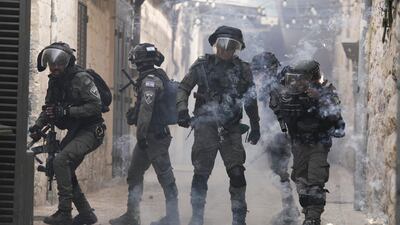
Palestinians launch fireworks at Israeli police at Al Aqsa Mosque in the Old City of Jerusalem. AP
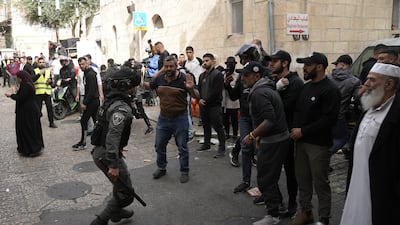
Israel police have words with a Palestinian worshipper. AP
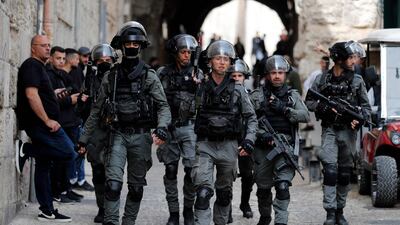
Officers try to disperse Palestinians in the Al Aqsa Mosque compound. AP
Paramedics carry an injured Palestinian. AP
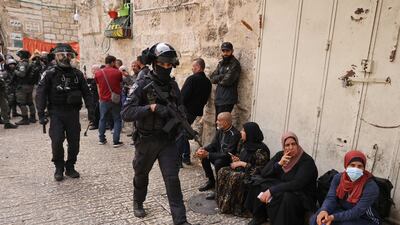
Israeli border police on patrol at the Lion's Gate in Jerusalem's Old City, as Palestinians wait to be allowed to enter the Al Aqsa Mosque compound. AFP
Israel's Foreign Ministry tweeted video purportedly showing masked Palestinians throwing objects inside the mosque. AFP
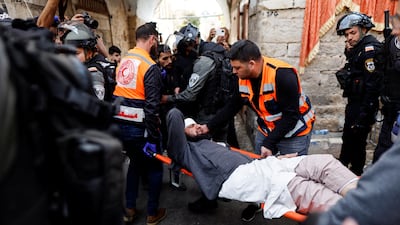
An injured man is stretchered to safety. The foreign ministry denied reports on social media that police had entered the mosque building itself during the violence. Reuters
Compounding this tragic dance of death are those who cheer the violence or seek to justify it. During this past bloody week, some Arab commentators praised the spate of Palestinian attacks on Israelis calling them “heroic acts of resistance", gloating that the killings had caused the Israelis to “cower in fear”. Supporters of Israel, on the other hand, applauded the repression, urging more forceful measures to “crack down” on Palestinians. Some called for more mass arrests or intensified settlement development, arguing that only tougher measures would put an end to the violence. Both views are dead wrong.
But it continues, with no lessons learnt and the behaviours of both sides playing into the fears of the other, setting the stage for yet another round of anger, revenge and violence.
During the second intifada, I warned that because violence was a dead end (literally), a new strategy was needed – a strategy that defines a goal and then develops a series of tactics that will lead to that goal. I understood that Palestinian anger was real and justified. But revenge is not a strategy. It might make some feel momentary satisfaction, but history has demonstrated that because the occupier has a monopoly on force, when it responds, it does so disproportionately, taking hundreds of lives for each one lost.
Violence begets more violence. One Palestinian leader noted to me: “When we use stones, they shoot us. When we use guns, they bring heavy weapons. And when we fire rockets, they bomb us with jets.” The lesson: when the tactics used don’t advance your goal, they do not constitute a strategy.
Back then, I also noted that Palestinian leadership also had no discernable strategy. Calls for a new UN resolution would never provide a solution because the US, for reasons of domestic politics, would block it. Relying on the EU was also pointless because the EU was weak and indecisive and had proven itself incapable of acting independently. The Russians, Chinese and the “non-aligned” might be counted on to pass resolutions denouncing the occupation, but because they had no interest in a direct confrontation with the US, their resolutions weren’t worth the paper they were printed on. And appeals to international law or “legitimacy” were hollow since there was no enforcement mechanism in place.
Revenge isn’t a strategy, but neither is complaining about injustice or passing toothless resolutions. Israel will not change by itself, nor will the US or the UN. Therefore, Palestinians must identify what they can change and lay out a path to produce that change. That’s the definition of a strategy.
Martin Luther King once observed that when confronting a more powerful foe, one must never play into their strength. Instead, use “jiu-jitsu” by turning their power into a weakness. What I proposed then and propose again is a mass non-violent resistance campaign. Imagine the power of a peaceful march of tens of thousands of unarmed, non-rock throwing Palestinians converging on Jerusalem saying: “Let my people pray.” Or marching from the refugee camps saying: “Let my people go home.”
It should be a time for religious celebration in Palestine and Israel. Reuters
Palestinians have tried such an approach in the past, for example, at Al Aqsa in July 2017. And instances of nonviolent resistance are in evidence across Palestine on a weekly basis. What is needed is to grow and sustain such an effort, making it the new definition of Palestinian resistance. It will require the combined support of the Palestinian leadership acting to project this new strategy and imposing the necessary discipline to control any counter-productive violence.
Consider how it would play out. The Israeli hardliners are likely to attempt to provoke violence. They may shoot demonstrators and make more arrests. But if the non-violence continues, it will put the Israeli government in a bind that neither their military might, nor their hasbara campaigns will be able to conquer. They won’t be able to claim victimhood. And they will not be able to defeat an empowered Palestinian constituency. Such a campaign will have a transformative impact on Israeli and US politics. That’s the strength of non-violence. It turns the tables, making the powerful weak and the oppressed stronger.
It will no doubt be hard to do. But it should be tried because what’s been done to date isn’t working and a new approach is desperately needed.

Wicked
Director: Jon M Chu
Stars: Cynthia Erivo, Ariana Grande, Jonathan Bailey
Advocate at Al Bahar & Associate Advocates and Legal Consultants, established in 1994
Education: Mr Al Bahar was born in 1979 and graduated in 2008 from the Judicial Institute. He took after his father, who was one of the first Emirati lawyers
How the bonus system works
The two riders are among several riders in the UAE to receive the top payment of £10,000 under the Thank You Fund of £16 million (Dh80m), which was announced in conjunction with Deliveroo's £8 billion (Dh40bn) stock market listing earlier this year.
The £10,000 (Dh50,000) payment is made to those riders who have completed the highest number of orders in each market.
There are also riders who will receive payments of £1,000 (Dh5,000) and £500 (Dh2,500).
All riders who have worked with Deliveroo for at least one year and completed 2,000 orders will receive £200 (Dh1,000), the company said when it announced the scheme.
Lexus LX700h specs
Engine: 3.4-litre twin-turbo V6 plus supplementary electric motor
Power: 464hp at 5,200rpm
Torque: 790Nm from 2,000-3,600rpm
Transmission: 10-speed auto
Fuel consumption: 11.7L/100km
On sale: Now
Price: From Dh590,000
Results
1. New Zealand Daniel Meech – Fine (name of horse), Richard Gardner – Calisto, Bruce Goodin - Backatorps Danny V, Samantha McIntosh – Check In. Team total First round: 200.22; Second round: 201.75 – Penalties 12 (jump-off 40.16 seconds) Prize €64,000
2. Ireland Cameron Hanley – Aiyetoro, David Simpson – Keoki, Paul Kennedy – Cartown Danger Mouse, Shane Breen – Laith. Team total 200.25/202.84 – P 12 (jump-off 51.79 – P17) Prize €40,000
3. Italy Luca Maria Moneta – Connery, Luca Coata – Crandessa, Simone Coata – Dardonge, Natale Chiaudani – Almero. Team total 130.82/198.-4 – P20. Prize €32,000
Living in...
This article is part of a guide on where to live in the UAE. Our reporters will profile some of the country’s most desirable districts, provide an estimate of rental prices and introduce you to some of the residents who call each area home.
Desert Warrior
Starring: Anthony Mackie, Aiysha Hart, Ben Kingsley
The company offers payments/bribes to win key contracts in the Middle East
May 2017
The UK SFO officially opens investigation into Petrofac’s use of agents, corruption, and potential bribery to secure contracts
September 2021
Petrofac pleads guilty to seven counts of failing to prevent bribery under the UK Bribery Act
October 2021
Court fines Petrofac £77 million for bribery. Former executive receives a two-year suspended sentence
December 2024
Petrofac enters into comprehensive restructuring to strengthen the financial position of the group
May 2025
The High Court of England and Wales approves the company’s restructuring plan
July 2025
The Court of Appeal issues a judgment challenging parts of the restructuring plan
August 2025
Petrofac issues a business update to execute the restructuring and confirms it will appeal the Court of Appeal decision
October 2025
Petrofac loses a major TenneT offshore wind contract worth €13 billion. Holding company files for administration in the UK. Petrofac delisted from the London Stock Exchange
November 2025
180 Petrofac employees laid off in the UAE
The biog
Age: 46
Number of Children: Four
Hobby: Reading history books
Loves: Sports
UAE v Gibraltar
What: International friendly
When: 7pm kick off
Where: Rugby Park, Dubai Sports City
Admission: Free
Online: The match will be broadcast live on Dubai Exiles’ Facebook page
UAE squad: Lucas Waddington (Dubai Exiles), Gio Fourie (Exiles), Craig Nutt (Abu Dhabi Harlequins), Phil Brady (Harlequins), Daniel Perry (Dubai Hurricanes), EsekaiaDranibota (Harlequins), Matt Mills (Exiles), JaenBotes (Exiles), KristianStinson (Exiles), Murray Reason (Abu Dhabi Saracens), Dave Knight (Hurricanes), Ross Samson (Jebel Ali Dragons), DuRandt Gerber (Exiles), Saki Naisau (Dragons), Andrew Powell (Hurricanes), EmosiVacanau (Harlequins), NikoVolavola (Dragons), Matt Richards (Dragons), Luke Stevenson (Harlequins), Josh Ives (Dubai Sports City Eagles), Sean Stevens (Saracens), ThinusSteyn (Exiles)
Mercer, the investment consulting arm of US services company Marsh & McLennan, expects its wealth division to at least double its assets under management (AUM) in the Middle East as wealth in the region continues to grow despite economic headwinds, a company official said.
Mercer Wealth, which globally has $160 billion in AUM, plans to boost its AUM in the region to $2-$3bn in the next 2-3 years from the present $1bn, said Yasir AbuShaban, a Dubai-based principal with Mercer Wealth.
“Within the next two to three years, we are looking at reaching $2 to $3 billion as a conservative estimate and we do see an opportunity to do so,” said Mr AbuShaban.
Mercer does not directly make investments, but allocates clients’ money they have discretion to, to professional asset managers. They also provide advice to clients.
“We have buying power. We can negotiate on their (client’s) behalf with asset managers to provide them lower fees than they otherwise would have to get on their own,” he added.
Mercer Wealth’s clients include sovereign wealth funds, family offices, and insurance companies among others.
From its office in Dubai, Mercer also looks after Africa, India and Turkey, where they also see opportunity for growth.
Wealth creation in Middle East and Africa (MEA) grew 8.5 per cent to $8.1 trillion last year from $7.5tn in 2015, higher than last year’s global average of 6 per cent and the second-highest growth in a region after Asia-Pacific which grew 9.9 per cent, according to consultancy Boston Consulting Group (BCG). In the region, where wealth grew just 1.9 per cent in 2015 compared with 2014, a pickup in oil prices has helped in wealth generation.
BCG is forecasting MEA wealth will rise to $12tn by 2021, growing at an annual average of 8 per cent.
Drivers of wealth generation in the region will be split evenly between new wealth creation and growth of performance of existing assets, according to BCG.
Another general trend in the region is clients’ looking for a comprehensive approach to investing, according to Mr AbuShaban.
“Institutional investors or some of the families are seeing a slowdown in the available capital they have to invest and in that sense they are looking at optimizing the way they manage their portfolios and making sure they are not investing haphazardly and different parts of their investment are working together,” said Mr AbuShaban.
Some clients also have a higher appetite for risk, given the low interest-rate environment that does not provide enough yield for some institutional investors. These clients are keen to invest in illiquid assets, such as private equity and infrastructure.
“What we have seen is a desire for higher returns in what has been a low-return environment specifically in various fixed income or bonds,” he said.
“In this environment, we have seen a de facto increase in the risk that clients are taking in things like illiquid investments, private equity investments, infrastructure and private debt, those kind of investments were higher illiquidity results in incrementally higher returns.”
The Abu Dhabi Investment Authority, one of the largest sovereign wealth funds, said in its 2016 report that has gradually increased its exposure in direct private equity and private credit transactions, mainly in Asian markets and especially in China and India. The authority’s private equity department focused on structured equities owing to “their defensive characteristics.”
Price: From Dh89,000 (Enjoy), Dh99,900 (Innovation)
On sale: Now
David Haye record
Total fights: 32 Wins: 28 Wins by KO: 26 Losses: 4
What vitamins do we know are beneficial for living in the UAE
Vitamin D: Highly relevant in the UAE due to limited sun exposure; supports bone health, immunity and mood. Vitamin B12: Important for nerve health and energy production, especially for vegetarians, vegans and individuals with absorption issues. Iron: Useful only when deficiency or anaemia is confirmed; helps reduce fatigue and support immunity. Omega-3 (EPA/DHA): Supports heart health and reduces inflammation, especially for those who consume little fish.
Eoin Morgan (capt), Moeen Ali, Jofra Archer, Jonny Bairstow, Jos Buttler (wkt), Tom Curran, Liam Dawson, Liam Plunkett, Adil Rashid, Joe Root, Jason Roy, Ben Stokes, James Vince, Chris Woakes, Mark Wood