


Seeing the images of Bucha, I cannot help but wonder what worse horrors we will find when and if the siege of Mariupol lifts. The Red Cross has called the siege “apocalyptic”. Since February 24, the day the Russian invasion began, Mariupol has been brutalised. It has sustained shelling by tanks, artillery, and an amphibious assault by the Black Sea Fleet.
Vadym Boychenko, the mayor of Mariupol, said BM 21-Grad, multiple rocket launchers were hitting the city’s hospitals. He called for humanitarian corridors to evacuate the civilians. Several times these corridors have failed. The shelling continued even as people tried to escape.
Of all the military tactics, laying siege to a city is among the cruelest. They turn neighbourhoods into concentration camps. Teenagers are killed playing soccer. Water supplies dwindle. Electricity goes dim. Civilians are buried in mass graves. After a while, there is no room left in cemeteries. Sometimes there are no more coffins and people are buried in bags.
-
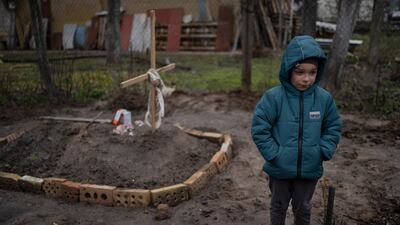
In the courtyard of their house, Vlad Tanyuk, 6, stands near the grave of his mother Ira Tanyuk, who died because of starvation and stress due to the war, on the outskirts of Kyiv. AP -
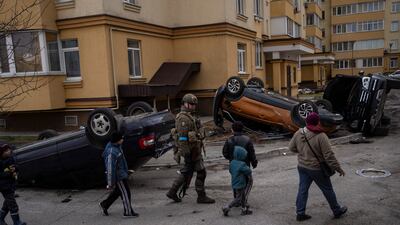
A Ukrainian soldier walks with children passing destroyed cars due to the war against Russia, in Bucha, on the outskirts of Kyiv, Ukraine. AP -
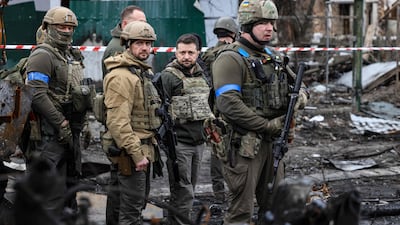
President Volodymyr Zelenskyy surveys the destruction in Bucha. AFP -
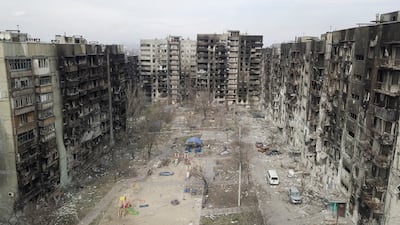
Residential buildings damaged during fighting in the southern port city of Mariupol. Reuters -

A bridge damaged by shelling in Bucha. EPA -

A soldier stationed in Bucha, after the city was the recaptured by the Ukrainian army. EPA -
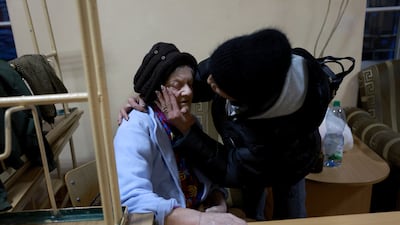
Chervona Voloshin kisses Varvara Statenova goodbye as she heads home to Kyiv after being housed at a shelter for displaced people in Lviv, Ukraine. Getty Images -
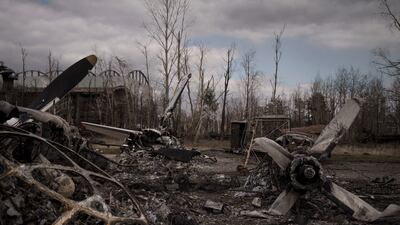
Parts of a destroyed aircraft at the Antonov airport in Hostomel, outskirts of Kyiv. AP -
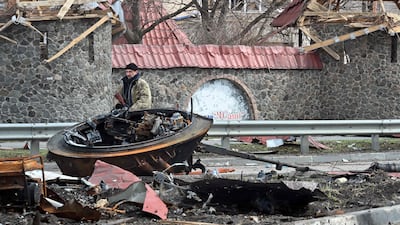
A Ukrainian territorial defence serviceman walks past a destroyed Russian armoured personnel carrier in the town of Borodianka, north-west of Kyiv. AFP -

Tanya Nedashkivska recounts how her husband Vasyl Ivanovych, who served in Ukraine’s navy, was killed by Russian soldiers, in Bucha, Ukraine. He was arrested by Russian soldiers. Tanya looked for him for days and found him in a building's basement where two bodies were lying. She recognised him by his shoes and trousers. AP -
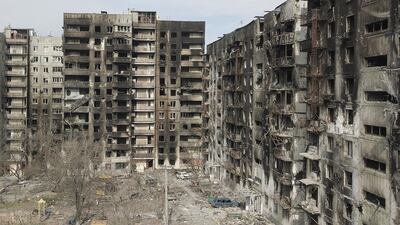
Damaged residential buildings in the southern port city of Mariupol. Reuters -
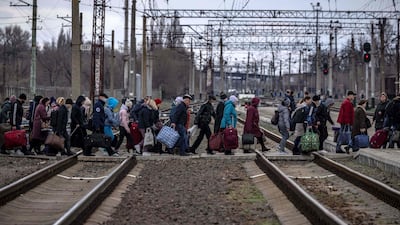
Families arrive to board a train at Kramatorsk central station as they flee the eastern city, in the Donbas region. AFP -
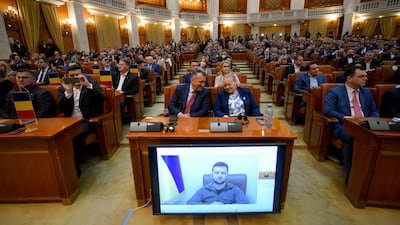
Romanian politicians listen to President Zelenskyy’s speech by video link, on a screen in the parliament in Bucharest. AP -
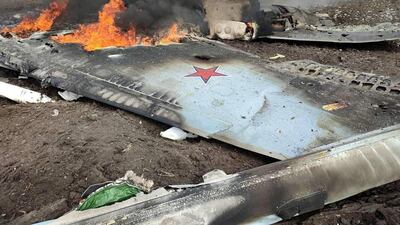
The remains of a Russian Su-35 aircraft that was hit by the Ukrainian armed forces in Kharkiv. Reuters -
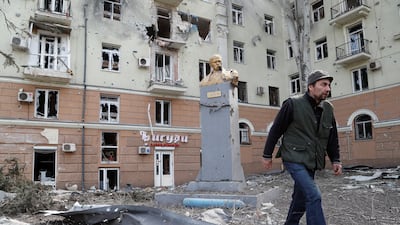
A damaged monument to Ukrainian poet Taras Shevchenko in the besieged city of Mariupol, southern Ukraine. Reuters -

A man removes a door covering the opening to an underground concrete enclosure in which bodies of civilians killed by Russian forces, residents say, were dumped as people were unable to transport them to a cemetery in Bucha, Ukraine. AP -

A Ukrainian soldier tries to convince a puppy to drink milk as residents wait for distribution of food products in Motyzhyn, Ukraine, which was until recently under the control of the Russian military. AP -
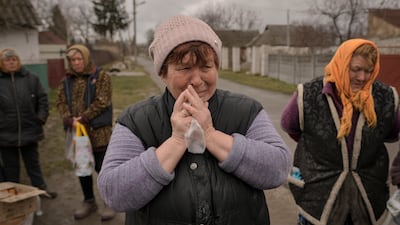
The pain of war is evident as women wait for food aid in the village of Motyzhyn. AP -

Ukraine's President Volodymyr Zelenskyy appears on screen during the 64th Grammy Awards at the MGM Grand Garden Arena in Las Vegas. AFP -
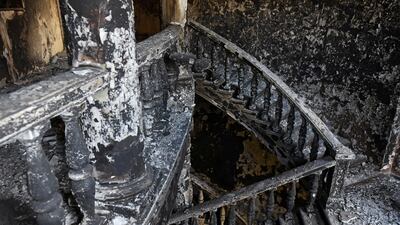
The gutted interior of a theatre in central Mariupol, destroyed in the course of Ukraine-Russia conflict. Reuters -
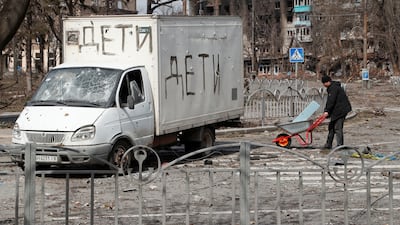
Desolation in Mariupol which has suffered intense bombardment. Reuters -

A Ukrainian soldier walks in front of the remains of an Antonov An-225 Mriya cargo plane, the world's biggest aircraft, destroyed by Russian troops at an airfield in the city of Hostomel, in the Kyiv region. Reuters -

A local woman salutes Ukrainian soldiers in the Chernihiv region. Reuters -
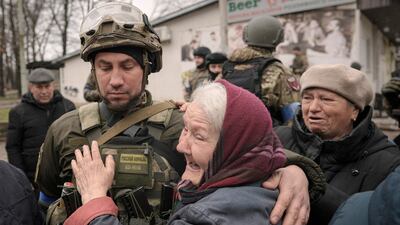
A woman hugs a Ukrainian soldier after a convoy of military and aid vehicles arrived in the formerly Russian-occupied town of Bucha, near Kyiv. AP -
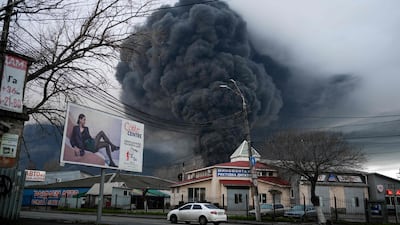
Smoke rises after an attack by Russian forces in Odesa. AFP -

Ukraine's President Volodymyr Zelenskyy presents an award to an injured Ukrainian service member at a military hospital in Kyiv. Reuters -
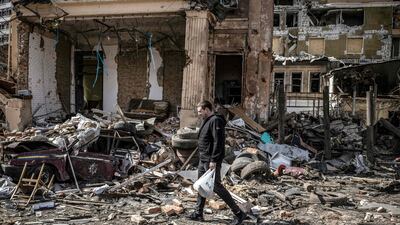
A destroyed building in the eastern Ukrainian city of Kharkiv. AFP -
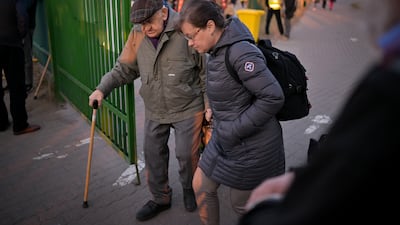
People, mainly women and children, pass through the Medyka border crossing on their journey out of Ukraine and into Poland. Getty


In Sarajevo, which withstood the longest siege in modern history, from April 2, 1992 to February 29, 1996, they began to bury the dead in a former football pitch. It was called Lion’s Cemetery because of a stone lion that had once stood at the gates of a city park in happier days. Today it is littered with graves, mostly of the very young. Whenever I have walked through it post-war, I remember those terrible funerals where the Bosnian Serbs continued to shell and snipe the mourners as they buried their loved ones.
What I remember most about the siege of Sarajevo is the hunger and the cravings. Bosnians are meat eaters, but for nearly four years they lived on rice and whatever they found in the humanitarian aid packages that arrived when the planes weren’t being shot down. They made cheese from rice.
In Yarmouk camp outside of Damascus, populated largely by Palestinians, people made soup from leaves during the siege – and where the United Nations, for a reason no one ever really understood, in 2015, stopped calling it a siege. That was despite the fact that they had not been able to deliver humanitarian aid to the starving people for months.
Sieges destroy the soul of a community, which is the primary intent. Sometimes, people rebel and refuse to be destroyed. Think of the 872-day siege of Leningrad in the year 1941, which caused mass casualties with starvation and the fierce cold. One million people died. But while the Nazis bombarded the city, the Soviet composer Dmitri Shostakovich completed his Symphony Number 7.
Although he was evacuated from Leningrad, the starving musicians of the Leningrad Radio Orchestra bravely carried on. Many of them were suffering from malnutrition, collapsing during rehearsals – three died. The night they performed Symphony Number 7 though, loudspeakers carried the music to the furious German forces as a method of psychological warfare. “In that moment, we triumphed over the soulless Nazi war machine,” the conductor said.
The Sarajevans had their own form of psychological defence: humour and an utter refusal to let their city fall, despite being shelled, sniped, starved and deprived of weapons because of an arms embargo.
Aida Cerkez, my friend, and colleague from the Associated Press Sarajevo, recently wrote an open letter to Ukrainians about not giving up. As a Bosnian, she endured nearly four years of pain and suffering. But she defied the siege. She had a T-shirt which read: "Sarajevo will be, everything else will pass". Meaning, the war, the pain, the agony, would end. Don’t give up.
-
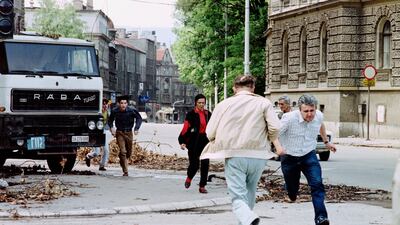
Bosnians run for shelter across a street to avoid shelling from Serbs, in the Bosnian capital Sarajevo, on July 12, 1992. Pascal Guyot/AFP -
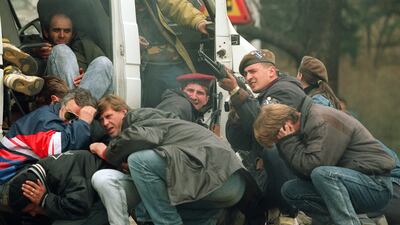
A Bosnian special forces soldier returns fire on April 6, 1992 in downtown Sarajevo, as he and civilians come under fire from Serbian snipers. The Serb extremists were shooting from the roof of a hotel at a peace demonstration of some of 30,000 people as fighting between Bosnian and Serb fighters escalated in the capital of Bosnia-Hercegovina. Mike Persson/AFP -
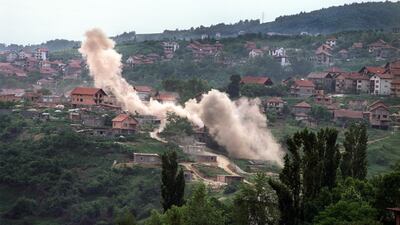
Houses in the suburbs of Sarajevo on June 6, 1992, hit by heavy shelling by Serbian forces perched on the hills around Sarajevo. Georges Gobet/AFP -
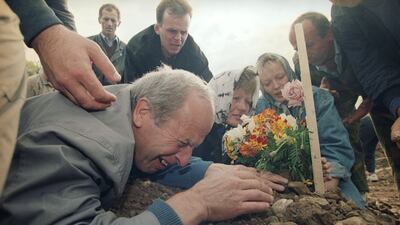
A man at his son's grave in Bosnia, on October 7, 1992. Hansi Krauss/AP -
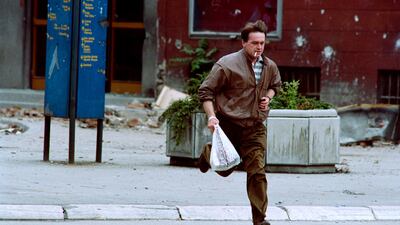
A resident of Sarajevo runs for cover crossing a street to avoid snipers who are posted in evacuated houses in the Bosnian Capital, on May 31, 1992. Georges Gobet/AFP -
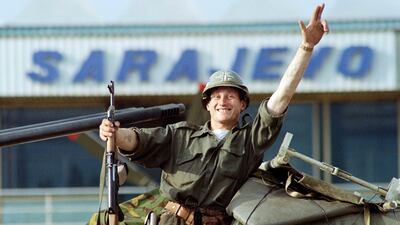
A Serb soldier leaving the Sarajevo airport on June 29, 1992 after an agreement was reached to hand the airport over to the United Nations peace-keeping forces to allow relief flights carrying humanitarian aid for residents of the besieged city to enter. Christophe Simon/AFP


Aida lived through the siege. Today she is a grandmother. During the four-year siege of Daraya in Syria, she helped give Syrians suffering what she had gone through critical advice. Last month, her letter to Ukrainians, which was broadcast on the BBC, went viral. In it she said, “Write down everything. Record it. One day it will define your history, explain what happened to Ukrainians who are yet to be born, and most likely, end up being used as evidence and proof in a court against those trying to kill you.”
That message was meant for people facing desperation. I think back of others who made it through the darkness of a siege. In 2016, some 25,000 inhabitants of Eastern Aleppo endured a brutal siege. Pope Francis called the trapped inhabitants “abandoned and beloved”. The cruelty of the siege was horrific to watch.
What did the Aleppans there miss the most? One man told me he missed simple things the most: meeting his friends to watch football on TV. But during siege life, there were no more friends and there was no TV or electricity. Another woman told me she missed seeing the fruit trees bloom. She had not been outside in weeks for fear of bombs. Living through a siege destroys your body with starvation but more urgently, the intent is to destroy your soul.
The resilience of the Ukrainians and their resistance has been profound. There are darker days ahead. I fear more war crimes and atrocities will be discovered. I am part of a team that is documenting and verifying war crimes for future tribunals and courts. It is painful work because you stare into the deepest pit of evil: that is, what man is capable of doing to his fellow man.
But there is hope. Others have survived. Aida's message to her embattled friends is this: “Over time, you will sing … but for now, I am sending you my most precious thing … my slogan … Ukraine will be, everything else will pass".

