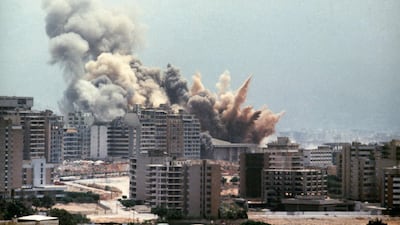

As Russian forces start surrounding the Ukrainian capital Kyiv, people are questioning whether this will lead to a siege of the city. Forty years ago, in the summer of 1982, Israel besieged West Beirut to force Palestinian armed groups to depart from Lebanon. The lessons from that battle may provide Ukrainians with some clarity with respect to what lies ahead.
A siege of Kyiv would pose many problems for the Russians. It could take valuable time, at a moment when Russian President Vladimir Putin seeks to quickly impose his political conditions on the Ukrainians, before Russia feels the full economic impact of sanctions. At the same time, slow progress or failure in Kyiv could stiffen resistance in other parts of Ukraine.

In this regard, Mr Putin is at a disadvantage compared to the Israelis in 1982, whose siege lasted for over three months. They had factored a longer timeframe into their aims – of using the siege of West Beirut to force the Palestinian leadership out of Lebanon, and to install an ally as Lebanon's president. Moreover, Israel conquered most of southern Lebanon up to Beirut in just one week. Russia is not in a similar situation.
The question is whether the Ukrainians will be able to force the Russians into a siege, intentionally or unintentionally. If the Russians try to enter Kyiv and find resistance too strong, Mr Putin will be left with one of two choices: to pursue the ground offensive, sending his men into a politically costly bloodbath; or pulling back to the outskirts of the city and continuing bombing.
As the Israelis knew well, military superiority has a relatively limited impact against well-organised defenders. They besieged West Beirut for three months, cutting off water, electricity and fresh food. Their air domination notwithstanding, when they tried to enter the city they met ferocious resistance and had to pull back.
Nor is relentless bombardment a solution to this. While it may demoralise the inhabitants of a city for a time, it also creates many more obstacles for an invading army. Bombing encumbers roads with rubble, hindering tanks and producing infinite new defensive positions for those in the city.

Mr Putin may face another problem. If Ukrainian President Volodymyr Zelenskyy remains in Kyiv, securing the political benefits that result from taking the capital would come to mean less than what happens to Mr Zelenskyy himself. This may narrow the Russians’ margin of manoeuvre, in that the Ukrainian president’s political survival could be seen as Mr Putin’s loss.
In West Beirut, the exit of the Palestinian leadership was a central aim of Israel. Mr Zelenskyy’s downfall was certainly a Russian priority when the invasion of Ukraine began, but today that appears to be less certain. If Mr Putin’s core objective is to bring Ukraine back in to Russia’s sphere of influence – and Mr Zelensky is willing to discuss this – then making the siege of Kyiv all about the fate of the Ukrainian president may detract from that aim and mean that Mr Zelenskyy comes out looking like a victor even if he makes concessions. That's precisely what happened to the Palestinian leader Yasser Arafat. While his exit from Lebanon represented a major defeat, the fact that he had survived politically allowed him to portray the Palestinian resistance in West Beirut as a triumph.
Then there is the symbolism. Sieges favour the besiegers, but in terms of public perceptions they reinforce the besieged, making them appear heroic. The courageous defiance of cities such as Leningrad (St Petersburg), Sarajevo and Gaza resonate to this day. If Mr Putin wants to draw Ukraine back in to the Russian fold, then inadvertently highlighting the valiant nature of Kyiv’s defenders may well have the opposite effect.
This can also have repercussions on the attitude adopted by Russia’s allies. The longer and bloodier is a siege of Kyiv, the more will Russia’s allies, notably China, have doubts about supporting its actions. This could limit Russia's political options.
That is precisely what happened in 1982. Initially, the Reagan administration was willing to cut the Israelis slack to get rid of the Palestinians. But when it sent its mediator Philip Habib to Lebanon, things changed. As civilian casualties mounted, and Washington was partly blamed, tensions rose between the Americans and Israelis.
Yet Israel had an advantage, in that the Sunni Muslim leadership in West Beirut openly opposed seeing their half of the city destroyed on the Palestinians’ behalf. Mr Zelenskyy faces no such difficulties. There is little pressure inside Kyiv that can help Russia.
I lived through the siege of Beirut and will not forget it. It is a matter of pride for me that I survived and put up with the hardships it imposed. I wouldn’t want to go through such a trial again but out of defiance I could if I had to. Reactions similar to mine are likely not the kind that Mr Putin sought to provoke when Russia invaded Ukraine.
As the Israelis neared West Beirut in 1982, one of the Palestinian leaders, George Habash, said he would transform the city into “a new Stalingrad”. Ultimately, it wasn’t quite that, but as Russian forces advance on Kyiv, Mr Putin may find that his country’s own history, ironically, provides his enemies with inspiring guidelines to fight the Russian attack.

