


The battle brewing among US liberals and progressives in response to the Russian invasion of Ukraine brought flashbacks of debates that occurred in the aftermath of Saddam Hussein’s invasion and occupation of Kuwait in August 1990.
Many in Kuwait were stunned by the brazenness and brutality of the assault. I had visited Kuwait a few months earlier and had many friends there. My calls to them left me acutely aware of their anguish over the loss of their homes, businesses and country. It was clear that Iraq’s violation of the rights of a sovereign nation and undermining of Kuwaiti people’s right to self-determination should be condemned unequivocally.
And yet a few prominent Arab American intellectuals attacked that position at the time. They were angered by the immediate support the US had offered to Kuwait, charging that it reflected a US “double standard”. Palestine, they argued, had been occupied for decades and after years of harsh rule, land theft, and violations of international law, no such US condemnation had been forthcoming. All that was true, of course, but nonetheless irrelevant to the matter at hand. This issue was not the US’s double standard. It was about Kuwait. And while I, of course, supported the Palestinian right to self-determination, I refused to have a double standard myself – by denying that same right to the Kuwaiti people.
-

Picture taken on August 14, 1990 at Ruwaished showing Arab refugees from different countries waiting for the permission to return to their homelands at the Iraq-Jordan border checkpoint as thousands of foreigners flee the war in Iraq and Kuwait. AFP -
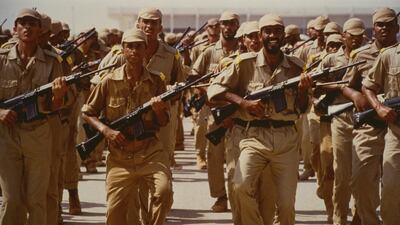
August 1990: A training camp for new recruits in the United Arab Emirates, following the country's appeal for servicemen on the 11th August 1990, during the Gulf Crisis. Getty -
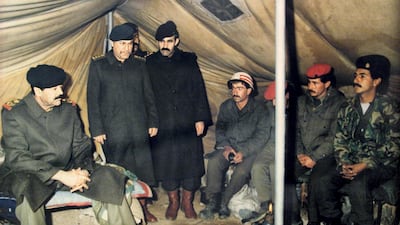
A reproduction of a picture displayed at the Nasr or Victory Museum in Baghdad shows Iraqi President Saddam Hussein (L) visiting Iraqi troops at a military camp in occupied territory in Kuwait after the August 2, 1990 invasion of the Gulf emirate. Getty -

The Emir of Kuwait Jaber Al Sabah (R) walks with Egyptian President Hosni Mubarak 9 August 1990 upon his arrival for the emergency Arab Summit to discuss Iraq's invasion of Kuwait and the worsening situation. AFP -
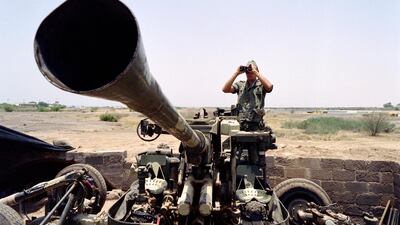
A French soldier looks through binoculars as he mans an anti-craft gun near Djibouti airport, on August 20, 1990, as French army was deployed in the Persian Gulf since Iraq's invasion of Kuwait on August 02, 1990, leading to a conflict between Iraq and Kuwait and an international military intervention. AFP -
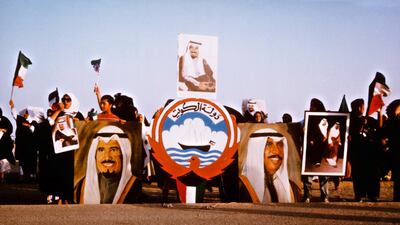
A demonstration in Kuwait, following the country's invasion by Iraq at the start of the Gulf War, 4th-6th August 1990. In the centre is the Emblem of Kuwait, adopted in 1962. Getty -
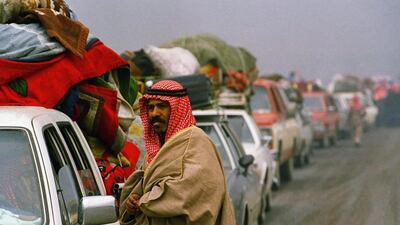
A Kuwaiti refugee stands beside his car outside Kuwait City after Iraq invaded 30 years ago. Scott Applewhite / AP


This issue of double standards is playing out once again today, albeit in a more dramatic and multi-layered way. A few people in America have criticised support for Ukraine because, in their view, that cause is tarnished by US support for the country and, of course, US double standards. But what is at issue here is not the US or Nato. It is the same question of an assault on sovereignty and independence that was brought about during the invasion of Kuwait.
This is not to dismiss the reality of the double standards on display by US political leaders, the mainstream media and commentators who apparently have no self-awareness as they put their anti-Arab bigotry and/or hypocrisy on full display. Examples abound:
For one, it passed without comment in the US press when an Israeli government official denounced the Russian invasion as a “grave violation of the international order” while another expressed his government’s support for Ukraine’s “territorial integrity and sovereignty”. Notably absent from discussions in that context was the fact that Israel has in the past invaded and occupied neighbouring countries using a similar “security” argument to the one invoked by Russia today.
Another example is that early in the invasion, there were two short film clips that went viral on various social media platforms. One showed a little child playing before falling victim in an aerial bombardment. The other featured a little girl hitting a soldier, twice her size, shouting at him that he should go back to his country.
Both the child victim and the girl were presented as Ukrainians, while the bomb and the soldier were claimed to be Russian. Neither was the case. The first was a Palestinian killed in an Israeli air assault in Gaza, and the second was a Palestinian girl, Ahed Tamimi, who was later arrested for striking an Israeli soldier.
In the same vein, on the day that American TV outlets were showing “heroic” Ukrainians stockpiling Molotov cocktails for use against the Russian invaders, a 14-year-old Palestinian boy was shot dead for throwing a Molotov cocktail at an Israeli settler’s car. The obvious point was that it is not what you do, but who you are that determines how you are to be seen.
Then there is the matter of boycotts and sanctions – two effective non-violent means of confronting aggressors. Several US governors and state legislatures have rushed through bills and executive orders calling for boycotts of all Russian goods. These same states have passed legislation criminalising boycotts against Israel. And while there is bipartisan consensus for sanctions against Russia because of its violations of Ukraine’s sovereignty and international law, there is a comparable bipartisan consensus that such measures may never be taken against Israel despite its decades-long egregious violations of Palestinian rights and international law. Again, it appears that it’s not what you do, but who you are that is the deciding factor.
A fourth case in point is the welcome that Ukrainian refugees have received from the same European countries that closed their doors in the face of refugees fleeing conflict in Middle Eastern and African countries. Multiple media commentators and political leaders have “explained” that these refugees are “different” as, their reasoning goes, “they have blue eyes” or “they’re civilised”. This is as racist as the xenophobic Trumpian effort to block Latin American and Muslim asylum seekers and refugees, while calling for more Europeans to emigrate to the US.
Finally, there is America's insistence that in defending Ukraine it is standing up for international law, human rights, and democracy – concepts which the US has never applied to the securing the rights and freedoms of the Palestinian people.
Behind each of these examples of clear double standards is racism. One group of people is more worthy of support than another; the rights of one group of people are sacrosanct, while others are expendable; one group of people may never be attacked or condemned even when they engage in patently criminal behaviour because their security is of greater import than the rights of the group they are oppressing.
While these double standards are deplorable and must be combatted, they in no way negate the correctness and urgency of defending the rights of the Ukrainian people. My message is: others may have double standards, but we can never allow ourselves to make our judgments based on the same logic others may use to selectively determine who has rights and who does not.

